

Origins and Evolution of the Theory
The moon landing conspiracy theory first gained traction in the mid-1970s, a period marked by growing distrust in the government following the Watergate scandal. Bill Kaysing, a former US Navy officer, played a significant role in popularizing this theory. In his 1974 book, “We Never Went to the Moon: America’s Thirty Billion Dollar Swindle,” Kaysing argued that the technology of the 1960s was not advanced enough to transport humans to the Moon and back safely.
As the years progressed, this theory evolved and expanded, with proponents pointing to various anomalies and inconsistencies in the moon landing footage and photographs as evidence of forgery.
Main Arguments of the Theory
- Photographic and Video Anomalies: Conspiracy theorists highlight several issues in the moon landing imagery. These include the absence of stars in the sky, the appearance of the American flag waving (as if in wind), and the presence of multiple light sources suggested by shadows cast in different directions.
- Van Allen Radiation Belts: Skeptics argue that the astronauts could not have passed through the Van Allen radiation belts surrounding the Earth without suffering lethal doses of radiation.
- Lack of a Blast Crater: The absence of a visible blast crater underneath the lunar module is often cited as proof that the module was placed on the moon’s surface by other means.
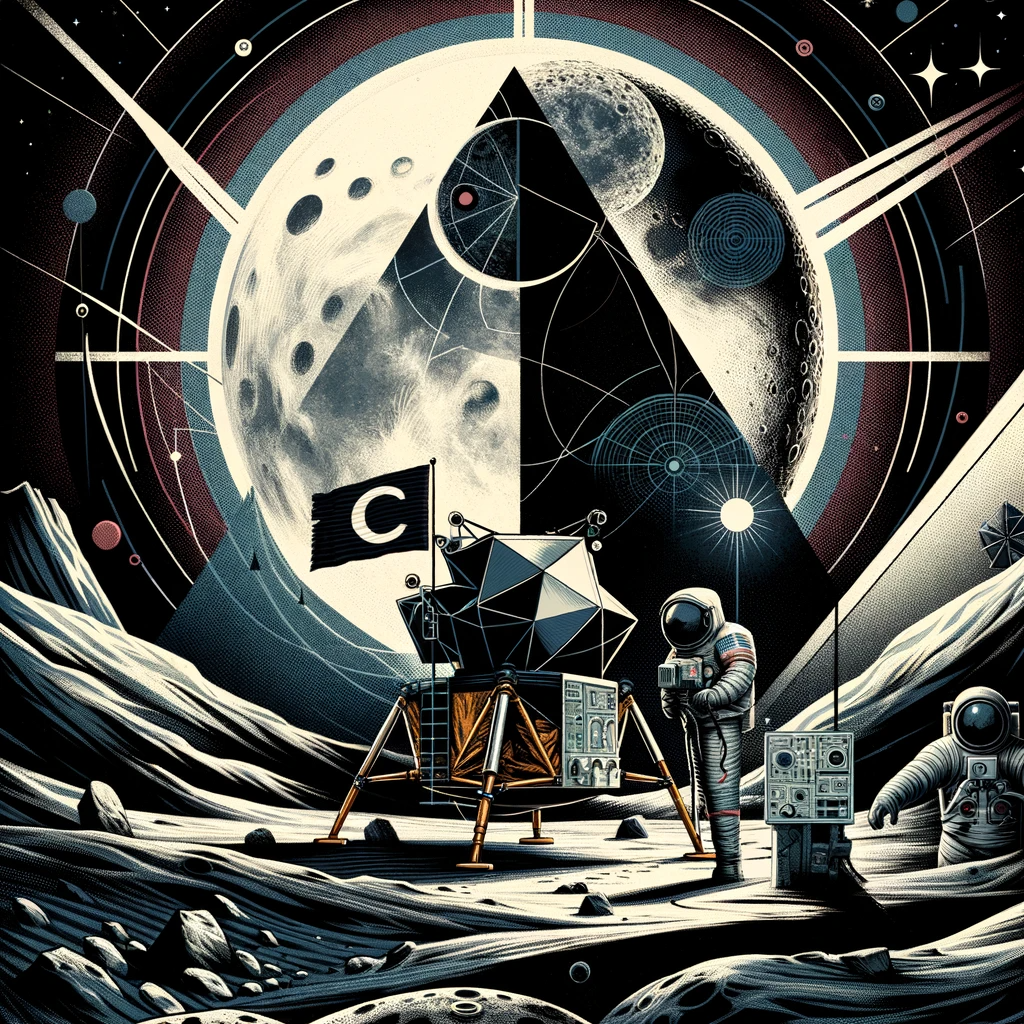
- The C Rock: One photo from the moon shows a rock with what appears to be the letter ‘C’ written on it, leading to claims that it was a prop mistakenly left in the shot.
- Technology and Expertise: Skeptics question whether the technology at the time was indeed capable of a moon landing, often citing the perceived inferiority of 1960s technology compared to today’s standards.
Counter-Arguments and Scientific Explanations
In response to these claims, scientists and experts have provided detailed counter-arguments:
- Stars Not Visible: The lack of stars in lunar sky photos is attributed to the camera’s settings, which were adjusted for daylight exposure, making faint stars invisible.
- Flag Movement: The flag appears to be waving because it was unfurled and moved while being planted, not because of wind. The Moon has no atmosphere to facilitate wind.
- Radiation Belts: NASA has stated that the astronauts’ short time spent flying through the Van Allen belts, combined with the protective shielding of the spacecraft, kept radiation levels safe.
- No Blast Crater: The lunar module’s engines were throttled down just before landing, meaning the thrust was not powerful enough to create a large crater on the lunar surface.
- The C Rock: The ‘C’ on the rock has been dismissed as a hair or fiber that got caught in the film’s development process.
- Technological Capability: While 1960s technology was less advanced than today’s, it was sufficient for the tasks required by the Apollo missions. The simpler, less complex computers and machinery were actually advantageous in some respects, given their resilience and less susceptibility to radiation and other space conditions.
Cultural and Sociological Implications
The moon landing conspiracy theory is not just a query into historical facts but also a reflection of cultural and sociological dynamics. It represents a broader skepticism towards government and authoritative narratives, a sentiment that has grown in various societies, especially during times of political and social turmoil. The theory also illustrates the impact of misinformation and how easily it can be propagated in the age of the internet.
What’s the truth?
The moon landing conspiracy theory remains one of the most enduring in modern history. While there is a consensus among the scientific community about the authenticity of the moon landing, the theory persists, fueled by skepticism and a deep-rooted distrust in governmental institutions. It stands as a testament to the complex relationship between society, technology, and the pursuit of truth in the postmodern era.


