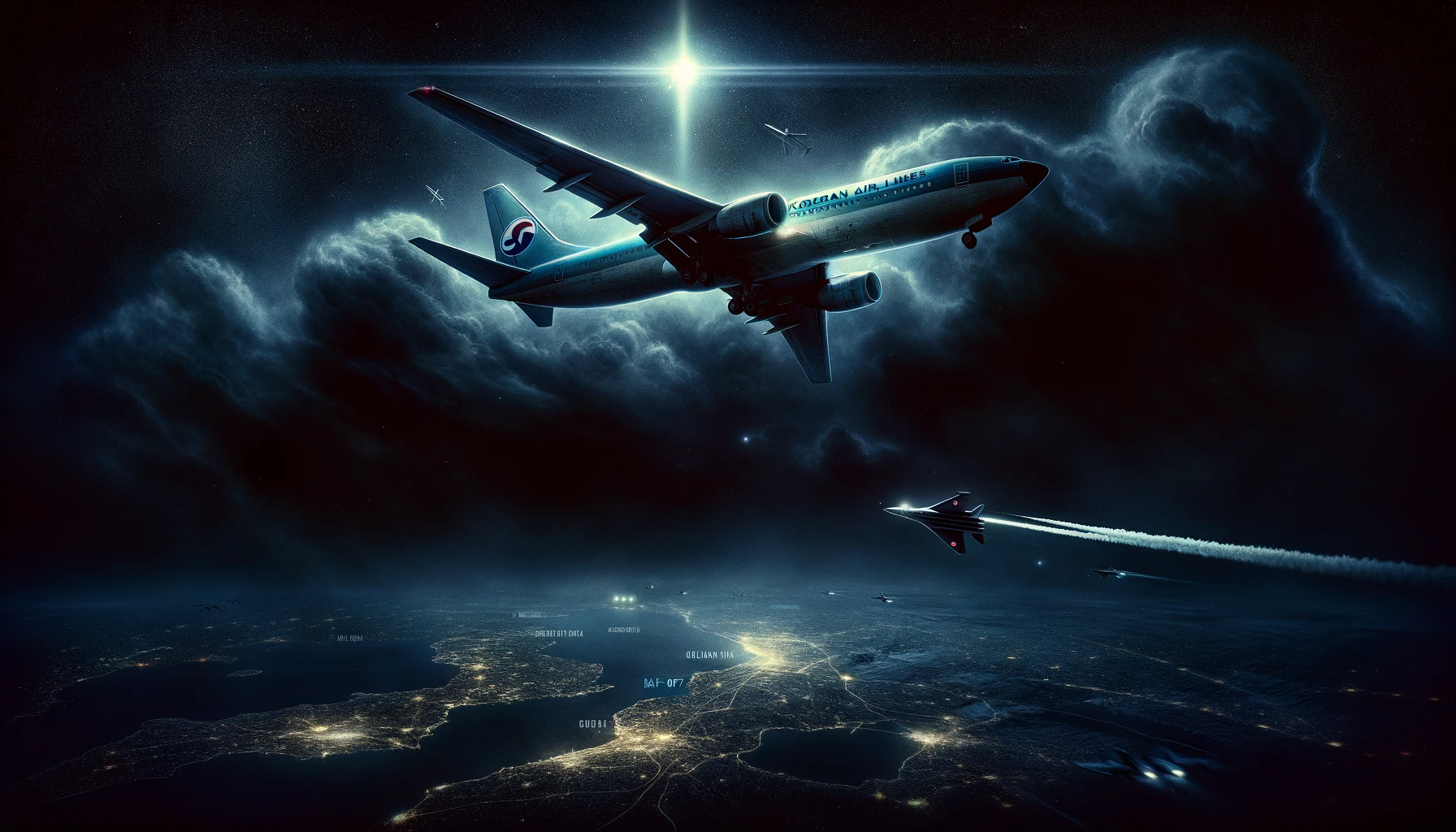
In-Depth Background of Korean Air Lines Flight 007
Korean Air Lines Flight 007, a Boeing 747 jumbo jet, was a scheduled flight from New York City to Seoul, South Korea, with an intermediate stop in Anchorage, Alaska. The aircraft, registered as HL7442, was one of the advanced commercial jets of its time, equipped with sophisticated navigation systems.
Departure and Flight Plan
The flight departed from John F. Kennedy International Airport in New York City on August 31, 1983. It carried 246 passengers and 23 crew members. The passenger list included a diverse group of individuals from various nationalities, including 62 Americans, highlighting the flight’s international significance. Among these passengers was U.S. Congressman Lawrence McDonald, a prominent figure and the then-chairman of the John Birch Society, known for his strong anti-communist views.
Upon completing its stopover in Anchorage, Alaska, for refueling and crew change, the flight took off again, bound for Seoul’s Gimpo International Airport. The flight path was supposed to follow a specific route – the Romeo 20 commercial air corridor – which would have kept it well clear of sensitive Soviet airspace.
Deviation into Soviet Airspace
Shortly after takeoff from Anchorage, KAL 007 began to deviate from its intended course. Instead of following the Romeo 20 route, it gradually veered off course, moving into Soviet airspace. The reasons for this deviation have been a matter of extensive investigation and speculation. The most widely accepted explanation is a navigational error, potentially due to the crew’s improper programming of the aircraft’s inertial navigation system. This error led the aircraft to fly more than 200 miles off course.
Cold War Context
The Cold War era was marked by heightened tensions and suspicion between the Western bloc, led by the United States, and the Eastern bloc, led by the Soviet Union. The airspace over the Soviet Union was particularly sensitive due to the ongoing military and political tensions. Any unauthorized entry into Soviet airspace, especially by a foreign aircraft, was considered a serious security breach, potentially escalating into an international incident.
Monitoring by Soviet Forces
Unbeknownst to the crew and passengers of KAL 007, their flight into Soviet airspace did not go unnoticed. Soviet radar installations picked up the unidentified aircraft and monitored its progress. Given the political climate and the sensitive military installations in the area, the Soviet Union perceived this breach as a potential threat, possibly even a military provocation or espionage attempt.
This background sets the stage for the tragic events that unfolded, deeply rooted in the geopolitical landscape of the Cold War era. The flight’s deviation into Soviet airspace was not just a navigational error but occurred in a world bristling with tension, suspicion, and the ever-present threat of conflict.
The Incident
Upon entering Soviet airspace, KAL 007 was tracked by Soviet air defense forces. Believing the aircraft to be a US spy plane, the Soviets dispatched fighter jets. After failed communication attempts and warnings, the Soviet Union decided to shoot down the plane. The decision was made under the assumption that KAL 007 was on a spying mission, as it was common during the Cold War for military aircraft to disguise as civilian ones for espionage purposes.
The Conspiracy Theory
The primary conspiracy theory suggests that KAL 007 was intentionally directed into Soviet airspace as part of a covert intelligence operation by the United States. Proponents of this theory argue that the deviation from the flight path was not accidental but a deliberate move to test Soviet air defense response or to gather electronic intelligence. They often point to several factors to support this claim:
- Navigational Error vs. Deliberate Course: The distance between the intended route and the actual path flown by KAL 007 was significant. Conspiracy theorists argue that such a deviation is unlikely to be a mere navigational error.
- Presence of a High-Profile Passenger: The presence of Congressman Lawrence McDonald, an outspoken anti-communist, on the flight is seen by some as more than coincidental. They speculate that his presence on the plane was somehow linked to a broader intelligence-gathering mission.
- Lack of Immediate U.S. Response: The U.S. government’s response to the downing was seen as unusually restrained initially, which some interpret as an indication of their foreknowledge or involvement.
- Technology and Espionage: During the Cold War, aerial reconnaissance and intelligence gathering were common. Some theorists suggest that KAL 007 carried equipment for signal intelligence (SIGINT) gathering, and the flight path was deliberately altered to probe Soviet military installations.
Variations of the Conspiracy Theory
There are several variations of the KAL 007 conspiracy theory. Some claim that the aircraft landed safely and that passengers and crew were taken captive by the Soviets. Others speculate about the possible survival of Congressman McDonald and his subsequent imprisonment in the Soviet Union.
Evidence Opposing the Conspiracy Theory
Counterarguments to the conspiracy theory include:
- Flight Data and Cockpit Voice Recordings: Analysis of the flight data and cockpit voice recordings suggests a navigational error caused by a misprogramming of the aircraft’s inertial navigation system.
- International Investigations: The International Civil Aviation Organization (ICAO) conducted an extensive investigation and concluded that the deviation was accidental.
- Lack of Credible Evidence for Espionage: There has been no conclusive evidence to support the claim that KAL 007 was on an espionage mission.
- Political and Diplomatic Consequences: The incident severely strained Soviet-American relations. It is argued that neither side would have intentionally risked such an escalation.
Unsolved Mystery
While the Korean Air Lines Flight 007 incident remains a subject of speculation and conspiracy theories, the predominant view supported by investigations and analyses is that the tragedy resulted from a tragic navigational error during a tense period of the Cold War.