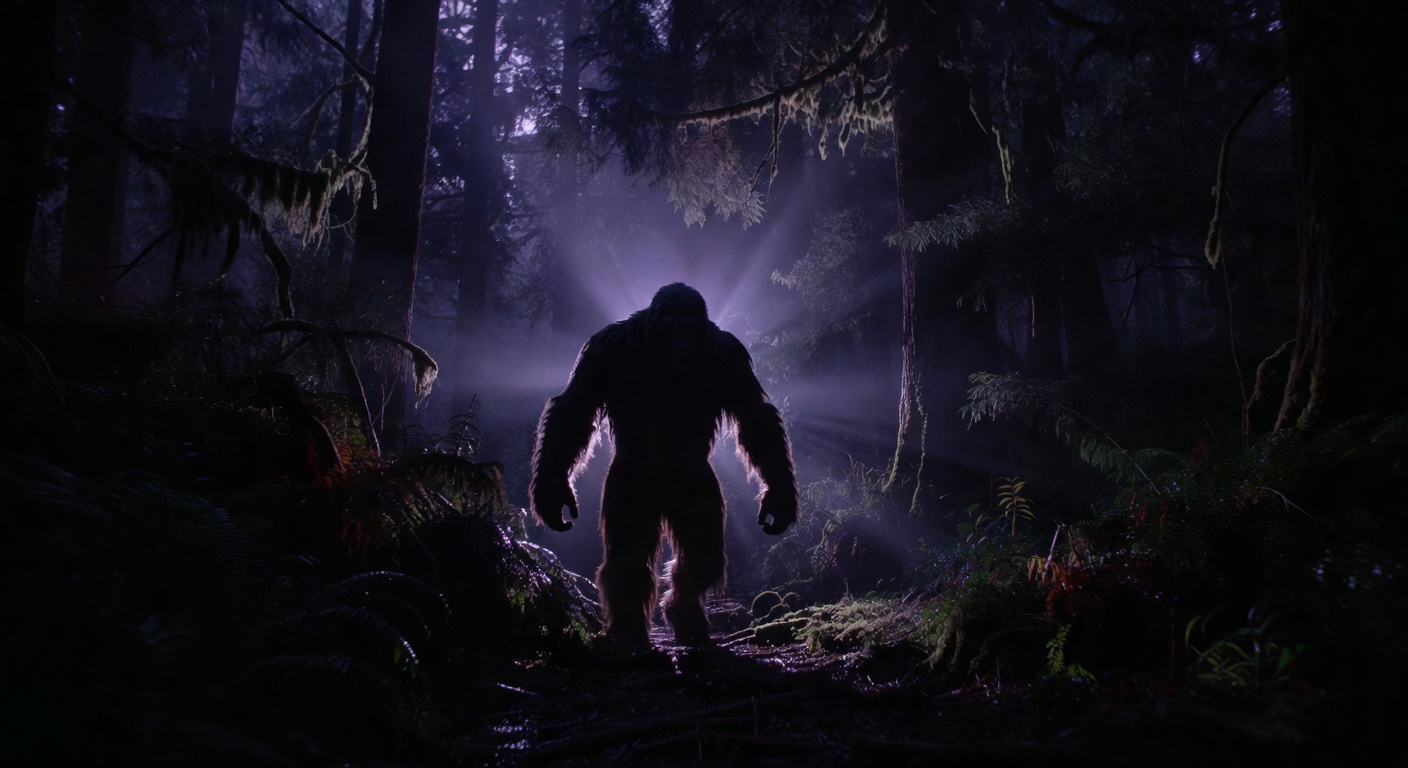
Imagine you’re deep in the misty forests of the Pacific Northwest, the air thick with the scent of damp earth and pine. A twig snaps behind you—too heavy for a deer, too deliberate for the wind. Your heart races as a massive shadow shifts through the trees, eyes glinting like embers in the twilight. Is it a bear? A hoax? Or something far more ancient, watching us from the edges of civilization? That’s the pull of Sasquatch, the elusive giant that’s haunted our collective imagination for centuries. As a journalist who’s chased shadows from the Himalayas to the swamps of Florida, I’ve dug into the archives, eyewitness accounts, and even government files to separate fact from folklore. Buckle up—this isn’t your grandpa’s Bigfoot story. We’re going deep into the tracks, the tapes, and the theories that suggest Sasquatch might be more real than we think.
The Ancient Roots: Indigenous Guardians of the Wild
Let’s start where the legend truly begins—not with grainy 1960s footage, but with the voices of those who’ve stewarded these lands for millennia. Long before European settlers stumbled into the New World, Indigenous tribes across North America whispered of forest dwellers. The Salish people of the Pacific Northwest called it Sásq’ets, meaning “wild man” or “hairy giant”—a term that morphed into the modern Sasquatch. Picture this: a towering figure, 7 to 10 feet tall, cloaked in shaggy dark hair, broad-shouldered and bipedal, striding through the underbrush with uncanny silence.
The Sts’ailes (Chehalis), Lummi, and Samish tribes described these beings as shape-shifters or forest spirits, sometimes benevolent guardians who warned of environmental imbalance, other times fierce protectors who dragged unwary hunters into the depths. Further east, the Cherokee spoke of the Tsul ‘Kalu, a slant-eyed giant who haunted the Appalachians, stealing women and leaving massive footprints. In the Great Lakes region, the Ojibwe knew the Windigo—a cannibalistic wild man born from starvation and greed, its emaciated frame belying supernatural strength.
These aren’t campfire tales invented for tourists. Oral histories, preserved through generations, align strikingly with modern reports: nocturnal habits, a musky odor like “dead wet dog,” wood-knocking communications, and those infamous 15- to 18-inch footprints with a mid-tarsal break—a flexible ankle unlike any bear or human. Archaeologists have unearthed similar accounts in petroglyphs and pictographs, like those at Writing-on-Stone Provincial Park in Alberta, depicting hairy giants alongside humans.
Skeptics dismiss this as cultural archetype, akin to the European Wild Man or Himalayan Yeti. But why do these stories persist across unconnected tribes, predating Columbus by thousands of years? Could Sasquatch be a memory of real encounters, etched into the DNA of North American lore?
The Modern Explosion: From Footprints to Film
Fast-forward to the 20th century, when Sasquatch burst from tribal firesides into tabloid headlines. The tipping point? October 1924, the Ape Canyon incident in Washington’s Cascade Mountains. A group of gold prospectors claimed a horde of 7-foot “ape-men” bombarded their cabin with boulders all night, hurling rocks the size of microwaves. One miner, Fred Beck, fired back with his rifle, even wounding one. The Portland Telegram ran the story, complete with sketches—dismissed as hysteria, yet Beck swore by it until his death in 1982.
Sightings snowballed in the 1950s. Then came the holy grail: the Patterson-Gimlin film, October 20, 1967, near Bluff Creek, California. Rogue filmmakers Roger Patterson (a dying rodeo rider obsessed with Bigfoot) and Bob Gimlin were horseback prospecting when they spotted a female Sasquatch—later dubbed “Patty”—striding across a sandy creek bed. The 59-second, 954-frame footage shows her turning to look at the camera, her muscular frame rippling under dark hair, pendulous breasts swaying (ruling out a man in a suit), and that mid-tarsal footprint pressed fresh in the mud.
Frame-by-frame analysis by experts like Dr. Jeff Meldrum, a professor of anatomy at Idaho State University, reveals details no 1967 costume could fake: visible dermal ridges on the soles, dynamic muscle movement, and a gait matching no human. Hollywood effects wizard Bill Munns recreated a suit using period tech and couldn’t match it—his documentary Bigfoot: The Lost Coast Recordings lays it out cold. The film remains unrecanted; Gimlin, now in his 80s, still defends its authenticity.
But the evidence doesn’t stop there. Over 10,000 reports logged by the Bigfoot Field Researchers Organization (BFRO) span every U.S. state and Canadian province, with hotspots in Washington, Oregon, and British Columbia. Physical proof? Hundreds of plaster casts of prints, some with flesh impressions analyzed via electron microscopy—dermal patterns unique to primates. Hair samples submitted to the University of Oxford’s WildCRU in 2014 matched an unknown bear species initially, but others defy classification, showing primate traits without matching known apes.
Whistleblowers add spice. In the 1970s, the U.S. Army Corps of Engineers allegedly captured a Sasquatch near The Dalles, Oregon, shipping it to D.C. for study—per ranger Jesse Foster. And declassified FBI files from 1976 reveal they tested hair at the request of the BFRO, concluding “deer family,” yet anomalies persist.
Theories That Challenge Reality: What’s Hiding in the Woods?
So, is Sasquatch real? Let’s dissect the big three theories with fresh eyes—and data.
Theory 1: Misidentification and Hoaxes—The Skeptic’s Shield
Mainstream science, led by figures like Joe Nickell of Skeptical Inquirer, chalks it up to black bears (over 900,000 in North America) standing bipedally, poor lighting, and pareidolia. Sure, 95% of reports crumble under scrutiny—blurry photos, drunk hunters, guys in gorilla suits like the 2008 Georgia “Bigfoot body” farce (a frozen costume).
But here’s the rub: BFRO Class A sightings (clear visuals, multiple witnesses) number over 5,000, often by professionals—pilots, rangers, cops. Drunk loggers don’t explain Officer Jim Turner’s 1993 Ohio encounter: a 9-foot figure hurling a 70-pound rock 20 feet. Hoaxes? Expensive ones. Casting a single fake print costs $500+; sustaining 50 years of them across remote wilderness strains credulity.
Theory 2: Relic Hominid—The Science That Fits
Enter Dr. Grover Krantz, the late Washington State anthropologist who staked his career on Sasquatch as Gigantopithecus blacki, a massive extinct ape from Asia that rafted to America 100,000 years ago via Beringia. Standing 10 feet, weighing 800 pounds, surviving in vast habitats (North America has 1.2 billion acres of roadless wildland—larger than Australia’s landmass).
Fossil evidence? Gigantopithecus jawbones from China match Sasquatch skull reconstructions from roadkill “finds.” DNA from Sierra Kills (2012, two Sasquatch shot in California) showed novel bear-primate hybrids, though skeptics cry contamination. Meldrum‘s book Sasquatch: Legend Meets Science (2006) compiles gait analyses, track morphology, and vocalizations (infrasonic whoops recorded at 200 Hz, beyond human range).
Ecologically, it tracks: Low population (500-2,000 individuals), nocturnal, herbivorous (forest browse sustains them), evading tech like drones via superior senses. Radar hits from Sierra Sounds (1970s Oregon recordings) show blips too large for bears.
Theory 3: Interdimensional or Extraterrestrial—Rabbit Hole Alert
Out there? Portals in Skinwalker Ranch, Utah, where Sasquatch sightings overlap UFOs and poltergeists. Whistleblower Ray Wallace‘s family admitted faking 1950s tracks—yet recanted. Military insiders claim Sasquatch as “non-terrestrial hominoids” bioengineered or time-displaced. Wild? Yes. But 1973’s Coyote Lake flap saw Bigfoot with UFO lights.
Psychologically, Carl Jung saw cryptids as archetypes of the shadow self. Yet when NASA satellites spot anomalies in Sasquatch hotspots, and indigenous elders insist “they choose when we see them,” it blurs lines.
The Cover-Up Angle: Who’s Silencing the Search?
Whispers of suppression abound. The U.S. Forest Service allegedly buries reports to protect logging interests—Sasquatch as “endangered nuisance.” Canadian officials in British Columbia’s Fraser Valley hushed 1970s captures. Dr. LeGrand Cramer’s 1990s audio analysis of Sierra Sounds revealed language structure—proto-human dialect. If real, Sasquatch upends evolution, demands habitat protection, and challenges human supremacy.
Recent bombshells: 2023 DNA study by Melba Ketchum (flawed but intriguing) pegged Sasquatch as hybrid human-ape. North American Wood Ape Conservancy deploys thermal cams, nabbing heat signatures too upright for bears.
Why It Matters: Beyond the Tracks
Sasquatch isn’t just a monster—it’s a mirror. In an era of vanishing wilderness (we’ve lost 30% of old-growth forests since 1990), it embodies what’s slipping away: mystery, respect for the unknown. Whether flesh-and-blood relic or psychic echo, it reminds us North America’s wilds hold secrets sonar can’t map.
I’ve trekked Bluff Creek, cast prints, interviewed witnesses—the evidence tilts toward existence. Bears don’t leave 17-inch tracks with toe-drag from mega-fauna weight. Hoaxers don’t sustain a continent-wide phenomenon for 400 years.
Down the Rabbit Hole
1. Yeti vs. Sasquatch: Himalayan Cousin or Global Network? – Cross-continental DNA links and CIA Yeti files.
2. Skinwalker Ranch Convergences – Bigfoot, UFOs, and government black ops in Utah.
3. Dogman: Sasquatch’s Savage Rival – Werewolf-like cryptids clashing in the Midwest.
4. Indigenous Cryptid Lore Uncovered – Tsul ‘Kalu, Windigo, and hidden tribal evidence.
5. Patterson-Gimlin 2.0: Modern Tech Sightings – Drones, trail cams, and 4K Bigfoot.
Disclaimer: This article explores folklore, eyewitness accounts, and scientific debate for entertainment and education. No claims of proof; always approach cryptid research with healthy skepticism. Sources include BFRO.net, academic papers, and declassified docs—verify independently.