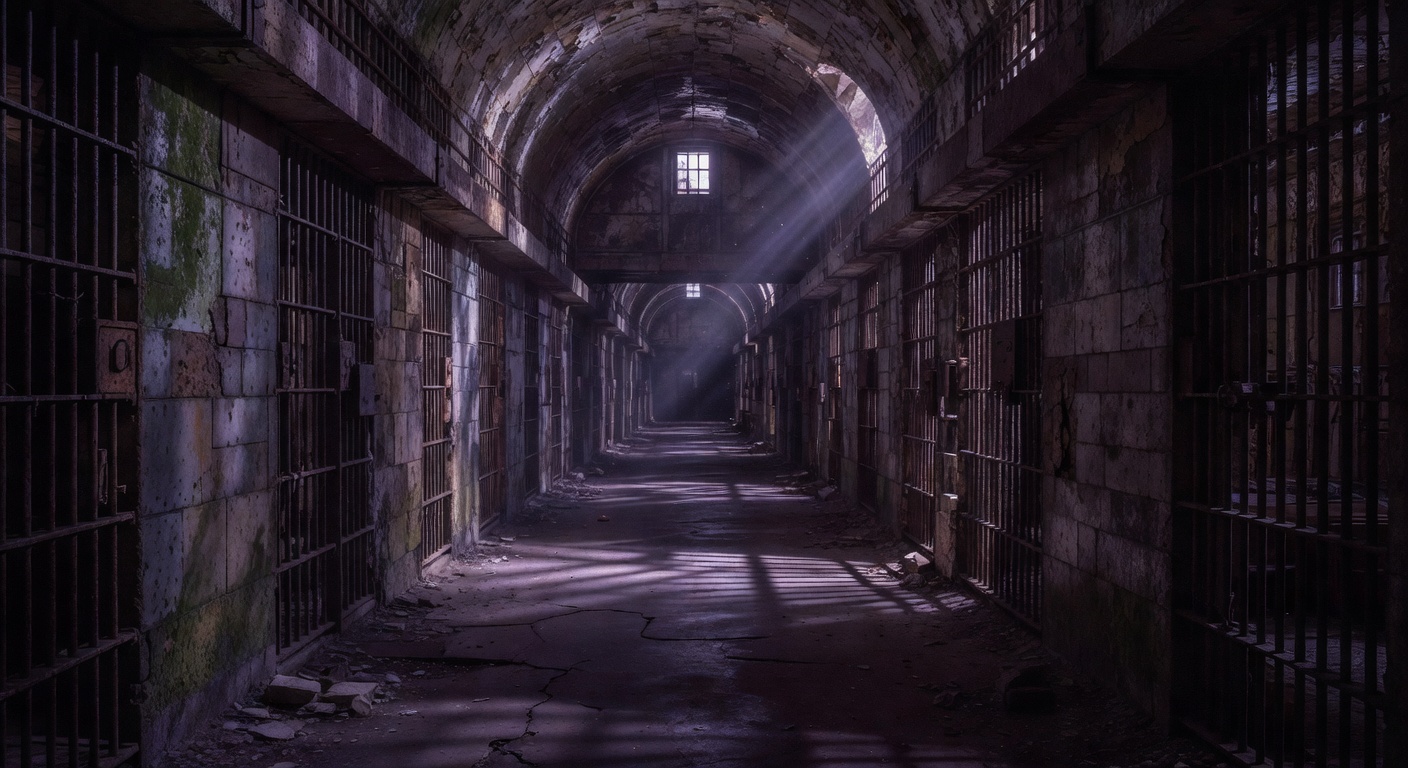
Imagine stepping into the crumbling shadows of Eastern State Penitentiary (ESP), where the air hangs heavy with echoes of forgotten screams and the faint clink of spectral chains. It’s not just a prison—it’s a time capsule of human suffering, revolutionary ideals gone wrong, and whispers from the grave that have drawn ghost hunters, historians, and thrill-seekers for decades. Opened in 1829 in Philadelphia, Pennsylvania, this hulking fortress was meant to redeem souls through isolation. Instead, it broke them. Today, as you wander its radial cellblocks under the cover of night during a Halloween haunt tour, you can’t shake the feeling that you’re not alone. Join me, your guide through the conspiracy-tinged underbelly of America’s penal past, as we peel back the layers of ESP‘s haunted legacy. What secrets do these walls hold? And could they connect to darker forces at play in other cursed sites?
The Revolutionary Dream That Turned to Nightmare
Let’s start at the beginning, because understanding Eastern State Penitentiary‘s origins is key to grasping why it’s more than just another spooky ruin. In the early 19th century, America was experimenting with crime and punishment. The old ways—dungeons, public floggings, and chaos—weren’t cutting it. Enter the Quakers, Philadelphia’s progressive reformers, who dreamed of a prison that rehabilitated rather than just warehoused.
A Radical Design Born of Enlightenment Ideals
Architect John Haviland was tasked with bringing this vision to life. Drawing from medieval fortresses and Eastern influences (hence the “Eastern” name), he crafted a radial masterpiece: a central octagonal hub from which 10 cellblocks (originally seven) fanned out like spokes on a wheel. Each inmate got their own 7×12-foot cell with a high-walled exercise yard, a skylight dubbed the “eye of God” for divine oversight, and amenities like running water and a toilet—luxuries unheard of in 1829.
The philosophy? The Pennsylvania System of solitary confinement. Prisoners, hooded during movement to avoid contact, were meant to reflect on their sins in total isolation, aided by Bible study and labor like weaving. No talking, no visitors, no companions. Proponents, including Charles Dickens (who visited in 1842 and called it “cruel and wrong”), believed it would forge moral rebirth. Dickens wasn’t wrong about the cruelty; he described inmates’ “hopeless, listless, mad” eyes in his book American Notes.
But here’s where it gets evidence-forward: Records from the Pennsylvania Prison Society show the system worked… at first. Early reports boasted low recidivism. Yet, within years, insanity rates skyrocketed. A 1833 state investigation revealed inmates hallucinating, self-mutilating, and dying from “penitentiary fever” (typhus). By the 1870s, critics like the National Prison Association slammed it as torture, paving the way for the Auburn System’s group labor.
Famous Inmates: From Gangsters to Escape Artists
ESP didn’t just hold petty thieves; it was a who’s who of American crime. Over 150 years, it processed tens of thousands, but a few names echo loudest.
**Al Capone**: The VIP Prisoner
In 1929, Al Capone, Chicago’s booze baron, landed here for carrying a concealed weapon. While most rotted in austerity, Capone’s cellblock 4 quarters were a scandal: fine rugs, oil paintings, a radio, even a desk phone. Photos from the era, preserved by the Eastern State Penitentiary Historic Site, show his plush setup. He served eight months, reportedly writing letters begging for release due to “nerves.” Conspiracy angle? Did his connections buy the comforts, hinting at early prison corruption that plagues the system today?
**Willie Sutton**: The Escape King’s Bold Bid
Bank robber Willie “Slick Willie” Sutton, captured in 1930, became infamous for tunneling out in 1934 with five others. They used a metal bar smuggled in a loaf of bread to dig 97 feet under a wall. Recaptured later, Sutton quipped, “I rob banks because that’s where the money is.” His story, detailed in his 1953 memoir I, Willie Sutton, underscores ESP‘s porous security despite its fortress design.
Other notables: Kate “Ma” Barker (Public Enemy No. 1 suspect), Fred Barker, and even Nate “Kid” Daniels, who allegedly went mad from solitary and laughed maniacally until his death. Execution records list botched hangings and suicides, fueling the site’s grim aura.
The Slow Rot: Overcrowding, Madness, and Shutdown
By the early 20th century, ESP‘s dream curdled. Designed for 450, it crammed in 1,900 by the 1920s. Cellblocks decayed; sewage backed up; medical care was a joke. Inmates slept three to a cell meant for one. A 1961 riot saw guards held hostage, exposing the chaos.
Psychological toll? Devastating. Warden Howard R. Gill in the 1940s noted “graveyard cells” for the suicidal. Official death toll: over 100, but whispers of unreported madness persist. The prison limped on until 1971, when Pennsylvania built newer facilities. Abandoned, it became a graffiti canvas for urban explorers, its towers looming like skeletal fingers over Fairmount.
Preservation kicked in 1980s-style: Added to the National Register of Historic Places in 1985, designated a National Historic Landmark in 1994. Today, the nonprofit Eastern State Penitentiary Historic Site runs tours, drawing 200,000 visitors yearly. For hard data, check their official timeline, packed with inmate logs and blueprints.
Paranormal Whispers: Ghosts of Cellblock All
Now, the juicy part—why ESP ranks among the world’s most haunted spots. Skeptics call it suggestion; believers cite EVPs and cold spots. I’ve toured it twice; the vibe hits like a gut punch, even daytime.
Eyewitness Hauntings and Investigations
Reports date to the 1940s: Guards heard banging from sealed “Klondike” punishment cells. Post-closure, squatters fled screaming. Modern accounts? Shadow figures in cellblock 12, where a 1929 riot killed guard Major James O’Neil. Visitors snap orbs; audio captures laughs, whimpers.
The Ghost Hunters TV crew (TAPS) investigated in 2008, logging unexplained footsteps and a shadowy monk-like figure. Their episode, viewable on streaming, includes EMF spikes in death row. Zak Bagans of Ghost Adventures in 2011 caught an EVP saying “Get out!” in the operating room, site of crude lobotomies.
Personal stories abound: A 2015 tour guide saw a figure in barred window; another heard chains in empty block 6. The site’s own “Terror Behind the Walls” haunt amps it up, but volunteers swear activity persists sans actors.
Ties to Other Cursed Hotspots: A Web of Darkness?
ESP doesn’t haunt alone. Conspiracy realists see patterns. Compare to LA’s Cecil Hotel (now Stay on Main), where solitary despair mirrored ESP’s isolation—think Elisa Lam’s eerie elevator footage and serial killer ties. Both ooze urban decay and unexplained deaths.
Or San Diego’s Whaley House, America’s “most haunted,” with its hanging ghosts echoing ESP’s executions. Both stem from 19th-century reform gone wrong. Deeper rabbit hole? Freemason influences in Haviland’s design (octagonal hub resembles occult symbols) link to other “enlightened” sites like the Gettysburg battlefield, rife with apparitions.
Evidence? Anecdotal clusters, but Society for Psychical Research archives note similar radial prison hauntings globally, suggesting architecture amplifies residual energy.
Life Inside: Inmate Stories That Chill the Bone
To humanize this, let’s dive into logs. John Blymire, a horse thief in 1836, spent years in solitary, emerging catatonic. His cell’s graffiti prayers still scar the walls. Leo Dworsky in 1934 carved “I am forever lost” into his door. Female wing tales? Mary Vandenhoff, convicted of infanticide, wailed nightly.
Warden diaries detail torture: water baths, straitjackets, dark cells with bread-and-water diets. A 1910 report by the Philadelphia Society for Alleviating Miseries of Public Prisons exposed beatings leaving “welts like hickory sticks.” These aren’t folklore; they’re digitized records.
Modern Legacy: Museum, Media, and Mysteries
Today, ESP thrives as education. Day tours unpack reform failures; night ones probe ghosts. Podcasts like Lore and books such as Eastern State Penitentiary by David Falco dissect it. Films? 12 Monkeys shot here, amplifying mystique.
But questions linger: Was solitary psychological warfare? Links to MKUltra-style experiments? Declassified docs hint at 20th-century behavior mod tests.
Conclusion: Echoes That Refuse to Fade
Eastern State Penitentiary isn’t just ruins—it’s a mirror to society’s penal sins. From Quaker utopia to ghostly purgatory, its story warns of good intentions paving hellish roads. Whether you buy the hauntings or not, one visit convinces: These walls remember. Head there, phone off, senses open. You might hear your own regrets… or something far worse. What’s your theory? Drop it in the comments—let’s uncover more.
Down the Rabbit Hole
1. Cecil Hotel Mysteries: Elisa Lam, serial killers, and cursed architecture—connected to ESP’s isolation horrors?
2. Whaley House Hauntings: America’s most haunted house vs. prison ghosts—shared execution echoes?
3. Al Capone’s Shadow Empire: Deep dive into his ESP stay and mob ties to modern prison rackets.
4. Solitary Confinement Conspiracies: From ESP to Guantanamo—government psy-ops exposed?
5. Philadelphia’s Occult Underbelly: Quaker secrets, Freemason designs, and hidden city hauntings.
Disclaimer: This article draws from historical records, eyewitness accounts, and public investigations. Paranormal claims are unverified; visit at your own risk. ConspiracyRealist.com explores theories for entertainment and education.