Menu

The 2010 Deepwater Horizon Disaster Conspiracy Theory

The 2010 Deepwater Horizon Disaster Conspiracy Theory

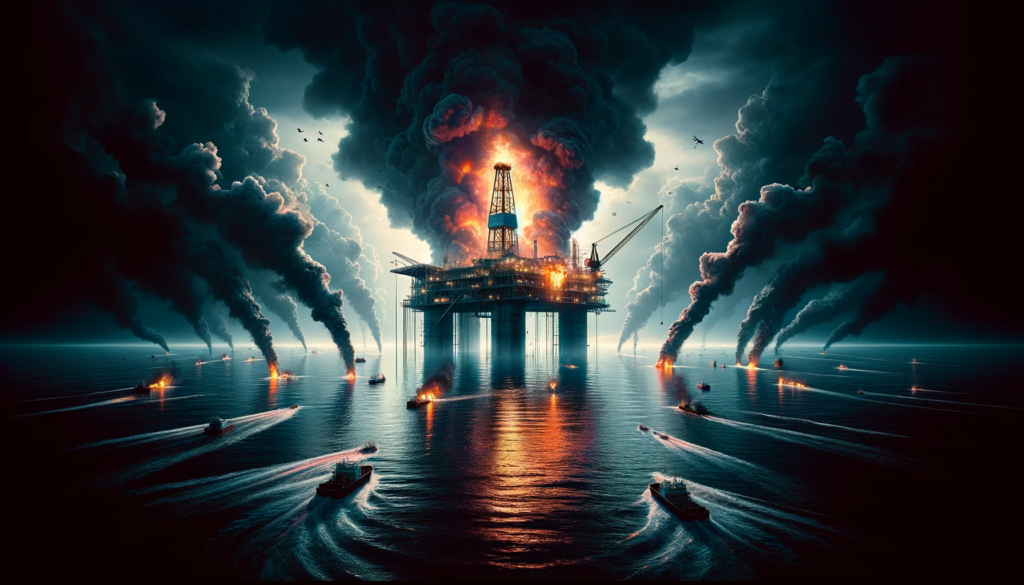
An offshore oil rig in the Gulf of Mexico engulfed in flames and smoke against a backdrop of dark clouds, with polluted waters around it, subtly hinting at hidden motives and conspiracy theories related to the Deepwater Horizon disaster

The rig was equipped with advanced technology designed to drill in deep water and challenging geological conditions. It had a notable track record, having drilled the deepest oil well in history in the Tiber Oil Field in the Gulf of Mexico in 2009.

The Deepwater Horizon Incident

The Deepwater Horizon disaster unfolded in a series of catastrophic events. It began with a well blowout, a violent release of crude oil and natural gas from the wellhead, which led to a massive explosion and fire on the rig. The explosion was so severe that it caused the rig to sink two days later.

As the rig sank, it severed the riser pipe that connected the wellhead to the rig, resulting in a massive and uncontrollable oil spill. For 87 days, oil gushed into the Gulf of Mexico, creating an environmental disaster of unprecedented scale in U.S. waters. The spill affected vast areas of the Gulf, including the coasts of Louisiana, Mississippi, Alabama, and Florida.

The Conspiracy Theory

The conspiracy theory postulates that the Deepwater Horizon disaster was not merely an accident but a planned event with various motives:

  1. Corporate Profit and Oil Prices: Proponents of this theory argue that the disaster was engineered to manipulate global oil markets. By causing a major disaster, oil companies could create a perceived scarcity of oil, driving up prices and securing higher profits.
  2. Government Involvement: This facet of the theory suggests complicity or even orchestration by the U.S. government. Theorists argue that the government used the disaster as a pretext to push through new legislation beneficial to the oil industry or to justify geopolitical maneuvers, particularly in oil-rich regions.
  3. Environmental Warfare: Some go as far as to claim that the spill was a deliberate act of environmental warfare. This version of the theory often implicates shadowy groups or governments aiming to damage the environment for strategic or economic gain.
  4. Technological Experimentation: There are claims that the disaster resulted from high-risk technological experiments in deep-sea drilling. These experiments, allegedly known to but unregulated by authorities, were pushed beyond safety limits.
  5. Insider Trading and Corporate Sabotage: Another variation suggests that insider trading might have occurred based on foreknowledge of the disaster. There are also claims of corporate sabotage, where the disaster was engineered by competitors or entities with vested interests in BP’s downfall.

Evidence Opposing the Conspiracy Theory

Despite the alluring nature of these theories, extensive investigations have pointed towards a more mundane but no less tragic set of causes for the Deepwater Horizon disaster:

  1. Faulty Cementing: The cement job on the well, conducted by Halliburton, failed to properly seal the well. This failure was a critical factor in the blowout, as it allowed hydrocarbons to enter the wellbore.
  2. Blowout Preventer Failure: The rig’s blowout preventer, a crucial safety device, failed to activate properly. This failure was due to a combination of mechanical faults and design flaws.
  3. Poor Risk Management and Oversight: Investigations uncovered a pattern of risky decisions made by BP, Transocean, and Halliburton. These decisions, driven by cost-cutting and time-saving measures, significantly increased the risk of a blowout.
  4. Safety Violations: The disaster revealed a culture of systemic safety violations. These included inadequate training, poor maintenance, and a lack of adequate emergency response protocols.
  5. Regulatory Failures: The Deepwater Horizon incident also highlighted failures in the regulatory framework overseeing offshore drilling. There was a lack of rigorous oversight and an underestimation of the risks associated with deepwater drilling.

Conclusion

While the conspiracy theories around the Deepwater Horizon disaster offer a range of dramatic and intricate narratives, the consensus among investigators points to a combination of corporate negligence, safety oversights, and systemic failures in risk management and regulatory oversight. The aftermath of the disaster led to significant legal and regulatory reforms in offshore drilling practices, aimed at preventing similar catastrophes in the future.

Table of contents

An offshore oil rig in the Gulf of Mexico engulfed in flames and smoke against a backdrop of dark clouds, with polluted waters around it, subtly hinting at hidden motives and conspiracy theories related to the Deepwater Horizon disaster
Unveiling the Depths: The Deepwater Horizon Mystery

The rig was equipped with advanced technology designed to drill in deep water and challenging geological conditions. It had a notable track record, having drilled the deepest oil well in history in the Tiber Oil Field in the Gulf of Mexico in 2009.

The Deepwater Horizon Incident

The Deepwater Horizon disaster unfolded in a series of catastrophic events. It began with a well blowout, a violent release of crude oil and natural gas from the wellhead, which led to a massive explosion and fire on the rig. The explosion was so severe that it caused the rig to sink two days later.

As the rig sank, it severed the riser pipe that connected the wellhead to the rig, resulting in a massive and uncontrollable oil spill. For 87 days, oil gushed into the Gulf of Mexico, creating an environmental disaster of unprecedented scale in U.S. waters. The spill affected vast areas of the Gulf, including the coasts of Louisiana, Mississippi, Alabama, and Florida.

The Conspiracy Theory

The conspiracy theory postulates that the Deepwater Horizon disaster was not merely an accident but a planned event with various motives:

  1. Corporate Profit and Oil Prices: Proponents of this theory argue that the disaster was engineered to manipulate global oil markets. By causing a major disaster, oil companies could create a perceived scarcity of oil, driving up prices and securing higher profits.
  2. Government Involvement: This facet of the theory suggests complicity or even orchestration by the U.S. government. Theorists argue that the government used the disaster as a pretext to push through new legislation beneficial to the oil industry or to justify geopolitical maneuvers, particularly in oil-rich regions.
  3. Environmental Warfare: Some go as far as to claim that the spill was a deliberate act of environmental warfare. This version of the theory often implicates shadowy groups or governments aiming to damage the environment for strategic or economic gain.
  4. Technological Experimentation: There are claims that the disaster resulted from high-risk technological experiments in deep-sea drilling. These experiments, allegedly known to but unregulated by authorities, were pushed beyond safety limits.
  5. Insider Trading and Corporate Sabotage: Another variation suggests that insider trading might have occurred based on foreknowledge of the disaster. There are also claims of corporate sabotage, where the disaster was engineered by competitors or entities with vested interests in BP’s downfall.

Evidence Opposing the Conspiracy Theory

Despite the alluring nature of these theories, extensive investigations have pointed towards a more mundane but no less tragic set of causes for the Deepwater Horizon disaster:

  1. Faulty Cementing: The cement job on the well, conducted by Halliburton, failed to properly seal the well. This failure was a critical factor in the blowout, as it allowed hydrocarbons to enter the wellbore.
  2. Blowout Preventer Failure: The rig’s blowout preventer, a crucial safety device, failed to activate properly. This failure was due to a combination of mechanical faults and design flaws.
  3. Poor Risk Management and Oversight: Investigations uncovered a pattern of risky decisions made by BP, Transocean, and Halliburton. These decisions, driven by cost-cutting and time-saving measures, significantly increased the risk of a blowout.
  4. Safety Violations: The disaster revealed a culture of systemic safety violations. These included inadequate training, poor maintenance, and a lack of adequate emergency response protocols.
  5. Regulatory Failures: The Deepwater Horizon incident also highlighted failures in the regulatory framework overseeing offshore drilling. There was a lack of rigorous oversight and an underestimation of the risks associated with deepwater drilling.

Conclusion

While the conspiracy theories around the Deepwater Horizon disaster offer a range of dramatic and intricate narratives, the consensus among investigators points to a combination of corporate negligence, safety oversights, and systemic failures in risk management and regulatory oversight. The aftermath of the disaster led to significant legal and regulatory reforms in offshore drilling practices, aimed at preventing similar catastrophes in the future.