Menu

The Hollow Earth Theory: What’s inside?

Artistic representation of the Hollow Earth theory with a cross-section view of Earth, showcasing an illuminated inner world with advanced civilizations and exotic ecosystems, hidden beneath the surface landscapes.
ourney to the Center: Unearthing the Hollow Earth Mystery

The Historical Roots of Hollow Earth Theory

The Hollow Earth theory is not a product of modern pseudoscience but has historical roots stretching back centuries. Ancient civilizations, including the Greeks, Tibetans, and Norse, held beliefs in underworlds or inner realms, which can be seen as early precursors to this theory. In the 17th century, Edmond Halley, the esteemed astronomer, proposed a model of the Earth consisting of concentric shells, inhabited and luminous, which was an early scientific rendition of the Hollow Earth concept.

The 19th century saw a resurgence of this theory, with John Cleves Symmes Jr. advocating for expeditions to find the supposed polar openings leading to the Earth’s interior. His ideas captivated the public imagination, leading to literature and speculative theories that further enriched the Hollow Earth narrative.

The Most Popular Explanations Behind the Theory

Proponents of the Hollow Earth theory offer various explanations and interpretations of what lies beneath the Earth’s crust. One popular version suggests the existence of vast caverns, extending hundreds of kilometers below the surface, hosting advanced civilizations or remnants of ancient ones. Another variant posits a central sun illuminating the inner Earth, creating a temperate paradise that could be home to exotic flora and fauna, or even human-like inhabitants.

These explanations often draw on anecdotal evidence, explorers’ accounts, and reinterpretations of mythological and religious texts. The allure of undiscovered lands and the human penchant for exploration fuel these narratives, making Hollow Earth one of the most enduring and captivating conspiracy theories.

Variations of the Theory

The Hollow Earth theory encompasses a spectrum of beliefs and hypotheses. Some adherents lean towards a more scientific approach, theorizing about subterranean ecosystems supported by geothermal energy, while others embrace a fantastical perspective, involving ancient races or extraterrestrial beings residing within the Earth.

Notable variations include the concept of Agartha, a legendary city said to exist in the Earth’s core, connected to the surface by a vast network of tunnels. This idea merges the Hollow Earth theory with legends of lost civilizations and ancient wisdom, adding layers of mystique and intrigue to the narrative.

Scientific Perspective and the Hollow Earth Theory

The Hollow Earth theory, despite its imaginative appeal, stands in stark contrast to established scientific knowledge. Geology, seismology, and planetary science provide comprehensive evidence supporting the Earth’s solid core and layered structure, from the crust to the inner and outer core.

Seismic studies, observing the behavior of earthquake waves, confirm the presence of liquid and solid layers deep within the Earth, negating the possibility of vast habitable spaces. The planet’s gravitational field, density, and magnetic properties further corroborate the conventional model of the Earth’s composition, leaving little room for the Hollow Earth theory within the realm of accepted science.

Conclusion: The Enduring Fascination with Hollow Earth

Despite the overwhelming scientific evidence against it, this continues to captivate imaginations around the globe. Its resilience lies not in empirical validation but in the human spirit’s exploratory nature and the timeless allure of the unknown. The Hollow Earth narrative encourages us to look beyond the surface, to question, and to imagine, embodying our innate curiosity and desire for adventure.

While this theory may remain in the realm of speculation and fantasy, it serves as a poignant reminder of the mysteries that lie both within our planet and within the depths of the human imagination. As we continue to explore the vast expanses of space and the oceanic depths, the Hollow Earth theory stands as a testament to the endless possibilities that await just beyond the edge of our current understanding.

dive down the rabbit hole

The Hollow Earth Theory: What’s inside?

Artistic representation of the Hollow Earth theory with a cross-section view of Earth, showcasing an illuminated inner world with advanced civilizations and exotic ecosystems, hidden beneath the surface landscapes.

The Historical Roots of Hollow Earth Theory

The Hollow Earth theory is not a product of modern pseudoscience but has historical roots stretching back centuries. Ancient civilizations, including the Greeks, Tibetans, and Norse, held beliefs in underworlds or inner realms, which can be seen as early precursors to this theory. In the 17th century, Edmond Halley, the esteemed astronomer, proposed a model of the Earth consisting of concentric shells, inhabited and luminous, which was an early scientific rendition of the Hollow Earth concept.

The 19th century saw a resurgence of this theory, with John Cleves Symmes Jr. advocating for expeditions to find the supposed polar openings leading to the Earth’s interior. His ideas captivated the public imagination, leading to literature and speculative theories that further enriched the Hollow Earth narrative.

The Most Popular Explanations Behind the Theory

Proponents of the Hollow Earth theory offer various explanations and interpretations of what lies beneath the Earth’s crust. One popular version suggests the existence of vast caverns, extending hundreds of kilometers below the surface, hosting advanced civilizations or remnants of ancient ones. Another variant posits a central sun illuminating the inner Earth, creating a temperate paradise that could be home to exotic flora and fauna, or even human-like inhabitants.

These explanations often draw on anecdotal evidence, explorers’ accounts, and reinterpretations of mythological and religious texts. The allure of undiscovered lands and the human penchant for exploration fuel these narratives, making Hollow Earth one of the most enduring and captivating conspiracy theories.

Variations of the Theory

The Hollow Earth theory encompasses a spectrum of beliefs and hypotheses. Some adherents lean towards a more scientific approach, theorizing about subterranean ecosystems supported by geothermal energy, while others embrace a fantastical perspective, involving ancient races or extraterrestrial beings residing within the Earth.

Notable variations include the concept of Agartha, a legendary city said to exist in the Earth’s core, connected to the surface by a vast network of tunnels. This idea merges the Hollow Earth theory with legends of lost civilizations and ancient wisdom, adding layers of mystique and intrigue to the narrative.

Scientific Perspective and the Hollow Earth Theory

The Hollow Earth theory, despite its imaginative appeal, stands in stark contrast to established scientific knowledge. Geology, seismology, and planetary science provide comprehensive evidence supporting the Earth’s solid core and layered structure, from the crust to the inner and outer core.

Seismic studies, observing the behavior of earthquake waves, confirm the presence of liquid and solid layers deep within the Earth, negating the possibility of vast habitable spaces. The planet’s gravitational field, density, and magnetic properties further corroborate the conventional model of the Earth’s composition, leaving little room for the Hollow Earth theory within the realm of accepted science.

Conclusion: The Enduring Fascination with Hollow Earth

Despite the overwhelming scientific evidence against it, this continues to captivate imaginations around the globe. Its resilience lies not in empirical validation but in the human spirit’s exploratory nature and the timeless allure of the unknown. The Hollow Earth narrative encourages us to look beyond the surface, to question, and to imagine, embodying our innate curiosity and desire for adventure.

While this theory may remain in the realm of speculation and fantasy, it serves as a poignant reminder of the mysteries that lie both within our planet and within the depths of the human imagination. As we continue to explore the vast expanses of space and the oceanic depths, the Hollow Earth theory stands as a testament to the endless possibilities that await just beyond the edge of our current understanding.
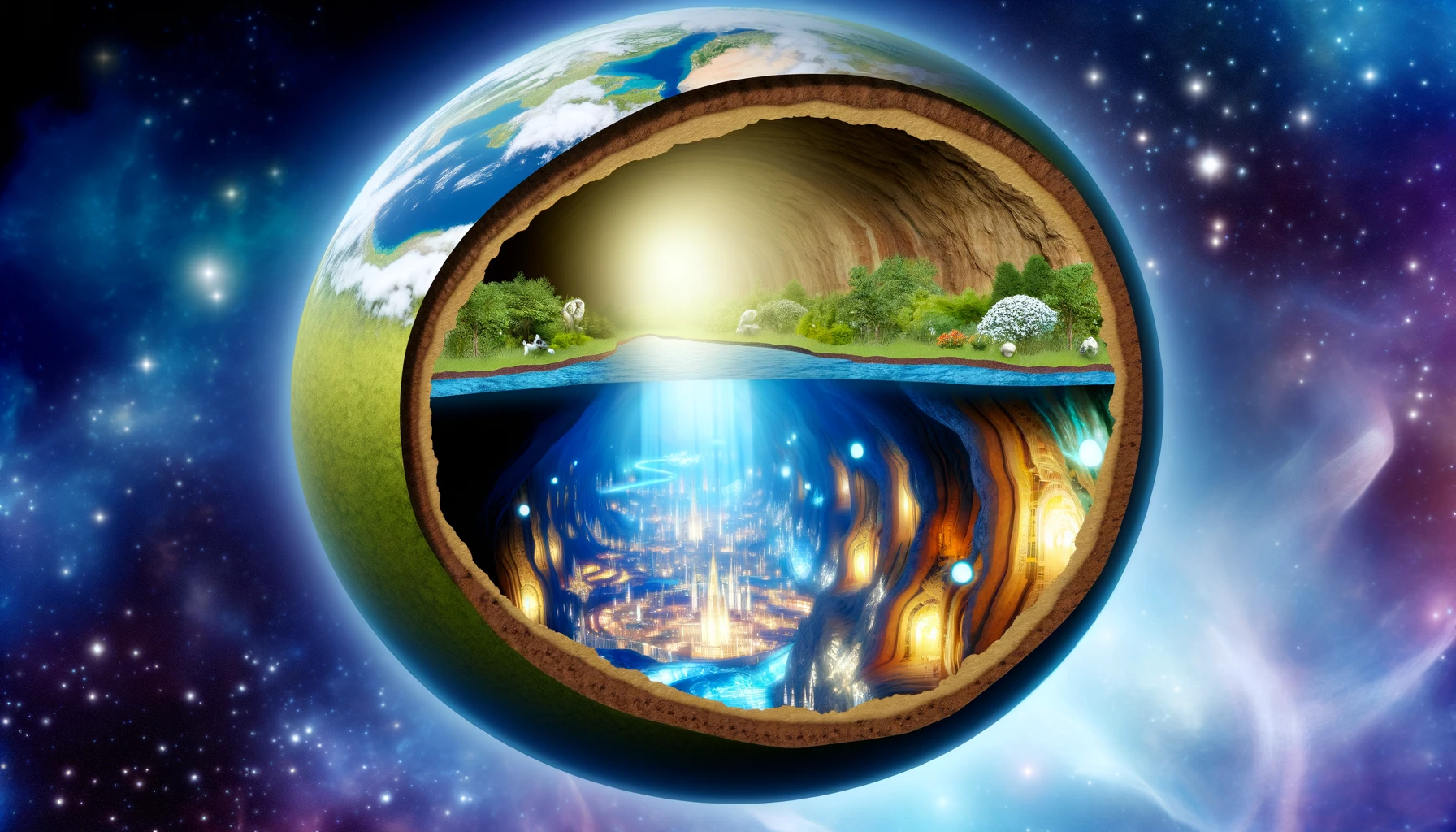
Table of contents

The Hollow Earth Theory: What’s inside?

The Historical Roots of Hollow Earth Theory The Hollow Earth theory is not a product of modern pseudoscience but has historical roots stretching back centuries. Ancient civilizations, including the Greeks, Tibetans, and Norse, held beliefs in underworlds or inner realms, which can be seen as early precursors to this theory. In the 17th century, Edmond Halley, the esteemed astronomer, proposed a model of the Earth consisting of concentric shells, inhabited and luminous, which was an early scientific rendition of the Hollow Earth concept. The 19th century saw a resurgence of this theory, with John Cleves Symmes Jr. advocating for…

S-FX.com
Artistic representation of the Hollow Earth theory with a cross-section view of Earth, showcasing an illuminated inner world with advanced civilizations and exotic ecosystems, hidden beneath the surface landscapes.
ourney to the Center: Unearthing the Hollow Earth Mystery

The Historical Roots of Hollow Earth Theory

The Hollow Earth theory is not a product of modern pseudoscience but has historical roots stretching back centuries. Ancient civilizations, including the Greeks, Tibetans, and Norse, held beliefs in underworlds or inner realms, which can be seen as early precursors to this theory. In the 17th century, Edmond Halley, the esteemed astronomer, proposed a model of the Earth consisting of concentric shells, inhabited and luminous, which was an early scientific rendition of the Hollow Earth concept.

The 19th century saw a resurgence of this theory, with John Cleves Symmes Jr. advocating for expeditions to find the supposed polar openings leading to the Earth’s interior. His ideas captivated the public imagination, leading to literature and speculative theories that further enriched the Hollow Earth narrative.

The Most Popular Explanations Behind the Theory

Proponents of the Hollow Earth theory offer various explanations and interpretations of what lies beneath the Earth’s crust. One popular version suggests the existence of vast caverns, extending hundreds of kilometers below the surface, hosting advanced civilizations or remnants of ancient ones. Another variant posits a central sun illuminating the inner Earth, creating a temperate paradise that could be home to exotic flora and fauna, or even human-like inhabitants.

These explanations often draw on anecdotal evidence, explorers’ accounts, and reinterpretations of mythological and religious texts. The allure of undiscovered lands and the human penchant for exploration fuel these narratives, making Hollow Earth one of the most enduring and captivating conspiracy theories.

Variations of the Theory

The Hollow Earth theory encompasses a spectrum of beliefs and hypotheses. Some adherents lean towards a more scientific approach, theorizing about subterranean ecosystems supported by geothermal energy, while others embrace a fantastical perspective, involving ancient races or extraterrestrial beings residing within the Earth.

Notable variations include the concept of Agartha, a legendary city said to exist in the Earth’s core, connected to the surface by a vast network of tunnels. This idea merges the Hollow Earth theory with legends of lost civilizations and ancient wisdom, adding layers of mystique and intrigue to the narrative.

Scientific Perspective and the Hollow Earth Theory

The Hollow Earth theory, despite its imaginative appeal, stands in stark contrast to established scientific knowledge. Geology, seismology, and planetary science provide comprehensive evidence supporting the Earth’s solid core and layered structure, from the crust to the inner and outer core.

Seismic studies, observing the behavior of earthquake waves, confirm the presence of liquid and solid layers deep within the Earth, negating the possibility of vast habitable spaces. The planet’s gravitational field, density, and magnetic properties further corroborate the conventional model of the Earth’s composition, leaving little room for the Hollow Earth theory within the realm of accepted science.

Conclusion: The Enduring Fascination with Hollow Earth

Despite the overwhelming scientific evidence against it, this continues to captivate imaginations around the globe. Its resilience lies not in empirical validation but in the human spirit’s exploratory nature and the timeless allure of the unknown. The Hollow Earth narrative encourages us to look beyond the surface, to question, and to imagine, embodying our innate curiosity and desire for adventure.

While this theory may remain in the realm of speculation and fantasy, it serves as a poignant reminder of the mysteries that lie both within our planet and within the depths of the human imagination. As we continue to explore the vast expanses of space and the oceanic depths, the Hollow Earth theory stands as a testament to the endless possibilities that await just beyond the edge of our current understanding.