The Story of Pope Joan
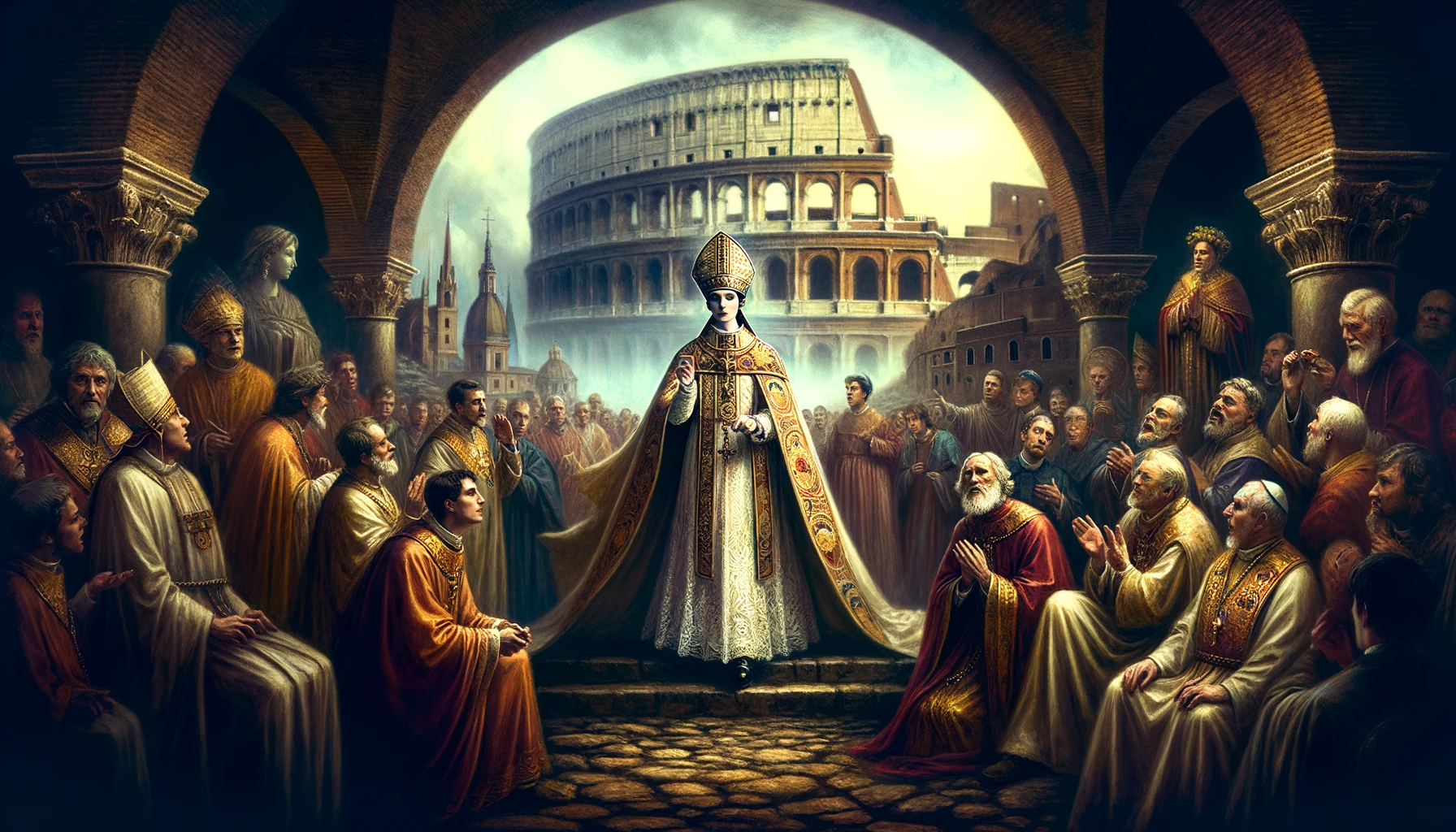
According to the most popular version of the story, Joan was a highly intelligent woman who was born in Mainz, Germany, during the early 9th century. Driven by a thirst for knowledge and learning, which was typically denied to women of her time, Joan disguised herself as a man. Under the name “John Anglicus,” she entered the Church and quickly rose through its ranks due to her exceptional intellect and piety.
Eventually, Joan was elected Pope, taking the name John VIII. She supposedly led the Church for several years, all the while concealing her true identity. The conspiracy theory claims that her gender was only discovered when she gave birth during a procession in Rome. This revelation caused an uproar, leading to her immediate downfall and, according to some accounts, her death.
Variations of the Pope Joan Conspiracy Theory
Over the centuries, several variations of the Pope Joan story have emerged. Some versions suggest that she did not die immediately after her exposure but was instead deposed and sent to a convent. Other tales imply that the Church, embarrassed by this incident, actively worked to erase all records of her papacy.
Some accounts go further to speculate on the identity of the child’s father, with theories ranging from a fellow clergyman to a member of the Roman nobility. There are also debates about the duration of her supposed papacy, with estimates varying from a few months to over two years.
Evidence Opposing the Validity of the Pope Joan Conspiracy
The historical accuracy of the Pope Joan story is highly disputed. Most modern scholars and historians dismiss it as a myth or legend. They argue that there is no contemporaneous evidence supporting her existence or papacy. The first known accounts of Pope Joan date from the 13th century, several hundred years after she was said to have lived.
Moreover, the list of Popes from that era does not include any John Anglicus or any gap that could accommodate her supposed reign. Critics of the theory also point out that the story of Pope Joan bears similarities to common medieval folklore motifs, suggesting it might be an amalgamation of various legends rather than a historical fact.
The Truth
The Pope Joan conspiracy theory, whether rooted in fact or fiction, provides an enthralling window into the intricacies of medieval society, the role of women in history, and the complexities involved in the construction and interpretation of historical narratives. This legend, transcending mere storytelling, serves as a powerful catalyst for ongoing debates and scholarly research. It not only highlights the societal perceptions and limitations placed on women in the past but also underscores the enduring challenges they face in religious and patriarchal institutions.
Furthermore, the enduring intrigue surrounding Pope Joan reflects our collective fascination with hidden histories and the potential for alternative narratives to challenge established truths. In this way, the Pope Joan story continues to resonate as a symbol of the intersection between gender, power, and historical memory, prompting us to re-examine our understanding of the past and its implications for the present.