Menu

The Church Committee: How Congress Exposed America’s Shadow Government

The Church Committee: How Congress Exposed America's Shadow Government

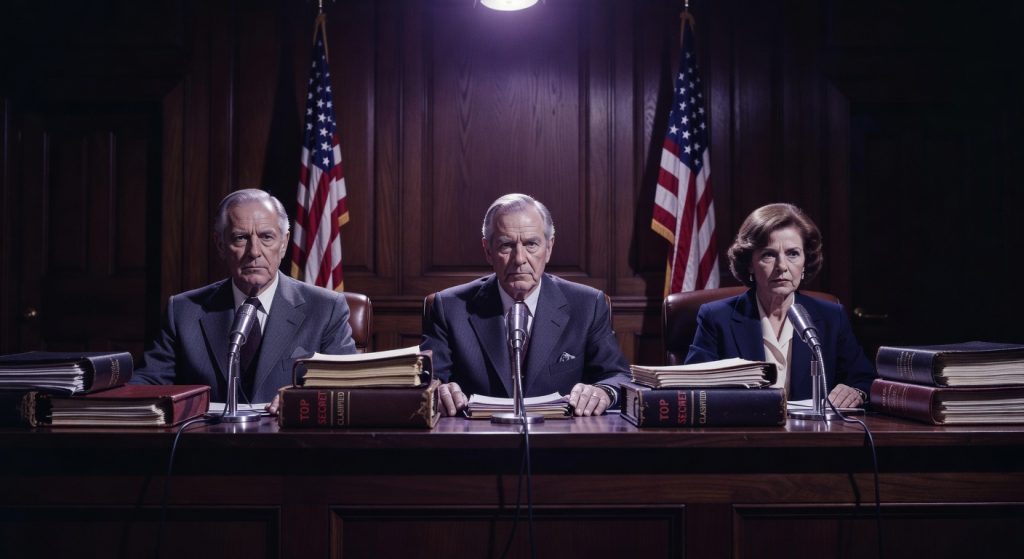
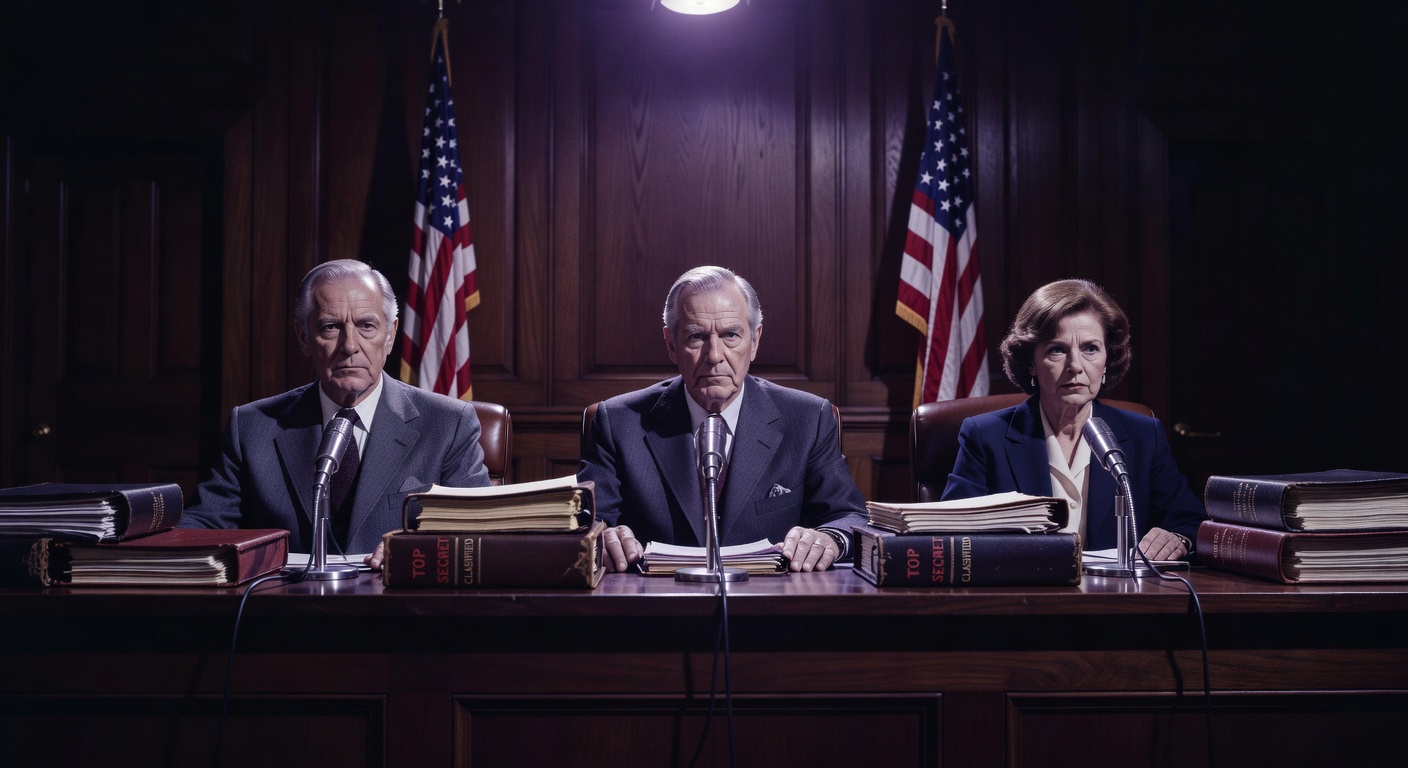
In the winter of 1975, a quiet senator from Idaho walked into the most explosive congressional investigation of the twentieth century and emerged holding proof that the United States government had spent decades engaged in assassination plots, illegal surveillance, domestic infiltration of political movements, and a systematic effort to subvert the democratic institutions it claimed to represent. Senator Frank Church — the chairman of what would become the most consequential congressional investigation in American history — held up a dart gun developed by the CIA for covert assassination and said into the television cameras: “We have met the enemy, and he is us.”

The Church Committee — formally the Senate Select Committee to Study Governmental Operations with Respect to Intelligence Activities — ran from 1975 to 1976 and produced a report of staggering scope. It documented CIA assassination plots against foreign leaders. It exposed the FBI’s COINTELPRO program, which had spent years harassing, infiltrating, and destroying domestic political organizations. It revealed NSA mass surveillance programs. It uncovered the CIA’s domestic mail-opening program. And it posed, for the first time in American public life, a question that has never fully been answered: who controls the secret government?

The Context: Intelligence Run Wild

To understand the Church Committee, you need to understand the America of 1974-1975: a country still reeling from Watergate, deeply shaken by the revelations that a sitting president had weaponized federal agencies for political purposes. But Watergate was, in some sense, the visible tip of a much larger iceberg. The abuses of the Nixon administration were outrageous — but they had been enabled by institutional structures and practices that predated Nixon by decades.

The triggering event for the Church Committee’s creation was a December 1974 article by journalist Seymour Hersh in the New York Times, reporting that the CIA had conducted “massive” illegal domestic intelligence operations against American citizens during the Vietnam War era — a program Hersh called the “family jewels.” The article was based on a secret internal CIA report, the existence of which had been known to a small number of officials. When it reached the public, the political pressure for investigation became irresistible.

President Gerald Ford convened the Rockefeller Commission (led by Vice President Nelson Rockefeller) to investigate CIA domestic activities — a classic strategy of controlling an investigation by staffing it with insiders. Senate Democrats, led by Frank Church, moved to conduct their own parallel investigation with subpoena power and a mandate that went far beyond the CIA.

Frank Church: The Man in the Arena

Frank Church was, in many respects, an unlikely avatar of accountability. A liberal Democrat from a conservative state, he had been a strong supporter of presidential prerogative in foreign policy for much of his career. But the revelations that emerged as his committee began its work transformed his view of what the intelligence community had become.

Church later described the CIA as a “rogue elephant on a rampage” — a phrase that became iconic but was also, as subsequent investigations showed, somewhat incomplete. The CIA had not simply run amok without direction. It had, in many cases, been directed by presidents and their advisors to conduct the very activities the committee was now uncovering. The elephant was on a leash — the question was who held it.

The committee operated for more than a year, conducting hundreds of interviews, reviewing thousands of classified documents, and holding both public and closed-door hearings. Its final report ran to fourteen volumes. What it found reshaped American understanding of what its secret services had actually been doing.

COINTELPRO: The War Against American Citizens

Perhaps the most disturbing revelation of the Church Committee was the full scope of the FBI’s COINTELPRO program. The acronym stood for Counterintelligence Program, but what the program actually did bore little resemblance to counterintelligence as normally understood. COINTELPRO was a systematic campaign to disrupt, discredit, and destroy American political organizations that FBI Director J. Edgar Hoover and his superiors deemed subversive.

The program’s targets ranged from the Communist Party USA — a legitimate counterintelligence concern — to organizations that had no plausible connection to foreign powers or genuine subversion. Among those targeted:

  • The Southern Christian Leadership Conference and Dr. Martin Luther King Jr., whom Hoover personally despised and whom the FBI tried to drive to suicide by sending him recordings of his extramarital affairs with a letter suggesting he kill himself
  • The Black Panther Party, which was subjected to forged letters designed to provoke lethal gang warfare with rival organizations
  • The Student Nonviolent Coordinating Committee (SNCC)
  • Vietnam War protest groups
  • Women’s liberation organizations
  • The American Indian Movement
  • Puerto Rican independence organizations
  • Even the Socialist Workers Party, which was never accused of violence and which ultimately successfully sued the FBI for its infiltration and disruption

The tactics employed by COINTELPRO were documented in chilling detail by the committee. They included: planting false stories in newspapers, sending anonymous threatening letters, using informants to sow dissension, engineering the firing of movement members from their jobs, contacting their landlords and families to harass them, and — in the most extreme cases — facilitating violence through the deliberate manipulation of rival factions.

The Church Committee’s final report concluded that COINTELPRO “was designed to ‘disrupt’ groups and ‘neutralize’ individuals deemed to be threats to domestic security. The Bureau conducted a sophisticated vigilante operation aimed squarely at preventing the exercise of First Amendment rights of speech and association.”

CIA Assassination Plots: The Cobra Strikes

If COINTELPRO was the domestic face of the shadow government, the CIA’s foreign assassination program was its international counterpart. The Church Committee documented plots against:

  • Fidel Castro (Cuba): Eight separate documented assassination attempts, including the infamous collaboration with the American Mafia and schemes involving poisoned cigars and an exploding seashell
  • Patrice Lumumba (Congo): The committee found evidence that the CIA had prepared poisons for use against Lumumba, though he was killed by Congolese rivals before they could be deployed
  • Rafael Trujillo (Dominican Republic): The CIA provided weapons to Dominican dissidents who assassinated Trujillo in 1961
  • Ngo Dinh Diem (South Vietnam): The committee examined CIA foreknowledge of the coup that resulted in Diem’s murder
  • René Schneider (Chile): A Chilean military general who was killed during a CIA-supported kidnapping attempt designed to prevent Salvador Allende from taking office

The committee grappled with the difficult question of how much these plots had been explicitly authorized by presidents and how much they reflected the initiative of CIA officers interpreting broad mandates for deniability. What emerged was a picture of a culture in which “plausible deniability” had become a mechanism for allowing presidents to authorize things they could later claim not to have ordered.

The NSA and the Surveillance State

The Church Committee also exposed, for the first time, the full scope of the National Security Agency’s domestic surveillance capabilities. Operation SHAMROCK — a program in which the NSA had been collecting international telegrams from American citizens since 1945, with the cooperation of the major telegraph companies — was revealed. Operation MINARET — in which the NSA had conducted warrantless surveillance of American civil rights leaders, anti-war activists, and politicians — was documented.

The scale of the NSA’s capabilities shocked even senators with national security backgrounds. The agency had the technological means to intercept and process vast quantities of communications, with essentially no legal restraints. Church famously warned that if the NSA’s capabilities were “ever turned inward on the American people, this country can’t afford to make a mistake.” It was a prescient observation — one that would resonate with new force when Edward Snowden’s revelations arrived four decades later.

The Reforms — and Their Limits

The Church Committee’s work led to a significant wave of intelligence reform. The Foreign Intelligence Surveillance Act (FISA) of 1978 created a court to oversee domestic surveillance requests. Executive orders banned assassination as an instrument of US policy. Congressional oversight committees — the Senate Select Committee on Intelligence and the House Permanent Select Committee on Intelligence — were created to provide ongoing congressional supervision of the intelligence community.

These were real reforms. But they were also limited in ways that subsequent history would reveal. The FISA court became, in practice, a rubber stamp rather than a genuine check. Executive orders banning assassination can be — and, critics argue, have been — reinterpreted to permit targeted killings under different legal theories. Congressional oversight committees developed their own institutional relationships with the agencies they were supposed to supervise.

The deeper problem the Church Committee identified — an executive branch claiming powers that no democratic system can legitimately vest in a secret, unaccountable bureaucracy — was never resolved. It was deferred.

A Thought-Provoking Conclusion

The Church Committee remains the high-water mark of American democratic accountability for its secret services. In fourteen volumes of documented evidence, it showed that the United States government had spent decades conducting operations that violated the Constitution, the laws of the United States, and the most basic norms of democratic governance — not as aberrations, but as policy.

What has changed in the decades since is mostly a matter of degree and legal scaffolding. The capabilities are vastly more powerful. The legal justifications are more sophisticated. The oversight mechanisms exist — but their effectiveness is, to put it charitably, contested. The shadow government that Frank Church illuminated in 1975 did not disappear. It evolved.

Church himself lost his Senate seat in 1980 in what many analysts attribute partly to an aggressive CIA-backed campaign against him. He died of cancer in 1984. The committee’s final report sits in archives and on government servers, mostly unread, a Rosetta Stone for anyone who wants to understand what American power actually does when it thinks no one is watching.

Down the Rabbit Hole

  • The Family Jewels: The CIA’s own internal report on its most problematic operations, which triggered the Church Committee. What does the full document reveal — and what do the still-redacted sections conceal?
  • COINTELPRO and Fred Hampton: The FBI’s role in the 1969 assassination of the Black Panther leader is one of the most disturbing specific cases to emerge from the COINTELPRO investigation. Explore the documented evidence of state-sponsored murder.
  • The Pike Committee: The House of Representatives ran its own concurrent investigation. Its final report was voted to be kept secret — and then leaked to the Village Voice. Why was it suppressed, and what did it contain?
  • Post-9/11 Surveillance: How did the programs exposed by the Church Committee — SHAMROCK, MINARET — evolve into the NSA mass surveillance architecture revealed by Edward Snowden? Follow the institutional genealogy.
  • The Assassination Ban and the Drone Wars: Executive Order 11905 banned assassination. How did subsequent administrations reinterpret the order to permit targeted killing programs? Where exactly is the line between assassination and counterterrorism?

Disclaimer: This article is intended for educational and entertainment purposes. The Church Committee’s findings are a matter of public record, documented in fourteen volumes available through the US Senate and the National Archives. Readers are encouraged to read the primary sources.

dive down the rabbit hole

The Church Committee: How Congress Exposed America’s Shadow Government

Conspiracy Realist
The Church Committee: How Congress Exposed America's Shadow Government

In the winter of 1975, a quiet senator from Idaho walked into the most explosive congressional investigation of the twentieth century and emerged holding proof that the United States government had spent decades engaged in assassination plots, illegal surveillance, domestic infiltration of political movements, and a systematic effort to subvert the democratic institutions it claimed to represent. Senator Frank Church — the chairman of what would become the most consequential congressional investigation in American history — held up a dart gun developed by the CIA for covert assassination and said into the television cameras: “We have met the enemy, and he is us.”

The Church Committee — formally the Senate Select Committee to Study Governmental Operations with Respect to Intelligence Activities — ran from 1975 to 1976 and produced a report of staggering scope. It documented CIA assassination plots against foreign leaders. It exposed the FBI’s COINTELPRO program, which had spent years harassing, infiltrating, and destroying domestic political organizations. It revealed NSA mass surveillance programs. It uncovered the CIA’s domestic mail-opening program. And it posed, for the first time in American public life, a question that has never fully been answered: who controls the secret government?

The Context: Intelligence Run Wild

To understand the Church Committee, you need to understand the America of 1974-1975: a country still reeling from Watergate, deeply shaken by the revelations that a sitting president had weaponized federal agencies for political purposes. But Watergate was, in some sense, the visible tip of a much larger iceberg. The abuses of the Nixon administration were outrageous — but they had been enabled by institutional structures and practices that predated Nixon by decades.

The triggering event for the Church Committee’s creation was a December 1974 article by journalist Seymour Hersh in the New York Times, reporting that the CIA had conducted “massive” illegal domestic intelligence operations against American citizens during the Vietnam War era — a program Hersh called the “family jewels.” The article was based on a secret internal CIA report, the existence of which had been known to a small number of officials. When it reached the public, the political pressure for investigation became irresistible.

President Gerald Ford convened the Rockefeller Commission (led by Vice President Nelson Rockefeller) to investigate CIA domestic activities — a classic strategy of controlling an investigation by staffing it with insiders. Senate Democrats, led by Frank Church, moved to conduct their own parallel investigation with subpoena power and a mandate that went far beyond the CIA.

Frank Church: The Man in the Arena

Frank Church was, in many respects, an unlikely avatar of accountability. A liberal Democrat from a conservative state, he had been a strong supporter of presidential prerogative in foreign policy for much of his career. But the revelations that emerged as his committee began its work transformed his view of what the intelligence community had become.

Church later described the CIA as a “rogue elephant on a rampage” — a phrase that became iconic but was also, as subsequent investigations showed, somewhat incomplete. The CIA had not simply run amok without direction. It had, in many cases, been directed by presidents and their advisors to conduct the very activities the committee was now uncovering. The elephant was on a leash — the question was who held it.

The committee operated for more than a year, conducting hundreds of interviews, reviewing thousands of classified documents, and holding both public and closed-door hearings. Its final report ran to fourteen volumes. What it found reshaped American understanding of what its secret services had actually been doing.

COINTELPRO: The War Against American Citizens

Perhaps the most disturbing revelation of the Church Committee was the full scope of the FBI’s COINTELPRO program. The acronym stood for Counterintelligence Program, but what the program actually did bore little resemblance to counterintelligence as normally understood. COINTELPRO was a systematic campaign to disrupt, discredit, and destroy American political organizations that FBI Director J. Edgar Hoover and his superiors deemed subversive.

The program’s targets ranged from the Communist Party USA — a legitimate counterintelligence concern — to organizations that had no plausible connection to foreign powers or genuine subversion. Among those targeted:

  • The Southern Christian Leadership Conference and Dr. Martin Luther King Jr., whom Hoover personally despised and whom the FBI tried to drive to suicide by sending him recordings of his extramarital affairs with a letter suggesting he kill himself
  • The Black Panther Party, which was subjected to forged letters designed to provoke lethal gang warfare with rival organizations
  • The Student Nonviolent Coordinating Committee (SNCC)
  • Vietnam War protest groups
  • Women’s liberation organizations
  • The American Indian Movement
  • Puerto Rican independence organizations
  • Even the Socialist Workers Party, which was never accused of violence and which ultimately successfully sued the FBI for its infiltration and disruption

The tactics employed by COINTELPRO were documented in chilling detail by the committee. They included: planting false stories in newspapers, sending anonymous threatening letters, using informants to sow dissension, engineering the firing of movement members from their jobs, contacting their landlords and families to harass them, and — in the most extreme cases — facilitating violence through the deliberate manipulation of rival factions.

The Church Committee’s final report concluded that COINTELPRO “was designed to ‘disrupt’ groups and ‘neutralize’ individuals deemed to be threats to domestic security. The Bureau conducted a sophisticated vigilante operation aimed squarely at preventing the exercise of First Amendment rights of speech and association.”

CIA Assassination Plots: The Cobra Strikes

If COINTELPRO was the domestic face of the shadow government, the CIA’s foreign assassination program was its international counterpart. The Church Committee documented plots against:

  • Fidel Castro (Cuba): Eight separate documented assassination attempts, including the infamous collaboration with the American Mafia and schemes involving poisoned cigars and an exploding seashell
  • Patrice Lumumba (Congo): The committee found evidence that the CIA had prepared poisons for use against Lumumba, though he was killed by Congolese rivals before they could be deployed
  • Rafael Trujillo (Dominican Republic): The CIA provided weapons to Dominican dissidents who assassinated Trujillo in 1961
  • Ngo Dinh Diem (South Vietnam): The committee examined CIA foreknowledge of the coup that resulted in Diem’s murder
  • René Schneider (Chile): A Chilean military general who was killed during a CIA-supported kidnapping attempt designed to prevent Salvador Allende from taking office

The committee grappled with the difficult question of how much these plots had been explicitly authorized by presidents and how much they reflected the initiative of CIA officers interpreting broad mandates for deniability. What emerged was a picture of a culture in which “plausible deniability” had become a mechanism for allowing presidents to authorize things they could later claim not to have ordered.

The NSA and the Surveillance State

The Church Committee also exposed, for the first time, the full scope of the National Security Agency’s domestic surveillance capabilities. Operation SHAMROCK — a program in which the NSA had been collecting international telegrams from American citizens since 1945, with the cooperation of the major telegraph companies — was revealed. Operation MINARET — in which the NSA had conducted warrantless surveillance of American civil rights leaders, anti-war activists, and politicians — was documented.

The scale of the NSA’s capabilities shocked even senators with national security backgrounds. The agency had the technological means to intercept and process vast quantities of communications, with essentially no legal restraints. Church famously warned that if the NSA’s capabilities were “ever turned inward on the American people, this country can’t afford to make a mistake.” It was a prescient observation — one that would resonate with new force when Edward Snowden’s revelations arrived four decades later.

The Reforms — and Their Limits

The Church Committee’s work led to a significant wave of intelligence reform. The Foreign Intelligence Surveillance Act (FISA) of 1978 created a court to oversee domestic surveillance requests. Executive orders banned assassination as an instrument of US policy. Congressional oversight committees — the Senate Select Committee on Intelligence and the House Permanent Select Committee on Intelligence — were created to provide ongoing congressional supervision of the intelligence community.

These were real reforms. But they were also limited in ways that subsequent history would reveal. The FISA court became, in practice, a rubber stamp rather than a genuine check. Executive orders banning assassination can be — and, critics argue, have been — reinterpreted to permit targeted killings under different legal theories. Congressional oversight committees developed their own institutional relationships with the agencies they were supposed to supervise.

The deeper problem the Church Committee identified — an executive branch claiming powers that no democratic system can legitimately vest in a secret, unaccountable bureaucracy — was never resolved. It was deferred.

A Thought-Provoking Conclusion

The Church Committee remains the high-water mark of American democratic accountability for its secret services. In fourteen volumes of documented evidence, it showed that the United States government had spent decades conducting operations that violated the Constitution, the laws of the United States, and the most basic norms of democratic governance — not as aberrations, but as policy.

What has changed in the decades since is mostly a matter of degree and legal scaffolding. The capabilities are vastly more powerful. The legal justifications are more sophisticated. The oversight mechanisms exist — but their effectiveness is, to put it charitably, contested. The shadow government that Frank Church illuminated in 1975 did not disappear. It evolved.

Church himself lost his Senate seat in 1980 in what many analysts attribute partly to an aggressive CIA-backed campaign against him. He died of cancer in 1984. The committee’s final report sits in archives and on government servers, mostly unread, a Rosetta Stone for anyone who wants to understand what American power actually does when it thinks no one is watching.

Down the Rabbit Hole

  • The Family Jewels: The CIA’s own internal report on its most problematic operations, which triggered the Church Committee. What does the full document reveal — and what do the still-redacted sections conceal?
  • COINTELPRO and Fred Hampton: The FBI’s role in the 1969 assassination of the Black Panther leader is one of the most disturbing specific cases to emerge from the COINTELPRO investigation. Explore the documented evidence of state-sponsored murder.
  • The Pike Committee: The House of Representatives ran its own concurrent investigation. Its final report was voted to be kept secret — and then leaked to the Village Voice. Why was it suppressed, and what did it contain?
  • Post-9/11 Surveillance: How did the programs exposed by the Church Committee — SHAMROCK, MINARET — evolve into the NSA mass surveillance architecture revealed by Edward Snowden? Follow the institutional genealogy.
  • The Assassination Ban and the Drone Wars: Executive Order 11905 banned assassination. How did subsequent administrations reinterpret the order to permit targeted killing programs? Where exactly is the line between assassination and counterterrorism?

Disclaimer: This article is intended for educational and entertainment purposes. The Church Committee’s findings are a matter of public record, documented in fourteen volumes available through the US Senate and the National Archives. Readers are encouraged to read the primary sources.

The Church Committee: How Congress Exposed America’s Shadow Government

The Church Committee: How Congress Exposed America's Shadow Government

In the winter of 1975, a quiet senator from Idaho walked into the most explosive congressional investigation of the twentieth century and emerged holding proof that the United States government had spent decades engaged in assassination plots, illegal surveillance, domestic infiltration of political movements, and a systematic effort to subvert the democratic institutions it claimed to represent. Senator Frank Church — the chairman of what would become the most consequential congressional investigation in American history — held up a dart gun developed by the CIA for covert assassination and said into the television cameras: “We have met the enemy, and he is us.”

The Church Committee — formally the Senate Select Committee to Study Governmental Operations with Respect to Intelligence Activities — ran from 1975 to 1976 and produced a report of staggering scope. It documented CIA assassination plots against foreign leaders. It exposed the FBI’s COINTELPRO program, which had spent years harassing, infiltrating, and destroying domestic political organizations. It revealed NSA mass surveillance programs. It uncovered the CIA’s domestic mail-opening program. And it posed, for the first time in American public life, a question that has never fully been answered: who controls the secret government?

The Context: Intelligence Run Wild

To understand the Church Committee, you need to understand the America of 1974-1975: a country still reeling from Watergate, deeply shaken by the revelations that a sitting president had weaponized federal agencies for political purposes. But Watergate was, in some sense, the visible tip of a much larger iceberg. The abuses of the Nixon administration were outrageous — but they had been enabled by institutional structures and practices that predated Nixon by decades.

The triggering event for the Church Committee’s creation was a December 1974 article by journalist Seymour Hersh in the New York Times, reporting that the CIA had conducted “massive” illegal domestic intelligence operations against American citizens during the Vietnam War era — a program Hersh called the “family jewels.” The article was based on a secret internal CIA report, the existence of which had been known to a small number of officials. When it reached the public, the political pressure for investigation became irresistible.

President Gerald Ford convened the Rockefeller Commission (led by Vice President Nelson Rockefeller) to investigate CIA domestic activities — a classic strategy of controlling an investigation by staffing it with insiders. Senate Democrats, led by Frank Church, moved to conduct their own parallel investigation with subpoena power and a mandate that went far beyond the CIA.

Frank Church: The Man in the Arena

Frank Church was, in many respects, an unlikely avatar of accountability. A liberal Democrat from a conservative state, he had been a strong supporter of presidential prerogative in foreign policy for much of his career. But the revelations that emerged as his committee began its work transformed his view of what the intelligence community had become.

Church later described the CIA as a “rogue elephant on a rampage” — a phrase that became iconic but was also, as subsequent investigations showed, somewhat incomplete. The CIA had not simply run amok without direction. It had, in many cases, been directed by presidents and their advisors to conduct the very activities the committee was now uncovering. The elephant was on a leash — the question was who held it.

The committee operated for more than a year, conducting hundreds of interviews, reviewing thousands of classified documents, and holding both public and closed-door hearings. Its final report ran to fourteen volumes. What it found reshaped American understanding of what its secret services had actually been doing.

COINTELPRO: The War Against American Citizens

Perhaps the most disturbing revelation of the Church Committee was the full scope of the FBI’s COINTELPRO program. The acronym stood for Counterintelligence Program, but what the program actually did bore little resemblance to counterintelligence as normally understood. COINTELPRO was a systematic campaign to disrupt, discredit, and destroy American political organizations that FBI Director J. Edgar Hoover and his superiors deemed subversive.

The program’s targets ranged from the Communist Party USA — a legitimate counterintelligence concern — to organizations that had no plausible connection to foreign powers or genuine subversion. Among those targeted:

  • The Southern Christian Leadership Conference and Dr. Martin Luther King Jr., whom Hoover personally despised and whom the FBI tried to drive to suicide by sending him recordings of his extramarital affairs with a letter suggesting he kill himself
  • The Black Panther Party, which was subjected to forged letters designed to provoke lethal gang warfare with rival organizations
  • The Student Nonviolent Coordinating Committee (SNCC)
  • Vietnam War protest groups
  • Women’s liberation organizations
  • The American Indian Movement
  • Puerto Rican independence organizations
  • Even the Socialist Workers Party, which was never accused of violence and which ultimately successfully sued the FBI for its infiltration and disruption

The tactics employed by COINTELPRO were documented in chilling detail by the committee. They included: planting false stories in newspapers, sending anonymous threatening letters, using informants to sow dissension, engineering the firing of movement members from their jobs, contacting their landlords and families to harass them, and — in the most extreme cases — facilitating violence through the deliberate manipulation of rival factions.

The Church Committee’s final report concluded that COINTELPRO “was designed to ‘disrupt’ groups and ‘neutralize’ individuals deemed to be threats to domestic security. The Bureau conducted a sophisticated vigilante operation aimed squarely at preventing the exercise of First Amendment rights of speech and association.”

CIA Assassination Plots: The Cobra Strikes

If COINTELPRO was the domestic face of the shadow government, the CIA’s foreign assassination program was its international counterpart. The Church Committee documented plots against:

  • Fidel Castro (Cuba): Eight separate documented assassination attempts, including the infamous collaboration with the American Mafia and schemes involving poisoned cigars and an exploding seashell
  • Patrice Lumumba (Congo): The committee found evidence that the CIA had prepared poisons for use against Lumumba, though he was killed by Congolese rivals before they could be deployed
  • Rafael Trujillo (Dominican Republic): The CIA provided weapons to Dominican dissidents who assassinated Trujillo in 1961
  • Ngo Dinh Diem (South Vietnam): The committee examined CIA foreknowledge of the coup that resulted in Diem’s murder
  • René Schneider (Chile): A Chilean military general who was killed during a CIA-supported kidnapping attempt designed to prevent Salvador Allende from taking office

The committee grappled with the difficult question of how much these plots had been explicitly authorized by presidents and how much they reflected the initiative of CIA officers interpreting broad mandates for deniability. What emerged was a picture of a culture in which “plausible deniability” had become a mechanism for allowing presidents to authorize things they could later claim not to have ordered.

The NSA and the Surveillance State

The Church Committee also exposed, for the first time, the full scope of the National Security Agency’s domestic surveillance capabilities. Operation SHAMROCK — a program in which the NSA had been collecting international telegrams from American citizens since 1945, with the cooperation of the major telegraph companies — was revealed. Operation MINARET — in which the NSA had conducted warrantless surveillance of American civil rights leaders, anti-war activists, and politicians — was documented.

The scale of the NSA’s capabilities shocked even senators with national security backgrounds. The agency had the technological means to intercept and process vast quantities of communications, with essentially no legal restraints. Church famously warned that if the NSA’s capabilities were “ever turned inward on the American people, this country can’t afford to make a mistake.” It was a prescient observation — one that would resonate with new force when Edward Snowden’s revelations arrived four decades later.

The Reforms — and Their Limits

The Church Committee’s work led to a significant wave of intelligence reform. The Foreign Intelligence Surveillance Act (FISA) of 1978 created a court to oversee domestic surveillance requests. Executive orders banned assassination as an instrument of US policy. Congressional oversight committees — the Senate Select Committee on Intelligence and the House Permanent Select Committee on Intelligence — were created to provide ongoing congressional supervision of the intelligence community.

These were real reforms. But they were also limited in ways that subsequent history would reveal. The FISA court became, in practice, a rubber stamp rather than a genuine check. Executive orders banning assassination can be — and, critics argue, have been — reinterpreted to permit targeted killings under different legal theories. Congressional oversight committees developed their own institutional relationships with the agencies they were supposed to supervise.

The deeper problem the Church Committee identified — an executive branch claiming powers that no democratic system can legitimately vest in a secret, unaccountable bureaucracy — was never resolved. It was deferred.

A Thought-Provoking Conclusion

The Church Committee remains the high-water mark of American democratic accountability for its secret services. In fourteen volumes of documented evidence, it showed that the United States government had spent decades conducting operations that violated the Constitution, the laws of the United States, and the most basic norms of democratic governance — not as aberrations, but as policy.

What has changed in the decades since is mostly a matter of degree and legal scaffolding. The capabilities are vastly more powerful. The legal justifications are more sophisticated. The oversight mechanisms exist — but their effectiveness is, to put it charitably, contested. The shadow government that Frank Church illuminated in 1975 did not disappear. It evolved.

Church himself lost his Senate seat in 1980 in what many analysts attribute partly to an aggressive CIA-backed campaign against him. He died of cancer in 1984. The committee’s final report sits in archives and on government servers, mostly unread, a Rosetta Stone for anyone who wants to understand what American power actually does when it thinks no one is watching.

Down the Rabbit Hole

  • The Family Jewels: The CIA’s own internal report on its most problematic operations, which triggered the Church Committee. What does the full document reveal — and what do the still-redacted sections conceal?
  • COINTELPRO and Fred Hampton: The FBI’s role in the 1969 assassination of the Black Panther leader is one of the most disturbing specific cases to emerge from the COINTELPRO investigation. Explore the documented evidence of state-sponsored murder.
  • The Pike Committee: The House of Representatives ran its own concurrent investigation. Its final report was voted to be kept secret — and then leaked to the Village Voice. Why was it suppressed, and what did it contain?
  • Post-9/11 Surveillance: How did the programs exposed by the Church Committee — SHAMROCK, MINARET — evolve into the NSA mass surveillance architecture revealed by Edward Snowden? Follow the institutional genealogy.
  • The Assassination Ban and the Drone Wars: Executive Order 11905 banned assassination. How did subsequent administrations reinterpret the order to permit targeted killing programs? Where exactly is the line between assassination and counterterrorism?

Disclaimer: This article is intended for educational and entertainment purposes. The Church Committee’s findings are a matter of public record, documented in fourteen volumes available through the US Senate and the National Archives. Readers are encouraged to read the primary sources.

Table of contents