Menu

DARPA’s LifeLog and the Suspicious Birth of Facebook

DARPA's LifeLog and the Suspicious Birth of Facebook

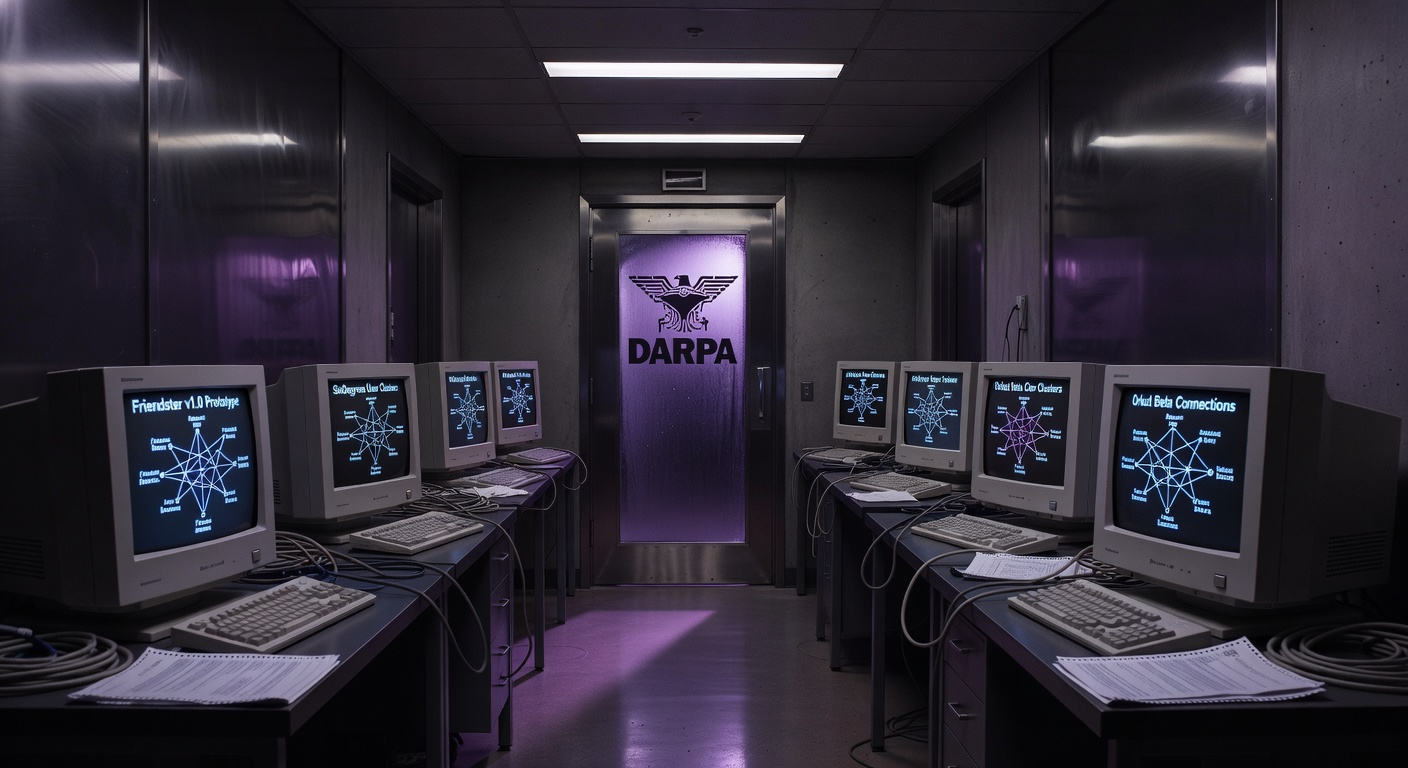
On January 15, 2004, the Defense Advanced Research Projects Agency — better known as DARPA — quietly cancelled a program called LifeLog. The project had attracted significant controversy: it aimed to create a comprehensive digital record of everything a person did, saw, read, communicated, and experienced, building a permanent, searchable, queryable archive of an individual’s entire life.

Privacy advocates had been alarmed. Journalists had started asking questions. DARPA pulled the plug.

The date of LifeLog’s cancellation: January 15, 2004.

The date Facebook launched: February 4, 2004.

Twenty days. The government’s dream of a comprehensive human-life database was supposedly cancelled, and three weeks later a Harvard sophomore launched what would become the most successful voluntary human-life database in history. Coincidence? Maybe. But the rabbit hole goes considerably deeper than the date alignment suggests.

What Was LifeLog?

LifeLog was a DARPA program announced in 2003 with the stated goal of creating “a multimedia, longitudinal autobiography.” The project solicitation described a system that would capture “all of a person’s experience” — every email sent and received, every website visited, every book read, every location visited, every person spoken to, every purchase made, every piece of media consumed — and integrate this into a searchable, queryable database.

The official purpose was military and intelligence application: helping soldiers and analysts manage information overload, improving memory, enabling better situational awareness. If you could perfectly recall everything a deployed soldier experienced, you could better analyze patterns, extract intelligence, and improve performance.

But the scope was broader and more personal. DARPA’s 2003 solicitation described LifeLog as building “a comprehensive autobiographical memory for individuals” that would capture the “full spectrum” of an individual’s experience. The system would need to be worn or carried — sensors, microphones, cameras — continuously recording the ambient data of a life.

Privacy advocates immediately recognized the implications. Marc Rotenberg of the Electronic Privacy Information Center called it “the most significant surveillance initiative in the United States.” Wired magazine ran pieces questioning the implications of a government-funded personal surveillance system. The public backlash was significant enough that DARPA terminated the program before it moved beyond the planning stage.

Or so the official story goes.

The Timing: More Than a Coincidence?

The twenty-day gap between LifeLog‘s cancellation and Facebook‘s launch has been noted by skeptics since at least 2011 and gained significant attention when journalist Yasha Levine and others began investigating Silicon Valley’s intelligence community connections more systematically.

The connection isn’t just about dates. It’s about what Facebook actually became. Consider what Facebook collects and maintains, compared to what LifeLog proposed to collect:

LifeLog wanted: every communication. Facebook has: messages, comments, posts, reactions to every piece of content. LifeLog wanted: location history. Facebook has: continuous location check-ins, event RSVPs, and fine-grained location data from the mobile app. LifeLog wanted: relationship mapping. Facebook has: the most comprehensive social graph in human history — who you know, how you know them, how often you interact. LifeLog wanted: media consumption. Facebook has: every article you’ve read, every video you’ve watched, every ad you’ve engaged with. LifeLog wanted: a longitudinal record of your entire life. Facebook has: years or decades of daily activity for over three billion people.

Facebook didn’t just accidentally build what LifeLog proposed. Facebook built LifeLog, voluntarily contributed to by billions of people who had no idea what they were signing up for.

Mark Zuckerberg and the DARPA Connection: Following the Money

Was Mark Zuckerberg connected to DARPA or the intelligence community? This is where the evidence becomes murkier and the speculation more speculative — but the circumstantial case is worth examining carefully.

Zuckerberg’s early funding came through Peter Thiel — the same Peter Thiel who founded Palantir with CIA seed money. In 2004, Thiel invested $500,000 in Facebook for roughly 10% of the company. This was Zuckerberg’s first significant outside investment, and Thiel joined the board. A man with deep intelligence community ties was on the board of the world’s most ambitious social data collection platform from the very beginning.

Later investors included In-Q-Tel-connected funds and venture capital firms with documented intelligence community relationships. Jim Breyer of Accel Partners, which led a $12.7 million investment in Facebook in 2005, had previously worked with Gilman Louie, the founding CEO of In-Q-Tel. The intelligence investment network and the early Facebook funding network were not neatly separate.

None of this proves Zuckerberg was a CIA asset or that Facebook was designed as a surveillance program. But it does suggest that the people who saw value in Facebook earliest were people with intelligence community connections who understood the value of comprehensive social data.

The Surveillance Valley Thesis

Journalist Yasha Levine, in his 2018 book Surveillance Valley, argued that the modern internet was not an accidental outgrowth of academic research and entrepreneurial energy, but was built from its foundations as a surveillance and communications monitoring network. The internet’s origins in ARPANET — explicitly a DARPA project — are well known. What’s less discussed is the continuous thread of intelligence community interest in and investment in the internet’s development.

DARPA’s research portfolio in the 1990s and 2000s included numerous projects focused on data collection, analysis, and surveillance. Total Information Awareness — another controversial DARPA program from the same era as LifeLog — proposed building a comprehensive database of Americans’ digital activities to identify terrorist threats. Congress terminated Total Information Awareness in 2003 after public outcry. The NSA reportedly continued the core research under different program names.

The pattern Levine documented: controversial government surveillance programs get cancelled when they attract public attention, but the underlying research and capability development continues through less visible channels — intelligence agency black budgets, university research partnerships, commercial technology investments.

DARPA’s own archived materials on LifeLog confirm the program’s described scope and its cancellation date. The question the documents don’t answer is what happened to the research, the researchers, and the institutional knowledge that LifeLog had developed.

Facebook’s Internal Culture and the Privacy Paradox

Whatever its origins, Facebook’s institutional culture in its early years was remarkably cavalier about user privacy in ways that aligned with, rather than contradicted, surveillance purposes. Internal messages from Zuckerberg — released during various legal proceedings — painted a picture of a founder who saw user data as something to be exploited rather than protected.

In a 2010 interview, Zuckerberg declared that privacy was no longer a “social norm.” The implication was that Facebook was responding to changing social attitudes about privacy. Critics argued the reverse: Facebook was actively reshaping those attitudes by creating systems that extracted maximum data sharing and used social pressure — the fear of missing out, the desire for social validation — to override privacy instincts.

The company repeatedly found ways to expand data collection, repeatedly faced regulatory challenges, and repeatedly settled those challenges without admitting wrongdoing. The FTC‘s 2012 consent decree, its 2019 $5 billion fine, and numerous international regulatory actions all documented specific privacy violations — but none altered Facebook’s fundamental business model, which is the harvesting and commercialization of personal data.

The Data Facebook Collects on Non-Users

One of the most revealing aspects of Facebook‘s data practices is what it collects on people who don’t have accounts. Through “shadow profiles” and off-platform tracking using the Facebook Pixel — a tiny piece of code embedded on millions of websites — Facebook tracks the browsing behavior of non-users across the internet.

When Zuckerberg testified before the European Parliament in 2018 and was asked about shadow profiles, he initially claimed not to know what the questioner was referring to, then acknowledged the practice. Facebook builds profiles on people based on their browsing behavior, their presence in other users’ contact lists, and information that other users share about them — all without any consent from the individual being profiled.

This is LifeLog without the opt-in. A system that builds a comprehensive profile of your activities, relationships, and interests whether you participate or not.

What DARPA Is Doing Now

The story doesn’t end in 2004. DARPA has continued to pursue research directions that parallel social media surveillance capabilities. Programs focused on social network analysis, information spread modeling, influence detection, and “narrative networks” — studying how stories and ideas propagate through populations — have been funded in the years since LifeLog’s cancellation.

The Social Media in Strategic Communication program, funded by DARPA and revealed in 2011, studied how social media could be used for propaganda and influence operations. The program funded university researchers to analyze Twitter and Facebook data, develop tools for detecting “persuasion campaigns,” and build systems for understanding how influence spreads through social networks.

The boundary between understanding influence operations for defensive purposes and developing influence operation capabilities for offensive purposes is — by design — technically indistinguishable. You can’t build a detector without understanding what you’re detecting. The research serves both masters.

The Permanent Record

LifeLog’s stated goal was a “comprehensive autobiographical memory.” Facebook’s Timeline feature — introduced in 2011 and extending retroactively through a user’s entire history — is exactly that. Every post, every photo, every location check-in, every relationship status change, organized chronologically from birth to present, stored indefinitely on Meta’s servers.

The irony is exquisite: the surveillance capability that privacy advocates fought hard enough to get the government to cancel, the public built voluntarily, enthusiastically, at enormous personal effort and expense, and handed to a private corporation. The corporation then made that data available to governments — through both voluntary cooperation and legal compulsion.

Whether or not there is a direct conspiratorial line connecting DARPA’s LifeLog to Mark Zuckerberg‘s Facebook, the functional outcome is the same: a comprehensive, longitudinal, searchable record of the activities, relationships, communications, interests, and movements of billions of human beings. The dream of LifeLog was realized. The question is whether we’re comfortable with that, and who gets access to the archive of our lives.

Down the Rabbit Hole

  • ARPANET to Internet: The internet itself grew out of a DARPA project — how deeply are military and intelligence priorities embedded in the architecture of the global communications network we all depend on?
  • Total Information Awareness: The DARPA program that proposed building a comprehensive database of American activities was allegedly cancelled in 2003 — what actually happened to the research and the researchers?
  • In-Q-Tel’s Tech Portfolio: Map the connections between CIA venture capital investments and the major consumer technology platforms used by billions of people today.
  • Google’s Intelligence Roots: Google’s founding research was partially funded by a grant from a joint NSA/CIA project called Massive Digital Data Systems — what is the full story of intelligence community involvement in search technology?
  • Facebook’s Government Data Requests: How many government data requests does Meta receive annually, from how many countries, and what categories of data are most commonly requested?

Disclaimer: This article is intended for educational and entertainment purposes. The connections drawn between LifeLog and Facebook are based on publicly available information and represent one interpretive framework among many. Readers are encouraged to research primary sources and consider multiple perspectives.

dive down the rabbit hole

DARPA’s LifeLog and the Suspicious Birth of Facebook

Conspiracy Realist
DARPA's LifeLog and the Suspicious Birth of Facebook

On January 15, 2004, the Defense Advanced Research Projects Agency — better known as DARPA — quietly cancelled a program called LifeLog. The project had attracted significant controversy: it aimed to create a comprehensive digital record of everything a person did, saw, read, communicated, and experienced, building a permanent, searchable, queryable archive of an individual’s entire life.

Privacy advocates had been alarmed. Journalists had started asking questions. DARPA pulled the plug.

The date of LifeLog’s cancellation: January 15, 2004.

The date Facebook launched: February 4, 2004.

Twenty days. The government’s dream of a comprehensive human-life database was supposedly cancelled, and three weeks later a Harvard sophomore launched what would become the most successful voluntary human-life database in history. Coincidence? Maybe. But the rabbit hole goes considerably deeper than the date alignment suggests.

What Was LifeLog?

LifeLog was a DARPA program announced in 2003 with the stated goal of creating “a multimedia, longitudinal autobiography.” The project solicitation described a system that would capture “all of a person’s experience” — every email sent and received, every website visited, every book read, every location visited, every person spoken to, every purchase made, every piece of media consumed — and integrate this into a searchable, queryable database.

The official purpose was military and intelligence application: helping soldiers and analysts manage information overload, improving memory, enabling better situational awareness. If you could perfectly recall everything a deployed soldier experienced, you could better analyze patterns, extract intelligence, and improve performance.

But the scope was broader and more personal. DARPA’s 2003 solicitation described LifeLog as building “a comprehensive autobiographical memory for individuals” that would capture the “full spectrum” of an individual’s experience. The system would need to be worn or carried — sensors, microphones, cameras — continuously recording the ambient data of a life.

Privacy advocates immediately recognized the implications. Marc Rotenberg of the Electronic Privacy Information Center called it “the most significant surveillance initiative in the United States.” Wired magazine ran pieces questioning the implications of a government-funded personal surveillance system. The public backlash was significant enough that DARPA terminated the program before it moved beyond the planning stage.

Or so the official story goes.

The Timing: More Than a Coincidence?

The twenty-day gap between LifeLog‘s cancellation and Facebook‘s launch has been noted by skeptics since at least 2011 and gained significant attention when journalist Yasha Levine and others began investigating Silicon Valley’s intelligence community connections more systematically.

The connection isn’t just about dates. It’s about what Facebook actually became. Consider what Facebook collects and maintains, compared to what LifeLog proposed to collect:

LifeLog wanted: every communication. Facebook has: messages, comments, posts, reactions to every piece of content. LifeLog wanted: location history. Facebook has: continuous location check-ins, event RSVPs, and fine-grained location data from the mobile app. LifeLog wanted: relationship mapping. Facebook has: the most comprehensive social graph in human history — who you know, how you know them, how often you interact. LifeLog wanted: media consumption. Facebook has: every article you’ve read, every video you’ve watched, every ad you’ve engaged with. LifeLog wanted: a longitudinal record of your entire life. Facebook has: years or decades of daily activity for over three billion people.

Facebook didn’t just accidentally build what LifeLog proposed. Facebook built LifeLog, voluntarily contributed to by billions of people who had no idea what they were signing up for.

Mark Zuckerberg and the DARPA Connection: Following the Money

Was Mark Zuckerberg connected to DARPA or the intelligence community? This is where the evidence becomes murkier and the speculation more speculative — but the circumstantial case is worth examining carefully.

Zuckerberg’s early funding came through Peter Thiel — the same Peter Thiel who founded Palantir with CIA seed money. In 2004, Thiel invested $500,000 in Facebook for roughly 10% of the company. This was Zuckerberg’s first significant outside investment, and Thiel joined the board. A man with deep intelligence community ties was on the board of the world’s most ambitious social data collection platform from the very beginning.

Later investors included In-Q-Tel-connected funds and venture capital firms with documented intelligence community relationships. Jim Breyer of Accel Partners, which led a $12.7 million investment in Facebook in 2005, had previously worked with Gilman Louie, the founding CEO of In-Q-Tel. The intelligence investment network and the early Facebook funding network were not neatly separate.

None of this proves Zuckerberg was a CIA asset or that Facebook was designed as a surveillance program. But it does suggest that the people who saw value in Facebook earliest were people with intelligence community connections who understood the value of comprehensive social data.

The Surveillance Valley Thesis

Journalist Yasha Levine, in his 2018 book Surveillance Valley, argued that the modern internet was not an accidental outgrowth of academic research and entrepreneurial energy, but was built from its foundations as a surveillance and communications monitoring network. The internet’s origins in ARPANET — explicitly a DARPA project — are well known. What’s less discussed is the continuous thread of intelligence community interest in and investment in the internet’s development.

DARPA’s research portfolio in the 1990s and 2000s included numerous projects focused on data collection, analysis, and surveillance. Total Information Awareness — another controversial DARPA program from the same era as LifeLog — proposed building a comprehensive database of Americans’ digital activities to identify terrorist threats. Congress terminated Total Information Awareness in 2003 after public outcry. The NSA reportedly continued the core research under different program names.

The pattern Levine documented: controversial government surveillance programs get cancelled when they attract public attention, but the underlying research and capability development continues through less visible channels — intelligence agency black budgets, university research partnerships, commercial technology investments.

DARPA’s own archived materials on LifeLog confirm the program’s described scope and its cancellation date. The question the documents don’t answer is what happened to the research, the researchers, and the institutional knowledge that LifeLog had developed.

Facebook’s Internal Culture and the Privacy Paradox

Whatever its origins, Facebook’s institutional culture in its early years was remarkably cavalier about user privacy in ways that aligned with, rather than contradicted, surveillance purposes. Internal messages from Zuckerberg — released during various legal proceedings — painted a picture of a founder who saw user data as something to be exploited rather than protected.

In a 2010 interview, Zuckerberg declared that privacy was no longer a “social norm.” The implication was that Facebook was responding to changing social attitudes about privacy. Critics argued the reverse: Facebook was actively reshaping those attitudes by creating systems that extracted maximum data sharing and used social pressure — the fear of missing out, the desire for social validation — to override privacy instincts.

The company repeatedly found ways to expand data collection, repeatedly faced regulatory challenges, and repeatedly settled those challenges without admitting wrongdoing. The FTC‘s 2012 consent decree, its 2019 $5 billion fine, and numerous international regulatory actions all documented specific privacy violations — but none altered Facebook’s fundamental business model, which is the harvesting and commercialization of personal data.

The Data Facebook Collects on Non-Users

One of the most revealing aspects of Facebook‘s data practices is what it collects on people who don’t have accounts. Through “shadow profiles” and off-platform tracking using the Facebook Pixel — a tiny piece of code embedded on millions of websites — Facebook tracks the browsing behavior of non-users across the internet.

When Zuckerberg testified before the European Parliament in 2018 and was asked about shadow profiles, he initially claimed not to know what the questioner was referring to, then acknowledged the practice. Facebook builds profiles on people based on their browsing behavior, their presence in other users’ contact lists, and information that other users share about them — all without any consent from the individual being profiled.

This is LifeLog without the opt-in. A system that builds a comprehensive profile of your activities, relationships, and interests whether you participate or not.

What DARPA Is Doing Now

The story doesn’t end in 2004. DARPA has continued to pursue research directions that parallel social media surveillance capabilities. Programs focused on social network analysis, information spread modeling, influence detection, and “narrative networks” — studying how stories and ideas propagate through populations — have been funded in the years since LifeLog’s cancellation.

The Social Media in Strategic Communication program, funded by DARPA and revealed in 2011, studied how social media could be used for propaganda and influence operations. The program funded university researchers to analyze Twitter and Facebook data, develop tools for detecting “persuasion campaigns,” and build systems for understanding how influence spreads through social networks.

The boundary between understanding influence operations for defensive purposes and developing influence operation capabilities for offensive purposes is — by design — technically indistinguishable. You can’t build a detector without understanding what you’re detecting. The research serves both masters.

The Permanent Record

LifeLog’s stated goal was a “comprehensive autobiographical memory.” Facebook’s Timeline feature — introduced in 2011 and extending retroactively through a user’s entire history — is exactly that. Every post, every photo, every location check-in, every relationship status change, organized chronologically from birth to present, stored indefinitely on Meta’s servers.

The irony is exquisite: the surveillance capability that privacy advocates fought hard enough to get the government to cancel, the public built voluntarily, enthusiastically, at enormous personal effort and expense, and handed to a private corporation. The corporation then made that data available to governments — through both voluntary cooperation and legal compulsion.

Whether or not there is a direct conspiratorial line connecting DARPA’s LifeLog to Mark Zuckerberg‘s Facebook, the functional outcome is the same: a comprehensive, longitudinal, searchable record of the activities, relationships, communications, interests, and movements of billions of human beings. The dream of LifeLog was realized. The question is whether we’re comfortable with that, and who gets access to the archive of our lives.

Down the Rabbit Hole

  • ARPANET to Internet: The internet itself grew out of a DARPA project — how deeply are military and intelligence priorities embedded in the architecture of the global communications network we all depend on?
  • Total Information Awareness: The DARPA program that proposed building a comprehensive database of American activities was allegedly cancelled in 2003 — what actually happened to the research and the researchers?
  • In-Q-Tel’s Tech Portfolio: Map the connections between CIA venture capital investments and the major consumer technology platforms used by billions of people today.
  • Google’s Intelligence Roots: Google’s founding research was partially funded by a grant from a joint NSA/CIA project called Massive Digital Data Systems — what is the full story of intelligence community involvement in search technology?
  • Facebook’s Government Data Requests: How many government data requests does Meta receive annually, from how many countries, and what categories of data are most commonly requested?

Disclaimer: This article is intended for educational and entertainment purposes. The connections drawn between LifeLog and Facebook are based on publicly available information and represent one interpretive framework among many. Readers are encouraged to research primary sources and consider multiple perspectives.

DARPA’s LifeLog and the Suspicious Birth of Facebook

DARPA's LifeLog and the Suspicious Birth of Facebook

On January 15, 2004, the Defense Advanced Research Projects Agency — better known as DARPA — quietly cancelled a program called LifeLog. The project had attracted significant controversy: it aimed to create a comprehensive digital record of everything a person did, saw, read, communicated, and experienced, building a permanent, searchable, queryable archive of an individual’s entire life.

Privacy advocates had been alarmed. Journalists had started asking questions. DARPA pulled the plug.

The date of LifeLog’s cancellation: January 15, 2004.

The date Facebook launched: February 4, 2004.

Twenty days. The government’s dream of a comprehensive human-life database was supposedly cancelled, and three weeks later a Harvard sophomore launched what would become the most successful voluntary human-life database in history. Coincidence? Maybe. But the rabbit hole goes considerably deeper than the date alignment suggests.

What Was LifeLog?

LifeLog was a DARPA program announced in 2003 with the stated goal of creating “a multimedia, longitudinal autobiography.” The project solicitation described a system that would capture “all of a person’s experience” — every email sent and received, every website visited, every book read, every location visited, every person spoken to, every purchase made, every piece of media consumed — and integrate this into a searchable, queryable database.

The official purpose was military and intelligence application: helping soldiers and analysts manage information overload, improving memory, enabling better situational awareness. If you could perfectly recall everything a deployed soldier experienced, you could better analyze patterns, extract intelligence, and improve performance.

But the scope was broader and more personal. DARPA’s 2003 solicitation described LifeLog as building “a comprehensive autobiographical memory for individuals” that would capture the “full spectrum” of an individual’s experience. The system would need to be worn or carried — sensors, microphones, cameras — continuously recording the ambient data of a life.

Privacy advocates immediately recognized the implications. Marc Rotenberg of the Electronic Privacy Information Center called it “the most significant surveillance initiative in the United States.” Wired magazine ran pieces questioning the implications of a government-funded personal surveillance system. The public backlash was significant enough that DARPA terminated the program before it moved beyond the planning stage.

Or so the official story goes.

The Timing: More Than a Coincidence?

The twenty-day gap between LifeLog‘s cancellation and Facebook‘s launch has been noted by skeptics since at least 2011 and gained significant attention when journalist Yasha Levine and others began investigating Silicon Valley’s intelligence community connections more systematically.

The connection isn’t just about dates. It’s about what Facebook actually became. Consider what Facebook collects and maintains, compared to what LifeLog proposed to collect:

LifeLog wanted: every communication. Facebook has: messages, comments, posts, reactions to every piece of content. LifeLog wanted: location history. Facebook has: continuous location check-ins, event RSVPs, and fine-grained location data from the mobile app. LifeLog wanted: relationship mapping. Facebook has: the most comprehensive social graph in human history — who you know, how you know them, how often you interact. LifeLog wanted: media consumption. Facebook has: every article you’ve read, every video you’ve watched, every ad you’ve engaged with. LifeLog wanted: a longitudinal record of your entire life. Facebook has: years or decades of daily activity for over three billion people.

Facebook didn’t just accidentally build what LifeLog proposed. Facebook built LifeLog, voluntarily contributed to by billions of people who had no idea what they were signing up for.

Mark Zuckerberg and the DARPA Connection: Following the Money

Was Mark Zuckerberg connected to DARPA or the intelligence community? This is where the evidence becomes murkier and the speculation more speculative — but the circumstantial case is worth examining carefully.

Zuckerberg’s early funding came through Peter Thiel — the same Peter Thiel who founded Palantir with CIA seed money. In 2004, Thiel invested $500,000 in Facebook for roughly 10% of the company. This was Zuckerberg’s first significant outside investment, and Thiel joined the board. A man with deep intelligence community ties was on the board of the world’s most ambitious social data collection platform from the very beginning.

Later investors included In-Q-Tel-connected funds and venture capital firms with documented intelligence community relationships. Jim Breyer of Accel Partners, which led a $12.7 million investment in Facebook in 2005, had previously worked with Gilman Louie, the founding CEO of In-Q-Tel. The intelligence investment network and the early Facebook funding network were not neatly separate.

None of this proves Zuckerberg was a CIA asset or that Facebook was designed as a surveillance program. But it does suggest that the people who saw value in Facebook earliest were people with intelligence community connections who understood the value of comprehensive social data.

The Surveillance Valley Thesis

Journalist Yasha Levine, in his 2018 book Surveillance Valley, argued that the modern internet was not an accidental outgrowth of academic research and entrepreneurial energy, but was built from its foundations as a surveillance and communications monitoring network. The internet’s origins in ARPANET — explicitly a DARPA project — are well known. What’s less discussed is the continuous thread of intelligence community interest in and investment in the internet’s development.

DARPA’s research portfolio in the 1990s and 2000s included numerous projects focused on data collection, analysis, and surveillance. Total Information Awareness — another controversial DARPA program from the same era as LifeLog — proposed building a comprehensive database of Americans’ digital activities to identify terrorist threats. Congress terminated Total Information Awareness in 2003 after public outcry. The NSA reportedly continued the core research under different program names.

The pattern Levine documented: controversial government surveillance programs get cancelled when they attract public attention, but the underlying research and capability development continues through less visible channels — intelligence agency black budgets, university research partnerships, commercial technology investments.

DARPA’s own archived materials on LifeLog confirm the program’s described scope and its cancellation date. The question the documents don’t answer is what happened to the research, the researchers, and the institutional knowledge that LifeLog had developed.

Facebook’s Internal Culture and the Privacy Paradox

Whatever its origins, Facebook’s institutional culture in its early years was remarkably cavalier about user privacy in ways that aligned with, rather than contradicted, surveillance purposes. Internal messages from Zuckerberg — released during various legal proceedings — painted a picture of a founder who saw user data as something to be exploited rather than protected.

In a 2010 interview, Zuckerberg declared that privacy was no longer a “social norm.” The implication was that Facebook was responding to changing social attitudes about privacy. Critics argued the reverse: Facebook was actively reshaping those attitudes by creating systems that extracted maximum data sharing and used social pressure — the fear of missing out, the desire for social validation — to override privacy instincts.

The company repeatedly found ways to expand data collection, repeatedly faced regulatory challenges, and repeatedly settled those challenges without admitting wrongdoing. The FTC‘s 2012 consent decree, its 2019 $5 billion fine, and numerous international regulatory actions all documented specific privacy violations — but none altered Facebook’s fundamental business model, which is the harvesting and commercialization of personal data.

The Data Facebook Collects on Non-Users

One of the most revealing aspects of Facebook‘s data practices is what it collects on people who don’t have accounts. Through “shadow profiles” and off-platform tracking using the Facebook Pixel — a tiny piece of code embedded on millions of websites — Facebook tracks the browsing behavior of non-users across the internet.

When Zuckerberg testified before the European Parliament in 2018 and was asked about shadow profiles, he initially claimed not to know what the questioner was referring to, then acknowledged the practice. Facebook builds profiles on people based on their browsing behavior, their presence in other users’ contact lists, and information that other users share about them — all without any consent from the individual being profiled.

This is LifeLog without the opt-in. A system that builds a comprehensive profile of your activities, relationships, and interests whether you participate or not.

What DARPA Is Doing Now

The story doesn’t end in 2004. DARPA has continued to pursue research directions that parallel social media surveillance capabilities. Programs focused on social network analysis, information spread modeling, influence detection, and “narrative networks” — studying how stories and ideas propagate through populations — have been funded in the years since LifeLog’s cancellation.

The Social Media in Strategic Communication program, funded by DARPA and revealed in 2011, studied how social media could be used for propaganda and influence operations. The program funded university researchers to analyze Twitter and Facebook data, develop tools for detecting “persuasion campaigns,” and build systems for understanding how influence spreads through social networks.

The boundary between understanding influence operations for defensive purposes and developing influence operation capabilities for offensive purposes is — by design — technically indistinguishable. You can’t build a detector without understanding what you’re detecting. The research serves both masters.

The Permanent Record

LifeLog’s stated goal was a “comprehensive autobiographical memory.” Facebook’s Timeline feature — introduced in 2011 and extending retroactively through a user’s entire history — is exactly that. Every post, every photo, every location check-in, every relationship status change, organized chronologically from birth to present, stored indefinitely on Meta’s servers.

The irony is exquisite: the surveillance capability that privacy advocates fought hard enough to get the government to cancel, the public built voluntarily, enthusiastically, at enormous personal effort and expense, and handed to a private corporation. The corporation then made that data available to governments — through both voluntary cooperation and legal compulsion.

Whether or not there is a direct conspiratorial line connecting DARPA’s LifeLog to Mark Zuckerberg‘s Facebook, the functional outcome is the same: a comprehensive, longitudinal, searchable record of the activities, relationships, communications, interests, and movements of billions of human beings. The dream of LifeLog was realized. The question is whether we’re comfortable with that, and who gets access to the archive of our lives.

Down the Rabbit Hole

  • ARPANET to Internet: The internet itself grew out of a DARPA project — how deeply are military and intelligence priorities embedded in the architecture of the global communications network we all depend on?
  • Total Information Awareness: The DARPA program that proposed building a comprehensive database of American activities was allegedly cancelled in 2003 — what actually happened to the research and the researchers?
  • In-Q-Tel’s Tech Portfolio: Map the connections between CIA venture capital investments and the major consumer technology platforms used by billions of people today.
  • Google’s Intelligence Roots: Google’s founding research was partially funded by a grant from a joint NSA/CIA project called Massive Digital Data Systems — what is the full story of intelligence community involvement in search technology?
  • Facebook’s Government Data Requests: How many government data requests does Meta receive annually, from how many countries, and what categories of data are most commonly requested?

Disclaimer: This article is intended for educational and entertainment purposes. The connections drawn between LifeLog and Facebook are based on publicly available information and represent one interpretive framework among many. Readers are encouraged to research primary sources and consider multiple perspectives.

Table of contents