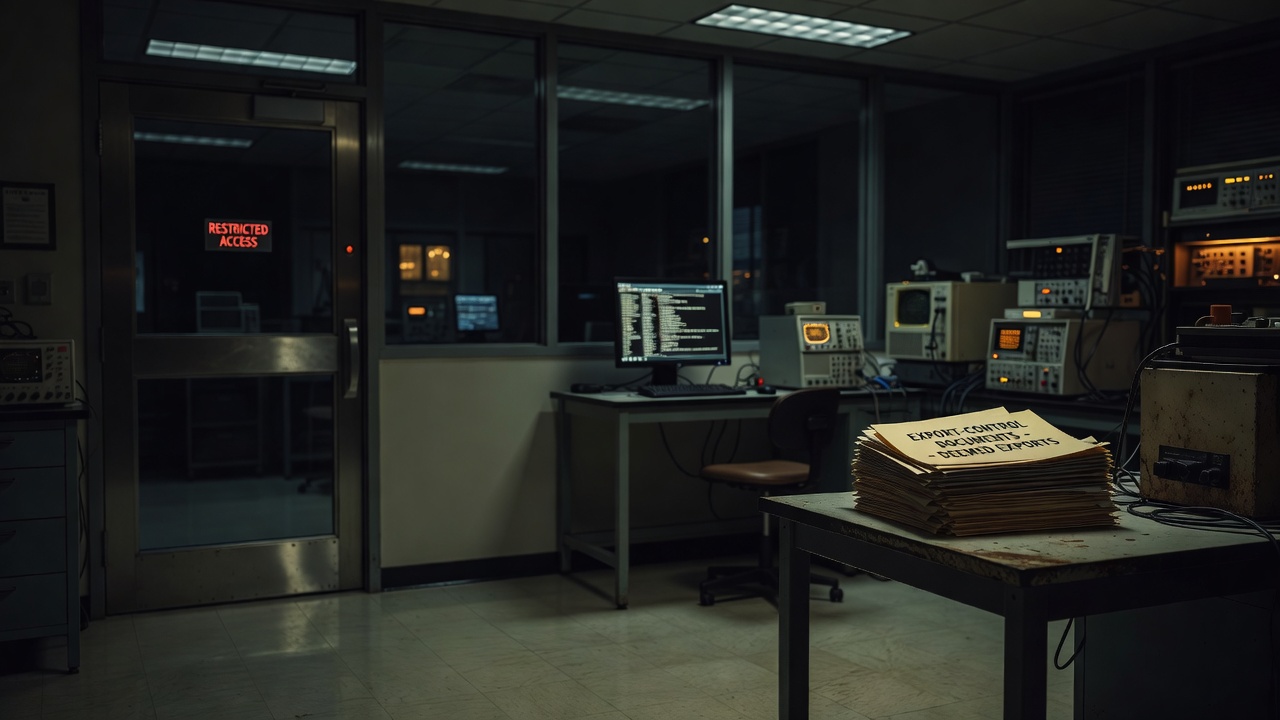
Just after midnight, the lab still hums. Cryogenic pumps breathe through the walls. A graduate student badges through one door, a visiting scholar opens a shared folder, and a principal investigator starts a screen share that lasts less than ten minutes. Nothing crosses a border. No crate leaves a loading dock. But under U.S. export-control law, that quiet moment can still count as an export. That is the tension sitting inside modern university research: the campus as an engine of open discovery, and the campus as a place where a conversation, a schematic, or a source-code walkthrough can suddenly look like a national-security event.
The Case For
The rule is real, and universities sit right in its path
The Bureau of Industry and Security does not hide what a deemed export is. On its deemed exports guidance page, BIS says the term refers to releasing controlled technology or source code to a foreign person within the United States. The regulatory text is even blunter. Under 15 CFR 734.13, releasing technology or source code to a foreign person in the United States is a deemed export, and the release is treated as an export to that person’s most recent country of citizenship or permanent residency. In other words, the border can move into the lab itself.
That matters because universities are exactly the kind of institutions BIS identifies in this space. Its public guidance says deemed-export licensing often touches universities, high-technology research institutions, and the medical and computer sectors. In a 2022 speech to college and university attorneys, Assistant Secretary Matthew Axelrod warned that sensitive research can now be exported with the click of a button and said proprietary research, not ordinary open scholarship, is where export-enforcement concern sharpens. That was the government describing the pressure point in public.
Open campuses still contain closed compartments
The unnerving part is not simply that the rules exist. It is how ordinary the trigger points can sound. A controlled design file in a restricted repository. A lab demonstration that reveals non-public operating parameters. Hands-on training with controlled equipment. A source-code review that goes beyond what has been published. Once a project contains controlled technology rather than just general academic knowledge, access starts to matter. Universities can suddenly find themselves sorting not only grants and experiments, but citizenship, permanent-residency status, sponsor restrictions, and whether a researcher is seeing research results or controlled inputs.
That is where this story starts to connect with the wider export-control cluster on the site. The last deep dive on intangible technology transfer as an invisible export net showed how email, cloud access, and remote support became part of the enforcement picture. In academic settings, the same logic becomes more intimate. The practical question is no longer whether a machine ships overseas. It is whether a lab notebook, workflow, or repository access right turns a campus into a checkpoint. Even a quick pass through the Government Secrets archive shows how often modern secrecy migrates from compounds and black sites into policy, paperwork, and silent compliance systems.
BIS guidance for chemical and biological licensing makes the point concrete. Its application instructions ask for the form in which technology will be released, the address where it will be released, the technical assistance to be given, and identifying documents for the foreign individual when a deemed-export license is required. The state is not just regulating shipments. It is mapping where knowledge changes hands and who is in the room when it happens.
The Realist’s Eye
Most university research is not trapped in this net
Now the cooling water on the theory. The strongest counterargument is that the campus is not secretly being converted into a closed national-security zone. BIS itself says the fundamental research rule in 15 CFR 734.8 keeps technology or software arising from research outside the EAR when it is intended to be published and shared broadly. Axelrod’s 2022 remarks made the same point in plain language: the vast majority of technology released in academic settings is not subject to the EAR because it is classroom instruction or tied to fundamental research. That is a major limiting principle, and it matters.
So the darker version of the story can go too far if it implies that every international student, every lab tour, or every cross-border collaboration is a latent violation. Most are not. The law does not treat being foreign as suspicious by itself. It treats access to certain controlled technology as regulated. Plenty of university work remains openly publishable, globally collaborative, and legally routine. In that sense, the system is narrower than the mood around it.
The real conflict is in the gray zone between openness and control
Still, the realist objection does not make the tension disappear. The hard cases live in the seam between open and proprietary research, between published results and controlled preexisting inputs, between general instruction and technical release. A campus can honestly say it defends open science while also running labs where foreign-national access must be screened and repository permissions curated with legal consequences in mind. That is not cinematic paranoia. It is administrative reality.
The other weak point in the official reassurance is visibility. The public can read the rules, but it rarely sees how often universities change access or workflows because of deemed-export concerns. We see the legal architecture. We do not always see the compliance decisions underneath it. That is why the subject keeps its conspiracy charge even when the documents are public. The mechanisms are visible. Their effects are not.
What We Know For Certain
- BIS publicly defines a deemed export as releasing controlled technology or source code to a foreign person inside the United States.
- 15 CFR 734.13 says such a release is treated as an export to the person’s most recent country of citizenship or permanent residency.
- 15 CFR 734.8 says research output intended to be published and shared broadly as fundamental research is not subject to the EAR.
- BIS says deemed-export licensing commonly affects universities and other research institutions.
- In 2022, BIS publicly warned universities that sensitive research can be exported digitally and urged stronger academic compliance programs.
The Unanswered Questions
- How often do universities quietly restructure lab access because a project drifts outside the fundamental-research safe zone?
- How many campus collaborations die early because no one wants to navigate a possible deemed-export license?
- When cloud repositories and remote lab tools are central to research, where does ordinary collaboration end and controlled release begin?
- Will emerging fields like quantum and advanced biotech push more university work into restricted-access compartments?
The Closer — You Decide
The old image of state secrecy is a locked archive and a guard. The newer version may be a compliance office, a permissions matrix, and a quiet decision about who can sit at which bench. Maybe that is sensible in a world of dual-use technology and strategic rivalry. Maybe it is the price of keeping genuinely dangerous knowledge from moving too freely. Or maybe it shows how the modern border has slipped into the bloodstream of institutions built to share ideas. The rules are real. The carve-outs are real. The tension is real too. The evidence is on the table. You decide.