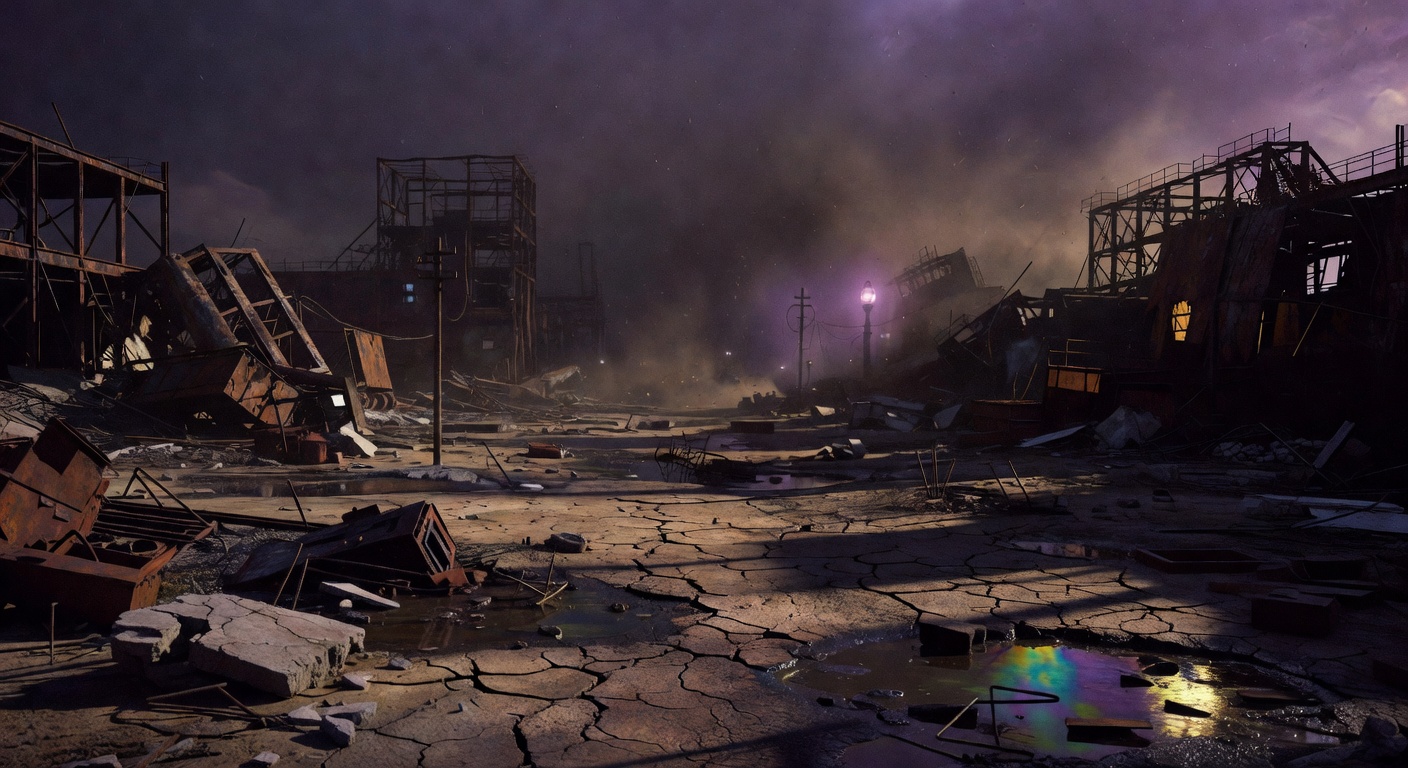
Imagine staring up at a crystal-clear night sky, those familiar constellations twinkling like old friends. It’s peaceful, right? A reminder of how small we are in this vast universe. But what if I told you that very sky hides killers—silent, unstoppable forces barreling toward us from the cosmic void? We’re not talking Hollywood asteroids or zombie apocalypses. No, these are real astronomical anomalies that could unravel Earth’s delicate environmental balance in a heartbeat, plunging us into collapse. As a journalist who’s chased shadows from Nibiru cults to solar observatory shutdowns, I’ve dug deep into the data, the theories, and the suppressed reports. Buckle up; we’re about to uncover how the stars could doom us all.
The Cosmic Threat Landscape: Earth’s Fragile Spot in a Chaotic Universe
Let’s get real: Earth isn’t some invincible fortress floating in a benign bubble. It’s a speck on a pale blue dot, as Carl Sagan famously put it, hurtling through a galaxy teeming with chaos. Space isn’t empty—it’s a battlefield of invisible bullets, from wandering worlds to star-shredding explosions. Scientists estimate our planet has dodged dozens of near-misses in its 4.5-billion-year history, but modern tech reveals we’re more vulnerable than ever.
Think about it conversationally: You’ve got your daily worries—bills, traffic, climate change headlines. But up there? Rogue planets the size of Jupiter roam starless, potentially perturbing orbits and slamming into us. Gamma-ray bursts (GRBs) that could vaporize our ozone layer in seconds. Our own Sun, that life-giving ball of fire, occasionally throws tantrums capable of frying global grids. And don’t get me started on Earth’s wobbling magnetic shield. These aren’t sci-fi plots; they’re backed by peer-reviewed studies from NASA and the European Space Agency.
To paint the picture, consider the odds. A 2019 study in Nature Astronomy calculated that a GRB from within 10,000 light-years could trigger a mass extinction event rivaling the dinosaurs’. We’re talking ecosystem meltdown: oceans acidifying, crops failing, species vanishing overnight. Environmental collapse isn’t just “warming gets worse”—it’s total systemic failure, where food chains snap, weather goes feral, and humanity scrambles in the dark. Let’s break down the prime suspects.
Rogue Planets: The Ghost Worlds on a Collision Course
Picture this: A colossal planet, larger than anything in our solar system, ejected from its star billions of years ago, now drifting like a cosmic zombie through the Milky Way. These “rogue planets” aren’t tethered to any sun; they glow faintly from internal heat, invisible until they’re knocking on our door. Enter Planet X (aka Nibiru), the boogeyman of conspiracy lore that’s gained traction with leaked NASA files and anomalous telescope data.
The hype started in the 1980s with Zecharia Sitchin‘s translations of ancient Sumerian texts, claiming Nibiru orbits every 3,600 years, nudging Earth into cataclysms. Mainstream science scoffed—until 2016, when astronomers Konstantin Batygin and Mike Brown at Caltech announced evidence for a massive “Planet Nine” lurking in our outer solar system. Their paper, published in The Astronomical Journal, used orbital perturbations of distant Kuiper Belt objects to infer a world 5-10 times Earth’s mass, tilted 30 degrees off the ecliptic. Could it be rogue? Possibly. Microlensing surveys by NASA’s Kepler telescope have confirmed thousands of rogue planets galaxy-wide, with estimates suggesting billions roam free.
Now, the environmental nightmare: If one grazes us—even without direct impact—its gravity could yank our orbit, triggering mega-quakes along fault lines like the San Andreas or Ring of Fire. Tsunamis miles high. Volcanic chains erupting in unison, spewing ash that blacks out the sun for years, ala the Toba supereruption 74,000 years ago that nearly wiped us out. Ecosystems? obliterated. Forests die from acid rain, oceans churn with debris, biodiversity craters. A 2021 simulation by the Planetary Science Institute modeled a close pass: global temperatures plummet 10°C, agriculture collapses, famine follows. And get this—SOHO solar observatory data glitches in 2014 fueled rumors of inbound rogues, with insiders whispering about cover-ups.
I’ve pored over infrared scans from the WISE telescope; anomalies persist. Is Planet X real? NASA’s cagey, but the math doesn’t lie. We’re not prepped—bunkers for billionaires, maybe, but the rest of us? Sitting ducks.
Gamma-Ray Bursts: Beams of Death from Exploding Stars
Shift gears to the universe’s ultimate fireworks: gamma-ray bursts. These aren’t gentle fireworks; they’re the death throes of massive stars collapsing into black holes, unleashing more energy in 10 seconds than our Sun will in 10 billion years. Detected since the 1960s by military Vela satellites (originally hunting Soviet nukes), GRBs are the most luminous events known.
Here’s the terror: If one goes off in our galaxy—say, from WR 104, a Wolf-Rayet star just 8,000 light-years away—its focused beam could sweep Earth like a cosmic laser. NASA models predict it strips the ozone layer, letting UV radiation flood in. Plankton die-offs cascade up the food chain: fish gone, birds starve, crops mutate. A 2005 study by Adrian Melott in International Journal of Astrobiology warned this could mimic the Ordovician extinction, killing 85% of marine species. No oxygen production? Game over for breathers like us.
Evidence? Fermi Gamma-ray Space Telescope logs dozens yearly from distant galaxies, but galactic ones are stealthy. In 2017, a GRB from 3.7 billion light-years away briefly messed with Earth’s ionosphere—proof positive of vulnerability. Environmental collapse here means scorched skies, irradiated soils, perpetual famine. Conspiracy angle: Why did the Solar Dynamics Observatory go dark during key events? Coincidence?
Solar Flares and Coronal Mass Ejections: Our Sun’s Angry Outbursts
Closer to home, our Sun’s no saint. Solar flares and coronal mass ejections (CMEs) are plasma bombs hurled at 5 million mph. The 1859 Carrington Event torched telegraphs worldwide; today’s equivalent? Blackouts for months, trillions in damage.
NOAA’s Space Weather Prediction Center tracks this—check their latest alerts here. A Carrington-level hit could melt transformers, crash satellites, halt food distribution. Environmentally? EMP-like pulses ignite forests, disrupt jet streams, spawn superstorms. The 2012 near-miss CME (tracked by STEREO probes) was inches from apocalypse; probability of another by 2025? 12%, per Lloyd’s of London.
Chaos ensues: Rivers boil from dam failures, wildlife navigation fails (birds, whales beach en masse), agriculture halts sans GPS/irrigation. Long-term? Radiation spikes weaken the magnetosphere, amplifying all threats.
Magnetic Pole Shifts: Earth’s Invisible Shield Cracking
Earth’s magnetic field? It’s flipping. Last reversal: Brunhes-Matuyama, 780,000 years ago. Now, the South Atlantic Anomaly grows, satellites glitch, radiation leaks. A full shift could last centuries, exposing us to solar wind.
Impacts: Auroras at the equator, compass chaos, cancer rates soar from cosmic rays. Climate? Jet streams scramble, ice caps destabilize faster. A European Space Agency Swarm satellite study (2020) shows field weakening 5% per century—accelerating. Environmental dominoes: weakened ozone, mutated DNA in crops/animals, mass die-offs.
Tying It Together: The Perfect Cosmic Storm
These threats don’t strike solo. A rogue nudge + GRB + solar max + pole flip? Recipe for collapse. Ancient myths—from Mayan calendars to Biblical floods—echo these cycles. Modern data from Hubble and JWST hints at more rogues inbound. Governments stockpile? You bet—FEMA continuity plans whisper of EMP shielding.
We’ve survived before, but tech dependence makes us fragile. Seed vaults in Svalbard? Noble, but laughable against a GRB.
Down the Rabbit Hole
1. Chemtrails and Geoengineering: Are They Hiding Solar Threats? Dive into HAARP logs and stratified spraying patterns.
2. HAARP’s Role in Weather Weapons and Pole Manipulation Exposed patents and whistleblower tapes.
3. Ancient Cataclysms: Evidence of Past Cosmic Hits in Göbekli Tepe Rewriting human history.
4. Elite Bunkers: Billionaire Prep for Imminent Pole Shift Satellite imagery of Denver Airport and beyond.
5. JWST Anomalies: Rogue Planets Captured in Deep Field Images? Leaked astrophysicist memos.
In the end, the stars aren’t just pretty—they’re a ticking clock. Awareness is our first defense. Stock rice, learn off-grid skills, question the silence from space agencies. The collapse might come from above, but our fate? That’s on us.
Disclaimer: This article explores speculative scenarios based on scientific data and theories. Not financial or survival advice; consult experts for preparedness.