Menu

The Glomar Conspiracy: How “Neither Confirm Nor Deny” Became the Government’s Most Elegant Cover Story

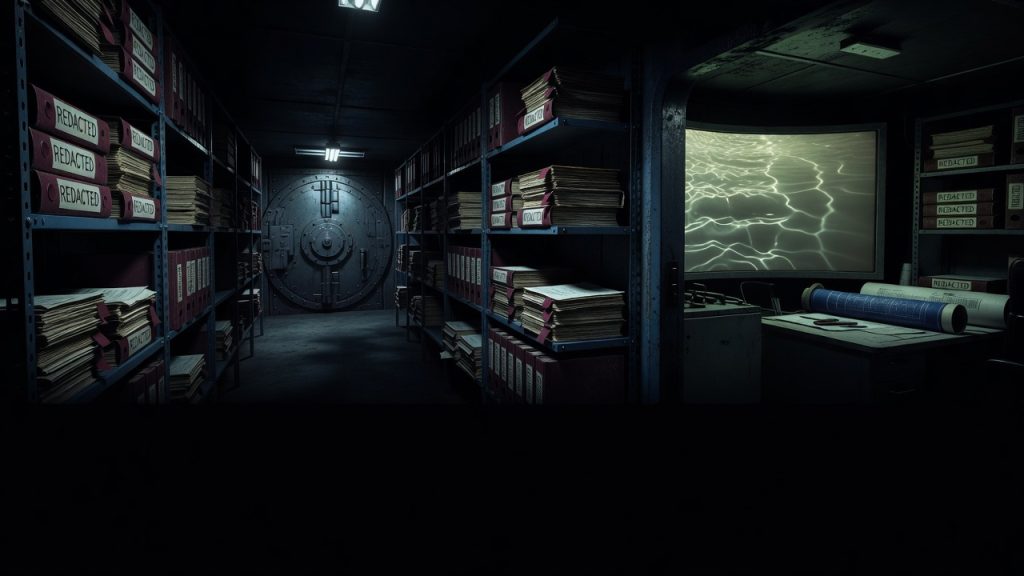
Dark faceless government records corridor with redacted dossiers, maroon evidence tabs, and shadowy intelligence-room lighting symbolizing the Glomar conspiracy — ConspiracyRealist.com

The Glomar Conspiracy: How “Neither Confirm Nor Deny” Became the Government’s Most Elegant Cover Story

A steel door closes. A clerk slides a letter across the table. No admission. No denial. Just a sentence so cold it feels engineered in a bunker: we can neither confirm nor deny. In that instant, the conspiracy is no longer about one hidden file. It is about a state that learned the cleanest way to hide the truth is to erase the public’s ability to prove the truth exists at all.

The Case For

This conspiracy theory says Glomar is not just a legal response. It is a governing technique.

The Glomar conspiracy begins with a simple but unnerving idea: the modern secrecy state discovered that outright lying is messy, denials can later collapse, and silence invites speculation. But a carefully engineered phrase — neither confirm nor deny — does something more powerful. It blocks the requester before the factual fight even starts. Instead of arguing over what a document says, the government can argue over whether the public is allowed to know the document exists.

That move is not folklore. The National Archives’ OGIS explainer on NCND/Glomar says that ordinary FOIA processing usually confirms records exist, but a Glomar response protects the fact of a record’s existence from disclosure. OGIS quotes Executive Order 13526, section 3.6(a): an agency may refuse to confirm or deny the existence or nonexistence of requested records whenever that fact is itself classified. That is the pivot point where many conspiracy realists stop seeing Glomar as a narrow procedural tool and start seeing it as a strategic shield. If the existence of records can be hidden, then evidence can be fenced off before the normal transparency machinery ever gets moving.

The origin story only deepens that suspicion. The National Archives’ FOIA Ombuds history of Glomar traces the term to the CIA and the Hughes Glomar Explorer, the cover vessel used in the covert effort to recover the sunken Soviet submarine K-129. The CIA’s own Project AZORIAN exhibit says the Agency used Howard Hughes and a deep-sea mining cover story to conceal a six-year operation to recover a Soviet submarine from roughly 16,500 feet below the Pacific. When journalists came asking questions after the story leaked, the CIA did not simply deny involvement. It used the formula that became Glomar. In other words, the most famous phrase in secrecy law was born not from openness, but from the need to protect one of the Cold War’s most elaborate cover stories.

The pattern became bigger than one submarine mission — it matured into a reusable architecture of controlled ambiguity

That is why the high-level conspiracy arc matters more than the original ship. The theory is not that every Glomar response hides a submarine, a black site, or an assassination file. The theory is that the state found a reusable method for preserving ambiguity where ambiguity itself protects power. OGIS notes that Glomar now appears not just in national security cases but in personal privacy and law-enforcement contexts as well. Once a secrecy tactic becomes portable across agencies and subject areas, it stops looking like an exotic exception and starts looking like institutional doctrine.

Even official reformers appear uneasy with how normalized the doctrine has become. The FOIA Advisory Committee recommendations from the 2020-2022 term called for agencies to use the plainer phrase “Neither Confirm Nor Deny,” to report annually on usage, to explain the practice on their websites, and to study it more closely. Those are not the recommendations you issue about a vanishingly rare tool. Those are the recommendations you issue when a secrecy device has become consequential enough that even the openness bureaucracy wants better visibility into how often it is being deployed.

The numbers reinforce that sense of spread. The Department of Justice’s 2026 Chief FOIA Officer Report says components that tracked the practice reported 474 Glomar responses during the reporting period, while 26 of DOJ’s 32 components either did not track Glomar use or reported issuing none. For a conspiracy realist, that statistic cuts both ways. It shows the tactic is active. It also shows the public still sees only part of the map, because many components either lack tracking or cannot cleanly surface the data. A secrecy tool that can be used across the federal system while remaining only partially measured is exactly the sort of thing that fuels bigger suspicions.

The Realist’s Eye

The hard evidence supports a secrecy mechanism with real power, even if it does not prove a master plot behind every use

A sober reading has to separate the dramatic framing from the documented record. Glomar is real. Its legal basis is real. Its history in Cold War concealment is real. Its spread into modern FOIA practice is real. But those facts alone do not prove that every agency is cynically abusing it to bury scandal. There are circumstances in which even confirming a record exists could expose an intelligence source, reveal a covert relationship, or effectively disclose a classified operation by implication.

Still, official materials show why critics think the system tilts toward opacity. OGIS explains that Glomar protects existence itself, not just contents. That matters because it changes the terrain of oversight. If a requester cannot cross the threshold question of whether records exist, then appeals, litigation, and public debate all begin from a position of engineered uncertainty. The government gets to preserve the possibility space. The public gets to fight shadows.

The court record shows how durable that ambiguity can be. In Connell v. CIA, summarized by DOJ in 2024, the D.C. Circuit held that a Senate report was not an official CIA acknowledgment and that the CIA’s limited production of some already public documents did not waive Glomar for other records. DOJ’s summary quotes the court saying the rule is strict: a statement must be official and attributable to the agency itself. That is a profound asymmetry. Congress can talk. Leaks can circulate. Newspapers can assemble the puzzle. But unless the right official source says the right thing at the right level of specificity, the agency may preserve deniability anyway.

And yet the wall is not absolute. In ACLU v. CIA, DOJ summarizes the D.C. Circuit saying that given official acknowledgments that the United States had participated in drone strikes, it was neither logical nor plausible for the CIA to maintain that confirming an intelligence interest would reveal something not already public. That case is crucial because it shows Glomar is not invincible. But it also reveals the deeper conspiracy concern: the state can manage the boundary for years, then concede only when its own senior officials have already made the fiction unsustainable.

The strongest conspiracy reading is not that Glomar always hides a lie. It is that it institutionalizes delay, fog, and narrative control.

Viewed that way, Glomar fits the broader patterns we have tracked in the classification conspiracy, the Project Azorian file, and the wider government secrets archive. The common thread is not merely secrecy. It is managed revelation. Information is not always hidden forever. Sometimes it is compartmented, contested, reframed, or released only after the pressure point has passed. In that ecosystem, Glomar becomes the sleekest instrument of all because it prevents adversaries, journalists, watchdogs, and citizens from even pinning down the existence of the evidence they want to test.

This is where the conspiracy frame becomes bigger than legal doctrine. A state that can neither confirm nor deny can preserve maximum maneuverability. If the allegation is false, it does not have to dignify it. If the allegation is true, it does not have to validate it. If the allegation becomes politically useful later, disclosure can be narrowed, delayed, or selectively acknowledged under controlled conditions. That is not proof of omnipotent conspiracy. But it is a serious theory of how bureaucratic power protects itself in the age of formal transparency.

What We Know For Certain

  • The National Archives’ OGIS says a NCND/Glomar response protects the fact of a record’s existence from disclosure, unlike ordinary FOIA withholdings that protect record contents.
  • Executive Order 13526 section 3.6(a), cited by OGIS, allows agencies to refuse to confirm or deny records when the fact of their existence or nonexistence is itself classified.
  • The National Archives’ FOIA Ombuds says the term “Glomar” came from the CIA’s response to a 1975 FOIA request about the Hughes Glomar Explorer.
  • The CIA’s Project AZORIAN exhibit says the Agency used the Hughes Glomar Explorer under a deep-sea mining cover story in a secret effort to recover the sunken Soviet submarine K-129.
  • The FOIA Advisory Committee recommended that agencies track, report, explain, and further study Neither Confirm Nor Deny/Glomar responses.
  • DOJ’s 2026 Chief FOIA Officer Report says components that tracked usage reported 474 Glomar responses during the reporting period, while 26 of 32 DOJ components either did not track Glomar use or reported issuing none.
  • DOJ’s summaries of Connell v. CIA and ACLU v. CIA show that courts can both uphold and pierce Glomar depending on whether official acknowledgment is specific enough and attributable to the proper source.

The Unanswered Questions

  • How often is Glomar being used across the whole federal government in ways the public still cannot quantify because agencies do not track it cleanly?
  • How many major stories remain suspended in permanent ambiguity because the existence of key records can be hidden before substantive review begins?
  • Has Glomar drifted from an extraordinary national security response into a routine administrative reflex for reputationally sensitive matters?
  • When agencies selectively acknowledge parts of a story but preserve deniability around the most damaging specifics, is that national security — or narrative management?
  • If formal transparency laws can be neutralized at the threshold question of existence, what kind of democratic oversight is left in practice?

Why This Conspiracy Persists

The Glomar conspiracy endures because it is psychologically perfect. It turns uncertainty into official policy. It invites the public to suspect the worst while giving the state a technically lawful language of non-commitment. And unlike a smoking gun memo, it scales. The same formula that protected a Cold War submarine recovery story can be repurposed for covert programs, intelligence relationships, law-enforcement files, or politically radioactive subjects where acknowledging records would instantly change the stakes.

It also persists because the modern transparency system keeps validating fragments of the critique. Reform bodies have asked for better tracking. Courts repeatedly litigate the boundary of official acknowledgment. Agencies still rely on a phrase born from one of the most famous cover stories in intelligence history. That does not prove every suspicion is true. It does prove the suspicion has a rational habitat.

In a healthier transparency culture, extraordinary denials would be genuinely rare, centrally measured, and publicly explainable in aggregate. Instead, the public is often told only that the tool exists, that it is lawful, and that in many cases even discussing its use too specifically would undercut its purpose. That circularity is exactly why conspiracy framing sticks. The system asks citizens to trust a silence that was designed to resist verification.

The Closer — You Decide

Maybe Glomar is simply the least bad answer to a hard problem: some records are so sensitive that even confirming their existence would cause real damage. But maybe that explanation is also what made the formula so durable. The beauty of Glomar, from the state’s perspective, is that it hides more than facts. It hides the map to the facts. It converts transparency law into a threshold maze, replaces proof with ambiguity, and lets official secrecy survive even in an era built on requests, appeals, and supposed oversight. The phrase was born in the shadow of a secret CIA recovery mission. Half a century later, it still whispers the same message to the public: the file may exist, the truth may be knowable, but you are not allowed to know whether you are even close. Elegant legal safeguard or perfected cover story? You decide.

dive down the rabbit hole

The Glomar Conspiracy: How “Neither Confirm Nor Deny” Became the Government’s Most Elegant Cover Story

S-FX.com
Dark faceless government records corridor with redacted dossiers, maroon evidence tabs, and shadowy intelligence-room lighting symbolizing the Glomar conspiracy — ConspiracyRealist.com

The Glomar Conspiracy: How “Neither Confirm Nor Deny” Became the Government’s Most Elegant Cover Story

A steel door closes. A clerk slides a letter across the table. No admission. No denial. Just a sentence so cold it feels engineered in a bunker: we can neither confirm nor deny. In that instant, the conspiracy is no longer about one hidden file. It is about a state that learned the cleanest way to hide the truth is to erase the public’s ability to prove the truth exists at all.

The Case For

This conspiracy theory says Glomar is not just a legal response. It is a governing technique.

The Glomar conspiracy begins with a simple but unnerving idea: the modern secrecy state discovered that outright lying is messy, denials can later collapse, and silence invites speculation. But a carefully engineered phrase — neither confirm nor deny — does something more powerful. It blocks the requester before the factual fight even starts. Instead of arguing over what a document says, the government can argue over whether the public is allowed to know the document exists.

That move is not folklore. The National Archives’ OGIS explainer on NCND/Glomar says that ordinary FOIA processing usually confirms records exist, but a Glomar response protects the fact of a record’s existence from disclosure. OGIS quotes Executive Order 13526, section 3.6(a): an agency may refuse to confirm or deny the existence or nonexistence of requested records whenever that fact is itself classified. That is the pivot point where many conspiracy realists stop seeing Glomar as a narrow procedural tool and start seeing it as a strategic shield. If the existence of records can be hidden, then evidence can be fenced off before the normal transparency machinery ever gets moving.

The origin story only deepens that suspicion. The National Archives’ FOIA Ombuds history of Glomar traces the term to the CIA and the Hughes Glomar Explorer, the cover vessel used in the covert effort to recover the sunken Soviet submarine K-129. The CIA’s own Project AZORIAN exhibit says the Agency used Howard Hughes and a deep-sea mining cover story to conceal a six-year operation to recover a Soviet submarine from roughly 16,500 feet below the Pacific. When journalists came asking questions after the story leaked, the CIA did not simply deny involvement. It used the formula that became Glomar. In other words, the most famous phrase in secrecy law was born not from openness, but from the need to protect one of the Cold War’s most elaborate cover stories.

The pattern became bigger than one submarine mission — it matured into a reusable architecture of controlled ambiguity

That is why the high-level conspiracy arc matters more than the original ship. The theory is not that every Glomar response hides a submarine, a black site, or an assassination file. The theory is that the state found a reusable method for preserving ambiguity where ambiguity itself protects power. OGIS notes that Glomar now appears not just in national security cases but in personal privacy and law-enforcement contexts as well. Once a secrecy tactic becomes portable across agencies and subject areas, it stops looking like an exotic exception and starts looking like institutional doctrine.

Even official reformers appear uneasy with how normalized the doctrine has become. The FOIA Advisory Committee recommendations from the 2020-2022 term called for agencies to use the plainer phrase “Neither Confirm Nor Deny,” to report annually on usage, to explain the practice on their websites, and to study it more closely. Those are not the recommendations you issue about a vanishingly rare tool. Those are the recommendations you issue when a secrecy device has become consequential enough that even the openness bureaucracy wants better visibility into how often it is being deployed.

The numbers reinforce that sense of spread. The Department of Justice’s 2026 Chief FOIA Officer Report says components that tracked the practice reported 474 Glomar responses during the reporting period, while 26 of DOJ’s 32 components either did not track Glomar use or reported issuing none. For a conspiracy realist, that statistic cuts both ways. It shows the tactic is active. It also shows the public still sees only part of the map, because many components either lack tracking or cannot cleanly surface the data. A secrecy tool that can be used across the federal system while remaining only partially measured is exactly the sort of thing that fuels bigger suspicions.

The Realist’s Eye

The hard evidence supports a secrecy mechanism with real power, even if it does not prove a master plot behind every use

A sober reading has to separate the dramatic framing from the documented record. Glomar is real. Its legal basis is real. Its history in Cold War concealment is real. Its spread into modern FOIA practice is real. But those facts alone do not prove that every agency is cynically abusing it to bury scandal. There are circumstances in which even confirming a record exists could expose an intelligence source, reveal a covert relationship, or effectively disclose a classified operation by implication.

Still, official materials show why critics think the system tilts toward opacity. OGIS explains that Glomar protects existence itself, not just contents. That matters because it changes the terrain of oversight. If a requester cannot cross the threshold question of whether records exist, then appeals, litigation, and public debate all begin from a position of engineered uncertainty. The government gets to preserve the possibility space. The public gets to fight shadows.

The court record shows how durable that ambiguity can be. In Connell v. CIA, summarized by DOJ in 2024, the D.C. Circuit held that a Senate report was not an official CIA acknowledgment and that the CIA’s limited production of some already public documents did not waive Glomar for other records. DOJ’s summary quotes the court saying the rule is strict: a statement must be official and attributable to the agency itself. That is a profound asymmetry. Congress can talk. Leaks can circulate. Newspapers can assemble the puzzle. But unless the right official source says the right thing at the right level of specificity, the agency may preserve deniability anyway.

And yet the wall is not absolute. In ACLU v. CIA, DOJ summarizes the D.C. Circuit saying that given official acknowledgments that the United States had participated in drone strikes, it was neither logical nor plausible for the CIA to maintain that confirming an intelligence interest would reveal something not already public. That case is crucial because it shows Glomar is not invincible. But it also reveals the deeper conspiracy concern: the state can manage the boundary for years, then concede only when its own senior officials have already made the fiction unsustainable.

The strongest conspiracy reading is not that Glomar always hides a lie. It is that it institutionalizes delay, fog, and narrative control.

Viewed that way, Glomar fits the broader patterns we have tracked in the classification conspiracy, the Project Azorian file, and the wider government secrets archive. The common thread is not merely secrecy. It is managed revelation. Information is not always hidden forever. Sometimes it is compartmented, contested, reframed, or released only after the pressure point has passed. In that ecosystem, Glomar becomes the sleekest instrument of all because it prevents adversaries, journalists, watchdogs, and citizens from even pinning down the existence of the evidence they want to test.

This is where the conspiracy frame becomes bigger than legal doctrine. A state that can neither confirm nor deny can preserve maximum maneuverability. If the allegation is false, it does not have to dignify it. If the allegation is true, it does not have to validate it. If the allegation becomes politically useful later, disclosure can be narrowed, delayed, or selectively acknowledged under controlled conditions. That is not proof of omnipotent conspiracy. But it is a serious theory of how bureaucratic power protects itself in the age of formal transparency.

What We Know For Certain

  • The National Archives’ OGIS says a NCND/Glomar response protects the fact of a record’s existence from disclosure, unlike ordinary FOIA withholdings that protect record contents.
  • Executive Order 13526 section 3.6(a), cited by OGIS, allows agencies to refuse to confirm or deny records when the fact of their existence or nonexistence is itself classified.
  • The National Archives’ FOIA Ombuds says the term “Glomar” came from the CIA’s response to a 1975 FOIA request about the Hughes Glomar Explorer.
  • The CIA’s Project AZORIAN exhibit says the Agency used the Hughes Glomar Explorer under a deep-sea mining cover story in a secret effort to recover the sunken Soviet submarine K-129.
  • The FOIA Advisory Committee recommended that agencies track, report, explain, and further study Neither Confirm Nor Deny/Glomar responses.
  • DOJ’s 2026 Chief FOIA Officer Report says components that tracked usage reported 474 Glomar responses during the reporting period, while 26 of 32 DOJ components either did not track Glomar use or reported issuing none.
  • DOJ’s summaries of Connell v. CIA and ACLU v. CIA show that courts can both uphold and pierce Glomar depending on whether official acknowledgment is specific enough and attributable to the proper source.

The Unanswered Questions

  • How often is Glomar being used across the whole federal government in ways the public still cannot quantify because agencies do not track it cleanly?
  • How many major stories remain suspended in permanent ambiguity because the existence of key records can be hidden before substantive review begins?
  • Has Glomar drifted from an extraordinary national security response into a routine administrative reflex for reputationally sensitive matters?
  • When agencies selectively acknowledge parts of a story but preserve deniability around the most damaging specifics, is that national security — or narrative management?
  • If formal transparency laws can be neutralized at the threshold question of existence, what kind of democratic oversight is left in practice?

Why This Conspiracy Persists

The Glomar conspiracy endures because it is psychologically perfect. It turns uncertainty into official policy. It invites the public to suspect the worst while giving the state a technically lawful language of non-commitment. And unlike a smoking gun memo, it scales. The same formula that protected a Cold War submarine recovery story can be repurposed for covert programs, intelligence relationships, law-enforcement files, or politically radioactive subjects where acknowledging records would instantly change the stakes.

It also persists because the modern transparency system keeps validating fragments of the critique. Reform bodies have asked for better tracking. Courts repeatedly litigate the boundary of official acknowledgment. Agencies still rely on a phrase born from one of the most famous cover stories in intelligence history. That does not prove every suspicion is true. It does prove the suspicion has a rational habitat.

In a healthier transparency culture, extraordinary denials would be genuinely rare, centrally measured, and publicly explainable in aggregate. Instead, the public is often told only that the tool exists, that it is lawful, and that in many cases even discussing its use too specifically would undercut its purpose. That circularity is exactly why conspiracy framing sticks. The system asks citizens to trust a silence that was designed to resist verification.

The Closer — You Decide

Maybe Glomar is simply the least bad answer to a hard problem: some records are so sensitive that even confirming their existence would cause real damage. But maybe that explanation is also what made the formula so durable. The beauty of Glomar, from the state’s perspective, is that it hides more than facts. It hides the map to the facts. It converts transparency law into a threshold maze, replaces proof with ambiguity, and lets official secrecy survive even in an era built on requests, appeals, and supposed oversight. The phrase was born in the shadow of a secret CIA recovery mission. Half a century later, it still whispers the same message to the public: the file may exist, the truth may be knowable, but you are not allowed to know whether you are even close. Elegant legal safeguard or perfected cover story? You decide.

The Glomar Conspiracy: How “Neither Confirm Nor Deny” Became the Government’s Most Elegant Cover Story

Dark faceless government records corridor with redacted dossiers, maroon evidence tabs, and shadowy intelligence-room lighting symbolizing the Glomar conspiracy — ConspiracyRealist.com

The Glomar Conspiracy: How “Neither Confirm Nor Deny” Became the Government’s Most Elegant Cover Story

A steel door closes. A clerk slides a letter across the table. No admission. No denial. Just a sentence so cold it feels engineered in a bunker: we can neither confirm nor deny. In that instant, the conspiracy is no longer about one hidden file. It is about a state that learned the cleanest way to hide the truth is to erase the public’s ability to prove the truth exists at all.

The Case For

This conspiracy theory says Glomar is not just a legal response. It is a governing technique.

The Glomar conspiracy begins with a simple but unnerving idea: the modern secrecy state discovered that outright lying is messy, denials can later collapse, and silence invites speculation. But a carefully engineered phrase — neither confirm nor deny — does something more powerful. It blocks the requester before the factual fight even starts. Instead of arguing over what a document says, the government can argue over whether the public is allowed to know the document exists.

That move is not folklore. The National Archives’ OGIS explainer on NCND/Glomar says that ordinary FOIA processing usually confirms records exist, but a Glomar response protects the fact of a record’s existence from disclosure. OGIS quotes Executive Order 13526, section 3.6(a): an agency may refuse to confirm or deny the existence or nonexistence of requested records whenever that fact is itself classified. That is the pivot point where many conspiracy realists stop seeing Glomar as a narrow procedural tool and start seeing it as a strategic shield. If the existence of records can be hidden, then evidence can be fenced off before the normal transparency machinery ever gets moving.

The origin story only deepens that suspicion. The National Archives’ FOIA Ombuds history of Glomar traces the term to the CIA and the Hughes Glomar Explorer, the cover vessel used in the covert effort to recover the sunken Soviet submarine K-129. The CIA’s own Project AZORIAN exhibit says the Agency used Howard Hughes and a deep-sea mining cover story to conceal a six-year operation to recover a Soviet submarine from roughly 16,500 feet below the Pacific. When journalists came asking questions after the story leaked, the CIA did not simply deny involvement. It used the formula that became Glomar. In other words, the most famous phrase in secrecy law was born not from openness, but from the need to protect one of the Cold War’s most elaborate cover stories.

The pattern became bigger than one submarine mission — it matured into a reusable architecture of controlled ambiguity

That is why the high-level conspiracy arc matters more than the original ship. The theory is not that every Glomar response hides a submarine, a black site, or an assassination file. The theory is that the state found a reusable method for preserving ambiguity where ambiguity itself protects power. OGIS notes that Glomar now appears not just in national security cases but in personal privacy and law-enforcement contexts as well. Once a secrecy tactic becomes portable across agencies and subject areas, it stops looking like an exotic exception and starts looking like institutional doctrine.

Even official reformers appear uneasy with how normalized the doctrine has become. The FOIA Advisory Committee recommendations from the 2020-2022 term called for agencies to use the plainer phrase “Neither Confirm Nor Deny,” to report annually on usage, to explain the practice on their websites, and to study it more closely. Those are not the recommendations you issue about a vanishingly rare tool. Those are the recommendations you issue when a secrecy device has become consequential enough that even the openness bureaucracy wants better visibility into how often it is being deployed.

The numbers reinforce that sense of spread. The Department of Justice’s 2026 Chief FOIA Officer Report says components that tracked the practice reported 474 Glomar responses during the reporting period, while 26 of DOJ’s 32 components either did not track Glomar use or reported issuing none. For a conspiracy realist, that statistic cuts both ways. It shows the tactic is active. It also shows the public still sees only part of the map, because many components either lack tracking or cannot cleanly surface the data. A secrecy tool that can be used across the federal system while remaining only partially measured is exactly the sort of thing that fuels bigger suspicions.

The Realist’s Eye

The hard evidence supports a secrecy mechanism with real power, even if it does not prove a master plot behind every use

A sober reading has to separate the dramatic framing from the documented record. Glomar is real. Its legal basis is real. Its history in Cold War concealment is real. Its spread into modern FOIA practice is real. But those facts alone do not prove that every agency is cynically abusing it to bury scandal. There are circumstances in which even confirming a record exists could expose an intelligence source, reveal a covert relationship, or effectively disclose a classified operation by implication.

Still, official materials show why critics think the system tilts toward opacity. OGIS explains that Glomar protects existence itself, not just contents. That matters because it changes the terrain of oversight. If a requester cannot cross the threshold question of whether records exist, then appeals, litigation, and public debate all begin from a position of engineered uncertainty. The government gets to preserve the possibility space. The public gets to fight shadows.

The court record shows how durable that ambiguity can be. In Connell v. CIA, summarized by DOJ in 2024, the D.C. Circuit held that a Senate report was not an official CIA acknowledgment and that the CIA’s limited production of some already public documents did not waive Glomar for other records. DOJ’s summary quotes the court saying the rule is strict: a statement must be official and attributable to the agency itself. That is a profound asymmetry. Congress can talk. Leaks can circulate. Newspapers can assemble the puzzle. But unless the right official source says the right thing at the right level of specificity, the agency may preserve deniability anyway.

And yet the wall is not absolute. In ACLU v. CIA, DOJ summarizes the D.C. Circuit saying that given official acknowledgments that the United States had participated in drone strikes, it was neither logical nor plausible for the CIA to maintain that confirming an intelligence interest would reveal something not already public. That case is crucial because it shows Glomar is not invincible. But it also reveals the deeper conspiracy concern: the state can manage the boundary for years, then concede only when its own senior officials have already made the fiction unsustainable.

The strongest conspiracy reading is not that Glomar always hides a lie. It is that it institutionalizes delay, fog, and narrative control.

Viewed that way, Glomar fits the broader patterns we have tracked in the classification conspiracy, the Project Azorian file, and the wider government secrets archive. The common thread is not merely secrecy. It is managed revelation. Information is not always hidden forever. Sometimes it is compartmented, contested, reframed, or released only after the pressure point has passed. In that ecosystem, Glomar becomes the sleekest instrument of all because it prevents adversaries, journalists, watchdogs, and citizens from even pinning down the existence of the evidence they want to test.

This is where the conspiracy frame becomes bigger than legal doctrine. A state that can neither confirm nor deny can preserve maximum maneuverability. If the allegation is false, it does not have to dignify it. If the allegation is true, it does not have to validate it. If the allegation becomes politically useful later, disclosure can be narrowed, delayed, or selectively acknowledged under controlled conditions. That is not proof of omnipotent conspiracy. But it is a serious theory of how bureaucratic power protects itself in the age of formal transparency.

What We Know For Certain

  • The National Archives’ OGIS says a NCND/Glomar response protects the fact of a record’s existence from disclosure, unlike ordinary FOIA withholdings that protect record contents.
  • Executive Order 13526 section 3.6(a), cited by OGIS, allows agencies to refuse to confirm or deny records when the fact of their existence or nonexistence is itself classified.
  • The National Archives’ FOIA Ombuds says the term “Glomar” came from the CIA’s response to a 1975 FOIA request about the Hughes Glomar Explorer.
  • The CIA’s Project AZORIAN exhibit says the Agency used the Hughes Glomar Explorer under a deep-sea mining cover story in a secret effort to recover the sunken Soviet submarine K-129.
  • The FOIA Advisory Committee recommended that agencies track, report, explain, and further study Neither Confirm Nor Deny/Glomar responses.
  • DOJ’s 2026 Chief FOIA Officer Report says components that tracked usage reported 474 Glomar responses during the reporting period, while 26 of 32 DOJ components either did not track Glomar use or reported issuing none.
  • DOJ’s summaries of Connell v. CIA and ACLU v. CIA show that courts can both uphold and pierce Glomar depending on whether official acknowledgment is specific enough and attributable to the proper source.

The Unanswered Questions

  • How often is Glomar being used across the whole federal government in ways the public still cannot quantify because agencies do not track it cleanly?
  • How many major stories remain suspended in permanent ambiguity because the existence of key records can be hidden before substantive review begins?
  • Has Glomar drifted from an extraordinary national security response into a routine administrative reflex for reputationally sensitive matters?
  • When agencies selectively acknowledge parts of a story but preserve deniability around the most damaging specifics, is that national security — or narrative management?
  • If formal transparency laws can be neutralized at the threshold question of existence, what kind of democratic oversight is left in practice?

Why This Conspiracy Persists

The Glomar conspiracy endures because it is psychologically perfect. It turns uncertainty into official policy. It invites the public to suspect the worst while giving the state a technically lawful language of non-commitment. And unlike a smoking gun memo, it scales. The same formula that protected a Cold War submarine recovery story can be repurposed for covert programs, intelligence relationships, law-enforcement files, or politically radioactive subjects where acknowledging records would instantly change the stakes.

It also persists because the modern transparency system keeps validating fragments of the critique. Reform bodies have asked for better tracking. Courts repeatedly litigate the boundary of official acknowledgment. Agencies still rely on a phrase born from one of the most famous cover stories in intelligence history. That does not prove every suspicion is true. It does prove the suspicion has a rational habitat.

In a healthier transparency culture, extraordinary denials would be genuinely rare, centrally measured, and publicly explainable in aggregate. Instead, the public is often told only that the tool exists, that it is lawful, and that in many cases even discussing its use too specifically would undercut its purpose. That circularity is exactly why conspiracy framing sticks. The system asks citizens to trust a silence that was designed to resist verification.

The Closer — You Decide

Maybe Glomar is simply the least bad answer to a hard problem: some records are so sensitive that even confirming their existence would cause real damage. But maybe that explanation is also what made the formula so durable. The beauty of Glomar, from the state’s perspective, is that it hides more than facts. It hides the map to the facts. It converts transparency law into a threshold maze, replaces proof with ambiguity, and lets official secrecy survive even in an era built on requests, appeals, and supposed oversight. The phrase was born in the shadow of a secret CIA recovery mission. Half a century later, it still whispers the same message to the public: the file may exist, the truth may be knowable, but you are not allowed to know whether you are even close. Elegant legal safeguard or perfected cover story? You decide.

Table of contents