The Site That Broke Archaeology
In 1994, a Kurdish shepherd named Şavak Yildiz was walking the rocky hillside of a ridge in southeastern Turkey near the city of Şanlıurfa when he stumbled across something strange poking out of the dirt — a carved limestone slab unlike anything he’d seen before. He reported it to a local museum. German archaeologist Klaus Schmidt showed up, took one look, and reportedly said something to the effect of: “This changes everything.”
He wasn’t exaggerating.
What Schmidt had found — and what he would spend the rest of his life excavating until his death in 2014 — was Göbekli Tepe, a site that has since forced historians, archaeologists, and anthropologists to either completely rewrite their models of early human civilization, or quietly ignore what they’ve found and hope nobody asks too many questions.
We’re going to ask the questions.
The Official Timeline Has a Problem
Before Göbekli Tepe, the standard academic narrative went something like this: Humans spent hundreds of thousands of years as nomadic hunter-gatherers — scraping by, following herds, barely surviving. Then, around 10,000–12,000 years ago, something clicked. We learned to farm. We settled down. We built villages. Villages became towns, towns became cities, cities developed writing, religion, architecture, and eventually — thousands of years later — organized religion and monumental building projects like Stonehenge (circa 3,000 BCE) and the Egyptian pyramids (circa 2,500 BCE).
Simple. Linear. Neat.
Göbekli Tepe is dated to approximately 9,600–8,200 BCE — making it over 11,600 years old. That’s not a rounding error. That’s 6,000 years older than Stonehenge. It predates the invention of the wheel. It predates pottery. It predates writing. It predates agriculture, according to the old timeline.
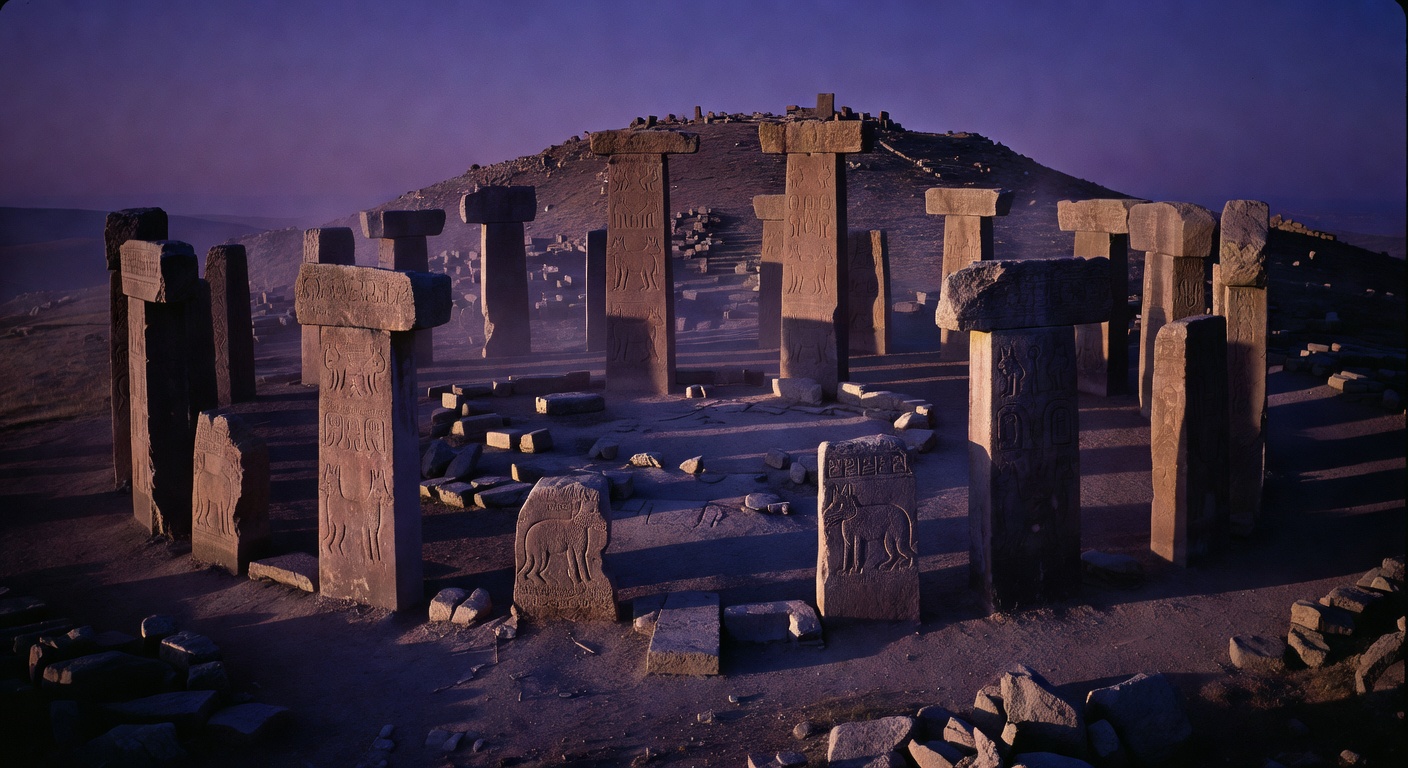
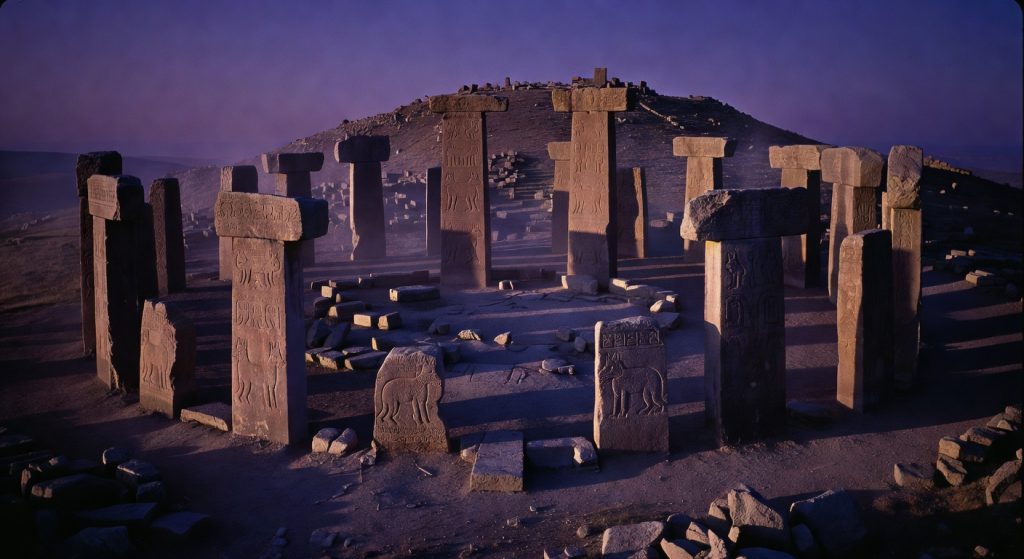
And yet here it is: a massive, intentionally constructed temple complex, with precisely carved T-shaped limestone pillars standing up to 18 feet tall and weighing up to 10 tons each, arranged in circular enclosures, decorated with sophisticated bas-relief carvings of animals — foxes, boars, cranes, vultures, scorpions, lions — and abstract symbols that researchers are still trying to decode.
According to the official story, the people who built this were hunter-gatherers with no agriculture, no permanent settlements, no writing, and no advanced social organization.
Yet they somehow coordinated the labor of hundreds — possibly thousands — of workers. They quarried and transported multi-ton stone blocks. They carved detailed, artistically sophisticated imagery. They built, used, and then deliberately buried the entire complex — layer by layer — over a period of hundreds of years.
Let that last part sink in: They buried it on purpose.
What’s Actually There
To understand why this site is so unsettling to the mainstream narrative, you need to understand the scale and craftsmanship involved.
Göbekli Tepe sits on a limestone ridge that was artificially shaped and flattened. The site covers roughly 22 acres (9 hectares), though only about 5% has been excavated. Researchers estimate there may be up to 20 additional circular enclosures still buried underground, detected via ground-penetrating radar.
The excavated enclosures — labeled A through D — each contain a ring of smaller peripheral pillars surrounding two large central T-pillars. The T-shape itself appears to be intentional: the “head” of the T is widely interpreted as representing a stylized human figure, with arms carved in low relief along the sides of some pillars, hands meeting at the front, and belt-like carvings at the waist. These aren’t random shapes. They look like beings.
The animal carvings are extraordinary in their detail and variety. Different enclosures seem to feature different dominant species — some researchers have proposed this represents different clan totems, seasonal gatherings, or even different cosmological themes. The vulture imagery in particular has drawn intense speculation, as vultures were associated with death, sky burial, and the afterlife in many ancient Near Eastern cultures.
There is also what appears to be a carved human skull — or possibly a stylized face — on at least one pillar, along with what some researchers have interpreted as a hunting bag or purse symbol that recurs across Göbekli Tepe and, strikingly, appears again thousands of years later in Mesopotamian and Mesoamerican iconography. Whether that’s coincidence, convergent symbolism, or evidence of cultural transmission across vast distances and time… nobody has a clean answer.
The Deliberate Burial: Why Would You Do That?
Here’s the detail that keeps serious researchers awake at night: Göbekli Tepe wasn’t abandoned and forgotten. It was deliberately backfilled.
As each enclosure went out of use, it was systematically filled in with flint, animal bones, and soil — preserving it almost perfectly. Then a new enclosure was built nearby. This happened repeatedly over centuries. The oldest, deepest enclosures (Layer III) feature the largest, most sophisticated pillars. The later enclosures (Layer II) are smaller and simpler.
This is the opposite of what we’d expect from a civilization “progressing.” Instead of building bigger and better over time, the craftsmanship seems to decline. Some researchers have suggested this represents the fading of a tradition — a gradual loss of knowledge or purpose — rather than advancement. Others suggest the burial was ritual, a sacred “sealing” of completed ceremonial cycles.
Either way, the intent was preservation — and it worked. Whoever buried Göbekli Tepe may have known, on some level, that they were burying something that shouldn’t be lost entirely.
The “Primitive Hunter-Gatherer” Problem
The academic explanation for Göbekli Tepe requires us to believe that nomadic hunter-gatherers — people with no permanent villages, no agriculture, no writing, and no metals — organized a multi-generational construction and ceremonial project of staggering complexity.
To be fair: mainstream archaeology’s current position, as articulated by researchers like Ian Hodder, Schmidt’s successors at the German Archaeological Institute, and others, is that Göbekli Tepe actually precedes agriculture — and may have helped cause it. The theory: the need to feed large numbers of people gathering at this ceremonial site may have driven the development of organized food production nearby. In other words, religion came before farming, not after.
That’s actually a fascinating and well-supported hypothesis. It inverts the old model. And it’s mainstream — it’s not fringe.
But it raises its own question: where did these people come from?
If nomadic hunter-gatherers spontaneously developed the social organization, astronomical knowledge (some researchers have identified possible astronomical alignments in the enclosure orientations), artistic sophistication, and engineering ability to build Göbekli Tepe — then the “primitive cave man” model of prehistoric humanity needs to be thrown out entirely.
Maybe that’s the real paradigm shift. Maybe our ancestors were never as primitive as we assumed.
The Younger Dryas, the Flood, and the Bigger Picture
Now we enter territory where mainstream archaeology gets nervous and alternative researchers get excited — sometimes for good reason, sometimes not.
Göbekli Tepe was built during and after the Younger Dryas — a catastrophic climate period roughly 12,900–11,700 years ago when Earth was plunged back into near-glacial conditions following a brief warming. Leading research published in peer-reviewed journals, including work by the Younger Dryas Impact Hypothesis research group, suggests this climate event may have been triggered or worsened by a cosmic impact — a comet or asteroid fragmenting over the North American ice sheet, causing massive flooding, fires, and extinctions.
The mammoths die. The megafauna collapse. Human populations crash. And then — right on the other side of this catastrophe — Göbekli Tepe appears.
Graham Hancock, Andrew Collins, and other alternative historians have argued that Göbekli Tepe is a remnant of a pre-catastrophe civilization — a memory in stone built by survivors of something that nearly wiped humanity out. Hancock’s “Magicians of the Gods” (2015) makes this case at length, pointing to flood myths across cultures as potential historical memory of the Younger Dryas catastrophe.
Mainstream archaeology dismisses much of this as speculation. Fair enough — speculation it is. But the timing is real. The catastrophe is real. And the sudden appearance of a sophisticated ceremonial site immediately afterward, in a region that would become the cradle of agriculture and eventually Western civilization, is… striking.
Is it proof of a lost civilization? No. Is it something worth taking seriously? Absolutely.
What We Still Don’t Know
Despite 30+ years of excavation and analysis, Göbekli Tepe still holds more questions than answers:
- No evidence of permanent habitation has been found on site — no hearths, no homes, no trash middens suggesting people lived there. It appears to have been a gathering place, not a settlement.
- No burials have been found — unusual for a site often described as a “temple.” Though human bone fragments have been recovered, no formal burial context has been identified.
- The purpose of the animal carvings remains debated. Are they totemic? Astronomical? Symbolic of specific events or narratives? Ritualistic apotropaic imagery (meant to ward something off)?
- Who organized the labor? Building this required coordination beyond a single family or band. It implies social hierarchy, leadership, and shared purpose — all supposedly hallmarks of civilization that hadn’t been “invented” yet.
- What’s in the unexcavated 95%? Ground-penetrating radar suggests there’s far more buried here. Funding, politics, and the sheer scale of the work have kept most of it underground.
Why This Matters Right Now
Göbekli Tepe isn’t just an interesting archaeological footnote. It’s a crack in the foundation of the story we’ve been told about human origins and the development of civilization.
The official model has always been: progress is linear, civilization is recent, and our distant ancestors were primitive. That model serves a particular worldview — one in which modern industrial society represents the pinnacle of human achievement, and everything before writing and cities was basically barbaric stumbling in the dark.
Göbekli Tepe suggests otherwise. It suggests that humans were capable of sophisticated symbolic thought, organized labor, and monumental construction at least 11,600 years ago — and possibly much earlier, if this site represents the continuation of an even older tradition rather than its beginning.
It doesn’t prove aliens built it. It doesn’t prove Atlantis was real. You don’t need any of that. The reality is strange enough on its own terms: our ancestors were not primitive. They were different from us — living differently, thinking differently, organizing society differently — but not lesser. And the sooner we integrate that into our understanding of history, the better equipped we’ll be to ask the really big questions about who we are and where we came from.
Down the Rabbit Hole
If Göbekli Tepe has you questioning the timeline, here are some threads worth pulling:
- The Sphinx Water Erosion Controversy — Geologist Robert Schoch’s argument that the erosion patterns on the Great Sphinx indicate it was carved thousands of years earlier than officially dated, during a wetter climate period. If correct, it would push sophisticated Egyptian civilization back to at least 7,000–10,000 BCE.
- Çatalhöyük — Another Neolithic site in Turkey (circa 7,500 BCE) with sophisticated art, ritual, and urban-style density. Göbekli Tepe and Çatalhöyük together paint a picture of a prehistoric Anatolian culture far more complex than textbooks acknowledge.
- The Younger Dryas Impact Hypothesis — Peer-reviewed research suggesting a cosmic impact event triggered the Younger Dryas cooling period ~12,900 years ago. Authors include researchers from multiple universities. If this is what happened, the implications for human prehistory are enormous.
- Karahan Tepe — A newly excavated site just 35 miles from Göbekli Tepe, currently being called its “sister site.” Early findings suggest it may be even older and equally sophisticated — with carvings that include what appears to be a realistic human head emerging from the ground. Excavations are ongoing as of 2024.
- The Pillar 43 “Vulture Stone” and the 10,950 BCE date — A 2017 paper by researchers at the University of Edinburgh proposed that the animal carvings on Pillar 43 at Göbekli Tepe may encode an astronomical event — specifically, a comet impact or meteor shower — dating to around 10,950 BCE. This would correlate with the Younger Dryas onset. The paper is peer-reviewed. Make of that what you will.
Disclaimer
This article presents a mix of established archaeological findings and speculative interpretations. The core facts about Göbekli Tepe — its age, construction, and deliberate burial — are well-documented by mainstream archaeology. Interpretations involving lost civilizations, astronomical encoding, or connections to flood mythology are speculative and contested. Readers are encouraged to consult primary sources and peer-reviewed research and to think critically about all claims, including the mainstream consensus. The goal here is to ask better questions, not to sell easy answers.