Menu

Hollow Moon Theory

Hollow Moon Theory
Hollow Moon Theory

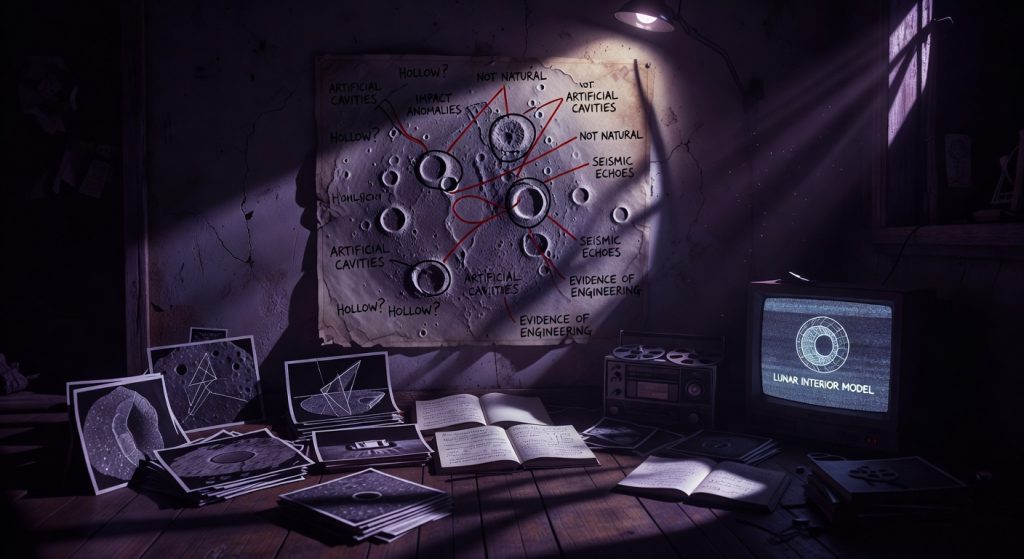
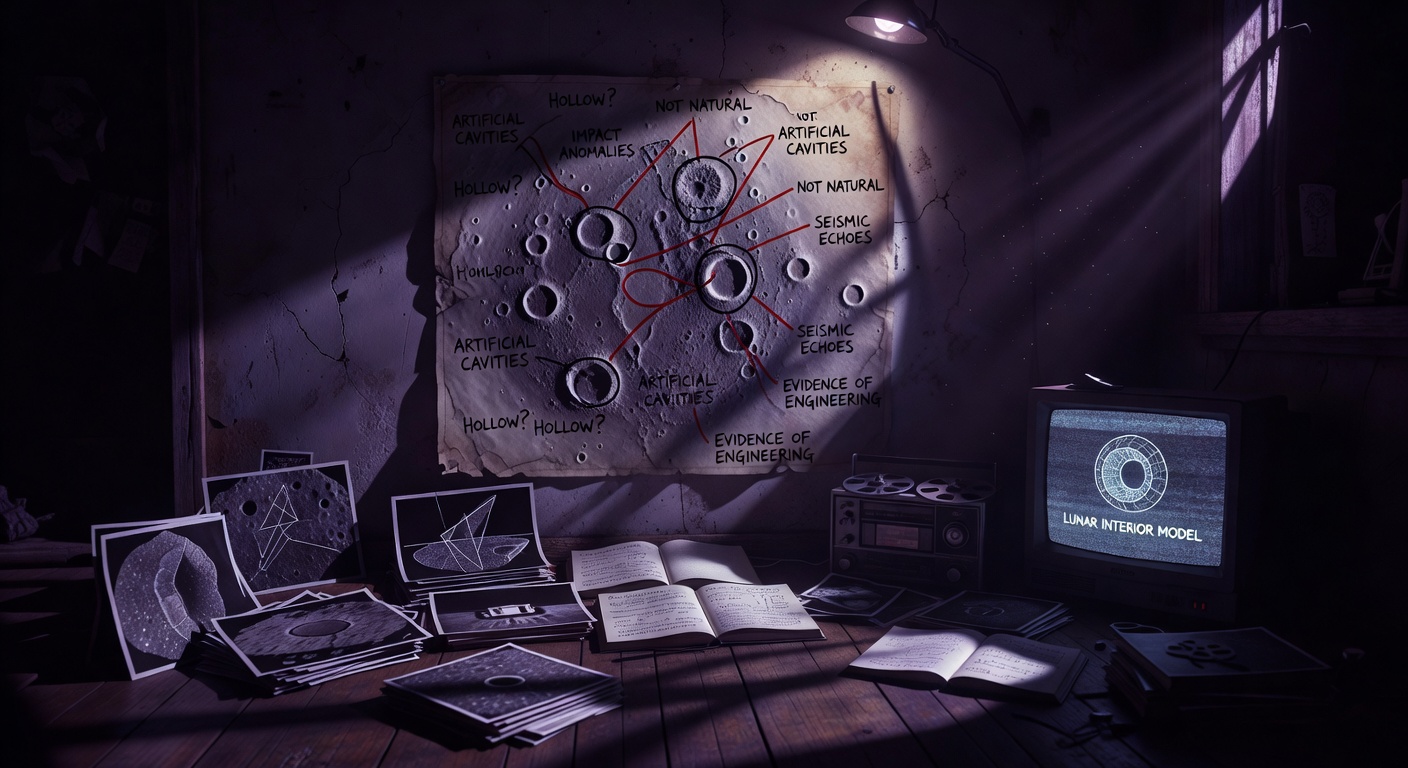
Imagine staring up at the full moon on a crisp night, that glowing orb that’s guided sailors, inspired poets, and sparked countless werewolf tales. But what if I told you it’s not a rock at all? What if the Moon is hollow—an artificial shell built by some ancient, advanced civilization? Sounds like sci-fi madness, right? Buckle up, because the Hollow Moon Theory isn’t just fringe chatter; it’s backed by seismic data from NASA’s own Apollo missions, weird crater patterns, and anomalies that mainstream science struggles to explain. We’re about to rabbit-hole deep into this celestial enigma, sifting through the evidence, debunking the debunkers, and exploring what it means if our nearest neighbor is a cosmic Trojan horse.

The Spark That Lit the Fuse: Origins of the Hollow Moon Theory

Let’s rewind to the 1970s, a golden era for space-age conspiracies. Apollo 12 had just returned from the Moon in 1969, and scientists were poring over the data. Then, boom—something bizarre: when the lunar module’s ascent stage was deliberately crashed into the Moon’s surface, seismometers left behind picked up vibrations that lasted nearly an hour. Not your typical rock-rattle; it was more like the Moon was ringing like a giant bell.

This anomaly caught the eye of researchers like Don Wilson, who dropped Our Mysterious Spaceship Moon in 1975. Wilson didn’t mince words: the Moon wasn’t a natural satellite but a “spaceship” parked in Earth’s orbit by extraterrestrials. He wasn’t alone. Soviet scientists Vasin and Shcherbakov had floated a similar idea in a 1970 article in Sputnik magazine, arguing the Moon’s perfect orbit and low density screamed “artificial.” Their piece, “Is the Moon the Creation of Alien Intelligence?” (read it here), suggested it was a hollow sphere with a thin metallic crust—explaining why impacts don’t penetrate like they should on a solid body.

Why the 1970s? Post-Apollo, the world was buzzing with UFO sightings and government distrust. Watergate, Vietnam—the stage was set for questioning NASA’s glossy narrative. Proponents weren’t just tin-foil types; they included engineers and astronomers frustrated by lunar oddities that didn’t fit the textbook story.

NASA’s Own Data: The Bell That Wouldn’t Stop Ringing

Let’s get evidence-forward. During Apollo 12, Apollo 13, Apollo 14, and Apollo 15, NASA intentionally slammed discarded hardware into the Moon. The results? Seismographs recorded “moonquakes” that reverberated for 55 minutes to over three hours—far longer than earthquakes on Earth, which fade in minutes.

NASA scientist Gary Latham described it bluntly: “It vibrates like a tuning fork… ringing like a bell.” Mainstream explanation? A super-dry, rigid crust fractures differently. But hollow theorists counter: a solid body shouldn’t echo like that. Computer models of a hollow sphere match the data eerily well. In fact, a 2012 study by Dr. Alexey Zhirov revisited the seismics, concluding the Moon’s internal structure is “inconsistent with a uniform solid sphere.”

Density seals the deal. The Moon’s average density is 3.34 g/cm³—less than Earth’s 5.51 g/cm³ and suspiciously low for a rocky body. Mars-sized Theia debris should pack more punch. Hollow advocates say it’s a shell: metallic outer layer over vacuum or lightweight core, averaging out low.

Craters That Defy Physics: Shallow, Symmetrical, Suspicious

Ever notice lunar craters look weird? Most are shallow relative to diameter—Tycho crater, for instance, is 85 km wide but only 4.8 km deep. On a solid Moon, mega-impacts should’ve gouged miles deep. Hollow theory: explosions on a shell spread energy laterally, like banging a drumhead.

Dr. Ken Johnson, a NASA spectroscopist, noted in the 1970s that craters showed “multi-layered” construction, hinting at artificial shielding. Gashes reveal straight edges, almost machined. And get this: no big basins like Earth’s moon-sized scar from Chicxulub. Why? Proponents say the shell absorbs and redirects impacts.

Remote viewing experiments by the Stanford Research Institute in the 1970s (declassified CIA docs) described the Moon as “hollow with a metallic field,” corroborating craters as “energy-distributing vents.”

Lights, Towers, and Transients: Anomalies That Scream “Occupied”

Lunar Transient Phenomena (LTPs)—flashes, mists, color changes—reported for centuries. Aristarchus crater alone accounts for 30% of observations. Apollo 17 astronaut Harrison Schmitt saw gas releases; Patrick Moore cataloged over 500 events.

Green glowing orbs filmed by Apollo 16? Official line: lens flares. Theorists: portholes or exhaust from inside. The NASA Moon Blink project logged thousands of LTPs, unexplained by science.

Blueprints of the Moon by Howard Hughes engineer William L. Brian II claims leaked docs show a base under Tycho, with towers 1.5 miles high. Dr. Bruce Cornet, a geologist, analyzed photos showing geometric ruins—bridges, spires—dismissed as pareidolia but matching hollow shell ports.

Tidal synchronicity? The Moon’s rotation perfectly matches its orbit, always showing the same face. Random chance? Odds are astronomical. Artificial stabilizer?

The Mainstream Counterpunch: Giant Impact or Giant Cover-Up?

Science says: Giant Impact Hypothesis. 4.5 billion years ago, Theia slammed Earth, ejecting mantle material that coalesced into the Moon. Isotopic matches (oxygen ratios) support it. Seismic data? “Scattering zones” in fractured regolith explain ringing.

Density low? Iron-poor mantle. Craters shallow? Regolith buildup and oblique angles. LTPs? Outgassing or reflections.

Fair points, but cracks show. No matching Theia remnants. Moon’s titanium-rich basalts defy models. Dr. Robin Brett, NASA cosmochemist: “It seems easier to explain the non-existence of the Moon than its existence.”

Zecharia Sitchin‘s ancient astronaut angle ties in: Sumerian texts describe Nibiru parking the Moon as a command center. Ingo Swann‘s remote viewing (CIA files) saw aliens mining Helium-3 inside.

Hollow Moon’s Wild Implications: Rewriting History and Humanity

If true, everything flips. No natural formation—Moon as spaceship, base, or hologram projector? Ties to Moon landing hoax: Kubrick footage from a hollow soundstage? Project Blue Beam projections explaining lights.

ET intervention: Why park it here? Monitor humanity? Resource hub (Helium-3 fusion fuel)? David Icke links to reptilian control. Biblical “greater light” as artificial.

Philosophically: Are we zoo animals? Tech leaps (rockets post-Roswell) reverse-engineered from Moon tech?

Recent buzz: Chang’e 4‘s far-side landing (2019) found “gel-like” substances—hollow ooze? Artemis delays smell fishy.

Down the Rabbit Hole

1. Moon Landing Hoax: Kubrick’s Lunar Lies – Kubrick filmed it in a hollow studio? Apollo tapes dissected.

2. Alien Bases on the Far Side – Hidden structures via leaked SOHO images and whistleblowers.

3. NASA Cover-Ups: From Roswell to Lunar Water – How space agency hides ET evidence.

4. Ancient Astronauts & Sumerian Gods – Moon as Anunnaki spaceship in clay tablets.

5. Holographic Universe: Is the Moon a Projection? – Blue Beam tech and Mandela effects.

There you have it—the Hollow Moon Theory isn’t proven, but the evidence nags like an unsolved itch. Next full moon, look closer. Is it watching back?

Disclaimer: This article explores speculative theories for entertainment and discussion. Claims are not scientifically verified; consult peer-reviewed sources for facts.

Related Reads

dive down the rabbit hole

Hollow Moon Theory

S-FX.com
Hollow Moon Theory

Imagine staring up at the full moon on a crisp night, that glowing orb that’s guided sailors, inspired poets, and sparked countless werewolf tales. But what if I told you it’s not a rock at all? What if the Moon is hollow—an artificial shell built by some ancient, advanced civilization? Sounds like sci-fi madness, right? Buckle up, because the Hollow Moon Theory isn’t just fringe chatter; it’s backed by seismic data from NASA’s own Apollo missions, weird crater patterns, and anomalies that mainstream science struggles to explain. We’re about to rabbit-hole deep into this celestial enigma, sifting through the evidence, debunking the debunkers, and exploring what it means if our nearest neighbor is a cosmic Trojan horse.

The Spark That Lit the Fuse: Origins of the Hollow Moon Theory

Let’s rewind to the 1970s, a golden era for space-age conspiracies. Apollo 12 had just returned from the Moon in 1969, and scientists were poring over the data. Then, boom—something bizarre: when the lunar module’s ascent stage was deliberately crashed into the Moon’s surface, seismometers left behind picked up vibrations that lasted nearly an hour. Not your typical rock-rattle; it was more like the Moon was ringing like a giant bell.

This anomaly caught the eye of researchers like Don Wilson, who dropped Our Mysterious Spaceship Moon in 1975. Wilson didn’t mince words: the Moon wasn’t a natural satellite but a “spaceship” parked in Earth’s orbit by extraterrestrials. He wasn’t alone. Soviet scientists Vasin and Shcherbakov had floated a similar idea in a 1970 article in Sputnik magazine, arguing the Moon’s perfect orbit and low density screamed “artificial.” Their piece, “Is the Moon the Creation of Alien Intelligence?” (read it here), suggested it was a hollow sphere with a thin metallic crust—explaining why impacts don’t penetrate like they should on a solid body.

Why the 1970s? Post-Apollo, the world was buzzing with UFO sightings and government distrust. Watergate, Vietnam—the stage was set for questioning NASA’s glossy narrative. Proponents weren’t just tin-foil types; they included engineers and astronomers frustrated by lunar oddities that didn’t fit the textbook story.

NASA’s Own Data: The Bell That Wouldn’t Stop Ringing

Let’s get evidence-forward. During Apollo 12, Apollo 13, Apollo 14, and Apollo 15, NASA intentionally slammed discarded hardware into the Moon. The results? Seismographs recorded “moonquakes” that reverberated for 55 minutes to over three hours—far longer than earthquakes on Earth, which fade in minutes.

NASA scientist Gary Latham described it bluntly: “It vibrates like a tuning fork… ringing like a bell.” Mainstream explanation? A super-dry, rigid crust fractures differently. But hollow theorists counter: a solid body shouldn’t echo like that. Computer models of a hollow sphere match the data eerily well. In fact, a 2012 study by Dr. Alexey Zhirov revisited the seismics, concluding the Moon’s internal structure is “inconsistent with a uniform solid sphere.”

Density seals the deal. The Moon’s average density is 3.34 g/cm³—less than Earth’s 5.51 g/cm³ and suspiciously low for a rocky body. Mars-sized Theia debris should pack more punch. Hollow advocates say it’s a shell: metallic outer layer over vacuum or lightweight core, averaging out low.

Craters That Defy Physics: Shallow, Symmetrical, Suspicious

Ever notice lunar craters look weird? Most are shallow relative to diameter—Tycho crater, for instance, is 85 km wide but only 4.8 km deep. On a solid Moon, mega-impacts should’ve gouged miles deep. Hollow theory: explosions on a shell spread energy laterally, like banging a drumhead.

Dr. Ken Johnson, a NASA spectroscopist, noted in the 1970s that craters showed “multi-layered” construction, hinting at artificial shielding. Gashes reveal straight edges, almost machined. And get this: no big basins like Earth’s moon-sized scar from Chicxulub. Why? Proponents say the shell absorbs and redirects impacts.

Remote viewing experiments by the Stanford Research Institute in the 1970s (declassified CIA docs) described the Moon as “hollow with a metallic field,” corroborating craters as “energy-distributing vents.”

Lights, Towers, and Transients: Anomalies That Scream “Occupied”

Lunar Transient Phenomena (LTPs)—flashes, mists, color changes—reported for centuries. Aristarchus crater alone accounts for 30% of observations. Apollo 17 astronaut Harrison Schmitt saw gas releases; Patrick Moore cataloged over 500 events.

Green glowing orbs filmed by Apollo 16? Official line: lens flares. Theorists: portholes or exhaust from inside. The NASA Moon Blink project logged thousands of LTPs, unexplained by science.

Blueprints of the Moon by Howard Hughes engineer William L. Brian II claims leaked docs show a base under Tycho, with towers 1.5 miles high. Dr. Bruce Cornet, a geologist, analyzed photos showing geometric ruins—bridges, spires—dismissed as pareidolia but matching hollow shell ports.

Tidal synchronicity? The Moon’s rotation perfectly matches its orbit, always showing the same face. Random chance? Odds are astronomical. Artificial stabilizer?

The Mainstream Counterpunch: Giant Impact or Giant Cover-Up?

Science says: Giant Impact Hypothesis. 4.5 billion years ago, Theia slammed Earth, ejecting mantle material that coalesced into the Moon. Isotopic matches (oxygen ratios) support it. Seismic data? “Scattering zones” in fractured regolith explain ringing.

Density low? Iron-poor mantle. Craters shallow? Regolith buildup and oblique angles. LTPs? Outgassing or reflections.

Fair points, but cracks show. No matching Theia remnants. Moon’s titanium-rich basalts defy models. Dr. Robin Brett, NASA cosmochemist: “It seems easier to explain the non-existence of the Moon than its existence.”

Zecharia Sitchin‘s ancient astronaut angle ties in: Sumerian texts describe Nibiru parking the Moon as a command center. Ingo Swann‘s remote viewing (CIA files) saw aliens mining Helium-3 inside.

Hollow Moon’s Wild Implications: Rewriting History and Humanity

If true, everything flips. No natural formation—Moon as spaceship, base, or hologram projector? Ties to Moon landing hoax: Kubrick footage from a hollow soundstage? Project Blue Beam projections explaining lights.

ET intervention: Why park it here? Monitor humanity? Resource hub (Helium-3 fusion fuel)? David Icke links to reptilian control. Biblical “greater light” as artificial.

Philosophically: Are we zoo animals? Tech leaps (rockets post-Roswell) reverse-engineered from Moon tech?

Recent buzz: Chang’e 4‘s far-side landing (2019) found “gel-like” substances—hollow ooze? Artemis delays smell fishy.

Down the Rabbit Hole

1. Moon Landing Hoax: Kubrick’s Lunar Lies – Kubrick filmed it in a hollow studio? Apollo tapes dissected.

2. Alien Bases on the Far Side – Hidden structures via leaked SOHO images and whistleblowers.

3. NASA Cover-Ups: From Roswell to Lunar Water – How space agency hides ET evidence.

4. Ancient Astronauts & Sumerian Gods – Moon as Anunnaki spaceship in clay tablets.

5. Holographic Universe: Is the Moon a Projection? – Blue Beam tech and Mandela effects.

There you have it—the Hollow Moon Theory isn’t proven, but the evidence nags like an unsolved itch. Next full moon, look closer. Is it watching back?

Disclaimer: This article explores speculative theories for entertainment and discussion. Claims are not scientifically verified; consult peer-reviewed sources for facts.

Related Reads

Hollow Moon Theory

Hollow Moon Theory

Imagine staring up at the full moon on a crisp night, that glowing orb that’s guided sailors, inspired poets, and sparked countless werewolf tales. But what if I told you it’s not a rock at all? What if the Moon is hollow—an artificial shell built by some ancient, advanced civilization? Sounds like sci-fi madness, right? Buckle up, because the Hollow Moon Theory isn’t just fringe chatter; it’s backed by seismic data from NASA’s own Apollo missions, weird crater patterns, and anomalies that mainstream science struggles to explain. We’re about to rabbit-hole deep into this celestial enigma, sifting through the evidence, debunking the debunkers, and exploring what it means if our nearest neighbor is a cosmic Trojan horse.

The Spark That Lit the Fuse: Origins of the Hollow Moon Theory

Let’s rewind to the 1970s, a golden era for space-age conspiracies. Apollo 12 had just returned from the Moon in 1969, and scientists were poring over the data. Then, boom—something bizarre: when the lunar module’s ascent stage was deliberately crashed into the Moon’s surface, seismometers left behind picked up vibrations that lasted nearly an hour. Not your typical rock-rattle; it was more like the Moon was ringing like a giant bell.

This anomaly caught the eye of researchers like Don Wilson, who dropped Our Mysterious Spaceship Moon in 1975. Wilson didn’t mince words: the Moon wasn’t a natural satellite but a “spaceship” parked in Earth’s orbit by extraterrestrials. He wasn’t alone. Soviet scientists Vasin and Shcherbakov had floated a similar idea in a 1970 article in Sputnik magazine, arguing the Moon’s perfect orbit and low density screamed “artificial.” Their piece, “Is the Moon the Creation of Alien Intelligence?” (read it here), suggested it was a hollow sphere with a thin metallic crust—explaining why impacts don’t penetrate like they should on a solid body.

Why the 1970s? Post-Apollo, the world was buzzing with UFO sightings and government distrust. Watergate, Vietnam—the stage was set for questioning NASA’s glossy narrative. Proponents weren’t just tin-foil types; they included engineers and astronomers frustrated by lunar oddities that didn’t fit the textbook story.

NASA’s Own Data: The Bell That Wouldn’t Stop Ringing

Let’s get evidence-forward. During Apollo 12, Apollo 13, Apollo 14, and Apollo 15, NASA intentionally slammed discarded hardware into the Moon. The results? Seismographs recorded “moonquakes” that reverberated for 55 minutes to over three hours—far longer than earthquakes on Earth, which fade in minutes.

NASA scientist Gary Latham described it bluntly: “It vibrates like a tuning fork… ringing like a bell.” Mainstream explanation? A super-dry, rigid crust fractures differently. But hollow theorists counter: a solid body shouldn’t echo like that. Computer models of a hollow sphere match the data eerily well. In fact, a 2012 study by Dr. Alexey Zhirov revisited the seismics, concluding the Moon’s internal structure is “inconsistent with a uniform solid sphere.”

Density seals the deal. The Moon’s average density is 3.34 g/cm³—less than Earth’s 5.51 g/cm³ and suspiciously low for a rocky body. Mars-sized Theia debris should pack more punch. Hollow advocates say it’s a shell: metallic outer layer over vacuum or lightweight core, averaging out low.

Craters That Defy Physics: Shallow, Symmetrical, Suspicious

Ever notice lunar craters look weird? Most are shallow relative to diameter—Tycho crater, for instance, is 85 km wide but only 4.8 km deep. On a solid Moon, mega-impacts should’ve gouged miles deep. Hollow theory: explosions on a shell spread energy laterally, like banging a drumhead.

Dr. Ken Johnson, a NASA spectroscopist, noted in the 1970s that craters showed “multi-layered” construction, hinting at artificial shielding. Gashes reveal straight edges, almost machined. And get this: no big basins like Earth’s moon-sized scar from Chicxulub. Why? Proponents say the shell absorbs and redirects impacts.

Remote viewing experiments by the Stanford Research Institute in the 1970s (declassified CIA docs) described the Moon as “hollow with a metallic field,” corroborating craters as “energy-distributing vents.”

Lights, Towers, and Transients: Anomalies That Scream “Occupied”

Lunar Transient Phenomena (LTPs)—flashes, mists, color changes—reported for centuries. Aristarchus crater alone accounts for 30% of observations. Apollo 17 astronaut Harrison Schmitt saw gas releases; Patrick Moore cataloged over 500 events.

Green glowing orbs filmed by Apollo 16? Official line: lens flares. Theorists: portholes or exhaust from inside. The NASA Moon Blink project logged thousands of LTPs, unexplained by science.

Blueprints of the Moon by Howard Hughes engineer William L. Brian II claims leaked docs show a base under Tycho, with towers 1.5 miles high. Dr. Bruce Cornet, a geologist, analyzed photos showing geometric ruins—bridges, spires—dismissed as pareidolia but matching hollow shell ports.

Tidal synchronicity? The Moon’s rotation perfectly matches its orbit, always showing the same face. Random chance? Odds are astronomical. Artificial stabilizer?

The Mainstream Counterpunch: Giant Impact or Giant Cover-Up?

Science says: Giant Impact Hypothesis. 4.5 billion years ago, Theia slammed Earth, ejecting mantle material that coalesced into the Moon. Isotopic matches (oxygen ratios) support it. Seismic data? “Scattering zones” in fractured regolith explain ringing.

Density low? Iron-poor mantle. Craters shallow? Regolith buildup and oblique angles. LTPs? Outgassing or reflections.

Fair points, but cracks show. No matching Theia remnants. Moon’s titanium-rich basalts defy models. Dr. Robin Brett, NASA cosmochemist: “It seems easier to explain the non-existence of the Moon than its existence.”

Zecharia Sitchin‘s ancient astronaut angle ties in: Sumerian texts describe Nibiru parking the Moon as a command center. Ingo Swann‘s remote viewing (CIA files) saw aliens mining Helium-3 inside.

Hollow Moon’s Wild Implications: Rewriting History and Humanity

If true, everything flips. No natural formation—Moon as spaceship, base, or hologram projector? Ties to Moon landing hoax: Kubrick footage from a hollow soundstage? Project Blue Beam projections explaining lights.

ET intervention: Why park it here? Monitor humanity? Resource hub (Helium-3 fusion fuel)? David Icke links to reptilian control. Biblical “greater light” as artificial.

Philosophically: Are we zoo animals? Tech leaps (rockets post-Roswell) reverse-engineered from Moon tech?

Recent buzz: Chang’e 4‘s far-side landing (2019) found “gel-like” substances—hollow ooze? Artemis delays smell fishy.

Down the Rabbit Hole

1. Moon Landing Hoax: Kubrick’s Lunar Lies – Kubrick filmed it in a hollow studio? Apollo tapes dissected.

2. Alien Bases on the Far Side – Hidden structures via leaked SOHO images and whistleblowers.

3. NASA Cover-Ups: From Roswell to Lunar Water – How space agency hides ET evidence.

4. Ancient Astronauts & Sumerian Gods – Moon as Anunnaki spaceship in clay tablets.

5. Holographic Universe: Is the Moon a Projection? – Blue Beam tech and Mandela effects.

There you have it—the Hollow Moon Theory isn’t proven, but the evidence nags like an unsolved itch. Next full moon, look closer. Is it watching back?

Disclaimer: This article explores speculative theories for entertainment and discussion. Claims are not scientifically verified; consult peer-reviewed sources for facts.

Related Reads

Table of contents