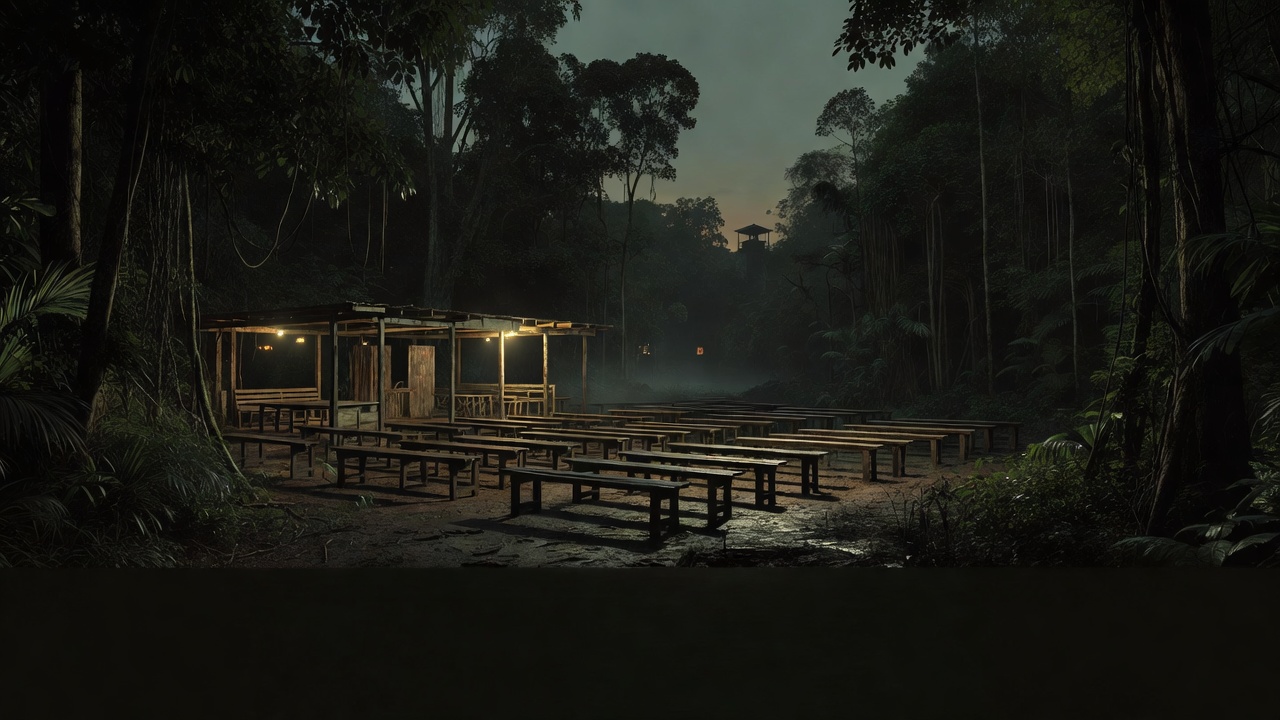
Night fell hard in the Guyanese jungle. Loudspeakers crackled. Armed guards moved through the dark. Children cried while adults stood in lines that had been rehearsed before. By dawn, more than 900 people were dead, a congressman lay murdered at a nearby airstrip, and one of the most haunting questions of the Cold War had been born: was Jonestown simply the final act of Jim Jones’ private tyranny, or did something bigger brush up against it in the shadows? The official record points squarely at Jones. But the paper trail around intelligence, secrecy, and missing context has never stopped needling the case.
The Case For
Why the CIA theory took root
The suspicion did not appear out of thin air. In the 1970s, Americans learned that intelligence agencies had monitored citizens, infiltrated political groups, and run illegal programs at home and abroad. That atmosphere matters. The editors behind San Diego State University’s Jonestown archive note that their first Freedom of Information Act request for CIA records was filed within weeks of the deaths, in part because recent congressional investigations had already exposed illegal surveillance of Americans by U.S. intelligence agencies. In other words, the public had reason to think the impossible might not be impossible after all.
Then there was Jonestown itself. The 1979 House Foreign Affairs Committee staff report, The Assassination of Representative Leo J. Ryan and the Jonestown, Guyana Tragedy, documented allegations of beatings, mail censorship, armed intimidation, “mass suicide” rehearsals, and people being held in Guyana against their will. The FBI’s historical summary likewise describes reports of forced labor, imprisonments, drugs used to control behavior, and rehearsals for mass suicide before Congressman Leo Ryan ever arrived. For conspiracy-minded readers, that sounds less like a commune and more like a closed behavioral laboratory.
The records that kept the suspicion alive
The CIA paper trail added fuel. In McGehee v. CIA, a 1982 FOIA case over Jonestown-related records, the court said the agency had identified 84 responsive documents, including some withheld in full and others released with deletions. The case did not prove CIA control of Jonestown. It did prove something narrower and still provocative: the agency had material on Peoples Temple, and parts of that record remained classified or heavily redacted. When the subject is a mass death event involving more than 900 Americans, even a thin stack of secret files can feel like an alarm bell.
Supporters of the black-site theory also point to Leo Ryan’s role. He had built a reputation for aggressive oversight of intelligence abuses. He traveled to Guyana because constituents feared people were trapped inside Jonestown. After his murder, suspicion hardened around the possibility that Jonestown intersected with larger intelligence interests in Guyana, whether through monitoring, informants, or something more operational.
Set against the wider Cold War backdrop — a period this site has explored in our look at the destruction of MKULTRA records — Jonestown can appear to some observers as one more place where coercion, secrecy, and psychological control blurred together. Even if there is no smoking gun, the pattern looks familiar enough to keep the theory alive.
The Realist’s Eye
What the evidence does not show
This is where the floor gets less stable. No public record currently shows that Jonestown was a CIA-run facility, an MKULTRA subproject, or a behavioral-modification black site in any documented operational sense. The strongest official and scholarly sources point instead to Jim Jones’ own machinery of control. The FBI’s case history attributes the massacre to Jones and his followers. The House staff report focused on Temple abuse, Guyanese and U.S. failures, and the chain of events that led to Ryan’s murder — not a proven intelligence operation.
Even the Jonestown archive page specifically devoted to “The CIA and Peoples Temple” is careful. It acknowledges why the agency drew suspicion, but it does not present proof that the CIA orchestrated the deaths. A separate SDSU control-data page goes further, stating that there is no verified or credible evidence directly linking the CIA to the massacre, and noting that official investigations did not substantiate those claims. That matters. A mystery is not the same thing as a case.
Coercion does not require Langley
The behavioral-control features at Jonestown were real enough without importing a covert operator into every gap. Authoritarian isolation, sleep deprivation, fear, loyalty tests, armed enforcement, public humiliation, and rehearsed suicide drills can all be built by a charismatic cult leader with total social control. Jones did not need the CIA to create dependency or terror. He had a captive audience, a remote jungle settlement, a culture of obedience, and years to refine the system.
The secret records argument is weaker than it first appears. Intelligence agencies often accumulate files on politically connected Americans, overseas compounds, or crises involving U.S. citizens without running the operation in question. A file proves awareness, interest, or collection. It does not, by itself, prove authorship. The McGehee litigation is important because it shows opacity. It is not important because it proves direction.
And then there is the hardest point of all: the violence at Port Kaituma and the deaths at Jonestown are already grimly explainable through Temple actors, surviving witness testimony, and the historical record assembled after November 18, 1978. That explanation may leave holes. It may leave plenty of bureaucratic embarrassment. But embarrassment and redaction are not automatically evidence of an intelligence murder plot.
For readers tracking our government secrets coverage, Jonestown sits in that maddening category where documented abuse and institutional secrecy are both real, yet the leap to a full covert-operation claim remains unproven.
What We Know For Certain
- Congressman Leo Ryan traveled to Guyana in November 1978 to investigate allegations of abuse and coercion at Jonestown.
- Ryan and four others were killed at the Port Kaituma airstrip by Peoples Temple members on November 18, 1978.
- More than 900 people died in Jonestown and related locations that same day.
- The FBI opened the RYMUR investigation and later published records related to the case.
- The CIA possessed at least some records concerning Peoples Temple, as confirmed in McGehee v. CIA.
The Unanswered Questions
- Why were some Jonestown-related intelligence records withheld or heavily redacted for so long?
- What exactly did U.S. agencies know about conditions inside Jonestown before Ryan’s trip?
- Did intelligence interest in Guyana during the Cold War create blind spots, informant relationships, or unreported contacts around Peoples Temple?
- How much of the surviving record remains fragmented because agencies gathered information separately and released it unevenly?
- Which anomalies around warnings, oversight, and response reflect bureaucratic failure, and which reflect something more deliberate?
The Closer — You Decide
Jonestown does not need embellishment to be horrifying. The documented abuses were real. The murders were real. The dead were real. So were the intelligence-era instincts that taught Americans to distrust a neat official ending when files stay hidden and timelines stay fuzzy. Maybe Jonestown was exactly what the mainstream record says: a cult leader’s final atrocity. Maybe the unanswered pieces point to a deeper layer of Cold War contact or awareness that never reached daylight. The evidence is on the table. You decide.