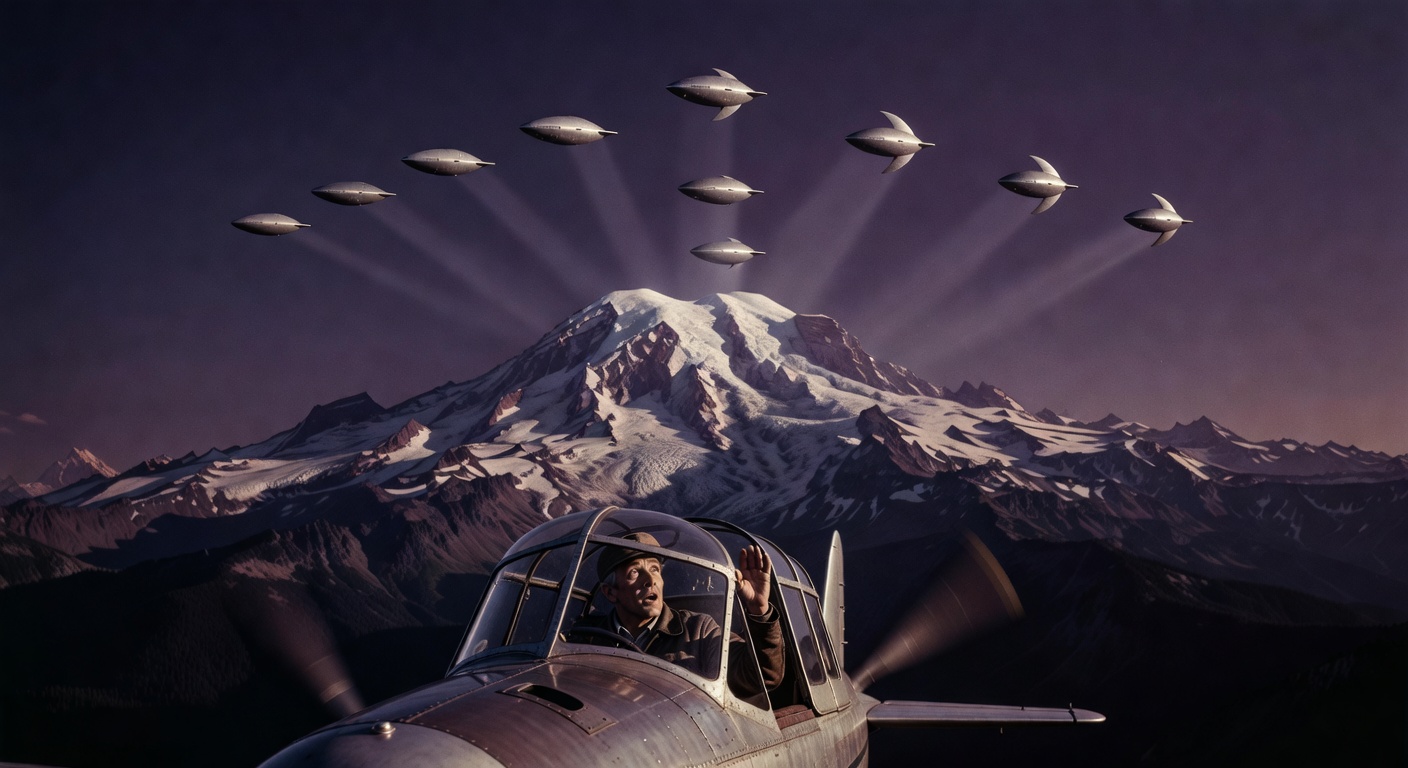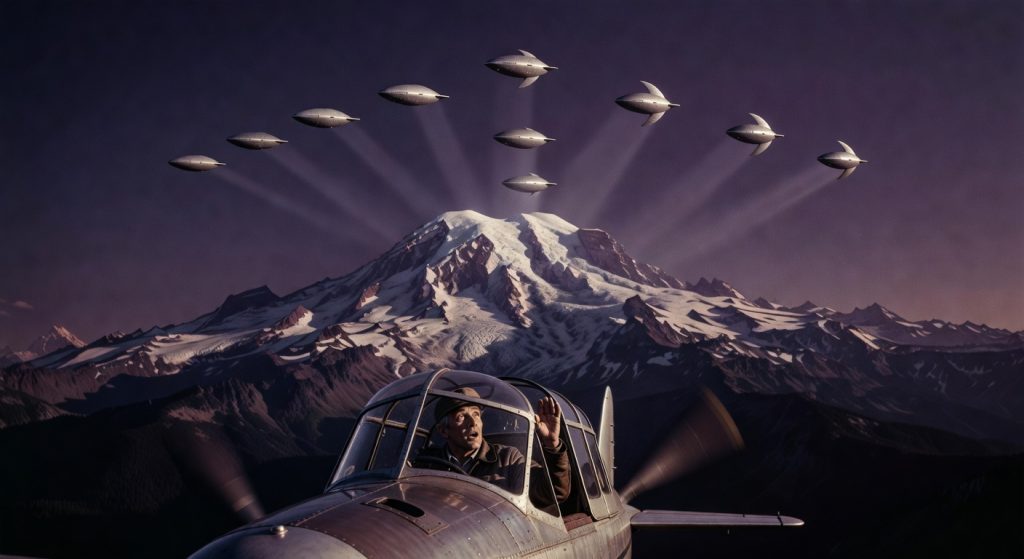
On June 24, 1947, commercial pilot [Kenneth Arnold] was flying his CallAir A-2 near Mount Rainier when he saw nine bright objects moving in a startling chain across the sky. What happened in those few minutes would not just become a strange pilot report—it would become the ignition point for the modern UFO era, a media phrase that rewired public imagination, and a policy chain reaction that eventually contributed to military studies like Project SIGN and, years later, Project Blue Book.
The Afternoon That Changed the Vocabulary
Arnold was not an amateur skywatcher. He was an experienced pilot and businessman, comfortable reading terrain, weather, and speed. He said the objects moved “like a saucer would if you skipped it across water,” describing motion, not shape. But once that phrase reached reporters, the term “flying saucer” took on a life of its own.
An Associated Press wire story amplified the wording nationally. Within days, Americans were not merely reading about an isolated sighting—they were scanning their own skies for “saucers.” Language led perception, and perception generated a feedback loop of new reports.
That framing shift is crucial. If Arnold had used the phrase “crescent craft” and newspapers repeated only that, the iconography of the entire UFO movement might have looked different. Instead, a metaphor became a category.
Why Arnold Was Taken Seriously
Arnold had incentives to avoid ridicule, not invite it. Reporting extraordinary observations in 1947 could damage business reputation and personal credibility. Yet he remained consistent in interviews and fielded questions from federal investigators.
The FBI documented interviews linked to the case context, and Air Force intelligence channels absorbed the wider wave of reports. The U.S. military was then navigating Cold War uncertainty, where unknown aerial phenomena could represent adversary technology or intelligence blind spots.
This is the same institutional anxiety that later fed investigations covered in our breakdown of Project SIGN and Project Grudge, and eventually Project Blue Book.
From One Sighting to a National Wave
In the weeks after Arnold’s report, press outlets logged hundreds of additional sightings—often cited near 850 in short order. Some were likely misidentifications; others came from trained observers who insisted the behavior defied normal aircraft profiles.
Psychology and sociology matter here: once a narrative enters mass media, copycat claims rise. But copycat dynamics do not automatically invalidate every event in the wave. They force triage, not dismissal.
This is where researchers still split today. Skeptics argue contagion explains most of 1947. Disclosure advocates argue contagion explains noise, while a hard core of high-credibility reports remains unresolved.
The 1,700 mph Problem
Arnold’s speed estimate—around 1,700 mph—was one of the most controversial details. Critics say rough visual triangulation can inflate speed dramatically. Supporters counter that even downgraded estimates still imply highly unusual performance for 1947.
Either way, the number forced officials and journalists to ask a dangerous question for the era: if the objects were real craft, whose were they? U.S., Soviet, or unknown? In early Cold War logic, all three answers had strategic consequences.
That same performance puzzle echoes through later military incidents, including the 1976 Tehran intercept case and the modern Navy events around Nimitz.
Project SIGN and the Bureaucratic Birth of UFO Policy
By late 1947 and into 1948, military intelligence formalized inquiry channels that became Project SIGN. Whether one believes these programs sought truth, containment, or public reassurance, Arnold’s case sits at the top of the modern timeline.
[Project SIGN] explored multiple hypotheses, from advanced foreign technology to more exotic possibilities. Official attitudes hardened and softened over time, eventually producing the public-relations balancing act that would define Blue Book decades later.
If you trace the lineage from Arnold to today’s [AARO] era, you can see the same institutional pattern: acknowledge unknowns, narrow language, protect sources, release selectively.
Conclusion: The First Domino
If Roswell became the mythic heart of UFO lore, Kenneth Arnold’s encounter was the spark that lit the wire. It gave the public a phrase, gave intelligence agencies a problem set, and gave future whistleblowers a historical anchor.
In that sense, Arnold belongs in the same continuity as Roswell, AATIP, and post-2017 disclosure battles. The names and acronyms change; the central mystery does not.
Research Threads and Disclosure Context
Investigators returning to The Kenneth Arnold Sighting often find that the hardest part is not collecting stories, but ranking evidence layers: witness memory, instrument logs, official records, and media interpretation. In case file review cycles, details that look trivial in week one become central in month six. That pattern is why long-form analysis still matters. It is also why readers should compare this case with related archives like this connected investigation before locking into a final conclusion.
Another overlooked angle in The Kenneth Arnold Sighting is institutional behavior under uncertainty. Agencies rarely admit complete ignorance in real time; they narrow language, preserve optionality, and protect sources. That can look like a cover-up from one side and risk management from the other. The truth may include both dynamics at once, which is exactly what makes modern disclosure debates so durable.
When researchers map timelines for The Kenneth Arnold Sighting, they usually see three phases: immediate witness shock, bureaucratic classification, and later narrative battle. By the time public audiences engage, the raw event has already passed through multiple filters. That does not mean nothing happened. It means the original signal is mixed with institutional noise, social mythmaking, and selective release cycles.
Investigators returning to The Kenneth Arnold Sighting often find that the hardest part is not collecting stories, but ranking evidence layers: witness memory, instrument logs, official records, and media interpretation. In case file review cycles, details that look trivial in week one become central in month six. That pattern is why long-form analysis still matters. It is also why readers should compare this case with related archives like this connected investigation before locking into a final conclusion.
Another overlooked angle in The Kenneth Arnold Sighting is institutional behavior under uncertainty. Agencies rarely admit complete ignorance in real time; they narrow language, preserve optionality, and protect sources. That can look like a cover-up from one side and risk management from the other. The truth may include both dynamics at once, which is exactly what makes modern disclosure debates so durable.
When researchers map timelines for The Kenneth Arnold Sighting, they usually see three phases: immediate witness shock, bureaucratic classification, and later narrative battle. By the time public audiences engage, the raw event has already passed through multiple filters. That does not mean nothing happened. It means the original signal is mixed with institutional noise, social mythmaking, and selective release cycles.
Investigators returning to The Kenneth Arnold Sighting often find that the hardest part is not collecting stories, but ranking evidence layers: witness memory, instrument logs, official records, and media interpretation. In case file review cycles, details that look trivial in week one become central in month six. That pattern is why long-form analysis still matters. It is also why readers should compare this case with related archives like this connected investigation before locking into a final conclusion.
Another overlooked angle in The Kenneth Arnold Sighting is institutional behavior under uncertainty. Agencies rarely admit complete ignorance in real time; they narrow language, preserve optionality, and protect sources. That can look like a cover-up from one side and risk management from the other. The truth may include both dynamics at once, which is exactly what makes modern disclosure debates so durable.
When researchers map timelines for The Kenneth Arnold Sighting, they usually see three phases: immediate witness shock, bureaucratic classification, and later narrative battle. By the time public audiences engage, the raw event has already passed through multiple filters. That does not mean nothing happened. It means the original signal is mixed with institutional noise, social mythmaking, and selective release cycles.
Investigators returning to The Kenneth Arnold Sighting often find that the hardest part is not collecting stories, but ranking evidence layers: witness memory, instrument logs, official records, and media interpretation. In case file review cycles, details that look trivial in week one become central in month six. That pattern is why long-form analysis still matters. It is also why readers should compare this case with related archives like this connected investigation before locking into a final conclusion.
Another overlooked angle in The Kenneth Arnold Sighting is institutional behavior under uncertainty. Agencies rarely admit complete ignorance in real time; they narrow language, preserve optionality, and protect sources. That can look like a cover-up from one side and risk management from the other. The truth may include both dynamics at once, which is exactly what makes modern disclosure debates so durable.
When researchers map timelines for The Kenneth Arnold Sighting, they usually see three phases: immediate witness shock, bureaucratic classification, and later narrative battle. By the time public audiences engage, the raw event has already passed through multiple filters. That does not mean nothing happened. It means the original signal is mixed with institutional noise, social mythmaking, and selective release cycles.
Investigators returning to The Kenneth Arnold Sighting often find that the hardest part is not collecting stories, but ranking evidence layers: witness memory, instrument logs, official records, and media interpretation. In case file review cycles, details that look trivial in week one become central in month six. That pattern is why long-form analysis still matters. It is also why readers should compare this case with related archives like this connected investigation before locking into a final conclusion.
Another overlooked angle in The Kenneth Arnold Sighting is institutional behavior under uncertainty. Agencies rarely admit complete ignorance in real time; they narrow language, preserve optionality, and protect sources. That can look like a cover-up from one side and risk management from the other. The truth may include both dynamics at once, which is exactly what makes modern disclosure debates so durable.
When researchers map timelines for The Kenneth Arnold Sighting, they usually see three phases: immediate witness shock, bureaucratic classification, and later narrative battle. By the time public audiences engage, the raw event has already passed through multiple filters. That does not mean nothing happened. It means the original signal is mixed with institutional noise, social mythmaking, and selective release cycles.
Investigators returning to The Kenneth Arnold Sighting often find that the hardest part is not collecting stories, but ranking evidence layers: witness memory, instrument logs, official records, and media interpretation. In case file review cycles, details that look trivial in week one become central in month six. That pattern is why long-form analysis still matters. It is also why readers should compare this case with related archives like this connected investigation before locking into a final conclusion.
Another overlooked angle in The Kenneth Arnold Sighting is institutional behavior under uncertainty. Agencies rarely admit complete ignorance in real time; they narrow language, preserve optionality, and protect sources. That can look like a cover-up from one side and risk management from the other. The truth may include both dynamics at once, which is exactly what makes modern disclosure debates so durable.
When researchers map timelines for The Kenneth Arnold Sighting, they usually see three phases: immediate witness shock, bureaucratic classification, and later narrative battle. By the time public audiences engage, the raw event has already passed through multiple filters. That does not mean nothing happened. It means the original signal is mixed with institutional noise, social mythmaking, and selective release cycles.
Investigators returning to The Kenneth Arnold Sighting often find that the hardest part is not collecting stories, but ranking evidence layers: witness memory, instrument logs, official records, and media interpretation. In case file review cycles, details that look trivial in week one become central in month six. That pattern is why long-form analysis still matters. It is also why readers should compare this case with related archives like this connected investigation before locking into a final conclusion.
Another overlooked angle in The Kenneth Arnold Sighting is institutional behavior under uncertainty. Agencies rarely admit complete ignorance in real time; they narrow language, preserve optionality, and protect sources. That can look like a cover-up from one side and risk management from the other. The truth may include both dynamics at once, which is exactly what makes modern disclosure debates so durable.
Down the Rabbit Hole
- [Ray Palmer], pulp media, and UFO mythmaking: How magazine culture transformed serious reports into mass occult modernism.
- [Fred Johnson Sighting]: The same day as Arnold, another witness reported a disk-like object—coincidence or corroborative fragment?
- [Project SIGN Estimate of the Situation]: Did early analysts privately consider extraordinary hypotheses before policy pushed back?
- [Civil Air Patrol UFO logs]: How many pilot reports never reached national headlines?
- [Cascade Mountain corridor]: Why do repeated regional sighting clusters appear in Pacific Northwest lore?
Reference trail starter: FBI records context on historic UFO reporting.
Disclaimer: This article is for entertainment and educational exploration. Readers are encouraged to research these topics independently and form their own conclusions.