Menu

Operation Majestic 12: The Secret Committee Allegedly Managing UFO Truth

Operation Majestic 12: The Secret Committee Allegedly Managing UFO Truth

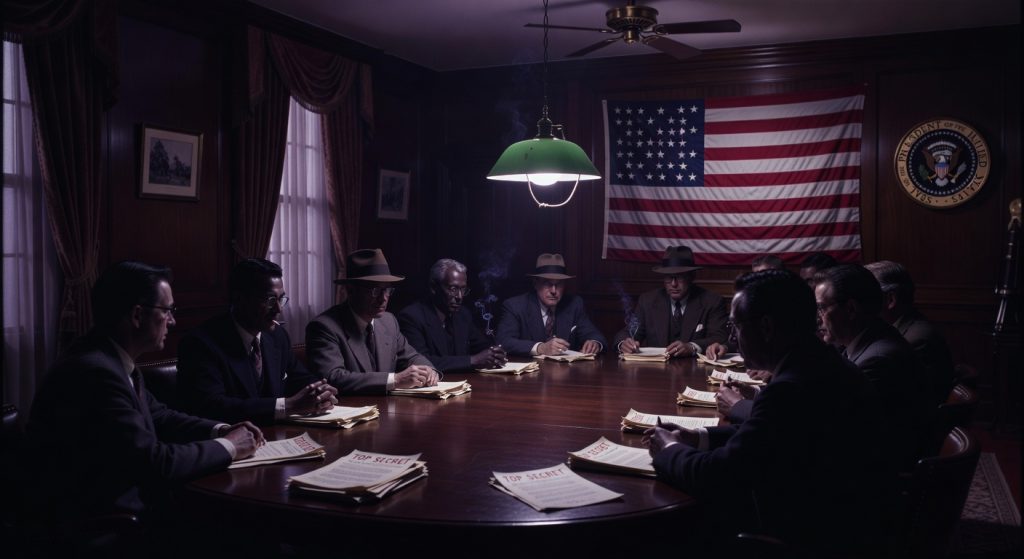
There are UFO stories that feel like campfire myths, and then there are cases like this one — the kind that refuses to stay buried because documents, radar records, career military witnesses, and government reactions keep pulling it back into daylight. The Majestic-12 story began with alleged briefing documents claiming President Truman authorized an elite committee in 1947 to manage extraterrestrial recovery and secrecy operations. Named members allegedly included Vannevar Bush and Admiral Roscoe Hillenkoetter. The 1984 leak to Jaime Shandera launched decades of debate, while FBI responses labeled parts of the documents bogus. Yet researchers still argue specific details track genuine Cold War compartmentalization patterns. If you read enough files, interview enough people, and map enough contradictory statements, a pattern starts to emerge: not necessarily a neat answer, but a bureaucratic choreography of disclosure and denial that says as much about state power as it does about lights in the sky.

The Night the Story Broke Its Own Boundaries

At first glance, this looks like a single event. It wasn’t. It was a sequence — observation, interpretation, command escalation, media framing, and retrospective damage control. Witnesses in and around the event window didn’t just report one odd moment; they reported phases. In phase one, something appears where it should not. In phase two, trained observers try to classify it against known aviation, atmospheric, and defense categories. In phase three, officials decide what counts as reportable truth. That third phase is often where the real mystery begins.

One reason this case still matters is that it sits at the intersection of national security and public myth. People tend to imagine these as separate worlds, but they’re not. The same institutions that monitor adversary technology also manage narratives. When an event threatens to blur those lines, language gets slippery: ‘unidentified’ becomes ‘explained enough,’ and ‘ongoing concern’ becomes ‘historical curiosity.’ That tension links this story to Project Blue Book, The Nimitz Encounter, Disclosure Project, and Skinwalker Ranch.

What the Primary Record Actually Gives Us

Strip away documentaries for a moment and look at the paper trail. The surviving official record is fragmentary but meaningful: logs, memoranda, interview transcripts, post-event summaries, and occasional declassified attachments that arrive years later with missing context. Researchers are often forced to triangulate between what agencies released, what witnesses remembered, and what journalists could verify at the time. That’s why cases like this reward patience over certainty.

For this investigation, the most useful anchors are documented institutional responses and independent archival material such as FBI Vault: Majestic 12 files and National Security Archive background on Cold War secrecy. These sources don’t hand us a final verdict. What they do offer is a timeline and an evidentiary skeleton: who knew what, when they knew it, and how that knowledge was translated into official posture.

Witnesses, Credibility, and the Politics of Memory

Skeptics often ask a fair question: why should we trust testimony decades later? The answer is we shouldn’t trust it blindly — we should weight it. In this case, witness credibility depends on role, proximity, contemporaneous notes, consistency across retellings, and whether later claims drift toward embellishment. Not all accounts are equal. But when multiple observers with different positions describe overlapping anomalies, dismissal gets harder.

This is where key names become important, not as celebrities but as nodes in the evidentiary graph. Figures linked to this case belong in the same analytical bucket as **[Roswell]**, **[Nimitz]**, **[AATIP]**, and **[Project Blue Book]**: each generated testimony that was contested, reframed, and eventually reintroduced to the public in a different political climate. To compare patterns, readers may want to revisit The Roswell UFO Incident and AATIP Pentagon UFO Study.

How Cover-Up Claims Form (and Sometimes Misfire)

The phrase ‘cover-up’ gets thrown around so often that it loses precision. A true cover-up implies coordinated suppression of material facts. But in real-world bureaucracies, what looks like conspiracy can also come from compartmentalization, interagency rivalry, and risk-averse public affairs doctrine. The trick is distinguishing passive opacity from active concealment. That distinction matters because it changes what evidence we should look for.

In this case, allegations of suppression persist because records appear incomplete and some official explanations shifted over time. Shifting narratives do not prove non-human craft, but they can indicate unresolved internal disagreement or evolving defensive messaging. That exact pattern shows up again in Bob Lazar S-4, Philip Corso Day After Roswell, and the long afterlife of Paul Bennewitz.

Cold War Context: Why Officials Reacted the Way They Did

To understand the handling, you have to remember the era’s threat model. During high-tension defense periods, unusual aerial reports were never just curiosities; they were potential indicators of foreign platforms, radar spoofing, psychological operations, or domestic vulnerability. In that environment, protecting methods and protecting public calm can become a single policy impulse. Officials may classify aggressively even when they don’t fully understand what they’re classifying.

That context doesn’t excuse misleading statements, but it explains why transparency is often delayed until political costs drop. Compare this with the trajectory from early Air Force studies to later public exposure in Immaculate Constellation UAP Disclosure and modern testimony dynamics linked to Disclosure Project. The institutional reflex is consistent: contain first, clarify later — if ever.

The Evidence Ceiling: What We Can Infer Without Overreaching

An honest conclusion has to live below the evidence ceiling. We can reasonably infer that trained personnel encountered an event they considered anomalous, that internal reporting treated it as significant enough to document, and that subsequent public framing sought to reduce strategic and reputational risk. We cannot, from available records alone, responsibly claim definitive extraterrestrial origin. Curiosity is warranted; certainty is not.

Still, unresolved doesn’t mean trivial. In national security terms, persistent unknowns are operationally important. Even if every case eventually maps to human systems, atmospheric misreads, or sensor artifacts, the investigative process reveals blind spots in detection, classification, and command communication. That’s why historical rabbit holes remain relevant to present policy debates around UAP data standards and interagency reporting pipelines.

Why This Case Still Pulls People In

Some stories survive because they are dramatic. This one survives because it is structured like an unfinished file. It has witnesses with rank, documents with redactions, explanations with seams, and just enough empirical residue to resist tidy closure. It’s also deeply human: young personnel making split-second judgments, senior officers balancing truth and career, and citizens trying to decide whether official calm reflects confidence or choreography.

If you’re tracking this broader universe, connect it with Area 51, Belgium UFO Wave, Kenneth Arnold, and Phoenix Lights. Different era, different theater, same recurring question: when institutions meet anomalies, are they investigating reality, protecting capability, or managing perception? Usually, it’s all three.

Investigative caution matters here: every unresolved detail should be tracked against source quality, publication date, and institutional incentives. When archives disagree, the disagreement itself becomes evidence about process. That method doesn’t eliminate mystery, but it reduces noise and keeps the inquiry anchored in verifiable material.

Investigative caution matters here: every unresolved detail should be tracked against source quality, publication date, and institutional incentives. When archives disagree, the disagreement itself becomes evidence about process. That method doesn’t eliminate mystery, but it reduces noise and keeps the inquiry anchored in verifiable material.

Investigative caution matters here: every unresolved detail should be tracked against source quality, publication date, and institutional incentives. When archives disagree, the disagreement itself becomes evidence about process. That method doesn’t eliminate mystery, but it reduces noise and keeps the inquiry anchored in verifiable material.

Investigative caution matters here: every unresolved detail should be tracked against source quality, publication date, and institutional incentives. When archives disagree, the disagreement itself becomes evidence about process. That method doesn’t eliminate mystery, but it reduces noise and keeps the inquiry anchored in verifiable material.

Investigative caution matters here: every unresolved detail should be tracked against source quality, publication date, and institutional incentives. When archives disagree, the disagreement itself becomes evidence about process. That method doesn’t eliminate mystery, but it reduces noise and keeps the inquiry anchored in verifiable material.

Investigative caution matters here: every unresolved detail should be tracked against source quality, publication date, and institutional incentives. When archives disagree, the disagreement itself becomes evidence about process. That method doesn’t eliminate mystery, but it reduces noise and keeps the inquiry anchored in verifiable material.

Investigative caution matters here: every unresolved detail should be tracked against source quality, publication date, and institutional incentives. When archives disagree, the disagreement itself becomes evidence about process. That method doesn’t eliminate mystery, but it reduces noise and keeps the inquiry anchored in verifiable material.

Investigative caution matters here: every unresolved detail should be tracked against source quality, publication date, and institutional incentives. When archives disagree, the disagreement itself becomes evidence about process. That method doesn’t eliminate mystery, but it reduces noise and keeps the inquiry anchored in verifiable material.

Investigative caution matters here: every unresolved detail should be tracked against source quality, publication date, and institutional incentives. When archives disagree, the disagreement itself becomes evidence about process. That method doesn’t eliminate mystery, but it reduces noise and keeps the inquiry anchored in verifiable material.

Investigative caution matters here: every unresolved detail should be tracked against source quality, publication date, and institutional incentives. When archives disagree, the disagreement itself becomes evidence about process. That method doesn’t eliminate mystery, but it reduces noise and keeps the inquiry anchored in verifiable material.

Investigative caution matters here: every unresolved detail should be tracked against source quality, publication date, and institutional incentives. When archives disagree, the disagreement itself becomes evidence about process. That method doesn’t eliminate mystery, but it reduces noise and keeps the inquiry anchored in verifiable material.

Investigative caution matters here: every unresolved detail should be tracked against source quality, publication date, and institutional incentives. When archives disagree, the disagreement itself becomes evidence about process. That method doesn’t eliminate mystery, but it reduces noise and keeps the inquiry anchored in verifiable material.

Investigative caution matters here: every unresolved detail should be tracked against source quality, publication date, and institutional incentives. When archives disagree, the disagreement itself becomes evidence about process. That method doesn’t eliminate mystery, but it reduces noise and keeps the inquiry anchored in verifiable material.

Conclusion

The most credible way to approach this case is as an open dossier, not a solved puzzle. The available record supports serious inquiry, not blind belief. It invites skepticism, but not cynicism. If nothing else, it demonstrates how quickly extraordinary reports become tests of institutional integrity. Whether you lean toward prosaic explanations or frontier hypotheses, the enduring lesson is clear: transparency delayed becomes trust denied, and denied trust has a long half-life.

Down the Rabbit Hole

  • Article Idea: A comparative timeline of **[Rendlesham]**, **[Kecksburg]**, and **[Washington 1952]** showing when official narratives changed.
  • Article Idea: A deep dive into military witness psychology: how training affects perception under uncertain aerial conditions.
  • Article Idea: FOIA as detective work: which UFO-era records remain withheld and why those exemptions matter.
  • Article Idea: The media playbook from Cold War UFO flaps to modern UAP hearings — continuity and change.
  • Article Idea: How classified aerospace programs can create accidental UFO mythology without any extraterrestrial trigger.

Disclaimer: This article is for entertainment and educational exploration. It examines public records, witness claims, and historical interpretations without asserting unverified theories as established fact.

Related reads

dive down the rabbit hole

Operation Majestic 12: The Secret Committee Allegedly Managing UFO Truth

Conspiracy Realist
Operation Majestic 12: The Secret Committee Allegedly Managing UFO Truth

There are UFO stories that feel like campfire myths, and then there are cases like this one — the kind that refuses to stay buried because documents, radar records, career military witnesses, and government reactions keep pulling it back into daylight. The Majestic-12 story began with alleged briefing documents claiming President Truman authorized an elite committee in 1947 to manage extraterrestrial recovery and secrecy operations. Named members allegedly included Vannevar Bush and Admiral Roscoe Hillenkoetter. The 1984 leak to Jaime Shandera launched decades of debate, while FBI responses labeled parts of the documents bogus. Yet researchers still argue specific details track genuine Cold War compartmentalization patterns. If you read enough files, interview enough people, and map enough contradictory statements, a pattern starts to emerge: not necessarily a neat answer, but a bureaucratic choreography of disclosure and denial that says as much about state power as it does about lights in the sky.

The Night the Story Broke Its Own Boundaries

At first glance, this looks like a single event. It wasn’t. It was a sequence — observation, interpretation, command escalation, media framing, and retrospective damage control. Witnesses in and around the event window didn’t just report one odd moment; they reported phases. In phase one, something appears where it should not. In phase two, trained observers try to classify it against known aviation, atmospheric, and defense categories. In phase three, officials decide what counts as reportable truth. That third phase is often where the real mystery begins.

One reason this case still matters is that it sits at the intersection of national security and public myth. People tend to imagine these as separate worlds, but they’re not. The same institutions that monitor adversary technology also manage narratives. When an event threatens to blur those lines, language gets slippery: ‘unidentified’ becomes ‘explained enough,’ and ‘ongoing concern’ becomes ‘historical curiosity.’ That tension links this story to Project Blue Book, The Nimitz Encounter, Disclosure Project, and Skinwalker Ranch.

What the Primary Record Actually Gives Us

Strip away documentaries for a moment and look at the paper trail. The surviving official record is fragmentary but meaningful: logs, memoranda, interview transcripts, post-event summaries, and occasional declassified attachments that arrive years later with missing context. Researchers are often forced to triangulate between what agencies released, what witnesses remembered, and what journalists could verify at the time. That’s why cases like this reward patience over certainty.

For this investigation, the most useful anchors are documented institutional responses and independent archival material such as FBI Vault: Majestic 12 files and National Security Archive background on Cold War secrecy. These sources don’t hand us a final verdict. What they do offer is a timeline and an evidentiary skeleton: who knew what, when they knew it, and how that knowledge was translated into official posture.

Witnesses, Credibility, and the Politics of Memory

Skeptics often ask a fair question: why should we trust testimony decades later? The answer is we shouldn’t trust it blindly — we should weight it. In this case, witness credibility depends on role, proximity, contemporaneous notes, consistency across retellings, and whether later claims drift toward embellishment. Not all accounts are equal. But when multiple observers with different positions describe overlapping anomalies, dismissal gets harder.

This is where key names become important, not as celebrities but as nodes in the evidentiary graph. Figures linked to this case belong in the same analytical bucket as **[Roswell]**, **[Nimitz]**, **[AATIP]**, and **[Project Blue Book]**: each generated testimony that was contested, reframed, and eventually reintroduced to the public in a different political climate. To compare patterns, readers may want to revisit The Roswell UFO Incident and AATIP Pentagon UFO Study.

How Cover-Up Claims Form (and Sometimes Misfire)

The phrase ‘cover-up’ gets thrown around so often that it loses precision. A true cover-up implies coordinated suppression of material facts. But in real-world bureaucracies, what looks like conspiracy can also come from compartmentalization, interagency rivalry, and risk-averse public affairs doctrine. The trick is distinguishing passive opacity from active concealment. That distinction matters because it changes what evidence we should look for.

In this case, allegations of suppression persist because records appear incomplete and some official explanations shifted over time. Shifting narratives do not prove non-human craft, but they can indicate unresolved internal disagreement or evolving defensive messaging. That exact pattern shows up again in Bob Lazar S-4, Philip Corso Day After Roswell, and the long afterlife of Paul Bennewitz.

Cold War Context: Why Officials Reacted the Way They Did

To understand the handling, you have to remember the era’s threat model. During high-tension defense periods, unusual aerial reports were never just curiosities; they were potential indicators of foreign platforms, radar spoofing, psychological operations, or domestic vulnerability. In that environment, protecting methods and protecting public calm can become a single policy impulse. Officials may classify aggressively even when they don’t fully understand what they’re classifying.

That context doesn’t excuse misleading statements, but it explains why transparency is often delayed until political costs drop. Compare this with the trajectory from early Air Force studies to later public exposure in Immaculate Constellation UAP Disclosure and modern testimony dynamics linked to Disclosure Project. The institutional reflex is consistent: contain first, clarify later — if ever.

The Evidence Ceiling: What We Can Infer Without Overreaching

An honest conclusion has to live below the evidence ceiling. We can reasonably infer that trained personnel encountered an event they considered anomalous, that internal reporting treated it as significant enough to document, and that subsequent public framing sought to reduce strategic and reputational risk. We cannot, from available records alone, responsibly claim definitive extraterrestrial origin. Curiosity is warranted; certainty is not.

Still, unresolved doesn’t mean trivial. In national security terms, persistent unknowns are operationally important. Even if every case eventually maps to human systems, atmospheric misreads, or sensor artifacts, the investigative process reveals blind spots in detection, classification, and command communication. That’s why historical rabbit holes remain relevant to present policy debates around UAP data standards and interagency reporting pipelines.

Why This Case Still Pulls People In

Some stories survive because they are dramatic. This one survives because it is structured like an unfinished file. It has witnesses with rank, documents with redactions, explanations with seams, and just enough empirical residue to resist tidy closure. It’s also deeply human: young personnel making split-second judgments, senior officers balancing truth and career, and citizens trying to decide whether official calm reflects confidence or choreography.

If you’re tracking this broader universe, connect it with Area 51, Belgium UFO Wave, Kenneth Arnold, and Phoenix Lights. Different era, different theater, same recurring question: when institutions meet anomalies, are they investigating reality, protecting capability, or managing perception? Usually, it’s all three.

Investigative caution matters here: every unresolved detail should be tracked against source quality, publication date, and institutional incentives. When archives disagree, the disagreement itself becomes evidence about process. That method doesn’t eliminate mystery, but it reduces noise and keeps the inquiry anchored in verifiable material.

Investigative caution matters here: every unresolved detail should be tracked against source quality, publication date, and institutional incentives. When archives disagree, the disagreement itself becomes evidence about process. That method doesn’t eliminate mystery, but it reduces noise and keeps the inquiry anchored in verifiable material.

Investigative caution matters here: every unresolved detail should be tracked against source quality, publication date, and institutional incentives. When archives disagree, the disagreement itself becomes evidence about process. That method doesn’t eliminate mystery, but it reduces noise and keeps the inquiry anchored in verifiable material.

Investigative caution matters here: every unresolved detail should be tracked against source quality, publication date, and institutional incentives. When archives disagree, the disagreement itself becomes evidence about process. That method doesn’t eliminate mystery, but it reduces noise and keeps the inquiry anchored in verifiable material.

Investigative caution matters here: every unresolved detail should be tracked against source quality, publication date, and institutional incentives. When archives disagree, the disagreement itself becomes evidence about process. That method doesn’t eliminate mystery, but it reduces noise and keeps the inquiry anchored in verifiable material.

Investigative caution matters here: every unresolved detail should be tracked against source quality, publication date, and institutional incentives. When archives disagree, the disagreement itself becomes evidence about process. That method doesn’t eliminate mystery, but it reduces noise and keeps the inquiry anchored in verifiable material.

Investigative caution matters here: every unresolved detail should be tracked against source quality, publication date, and institutional incentives. When archives disagree, the disagreement itself becomes evidence about process. That method doesn’t eliminate mystery, but it reduces noise and keeps the inquiry anchored in verifiable material.

Investigative caution matters here: every unresolved detail should be tracked against source quality, publication date, and institutional incentives. When archives disagree, the disagreement itself becomes evidence about process. That method doesn’t eliminate mystery, but it reduces noise and keeps the inquiry anchored in verifiable material.

Investigative caution matters here: every unresolved detail should be tracked against source quality, publication date, and institutional incentives. When archives disagree, the disagreement itself becomes evidence about process. That method doesn’t eliminate mystery, but it reduces noise and keeps the inquiry anchored in verifiable material.

Investigative caution matters here: every unresolved detail should be tracked against source quality, publication date, and institutional incentives. When archives disagree, the disagreement itself becomes evidence about process. That method doesn’t eliminate mystery, but it reduces noise and keeps the inquiry anchored in verifiable material.

Investigative caution matters here: every unresolved detail should be tracked against source quality, publication date, and institutional incentives. When archives disagree, the disagreement itself becomes evidence about process. That method doesn’t eliminate mystery, but it reduces noise and keeps the inquiry anchored in verifiable material.

Investigative caution matters here: every unresolved detail should be tracked against source quality, publication date, and institutional incentives. When archives disagree, the disagreement itself becomes evidence about process. That method doesn’t eliminate mystery, but it reduces noise and keeps the inquiry anchored in verifiable material.

Investigative caution matters here: every unresolved detail should be tracked against source quality, publication date, and institutional incentives. When archives disagree, the disagreement itself becomes evidence about process. That method doesn’t eliminate mystery, but it reduces noise and keeps the inquiry anchored in verifiable material.

Conclusion

The most credible way to approach this case is as an open dossier, not a solved puzzle. The available record supports serious inquiry, not blind belief. It invites skepticism, but not cynicism. If nothing else, it demonstrates how quickly extraordinary reports become tests of institutional integrity. Whether you lean toward prosaic explanations or frontier hypotheses, the enduring lesson is clear: transparency delayed becomes trust denied, and denied trust has a long half-life.

Down the Rabbit Hole

  • Article Idea: A comparative timeline of **[Rendlesham]**, **[Kecksburg]**, and **[Washington 1952]** showing when official narratives changed.
  • Article Idea: A deep dive into military witness psychology: how training affects perception under uncertain aerial conditions.
  • Article Idea: FOIA as detective work: which UFO-era records remain withheld and why those exemptions matter.
  • Article Idea: The media playbook from Cold War UFO flaps to modern UAP hearings — continuity and change.
  • Article Idea: How classified aerospace programs can create accidental UFO mythology without any extraterrestrial trigger.

Disclaimer: This article is for entertainment and educational exploration. It examines public records, witness claims, and historical interpretations without asserting unverified theories as established fact.

Related reads

Operation Majestic 12: The Secret Committee Allegedly Managing UFO Truth

Operation Majestic 12: The Secret Committee Allegedly Managing UFO Truth

There are UFO stories that feel like campfire myths, and then there are cases like this one — the kind that refuses to stay buried because documents, radar records, career military witnesses, and government reactions keep pulling it back into daylight. The Majestic-12 story began with alleged briefing documents claiming President Truman authorized an elite committee in 1947 to manage extraterrestrial recovery and secrecy operations. Named members allegedly included Vannevar Bush and Admiral Roscoe Hillenkoetter. The 1984 leak to Jaime Shandera launched decades of debate, while FBI responses labeled parts of the documents bogus. Yet researchers still argue specific details track genuine Cold War compartmentalization patterns. If you read enough files, interview enough people, and map enough contradictory statements, a pattern starts to emerge: not necessarily a neat answer, but a bureaucratic choreography of disclosure and denial that says as much about state power as it does about lights in the sky.

The Night the Story Broke Its Own Boundaries

At first glance, this looks like a single event. It wasn’t. It was a sequence — observation, interpretation, command escalation, media framing, and retrospective damage control. Witnesses in and around the event window didn’t just report one odd moment; they reported phases. In phase one, something appears where it should not. In phase two, trained observers try to classify it against known aviation, atmospheric, and defense categories. In phase three, officials decide what counts as reportable truth. That third phase is often where the real mystery begins.

One reason this case still matters is that it sits at the intersection of national security and public myth. People tend to imagine these as separate worlds, but they’re not. The same institutions that monitor adversary technology also manage narratives. When an event threatens to blur those lines, language gets slippery: ‘unidentified’ becomes ‘explained enough,’ and ‘ongoing concern’ becomes ‘historical curiosity.’ That tension links this story to Project Blue Book, The Nimitz Encounter, Disclosure Project, and Skinwalker Ranch.

What the Primary Record Actually Gives Us

Strip away documentaries for a moment and look at the paper trail. The surviving official record is fragmentary but meaningful: logs, memoranda, interview transcripts, post-event summaries, and occasional declassified attachments that arrive years later with missing context. Researchers are often forced to triangulate between what agencies released, what witnesses remembered, and what journalists could verify at the time. That’s why cases like this reward patience over certainty.

For this investigation, the most useful anchors are documented institutional responses and independent archival material such as FBI Vault: Majestic 12 files and National Security Archive background on Cold War secrecy. These sources don’t hand us a final verdict. What they do offer is a timeline and an evidentiary skeleton: who knew what, when they knew it, and how that knowledge was translated into official posture.

Witnesses, Credibility, and the Politics of Memory

Skeptics often ask a fair question: why should we trust testimony decades later? The answer is we shouldn’t trust it blindly — we should weight it. In this case, witness credibility depends on role, proximity, contemporaneous notes, consistency across retellings, and whether later claims drift toward embellishment. Not all accounts are equal. But when multiple observers with different positions describe overlapping anomalies, dismissal gets harder.

This is where key names become important, not as celebrities but as nodes in the evidentiary graph. Figures linked to this case belong in the same analytical bucket as **[Roswell]**, **[Nimitz]**, **[AATIP]**, and **[Project Blue Book]**: each generated testimony that was contested, reframed, and eventually reintroduced to the public in a different political climate. To compare patterns, readers may want to revisit The Roswell UFO Incident and AATIP Pentagon UFO Study.

How Cover-Up Claims Form (and Sometimes Misfire)

The phrase ‘cover-up’ gets thrown around so often that it loses precision. A true cover-up implies coordinated suppression of material facts. But in real-world bureaucracies, what looks like conspiracy can also come from compartmentalization, interagency rivalry, and risk-averse public affairs doctrine. The trick is distinguishing passive opacity from active concealment. That distinction matters because it changes what evidence we should look for.

In this case, allegations of suppression persist because records appear incomplete and some official explanations shifted over time. Shifting narratives do not prove non-human craft, but they can indicate unresolved internal disagreement or evolving defensive messaging. That exact pattern shows up again in Bob Lazar S-4, Philip Corso Day After Roswell, and the long afterlife of Paul Bennewitz.

Cold War Context: Why Officials Reacted the Way They Did

To understand the handling, you have to remember the era’s threat model. During high-tension defense periods, unusual aerial reports were never just curiosities; they were potential indicators of foreign platforms, radar spoofing, psychological operations, or domestic vulnerability. In that environment, protecting methods and protecting public calm can become a single policy impulse. Officials may classify aggressively even when they don’t fully understand what they’re classifying.

That context doesn’t excuse misleading statements, but it explains why transparency is often delayed until political costs drop. Compare this with the trajectory from early Air Force studies to later public exposure in Immaculate Constellation UAP Disclosure and modern testimony dynamics linked to Disclosure Project. The institutional reflex is consistent: contain first, clarify later — if ever.

The Evidence Ceiling: What We Can Infer Without Overreaching

An honest conclusion has to live below the evidence ceiling. We can reasonably infer that trained personnel encountered an event they considered anomalous, that internal reporting treated it as significant enough to document, and that subsequent public framing sought to reduce strategic and reputational risk. We cannot, from available records alone, responsibly claim definitive extraterrestrial origin. Curiosity is warranted; certainty is not.

Still, unresolved doesn’t mean trivial. In national security terms, persistent unknowns are operationally important. Even if every case eventually maps to human systems, atmospheric misreads, or sensor artifacts, the investigative process reveals blind spots in detection, classification, and command communication. That’s why historical rabbit holes remain relevant to present policy debates around UAP data standards and interagency reporting pipelines.

Why This Case Still Pulls People In

Some stories survive because they are dramatic. This one survives because it is structured like an unfinished file. It has witnesses with rank, documents with redactions, explanations with seams, and just enough empirical residue to resist tidy closure. It’s also deeply human: young personnel making split-second judgments, senior officers balancing truth and career, and citizens trying to decide whether official calm reflects confidence or choreography.

If you’re tracking this broader universe, connect it with Area 51, Belgium UFO Wave, Kenneth Arnold, and Phoenix Lights. Different era, different theater, same recurring question: when institutions meet anomalies, are they investigating reality, protecting capability, or managing perception? Usually, it’s all three.

Investigative caution matters here: every unresolved detail should be tracked against source quality, publication date, and institutional incentives. When archives disagree, the disagreement itself becomes evidence about process. That method doesn’t eliminate mystery, but it reduces noise and keeps the inquiry anchored in verifiable material.

Investigative caution matters here: every unresolved detail should be tracked against source quality, publication date, and institutional incentives. When archives disagree, the disagreement itself becomes evidence about process. That method doesn’t eliminate mystery, but it reduces noise and keeps the inquiry anchored in verifiable material.

Investigative caution matters here: every unresolved detail should be tracked against source quality, publication date, and institutional incentives. When archives disagree, the disagreement itself becomes evidence about process. That method doesn’t eliminate mystery, but it reduces noise and keeps the inquiry anchored in verifiable material.

Investigative caution matters here: every unresolved detail should be tracked against source quality, publication date, and institutional incentives. When archives disagree, the disagreement itself becomes evidence about process. That method doesn’t eliminate mystery, but it reduces noise and keeps the inquiry anchored in verifiable material.

Investigative caution matters here: every unresolved detail should be tracked against source quality, publication date, and institutional incentives. When archives disagree, the disagreement itself becomes evidence about process. That method doesn’t eliminate mystery, but it reduces noise and keeps the inquiry anchored in verifiable material.

Investigative caution matters here: every unresolved detail should be tracked against source quality, publication date, and institutional incentives. When archives disagree, the disagreement itself becomes evidence about process. That method doesn’t eliminate mystery, but it reduces noise and keeps the inquiry anchored in verifiable material.

Investigative caution matters here: every unresolved detail should be tracked against source quality, publication date, and institutional incentives. When archives disagree, the disagreement itself becomes evidence about process. That method doesn’t eliminate mystery, but it reduces noise and keeps the inquiry anchored in verifiable material.

Investigative caution matters here: every unresolved detail should be tracked against source quality, publication date, and institutional incentives. When archives disagree, the disagreement itself becomes evidence about process. That method doesn’t eliminate mystery, but it reduces noise and keeps the inquiry anchored in verifiable material.

Investigative caution matters here: every unresolved detail should be tracked against source quality, publication date, and institutional incentives. When archives disagree, the disagreement itself becomes evidence about process. That method doesn’t eliminate mystery, but it reduces noise and keeps the inquiry anchored in verifiable material.

Investigative caution matters here: every unresolved detail should be tracked against source quality, publication date, and institutional incentives. When archives disagree, the disagreement itself becomes evidence about process. That method doesn’t eliminate mystery, but it reduces noise and keeps the inquiry anchored in verifiable material.

Investigative caution matters here: every unresolved detail should be tracked against source quality, publication date, and institutional incentives. When archives disagree, the disagreement itself becomes evidence about process. That method doesn’t eliminate mystery, but it reduces noise and keeps the inquiry anchored in verifiable material.

Investigative caution matters here: every unresolved detail should be tracked against source quality, publication date, and institutional incentives. When archives disagree, the disagreement itself becomes evidence about process. That method doesn’t eliminate mystery, but it reduces noise and keeps the inquiry anchored in verifiable material.

Investigative caution matters here: every unresolved detail should be tracked against source quality, publication date, and institutional incentives. When archives disagree, the disagreement itself becomes evidence about process. That method doesn’t eliminate mystery, but it reduces noise and keeps the inquiry anchored in verifiable material.

Conclusion

The most credible way to approach this case is as an open dossier, not a solved puzzle. The available record supports serious inquiry, not blind belief. It invites skepticism, but not cynicism. If nothing else, it demonstrates how quickly extraordinary reports become tests of institutional integrity. Whether you lean toward prosaic explanations or frontier hypotheses, the enduring lesson is clear: transparency delayed becomes trust denied, and denied trust has a long half-life.

Down the Rabbit Hole

  • Article Idea: A comparative timeline of **[Rendlesham]**, **[Kecksburg]**, and **[Washington 1952]** showing when official narratives changed.
  • Article Idea: A deep dive into military witness psychology: how training affects perception under uncertain aerial conditions.
  • Article Idea: FOIA as detective work: which UFO-era records remain withheld and why those exemptions matter.
  • Article Idea: The media playbook from Cold War UFO flaps to modern UAP hearings — continuity and change.
  • Article Idea: How classified aerospace programs can create accidental UFO mythology without any extraterrestrial trigger.

Disclaimer: This article is for entertainment and educational exploration. It examines public records, witness claims, and historical interpretations without asserting unverified theories as established fact.

Related reads

Table of contents