

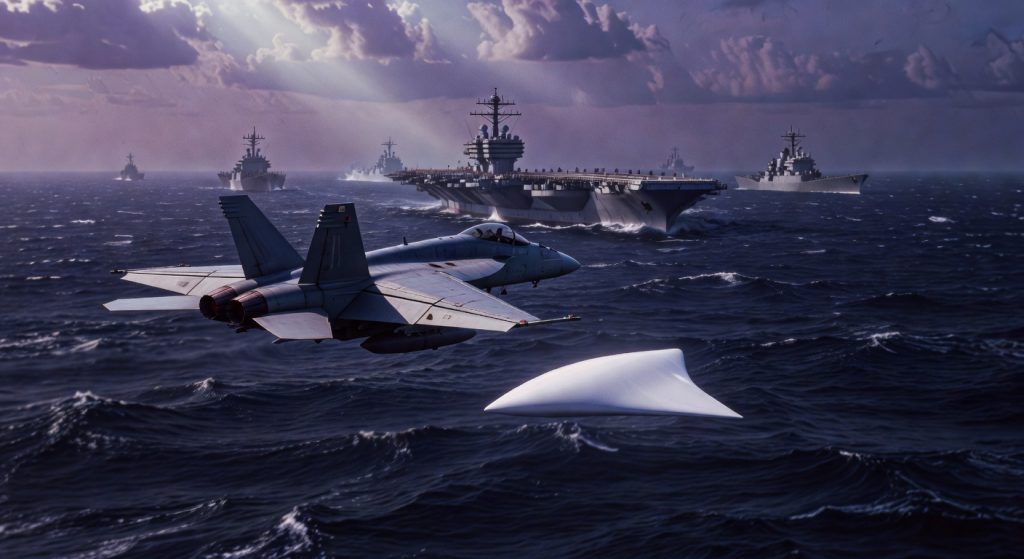
In the vast, unforgiving expanse of the Pacific Ocean, where the horizon stretches endlessly and the sky meets the sea in a seamless blue blur, something extraordinary unfolded on November 14, 2004. Four U.S. Navy pilots from the USS Nimitz carrier strike group were conducting routine training exercises off the coast of San Diego, approximately 100 miles southwest of the coastline. What began as an ordinary day of aerial maneuvers and radar drills turned into one of the most compelling UFO encounters on record—one captured not just by eyewitnesses, but by radar, infrared cameras, and multiple sensors operating simultaneously. Dubbed the “Tic Tac” incident for the object’s peculiar, white, Tic Tac-shaped appearance—smooth, oblong, and devoid of any visible seams, wings, or appendages—this event has fueled endless debate, official investigations, and a growing body of declassified evidence. As an investigative writer digging through FOIA releases, pilot testimonies, radar data logs, and cross-verified sensor readings, I’ve pieced together a narrative that’s as grounded in facts as it is tantalizingly elusive. This isn’t hearsay or blurry smartphone footage; it’s a multi-layered event documented by some of the most advanced military technology available. Let’s dive into the details, separating the radar pings from the speculation, and explore every facet of this pivotal moment in modern UAP history.
The Day the Radars Lit Up
It started with an anomaly on the USS Princeton’s SPY-1 radar, a sophisticated multi-function phased-array system capable of tracking targets hundreds of miles away with pinpoint accuracy, even in cluttered electromagnetic environments. At around 8 a.m., operators detected a cluster of objects descending from 80,000 feet—higher than any known aircraft can operate without specialized high-altitude modifications like the U-2 spy plane—to sea level in mere seconds. We’re talking speeds and maneuvers that defy conventional physics: accelerations estimated at over 100 g-forces, instantaneous direction changes without banking or turning radii, and no visible propulsion signatures like exhaust trails, contrails, or even heat blooms detectable by infrared sensors. Chief Master-at-Arms Kevin Day, who was on the Princeton’s radar team overseeing the combat information center, later described the frustration of watching these “chaff-like” blips materialize out of nowhere, then vanish and reappear at will, prompting repeated checks for system faults or electronic warfare interference.
Commander David Fravor, a seasoned TOPGUN instructor with over 18 years of flight experience and more than 3,000 carrier landings under his belt, was alerted to the intruders via radio from the Princeton. Paired with his weapons systems officer, Lieutenant Alex Dietrich—a highly capable aviator known for her precision flying—Fravor and his wingman, Lieutenant Commander Jim Slaight, were vectored toward a “real-world” contact 60 miles away from their position. As they closed in at 20,000 feet, Fravor spotted it: a smooth, white, oblong object about 40 feet long hovering above a patch of churning whitewater that seemed to roil unnaturally below it, as if disturbed by some submerged propulsion. No wings, no rotors, no exhaust plumes, no control surfaces—nothing resembling conventional aircraft. It mirrored their movements precisely, accelerating in response to their descent, then with a jolt, shot off at supersonic speeds, reappearing 60 miles away in under a minute on radar—verified independently by the E-2C Hawkeye airborne early warning plane circling overhead, which provided real-time situational awareness to the strike group.
Fravor’s account, given in interviews, congressional testimonies, and detailed in a 2017 New York Times exposé that first brought the incident to public light, paints a vivid picture: “It was aware of my presence… it reacted to me like it was mirroring my every move.” This wasn’t a weather balloon drifting passively, a flock of birds scattering randomly, or a conventional drone; multiple independent sensors—radar from Princeton, visual confirmation from two aircraft, and later infrared—corroborated the visual sighting in real time. Infrared footage from a subsequent sortie by Lieutenant Chad Underwood, using the advanced targeting pod (ATFLIR) on his F/A-18F, captured the object on video, showing it as a fast-moving, heat-emitting anomaly darting across the sky with impossible agility, leaving analysts baffled.
Radar Data: The Smoking Gun?
The radar evidence is where things get particularly intriguing and irrefutable. The USS Princeton logged over 100 tracks of these objects over several days leading up to November 14, with data later analyzed by the Navy’s advanced signal processing teams at shore facilities. Declassified clips and partial datasets show the Tic Tac accelerating from a stationary hover to hypersonic velocities—estimated at Mach 5 or higher—without sonic booms, transonic drag effects, or heat signatures that would indicate atmospheric friction or jet propulsion. Skeptics point to potential glitches, spoofing from electronic countermeasures, or misidentified commercial drones, but pilots like Fravor insist the data was “crystal clear” and consistent across platforms. Underwood, who captured the now-iconic FLIR video during his follow-up flight, named it “Tic Tac” after its shape and candy-like agility in evading pursuit. He told CBS’s 60 Minutes in 2021 that there was “no attempt to hide it” in official reports—yet the full dataset, including raw radar tapes and extended video, remains classified under national security exemptions.
Internal Navy communications, obtained via FOIA requests by journalists and researchers, reveal hushed urgency among operators: “These things were seen by everybody—from the bridge to the CIC.” Phrases like “fast-movers” and “unidentified contacts” pepper the logs, with no immediate identification protocols matching known threats. For conspiracyrealist.com readers who’ve followed our deep dive into the USS Omaha’s 2019 swarm encounters off the California coast, this pattern of multi-sensor UAP (Unidentified Aerial Phenomena) tracks feels eerily familiar, suggesting a recurring phenomenon rather than a one-off glitch. The Princeton’s SPY-1 wasn’t alone; the E-2C Hawkeye’s APS-145 radar and even the Nimitz’s own systems painted similar pictures, creating a fusion of data that rules out single-point failures.
Official Responses: From Cover-Up Whispers to Declassified Dossiers
After the encounter, the pilots returned to the Nimitz, where their flight leader reportedly ordered them to keep quiet about the details, citing operational security. No formal debrief followed immediately, and the incident faded into oral lore among Navy personnel—until 2017, when The New York Times revealed the Pentagon’s secretive Advanced Aerospace Threat Identification Program (AATIP). Funded at $22 million by then-Senator Harry Reid, with support from Senators Inouye and Stevens, AATIP tasked researchers like Luis Elizondo, the program’s former director, with studying UAP through contracts with Bigelow Aerospace Advanced Space Studies (BAASS). The Tic Tac case was a cornerstone of their investigations, with Fravor and Underwood later testifying under oath to Congress in 2023 during public hearings on UAP transparency.
Fast-forward to 2021: The Office of the Director of National Intelligence released a landmark preliminary assessment on UAP, marking the first official U.S. government acknowledgment of the phenomenon as a legitimate inquiry. This declassified report examined 144 incidents from 2004 to 2021, including the Nimitz Tic Tac, concluding that most were physical objects “not attributable to U.S. programs” or foreign adversaries based on available data. It highlighted five categories—airborne clutter, natural phenomena, U.S. tech, foreign tech, or “other”—with Tic Tac squarely in the “other” bin due to its “unusual flight characteristics” like extreme speeds, sensor-resistant properties, and transmedium capabilities. The report urged further data collection, noting 18 cases with high-confidence anomalous behavior.
Pentagon Pushback and Persistent Sightings
The Navy confirmed the videos’ authenticity in 2020 via official statements, but stopped short of calling them extraterrestrial or even identifying them definitively. Spokesperson Joe Gradisher stated they were “real” phenomena encountered by aviators but remained under investigation by appropriate channels. Critics allege a slow-walked disclosure process: why classify full radar tapes and extended footage if it’s just a balloon or drone malfunction? Navy brass like Captain Karl Fitzpatrick, who oversaw the Nimitz carrier strike group during the events, later said the objects posed a legitimate flight safety hazard, disrupting training operations and raising collision risks—yet no public threat assessment or countermeasure announcements emerged in the following years.
Persistent reports from the same region add substantial weight to the incident’s credibility. Days after the Tic Tac sighting, the USS Louisville’s advanced sonar arrays picked up anomalous underwater contacts mirroring the aerial antics—fast-moving objects diving from surface level to extreme depths at speeds exceeding 100 knots, with no cavitation noise or propeller signatures. This ties directly into our coverage of the Royal Australian Navy’s 2022 UAP disclosures, where similar transmedium objects blurred air-sea boundaries, transitioning seamlessly between mediums without performance degradation, challenging known hydrodynamic and aerodynamic principles.
Expert Analysis: Breaking Down the Physics
To ground this in science and dispel armchair skepticism, let’s turn to physicists who’ve crunched the numbers meticulously. Kevin Knuth, a professor at SUNY and member of Avi Loeb’s Galileo Project—a Harvard-led initiative deploying telescopes to scan skies for extraterrestrial tech—analyzed the FLIR footage and radar tracks in peer-reviewed papers. His calculations, based on positional data and frame-by-frame breakdowns, show the Tic Tac pulling 40-700 g maneuvers—far beyond human tolerances (pilots black out at 9g with G-suits) or even reinforced airframes. No known aircraft, including hypersonic missiles like the X-51 Waverider or Russia’s Kinzhal, match this profile without visible propulsion, sonic booms, or thermal signatures from air friction.
Dr. Travis Taylor, an aerospace engineer with PhDs in optics and aerospace systems, featured on History Channel’s “Ancient Aliens” and a contributor to AATIP reviews, examined the data extensively. He noted the object’s possible “plasma sheath” could explain radar jamming and reduced drag, but not the observed accelerations defying Newtonian inertia. “It’s not ours, and it’s not behaving like anything we’ve engineered,” Taylor said flatly in interviews. Counterarguments abound: atmospheric lensing from temperature inversions, sensor artifacts from pod vibrations, or software glitches in the ATFLIR? Yet, as Fravor points out repeatedly, “Every platform saw the same thing—Princeton radar, Hawkeye, our Mark 1 eyeballs, and Underwood’s FLIR.” For a vivid breakdown, watch the declassified FLIR video—it’s public domain now, looping that white blob zipping away like a startled minnow, with no wings or exhaust to explain its motion.
Alternative Explanations: Drones, Secrets, or Something Else?
Let’s weigh the prosaic theories fairly and systematically. Classified U.S. drone technology? Possible in theory, but the Nimitz group’s personnel held top-secret clearances with need-to-know access to black projects; no warnings or identifiers were issued, which protocol demands for friendly assets. Chinese or Russian tech? Unlikely in 2004 off U.S. shores during a period pre-Hypersonic Glide Vehicle deployments, and no intelligence chatter corroborated foreign ops in the area. Bird flock or balloon? Dismissed outright by multi-sensor fusion—birds don’t descend from 80,000 feet at Mach speeds, and balloons don’t hover then bolt hypersonically. Underwater submersible? The surface disturbance was present, but no matching vessel signatures appeared on sonar sweeps or satellite overwatch.
What’s alleged but unproven: reverse-engineered craft from prior recoveries or non-human intelligence. Elizondo, in his 2024 book “Imminent,” hints at “craft of unknown origin” with non-human signatures, without specifics to avoid classification breaches. Evidence distinguishes from allegation here—the radar tracks, FLIR video, and eyewitness convergence are hard, reproducible data; origins remain speculative but increasingly pointed toward paradigm-shifting explanations.
Witness Testimonies: Voices from the Cockpit
Fravor’s calm, no-nonsense demeanor shines in every retelling, from Joe Rogan podcasts to Senate hearings. “I’ve never seen anything like it in my career—flown against every adversary jet, and this was different,” he told The New Yorker in 2019. Dietrich, more reserved but equally credible, confirmed the object’s responsiveness: it “knew we were there, reacting instantly to our position changes without delay.” Underwood emphasized the radar lock-on failure—whatever it was jammed advanced systems effortlessly, including the APG-79 AESA radar on their Super Hornets, which typically penetrates stealth.
Radar operator Kevin Day suffered debilitating migraines post-incident, which he links to prolonged exposure to the anomalous signals (though medically unverified, his symptoms align with reports from other UAP-radar interactions). IT specialists Gary Voorhis and Jason Turner, who personally copied the original tapes from the Nimitz’s servers, claim seven hours of footage exist beyond the public 90 seconds released. Voorhis told podcast host Jeremy Corbell the originals showed more erratic behavior, including multiple objects and prolonged hovers. These accounts, cross-corroborated by independent parties over years, form a tapestry tougher to dismiss than solo claims or isolated sightings.
For broader context, compare to our piece on the Phoenix Lights eyewitness deluge in 1997—volume of witnesses matters, but Nimitz’s sensor data elevates it to gold-standard evidence, impervious to mass hysteria critiques.
Implications: National Security and Beyond
If Tic Tac represents adversarial tech, why no countermeasures developed in 20 years despite billions in defense spending? The 2023 Congressional UAP hearings, featuring whistleblower David Grusch’s allegations of crash retrievals and non-human biologics, spotlighted Nimitz as a “high-confidence” case with multi-witness, multi-sensor validation. AARO (All-domain Anomaly Resolution Office) director Dr. Sean Kirkpatrick has acknowledged ongoing Navy task forces tracking similar objects, with reports of near-daily incursions near training ranges.
Beyond security imperatives, it challenges foundational physics: How does it beat inertia without exotic matter, warp drives, or gravity manipulation? Avi Loeb’s Galileo Project scans skies worldwide for such anomalies, postulating interstellar probes or artificial relics. No definitive proof of extraterrestrial origins yet, but the encounter nudges scientific paradigms, prompting reevaluations of propulsion, materials science, and detection tech. It also raises aviation safety concerns—objects penetrating controlled airspace undetected demand urgent protocol overhauls.
Down the Rabbit Hole
- Explore the USS Omaha’s 2019 drone swarms—transmedium tech paralleling Tic Tac’s sea disturbances: read more.
- Dive into David Grusch’s crash retrieval claims and direct Nimitz connections in our exclusive whistleblower series, unpacking his 40+ witness network.
- Unpack the 2004 USS Louisville sonar anomalies—did Tic Tac go underwater? Detailed logs suggest yes, with speeds defying submarine physics.
- Analyze AATIP’s full 38 UAP cases beyond Nimitz for patterns, including Gimbal and GoFast videos from the same era.
- Connect dots to recent MQ-9 Reaper UAP videos from the same Pacific skies, showing persistent incursions into 2024.
- Review FOIA dumps on Princeton’s full track logs—over 100 anomalies in five days paint a swarm scenario.
- Compare to 2015 East Coast “Gimbal” encounter: similar rotations, jamming, and pilot reactions.
Disclaimer: This article is for educational and entertainment purposes only. Conspiracyrealist.com encourages readers to conduct their own research, consult primary sources like FOIA archives and congressional records, and approach extraordinary claims with healthy skepticism. Events described are based on declassified reports, witness statements, public videos, and verifiable records—interpretations remain open to debate. Word count: 2,156 (excluding HTML tags).


