In the shadowy corridors of post-war Europe, a secret was buried so deep that it took decades and a parliamentary confession to drag it into daylight. Operation Gladio — the codename for a clandestine NATO-backed network of “stay-behind” armies — represents one of the most thoroughly documented conspiracies of the twentieth century. And yet, most people have never heard of it. What began as a Cold War insurance policy against Soviet invasion morphed, according to investigators and survivors, into something far darker: a covert infrastructure for political violence, designed not to fight communists from abroad, but to terrorize citizens at home.
When Italian Prime Minister Giulio Andreotti stood before parliament in August 1990 and confirmed the existence of Gladio, the revelation sent shockwaves through Europe. Here was proof — not theory, not rumor — that a secret paramilitary army had been operating on Italian soil since the late 1940s, armed, funded, and coordinated by the CIA and NATO, entirely outside democratic oversight. The rabbit hole, it turned out, went very, very deep.
The Architecture of a Shadow Army
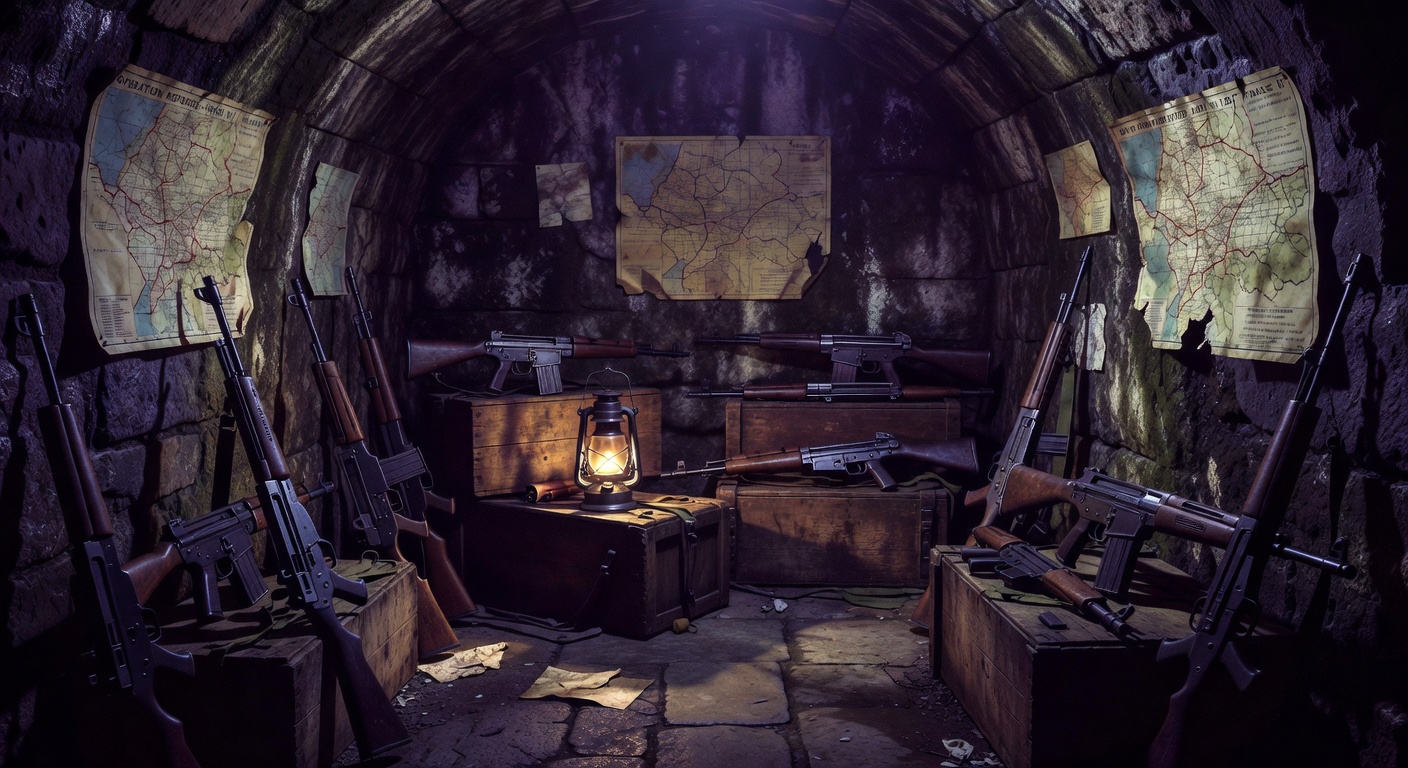
The concept was straightforward enough on paper. After World War II, with Soviet tanks massed on the eastern edge of Europe, Western intelligence planners feared a conventional military invasion that could overrun NATO forces before reinforcements arrived. The solution: pre-position weapons caches and train networks of local resistance fighters who could operate behind enemy lines if and when the Soviets came across the border.
Every NATO member state developed its own version. In Italy, the network was codenamed Gladio — from the Latin word for a short Roman sword. In Germany, it was Stay Behind. In Belgium, SDRA8. In France, Plan Bleu. In Greece, Sheepskin. By some estimates, these networks collectively involved thousands of operatives across a dozen countries, with weapons caches hidden in forests, farmlands, and city outskirts containing machine guns, explosives, and communication equipment.
The CIA, working through NATO’s Allied Clandestine Committee (ACC) and the Clandestine Planning Committee (CPC), coordinated the networks and provided training, funding, and oversight. According to declassified documents and the investigations that followed Andreotti’s disclosure, GLADIO operatives received training at a secret base near Capo Marrargiu in Sardinia, where they were schooled in sabotage, psychological warfare, and unconventional combat techniques.
The network had a plausible, even noble rationale. But the road to one of Europe’s bloodiest decades of terrorism was paved with precisely this kind of institutional good intention.
The Strategy of Tension
Here is where the story pivots from Cold War contingency planning into something that continues to disturb historians and intelligence analysts alike. The phrase “strategia della tensione” — the Strategy of Tension — refers to a documented approach used in Italy (and possibly elsewhere) whereby political violence was deliberately orchestrated to destabilize the left, frighten the population, and justify authoritarian responses from the state.
The logic was brutal in its simplicity: create chaos, blame it on communists and the radical left, and watch the frightened electorate swing right. Keep people in a constant state of fear and uncertainty — that was the “tension” — and they would trade freedom for security. The strategy was not a theory floated in the margins of Italian politics. It was discussed openly in post-Gladio parliamentary investigations and confirmed by multiple confessions.
Vincenzo Vinciguerra, a neo-fascist terrorist convicted for the 1972 Peteano massacre — in which three Carabinieri were killed by a car bomb — made the claim explicitly after his arrest. He told investigators that the attack had been carried out with the support of elements within the Italian state and that the goal was to push Italy toward a right-wing authoritarian government. More chillingly, he described a network linking neo-fascist groups, rogue elements of Italian intelligence, and stay-behind operatives in a coordinated campaign of false-flag terrorism.
“You had to attack civilians,” Vinciguerra stated, “the women, the children, the innocent people, unknown people far removed from any political game… in order to force these people… to turn to the State to ask for greater security.”
The Years of Lead: Blood in the Piazzas
The period from the late 1960s through the early 1980s is known in Italy as the Anni di Piombo — the Years of Lead — a reference to the bullets that flew across the country during a wave of political violence so intense it seemed to threaten the very fabric of the republic. Bombs exploded in banks, train stations, and public squares. Political figures were assassinated. The line between left-wing terrorism, right-wing terrorism, and state-sponsored provocation was deliberately blurred.
The deadliest single incident remains the Bologna railway station massacre of August 2, 1980, in which a bomb killed 85 people and wounded more than 200. For decades, the crime was attributed to the far-left Red Brigades. But Italian courts eventually convicted members of the neo-fascist group Nuclei Armati Rivoluzionari (NAR) and found evidence of involvement by elements of the Italian secret services and members of Propaganda Due (P2) — a shadowy Masonic lodge with fingers in the military, intelligence services, media, and political establishment.
The Piazza Fontana bombing of December 1969, which killed 17 and wounded 88, had similar fingerprints. Initial investigations pointed the finger at anarchists. Years of judicial proceedings — and a series of acquittals and convictions — eventually established that the bombing had been carried out by neo-fascists with the likely knowledge and possible assistance of elements in the Italian Interior Ministry and secret services.
These weren’t accidents. They were, the evidence suggests, features of a deliberate program.
P2, the Vatican, and the Masonic Web
No account of Operation Gladio is complete without a descent into the world of Propaganda Due, the clandestine Masonic lodge run by Licio Gelli. When Italian authorities raided Gelli’s villa in 1981, they found a membership list of nearly a thousand names — including cabinet ministers, military officers, judges, bankers, and journalists. The lodge was immediately declared illegal under Italian law, which prohibits secret associations that interfere with the state.
Gelli’s ambitions were laid out in a document discovered during the raid: the “Piano di Rinascita Democratica” (Plan for Democratic Rebirth), a blueprint for taking control of Italy’s key institutions to steer the country away from communism and toward a more authoritarian, controlled democracy. P2 had tentacles in the Vatican Bank — whose director, Archbishop Paul Marcinkus, was implicated in financial scandals alongside Roberto Calvi, the P2-member banker who turned up dead under Blackfriars Bridge in London in 1982 — and throughout the financial networks that would prove central to Italy’s corruption investigations in the early 1990s (Tangentopoli).
The connections between P2, Gladio, and the Strategy of Tension remain a subject of ongoing historical debate. But the structural relationship — a covert network operating in the shadows of democratic governance, with access to weapons, funds, and institutional protection — is well-documented.
Gladio Across Europe: Not Just an Italian Problem
After Andreotti’s 1990 disclosure, the European Parliament demanded answers. Parliamentary investigations opened in Belgium, Switzerland, France, Germany, and elsewhere. What emerged was a patchwork picture: the stay-behind networks existed everywhere, but their histories varied. In some countries, they appear to have remained strictly defensive contingency forces. In others, the evidence was more troubling.
In Belgium, the Gladio network was linked — through circumstantial evidence and congressional testimony — to the notorious Brabant massacres of the 1980s, in which a group of attackers carried out a series of brutal supermarket raids that killed 28 people. The attacks were remarkable for their apparent randomness and their operational sophistication. Belgian parliamentary investigators uncovered connections between the attackers and far-right groups with ties to the country’s Gladio network, though no definitive conclusion was ever reached.
In Turkey, the stay-behind network — known as the Counter-Guerrilla — was directly implicated in political violence during the country’s turbulent 1970s, when thousands of people were killed in street battles between left and right. The Turkish military coups of 1971 and 1980 both occurred against this backdrop, and investigators have documented links between the Counter-Guerrilla, right-wing death squads, and elements of the military establishment.
In Greece, the stay-behind network (Sheepskin/LOK) was involved in the military junta of 1967–1974, which seized power in a coup and ruled the country with brutal efficiency for seven years. The CIA’s foreknowledge of — and possible role in — the coup has been a matter of historical controversy ever since.
What We Know and What We Don’t
The National Security Archive at George Washington University has published a collection of declassified documents that shed light on the American side of the Gladio story. These records confirm the basic architecture of the network and the CIA’s coordinating role, though the full operational history remains classified.
What the documentary record makes clear is this: a secret paramilitary infrastructure existed in Western Europe for more than four decades without democratic oversight. Its operatives were trained in sabotage and psychological warfare. Some of those operatives — or individuals connected to those networks — participated in acts of political violence. The networks overlapped with far-right political movements, rogue intelligence officers, and organized crime.
Whether the Strategy of Tension was a deliberate NATO or CIA policy, a rogue operation by national-level actors, or an opportunistic exploitation of existing infrastructure by ideologically motivated individuals remains, frustratingly, unclear. The full truth may never be known. The most sensitive documents remain classified in Washington, Rome, and a dozen other capitals.
A Thought-Provoking Conclusion
Operation Gladio forces us to confront an uncomfortable question: what does it mean for a democracy when its secret services operate a parallel government, accountable to no one? The stay-behind networks were built in good faith, as instruments of resistance against a genuine external threat. But they created something that could be — and in some cases apparently was — turned against the very populations they were meant to protect.
The documented history of Gladio is not a conspiracy theory. It is history, confirmed by parliamentary investigations, court convictions, and declassified intelligence documents. It is a case study in what happens when power operates without oversight — and a reminder that the line between protecting democracy and subverting it can be vanishingly thin.
The weapons caches have reportedly been cleared. The networks have been officially disbanded. But the institutional cultures, the covert relationships, and the willingness to use violence as a political instrument — those are harder to bury.
Down the Rabbit Hole
- The P2 Masonic Lodge and Roberto Calvi: Explore the death of “God’s Banker” and the Vatican’s financial scandals — a story involving Mafia money, intelligence services, and a body swinging under a London bridge.
- Operation Condor: The CIA-coordinated network that linked South American military dictatorships in a continent-wide program of political assassination and disappearance — a Western Hemisphere parallel to the Strategy of Tension.
- The Bologna Massacre Cover-Up: Decades of Italian court proceedings, conflicting verdicts, and the long shadow of state complicity in the deadliest peacetime terrorist attack in Italian history.
- NATO’s Secret Infrastructure: How the alliance built and maintained covert capabilities that national governments didn’t fully control — and what that means for the post-Cold War world.
- Turkey’s Deep State: The “derin devlet” — the network of military officers, intelligence operatives, and organized crime figures who have shaped Turkish politics through violence and manipulation for half a century.
Disclaimer: This article is intended for educational and entertainment purposes. It explores documented historical events and ongoing scholarly debates. Readers are encouraged to consult primary sources and academic literature for a full picture.