

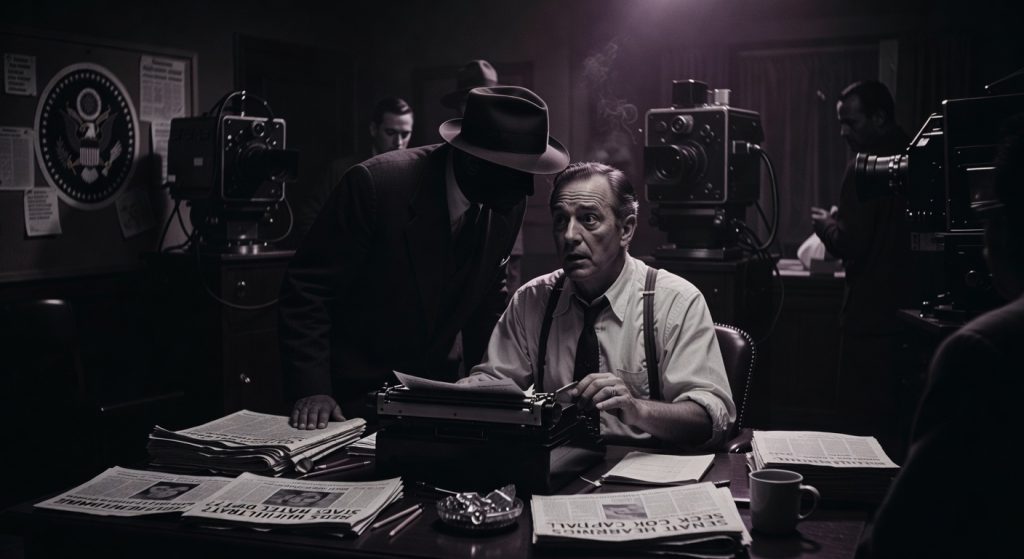
Imagine waking up one morning to discover that the trusted journalists delivering your daily news were, in some cases, also reporting directly to the Central Intelligence Agency. That the editors shaping public opinion had agreements with Langley. That the very machinery of American journalism — the networks, the wire services, the major newspapers — had been quietly colonized by intelligence operatives who understood that controlling the narrative was just as powerful as controlling the battlefield. For many Americans, this would sound like paranoia of the highest order. But for those who’ve followed the documented history of Operation Mockingbird, it sounds like a history lesson.
The Architecture of Influence
The story begins in the early years of the Cold War, when the newly-formed CIA recognized something fundamental: in a conflict fought as much with ideas as with weapons, controlling information was a strategic imperative. The Soviet Union had its propaganda apparatus. The United States needed one too — but one that operated with subtlety, embedded within the existing fabric of a free press rather than visibly replacing it.
The man most associated with building this apparatus was Frank Wisner, the first head of the CIA’s Office of Policy Coordination. Wisner was a Wall Street lawyer turned intelligence operative who had an extraordinary talent for networking among the social elite. In postwar Washington and New York, the worlds of journalism, government, and intelligence overlapped significantly — the Ivy League backgrounds, the gentlemen’s clubs, the wartime OSS connections. Wisner moved through these circles with ease, cultivating relationships that would become the backbone of what later became known as Operation Mockingbird.
Wisner reportedly called his network of media assets his “Mighty Wurlitzer” — a reference to the theater organ that could fill an entire hall with sound, implying he could play whatever tune was needed and have it echo through the entire American media landscape.
The Names and the Outlets
The most comprehensive public accounting of Operation Mockingbird came not from internal CIA documents but from a bombshell piece of journalism: Carl Bernstein’s landmark 1977 article in Rolling Stone magazine, “The CIA and the Media.” Bernstein, fresh off the Watergate reporting that had toppled a presidency, spent six months investigating the relationship between the CIA and the American press.
What he found was staggering. According to Bernstein’s reporting, based on CIA documents and interviews with intelligence officials and journalists, the Agency had relationships with more than 400 American journalists over a 25-year period. These weren’t just peripheral figures. They included some of the most prominent names in American media:
- CBS News was identified as having particularly deep ties to the CIA, with the network’s founder William Paley maintaining a personal friendship with CIA director Allen Dulles.
- The New York Times provided cover for CIA officers and cooperated with requests to kill or delay stories that the Agency deemed sensitive to national security.
- Time magazine and its founder Henry Luce were reportedly close to CIA operations, with several Time correspondents operating as intelligence assets.
- The Washington Post, Newsweek, The Louisville Courier-Journal, and numerous wire services were named as having participated in varying degrees of cooperation with the Agency.
Some of these relationships were straightforward: journalists passed along information gathered in the course of their work. Others were more involved: CIA officers used journalistic credentials as cover for overseas operations. And in some cases, journalists actively wrote stories shaped by CIA guidance, promoting narratives that served Agency interests.
The Church Committee Revelations
Bernstein’s reporting drew heavily on the work of the Church Committee — the Senate Select Committee to Study Governmental Operations with Respect to Intelligence Activities, chaired by Senator Frank Church of Idaho in 1975. The Church Committee was the most thorough congressional investigation of U.S. intelligence activities ever conducted, and its findings were explosive.
The Committee confirmed that the CIA had used American journalists as intelligence assets. In its final report, it noted that the CIA maintained a network of “several hundred” individuals around the world who provided intelligence to the Agency, including journalists. CIA Director William Colby testified before the committee and acknowledged the practice, though he insisted it was being curtailed.
The official response to these revelations was a set of new guidelines announced in 1977 by then-Director Stansfield Turner, who declared that the CIA would no longer use journalists as paid agents or maintain covert relationships with American media organizations. Critics noted that the guidelines had significant loopholes — they applied to “staff employees” of news organizations but left room for freelancers and stringers — and expressed skepticism about whether the culture of media penetration could be dismantled by administrative decree.
How It Actually Worked
Understanding Operation Mockingbird requires understanding how these relationships actually functioned in practice. This wasn’t, for the most part, a matter of journalists being handed scripts and ordered to publish propaganda. The reality was more subtle and, in some ways, more insidious.
Relationships between CIA officers and journalists often began organically. A CIA officer stationed in a foreign country might cultivate a friendship with a foreign correspondent over years. Information would be exchanged informally — the journalist would share things learned in the course of reporting, and the CIA officer might provide background information that shaped how the journalist understood a story. Over time, these relationships could deepen into something more operational.
The CIA also used its overseas media operations to plant stories internationally that would then be “discovered” and reported by American journalists — a technique known as “black propaganda” or “blowback.” A story seeded in a European newspaper might find its way back to the U.S. press, presenting itself as independent foreign reporting while actually originating with CIA disinformation operations.
At the institutional level, the CIA cultivated relationships with media executives who shared their Cold War anticommunist worldview. These weren’t necessarily paid agents — they were ideological allies who genuinely believed that certain stories should be killed for national security reasons, or that certain narratives about the Soviet threat needed amplification. The line between willing cooperation and coercion was often blurry.
The Debate: How Deep Did It Go?
Defenders of American journalism during the Cold War era argue that the Mockingbird narrative has been exaggerated. They point out that many journalists who had relationships with the CIA maintained their editorial independence, that the Agency’s influence was far from total, and that the American press during this period also published significant journalism that was deeply critical of U.S. foreign policy.
These counterarguments have merit. The picture that emerges from the historical record is not one of a completely captured media, but of a press that was significantly penetrated by intelligence interests, that was deeply sympathetic to Cold War anticommunist ideology, and that often failed to apply adequate skepticism to official government narratives — particularly in the area of foreign policy.
What’s beyond dispute is that the relationships described by Bernstein and the Church Committee existed and were significant. Whether they constituted a coordinated “operation” in a formal sense, or a more diffuse network of mutual interests and informal relationships, their effect on American public discourse was real.
The Question That Won’t Go Away
The obvious question, of course, is: does it still happen? The CIA’s 1977 guidelines notwithstanding, there’s no reason to believe that the culture of media penetration simply evaporated. Intelligence agencies don’t voluntarily surrender influence; they adapt and evolve.
In the decades since the original Mockingbird revelations, a number of journalists have reported that they were approached by intelligence operatives or asked to cooperate with government narratives. The Pentagon’s Information Operations programs, which paid Iraqi newspapers to publish pro-American content in the early 2000s, suggest that the basic playbook remains in use. The integration of former intelligence officials into news commentary roles — retired CIA directors and NSA analysts appearing as regular paid commentators on major networks — represents another dimension of the same basic dynamic.
The media landscape has changed dramatically since the 1970s. The consolidation of media ownership, the rise of digital information, and the fragmentation of the public sphere have created new vulnerabilities and new vectors for influence operations that Frank Wisner could never have imagined with his Mighty Wurlitzer. The notes may have changed. But the instrument remains.
Down the Rabbit Hole
If Operation Mockingbird has you questioning your information sources, here are some connected threads to pull:
- Operation Paperclip: The CIA and military’s recruitment of Nazi scientists after World War II — and what some researchers argue was the simultaneous importation of Nazi-era propaganda and psychological warfare techniques.
- The Office of Strategic Influence (OSI): The post-9/11 Pentagon office that was publicly shut down after revelations it was planning to spread disinformation to foreign media — but which critics argue simply went underground.
- COINTELPRO and Media: The FBI’s program to manipulate media coverage of domestic political groups, planting fake stories and smearing civil rights leaders.
- Project Mockingbird’s Successors: Research into the CIA’s contemporary media operations, including the documented use of social media companies and tech platforms for information operations.
- The Mighty Wurlitzer Today: Investigative journalist Udo Ulfkotte, former editor of a major German newspaper, claimed before his death in 2017 that European journalism was similarly penetrated by intelligence services — a claim that has never been fully investigated.
Disclaimer: This article is intended for educational and entertainment purposes. The events described are based on congressional testimony, declassified documents, and published investigative journalism. Conspiracy Realist presents these topics as historical rabbit holes. Readers are encouraged to consult primary sources and form their own conclusions.


