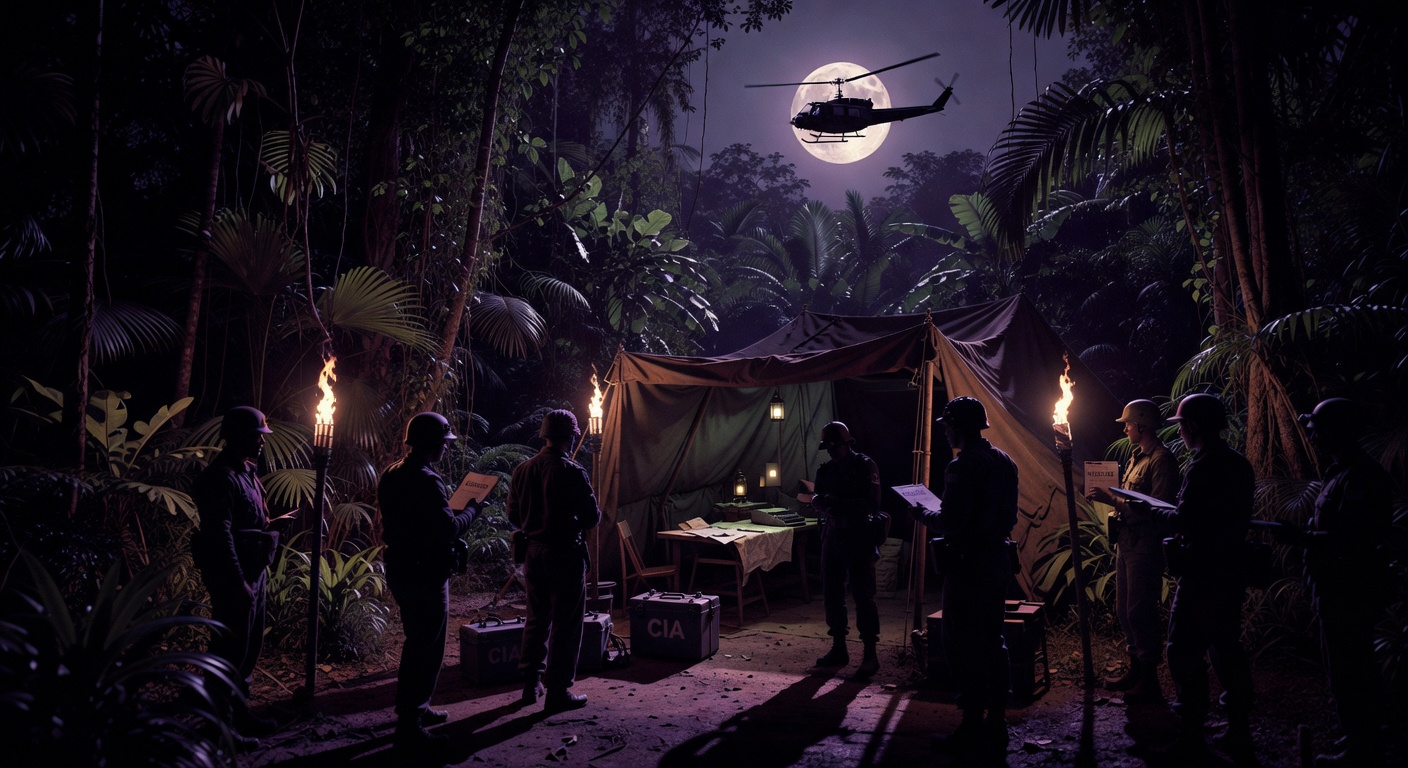
Between 1965 and 1972, a U.S.-managed program operating in South Vietnam identified, neutralized, and in many cases killed an estimated 20,000 to 40,000 people — most of them civilians suspected of belonging to the Viet Cong’s political infrastructure. It was called the Phoenix Program, and it remains one of the most controversial, morally troubling, and instructive covert operations in American history.
Phoenix was not a battlefield program. It was a systematic program of targeted assassination, capture, and “neutralization” of suspected Communist political operatives in South Vietnamese villages. It was managed by the CIA, funded by the U.S. government, and carried out by South Vietnamese forces with American advisors. And it became the template for a doctrine of counterinsurgency that has echoed through American military and intelligence operations ever since.
The Problem Phoenix Was Designed to Solve
By the mid-1960s, American military commanders in Vietnam faced a problem that conventional military strategy was helpless to address. The Viet Cong were not primarily a military force — they were a political movement embedded in the social fabric of South Vietnamese rural life. In thousands of villages across the country, local VC “cadres” collected taxes, recruited fighters, gathered intelligence, distributed propaganda, and maintained the organizational infrastructure that kept the insurgency alive.
Bombing, artillery, and infantry sweeps could kill fighters in the field. But the political infrastructure — the local tax collectors, the sympathetic village chiefs, the VC courier networks, the women who hid supplies, the men who reported troop movements — remained largely untouched. As long as the infrastructure survived, the insurgency would regenerate regardless of battlefield losses.
The answer, in the logic of the CIA and the military planners who designed Phoenix, was to attack the infrastructure directly. To identify each node in the VC network — each local organizer, each intelligence contact, each political operative — and either capture them for interrogation, “turn” them into informants, or kill them.
This was the theory of Phoenix. In practice, it became something considerably more complicated and considerably darker.
The Architecture of Assassination
The Phoenix Program was formally established in 1968 under CIA officer William Colby, who would later become CIA Director. It operated through a network of Provincial Reconnaissance Units (PRUs) — South Vietnamese paramilitary teams advised by American CIA officers and Special Forces personnel.
Each province maintained an Intelligence Operations Coordinating Center (IOCC) that compiled dossiers on suspected VC infrastructure members. Informants — motivated by money, personal grudges, fear, or ideology — provided the raw intelligence. The dossiers were supposed to be reviewed by review boards that would authorize capture, defection, or neutralization operations.
On paper, there were safeguards. In practice, the system was deeply and fatally flawed from the beginning.
Intelligence in wartime Vietnam was extraordinarily difficult to verify. Informants had their own agendas. Local rivalries and personal vendettas were dressed up as VC intelligence. The pressure to produce “neutralizations” — measured and reported as metrics of program success — created perverse incentives to count anyone killed as a VC operative. American advisors, operating in a foreign culture with a foreign language, were often unable to meaningfully evaluate the quality of intelligence they were acting on.
The Torture Problem
Captured suspects in the Phoenix Program were typically taken to Provincial Interrogation Centers (PICs) — facilities run by South Vietnamese security forces with CIA oversight. What happened in those facilities was not a secret, even at the time.
Torture was routine. Electric shocks applied to genitals, water torture, suspension by the arms, and beatings were standard interrogation techniques. Former CIA officer K. Barton Osborn testified before Congress in 1971 that he had witnessed the use of electric shock torture, the insertion of a six-inch dowel into the ear canal of a prisoner (who died as a result), and the imprisonment of prisoners in “tiger cages” — small concrete cells barely large enough to stand in — at the Con Son prison island.
Osborn testified that he had never seen a prisoner exit a PIC alive. His testimony was corroborated by other witnesses. CIA Director Colby disputed the characterizations but acknowledged that abuses had occurred.
The Numbers and What They Mean
The official CIA figures, presented to Congress by Colby in 1971, stated that from 1968 to mid-1971, the Phoenix Program had “neutralized” 20,587 Viet Cong suspects — of whom 6,187 were killed, 8,742 were captured, and 5,658 had “defected.”
South Vietnamese government figures put the total killed under the program at over 40,000 by the time it officially ended. Some researchers believe the true figures were higher.
What the numbers don’t capture is how many of those killed were actual VC operatives and how many were innocent civilians. Multiple veterans who served in Phoenix-related operations have gone on record stating that the “body count” pressure led to innocent people being killed to fill quotas. Documents preserved in the Vietnam Center and Archives at Texas Tech University include internal U.S. government assessments acknowledging that the program’s intelligence was often unreliable.
One of the most damning accounts came from K. William Colby himself, who in his memoir acknowledged that many of those neutralized were not hardened VC cadres but ordinary villagers caught up in a deeply flawed process.
William Colby and the Congressional Reckoning
In July 1971, William Colby testified before the House Government Operations subcommittee chaired by Representative William Anderson. Anderson had served in Vietnam and had seen the program firsthand. His questioning was pointed.
Colby defended Phoenix as a necessary and generally effective counterinsurgency tool. He acknowledged abuses but characterized them as exceptions. He insisted that the program had legitimate safeguards and review processes.
Critics were unconvinced. Vietnam Veterans Against the War were publishing accounts from veterans who had participated in Phoenix operations and described systematic murder. Former intelligence officers were going to the press. The program had become a symbol — for those who opposed the war — of everything that had gone morally wrong in American conduct in Vietnam.
Congress did not shut Phoenix down. The program continued until the broader U.S. withdrawal from Vietnam made it moot. No one was prosecuted for abuses committed under its authority.
The Blueprint Question
What makes Phoenix more than a historical footnote is the question of legacy. After Vietnam, American counterinsurgency doctrine went through a period of official disfavor — the lessons of the war were largely buried rather than analyzed. But the underlying logic of Phoenix — target the leadership, destroy the organizational infrastructure, use local allies to do the killing — never entirely disappeared.
It re-emerged in El Salvador in the 1980s, where CIA and Special Forces advisors helped the Salvadoran military build a counterinsurgency program that bore striking similarities to Phoenix. The architects of that program explicitly drew on Phoenix experience. The death squads of El Salvador killed tens of thousands of people, a significant proportion of them civilians.
It re-emerged again after 9/11, in the global counterterrorism framework built by the George W. Bush administration. The targeted killing program — using drones and special operations forces to kill suspected terrorists without arrest, trial, or judicial review — is Phoenix logic applied with 21st-century technology. The High-Value Target lists that became central to U.S. operations in Iraq and Afghanistan were direct descendants of the VC infrastructure target lists of Phoenix.
Former CIA and military officials have explicitly acknowledged the intellectual lineage. Architect of the surge in Iraq, General David Petraeus, studied Phoenix as a model for the Sons of Iraq program that helped pacify certain areas of Iraq by co-opting local leaders.
The Moral Reckoning That Never Came
The United States has never conducted a full, honest accounting of the Phoenix Program. Colby’s congressional testimony in 1971 was the closest thing to a public reckoning, and it was wholly inadequate. No independent investigation ever assessed how many of the program’s victims were genuine VC operatives and how many were innocent. No one was ever prosecuted for torture or unlawful killing.
The deeper question Phoenix raises is not just about Vietnam but about a consistent pattern in American counterinsurgency doctrine: the willingness to accept civilian casualties, torture, and assassination as legitimate tools when fighting designated enemies, combined with the institutional refusal to honestly assess the costs and efficacy of those tools afterward.
The pattern runs from Phoenix to El Salvador to Iraq to the contemporary drone program. Each iteration promises better targeting, more safeguards, fewer civilian casualties. Each iteration produces its own version of the same moral failures. And each iteration is eventually buried in a classified report that no one is allowed to read.
Down the Rabbit Hole
The Phoenix Program connects to a broader history of American covert operations worth exploring:
- Operation Condor — A U.S.-backed program in South America during the 1970s that coordinated assassination and disappearances across multiple Latin American military dictatorships, using techniques directly informed by Phoenix veterans.
- The Salvador Option — A 2005 Newsweek report revealed that the U.S. military was considering applying Phoenix-style death squad tactics in Iraq. The subsequent history of Iraqi sectarian violence raises questions about what actually happened.
- The Drone Strike Program and Signature Strikes — The Obama administration’s expansion of “signature strikes” — killing people based on patterns of behavior rather than positive identification — is Phoenix logic in its purest form.
- Tiger Cages and Black Sites — The CIA’s post-9/11 detention and interrogation program used techniques strikingly similar to those documented in Phoenix-era PICs, raising questions about institutional memory and doctrine.
- Frank Snepp and CIA Whistleblowing — Former CIA officer Frank Snepp wrote about the chaos of the CIA’s final days in Saigon in his book Decent Interval. The CIA sued him for it. His case raises fundamental questions about accountability and secrecy.
Disclaimer: This article is intended for educational and entertainment purposes. The Conspiracy Realist presents documented historical facts, congressional testimony, and credible historical scholarship alongside analysis. The Phoenix Program is a fully documented historical program. Readers are encouraged to consult primary sources and form their own conclusions.