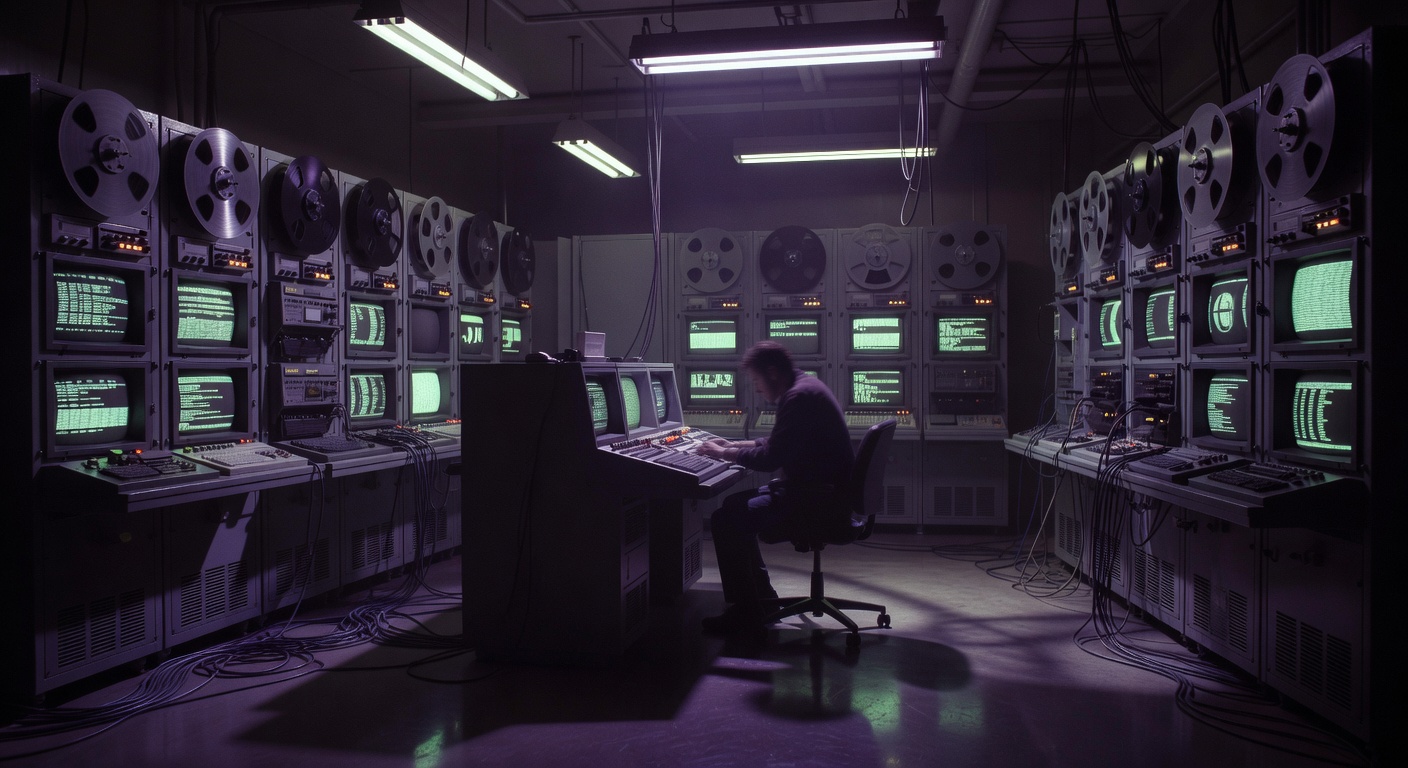
In the early 1980s, a small Washington D.C. software company called Inslaw Inc. developed what may have been the most sophisticated case-management software ever created for law enforcement. They called it PROMIS — Prosecutor’s Management Information System. It was designed to track criminal cases through the court system, connecting disparate databases in ways that no other software could match at the time.
The Department of Justice licensed it. Then, according to a remarkable chain of evidence assembled over more than a decade of investigation, someone modified it, inserted a hidden backdoor, and sold it to intelligence agencies and governments around the world — allowing U.S. intelligence services to monitor the most sensitive operations of foreign governments in real time.
If true, PROMIS represented one of the most audacious intelligence operations in American history. And the story of how it was allegedly stolen, modified, and weaponized — and the cover-up that followed — is stranger than almost any spy novel.
The Software That Could Do Everything
PROMIS was extraordinary for its time. Developed by William Hamilton and his company Inslaw in the late 1970s and early 1980s, it could integrate data from multiple incompatible databases simultaneously — a capability that was genuinely revolutionary when most government systems couldn’t talk to each other at all.
The Department of Justice contracted with Inslaw in 1982 to deploy PROMIS across 94 U.S. Attorney’s offices. The contract was worth approximately $10 million. What followed was, according to Hamilton and subsequent investigations, a deliberate effort by DOJ officials to steal the software without paying for the enhanced version, force Inslaw into bankruptcy, and then quietly distribute the technology to parties who would put it to very different uses.
The DOJ disputes this characterization entirely. But courts — repeatedly — sided with Inslaw.
The Courts Weigh In
In 1987, a U.S. Bankruptcy Court judge named George Bason ruled that the Department of Justice had “stolen” PROMIS from Inslaw “through trickery, fraud and deceit.” He awarded Inslaw $6.8 million. His ruling was extraordinary — a federal court directly accusing the Department of Justice of fraud.
Bason’s ruling was later overturned on technical procedural grounds by an appeals court — not because the underlying findings were wrong, but because a bankruptcy court allegedly lacked jurisdiction over the government. Bason, notably, was not reappointed to the bench after making his ruling, a decision he publicly attributed to his PROMIS findings.
In 1989, a U.S. District Court also found in Inslaw’s favor. The House Judiciary Committee opened an investigation. The Senate Judiciary Committee eventually followed.
In 1992, the House Judiciary Committee’s investigative counsel, Joseph Goulden, issued a report that found “strong indications” that PROMIS had been stolen and misappropriated, and recommended a special counsel investigation. Attorney General William Barr — then serving his first term as AG — refused to appoint one.
Enter the Intelligence Community
The PROMIS story might have remained a complex but relatively conventional government contract dispute. What transformed it into one of the most fascinating alleged intelligence conspiracies of the late 20th century was a series of investigations by journalists, most notably Danny Casolaro and later Seymour Hersh and others, that suggested PROMIS had been modified with a hidden backdoor and sold to foreign governments and intelligence agencies.
The alleged mechanism was brilliant in its simplicity: PROMIS was already designed to pull together data from multiple sources. If a foreign intelligence service, a drug enforcement agency, or a foreign government used PROMIS to track their most sensitive operations, a hidden backdoor would allow whoever installed it to monitor everything those agencies knew.
According to multiple sources developed by investigative journalists, PROMIS with its backdoor was sold to intelligence services in Israel, Jordan, Iraq, Canada, South Korea, and numerous other countries. It was allegedly sold to foreign banks. It was allegedly installed in systems at Los Alamos National Laboratory. It was allegedly used by Interpol.
The person most often named as the central figure in the alleged distribution of modified PROMIS is Earl Brian, a former California cabinet official with close ties to the Reagan administration. Brian has categorically denied all such allegations. He was never criminally charged in connection with PROMIS.
Danny Casolaro and the Octopus
The journalist who pursued the PROMIS story most aggressively paid for it with his life — or so many believe.
Danny Casolaro was a freelance writer who became obsessed with what he called “the Octopus” — a shadowy network of intelligence operatives, organized crime figures, and government officials that he believed connected PROMIS, the Iran-Contra affair, the Bank of Credit and Commerce International (BCCI) scandal, and numerous other threads into a single overarching criminal conspiracy.
In August 1991, Casolaro traveled to Martinsburg, West Virginia to meet a source he said would give him the final piece of his story. He told friends and family he was close to breaking everything open. He was found dead in his hotel bathtub on August 10, 1991, his wrists slashed multiple times.
The death was ruled a suicide. But the ruling drew immediate skepticism. Casolaro had recently told friends he was being followed and had received death threats. His briefcase, which colleagues said contained his research notes, was missing when his body was found — similar to what happened with Caradori’s briefcase in the Franklin case.
Local authorities embalmed his body before his family could be notified and before an independent autopsy could be conducted. The manner of the embalming was later criticized as having destroyed forensic evidence. His family has never accepted the suicide ruling.
Robert Hanssen and the Russian Connection
In 2001, FBI agent Robert Hanssen was arrested for being one of the most damaging spies in American history, having sold intelligence to the Soviet Union and Russia for over 20 years. Among the secrets he allegedly sold: the existence of PROMIS and how it had been distributed.
According to reporting in Insight magazine and later in other outlets, Hanssen had informed the Russians about the PROMIS backdoor, potentially allowing them to exploit the same backdoor in systems the U.S. had sold PROMIS to — or to warn the intelligence services using PROMIS about the vulnerability.
This alleged connection tied the PROMIS story directly to one of the FBI’s worst counterintelligence failures. The Department of Justice’s own records on the Hanssen case confirm the extraordinary damage he caused, though the specific PROMIS allegations remain in the realm of investigative reporting rather than formal legal findings.
The Technology That Preceded Everything
What makes PROMIS particularly haunting in retrospect is how prescient it was. PROMIS’s alleged function — a surveillance system that could aggregate data from multiple incompatible sources in real time and track targets across databases — is precisely what modern intelligence systems do. PRISM, the NSA surveillance program revealed by Edward Snowden in 2013, does essentially what PROMIS allegedly did, but at internet scale.
Did PROMIS serve as a template — technical, conceptual, or both — for what came later? Several former intelligence officials and technology researchers have suggested as much.
The broader questions the PROMIS case raises about the relationship between government agencies and technology companies, about backdoors in software, and about the weaponization of commercial software for intelligence purposes have only become more relevant with each passing year.
What the Official Record Shows
The official record is itself remarkable. Courts found that the DOJ stole PROMIS from Inslaw. Congressional investigators found strong evidence of wider misappropriation and recommended a special counsel. The appointed special counsel in 1993, Nicholas Bua, investigated and concluded there was no credible evidence of the wider conspiracy — but Bua’s investigation was criticized by Inslaw’s attorneys and congressional investigators as inadequate. Inslaw sued the government for decades.
William Hamilton continued pursuing legal remedies into the 2000s. The case was never fully resolved to his satisfaction. PROMIS — what it was, what was done with it, and who benefited — remains one of the genuinely murky episodes in the history of American intelligence.
Down the Rabbit Hole
The PROMIS story branches in multiple directions worth following:
- The BCCI Scandal — The Bank of Credit and Commerce International was a Pakistani-founded bank that served as a financial clearing house for intelligence agencies, drug cartels, and arms dealers worldwide. Its connections to the PROMIS network have been alleged by multiple investigators.
- The NSA’s Backdoor Programs — The Snowden revelations confirmed that the NSA has worked with technology companies to insert vulnerabilities into commercial software. PROMIS may have been an early proof of concept.
- Iran-Contra’s Hidden Tentacles — The Iran-Contra affair’s official investigation was widely believed to have only scratched the surface. Several researchers believe PROMIS was part of the same operational network.
- The Death of Journalists Investigating Intelligence — Casolaro is not the only journalist to have died while investigating intelligence-related stories. The pattern is worth examining.
- Software Supply Chain Attacks — From the 2020 SolarWinds hack to other incidents, the weaponization of legitimate software for intelligence gathering is a well-documented modern phenomenon. PROMIS may have been where it started.
Disclaimer: This article is intended for educational and entertainment purposes. The Conspiracy Realist presents documented historical facts, court findings, congressional records, and credible investigative journalism alongside speculative analysis. Some allegations in this case have not been legally proven. Readers are encouraged to research primary sources and form their own conclusions.