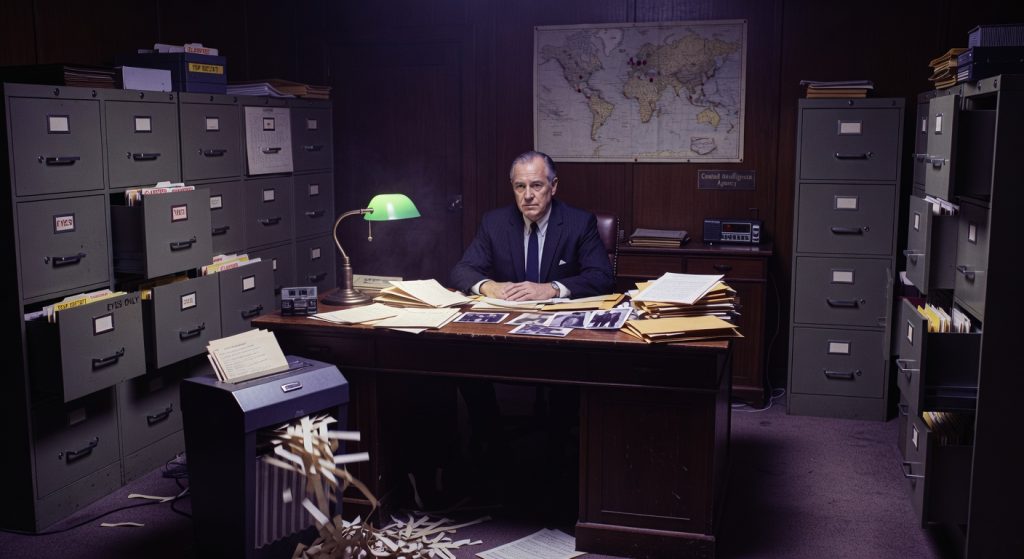
There is a phrase that runs like a thread through every major CIA scandal of the twentieth century — a phrase so elegantly cynical, so perfectly designed to absorb blame and scatter accountability, that it became less a policy and more an art form. The phrase is plausible deniability. And no one wielded it with more precision — or more consequence — than Richard Helms, the CIA’s master of the long game.
Helms didn’t invent the concept. Governments have always created buffer layers between decision-makers and dirty deeds. But Helms turned it into architecture. During his tenure as Director of Central Intelligence from 1966 to 1973 — and during the critical years before it, when he was rising through the ranks of the Agency’s clandestine service — he built systems specifically designed so that the most damaging operations could proceed without anyone at the top ever having to admit they authorized them. And when things went wrong, as they inevitably did, the shield held. Mostly.
To understand why this matters today, you have to go back to a moment in history when the United States government decided that the rules applying to everyone else didn’t apply to its intelligence agencies.
The Man Behind the Curtain
Richard Helms was born in 1913 in St. Davids, Pennsylvania, into a family connected to the upper reaches of American business and society. His grandfather had once run a major U.S. corporation. Helms attended prep school in Germany and Switzerland, spoke fluent German, and briefly worked as a journalist before World War II — an experience that shaped his understanding of how information could be curated, suppressed, or weaponized.
He joined the Office of Strategic Services (OSS), the wartime predecessor to the CIA, and took to intelligence work the way a natural athlete takes to a new sport. He was calm, methodical, and deeply skeptical of ideology — a trait that would define both his strengths and his moral blind spots. Where some Cold Warriors were driven by anticommunist fervor, Helms was driven by something colder: the conviction that the game itself required certain players to operate without constraints.
By the time the CIA was formally established in 1947, Helms was already embedded in its culture. He rose steadily through the Directorate of Plans — later renamed the Directorate of Operations — the branch of the Agency responsible for covert action. He was a survivor. When directors came and went, when programs were exposed, when congressional investigations loomed, Helms remained. He had cultivated the one skill that matters most in Washington: the ability to know things that could destroy others, while keeping your own exposure minimal.
What Plausible Deniability Actually Means
The term itself entered the official lexicon through a 1948 document known as NSC 10/2, a National Security Council directive authorizing the CIA to conduct covert operations — defined, in breathtaking bureaucratic neutrality, as “propaganda, economic warfare, preventive direct action including sabotage, anti-sabotage, demolition and evacuation measures, subversion against hostile states, including assistance to underground resistance movements, guerrillas and refugee liberation groups.” The directive specified that these activities must be “so planned and executed that any US Government responsibility for them is not evident to unauthorized persons and that if uncovered the US Government can plausibly disclaim any responsibility.”
There it is. Not just an operational guideline — a philosophical foundation. The government was explicitly authorizing itself to conduct operations it would be required to lie about. And the structure of plausible deniability was designed not merely to deceive foreign adversaries or the press, but to give domestic leaders — presidents, cabinet members, members of Congress — the ability to say, under oath or in public, that they didn’t know. Whether they actually didn’t know was, in many cases, deliberately left ambiguous.
This ambiguity was not an accident. It was a feature. Helms understood it better than almost anyone.
MKULTRA and the Deniability Architecture
The most documented example of how this worked in practice involves MKULTRA, the CIA’s sprawling behavioral modification and mind-control research program that ran from 1953 to at least 1973. MKULTRA — which consisted of at least 150 subprojects distributed across universities, hospitals, prisons, and private research facilities — was designed precisely to exploit deniability architecture. The Agency funded research through front organizations like the Society for the Investigation of Human Ecology (later renamed the Human Ecology Fund) and the Geschickter Fund for Medical Research, ensuring that even the researchers in many cases did not know they were working for the CIA.
Helms was not the founder of MKULTRA — that distinction belongs primarily to Sidney Gottlieb, the chemist who ran the program, and Allen Dulles, the Director who authorized it. But Helms was deeply aware of it. As head of the Directorate of Plans from 1962 onward, he was responsible for the operational side of the Agency during some of MKULTRA’s most controversial years. And when the program began to generate legal and political risk, Helms made a decision that would become one of the most consequential acts of institutional self-protection in American history.
In 1973, as Helms was being replaced as DCI by James Schlesinger and preparing to depart for his new posting as Ambassador to Iran, he ordered the destruction of MKULTRA files. The bulk of the program’s records — detailing experiments on unwitting subjects, the use of LSD and other psychoactive substances, the participation of prisoners and hospital patients — were fed into the Agency’s shredders. The man who had spent his career protecting secrets now used destruction itself as a form of protection.
The decision, as revealed during the Church Committee investigations of 1975, was extraordinary even by the standards of an intelligence agency accustomed to operational secrecy. Senator Frank Church and his colleagues found themselves investigating a program whose primary records no longer existed — which was, of course, the point. What they managed to reconstruct came largely from financial records that had been misfiled outside the main archive and survived the purge by accident.
The 1973 Purge and Its Aftermath
The timing of the file destruction was notable. The early 1970s were a period of unprecedented pressure on the CIA. The Watergate scandal had begun metastasizing into a broader investigation of government abuses. Investigative journalism — particularly the work of journalists like Seymour Hersh, who would eventually break the domestic surveillance story — was probing deep into the Agency’s activities. The political winds had shifted; what had once been acceptable under the banner of Cold War necessity was being reexamined with something approaching moral scrutiny.
Helms saw what was coming. The destruction of files wasn’t impulsive — it was calculated. And it worked, in the sense that the full scope of MKULTRA was never reconstructed. We know there were at least 150 subprojects. We know the program involved universities including Harvard, Stanford, and Johns Hopkins. We know it involved experiments on prisoners, psychiatric patients, and civilians who had no idea they were test subjects. But the precise details of most subprojects — the names of subjects, the outcomes of experiments, the chain of authorization — are gone. They were made to disappear by a man who had spent his entire career making things disappear.
When Helms was eventually called before the Senate to testify about his knowledge of various covert programs — including CIA involvement in the destabilization of Salvador Allende’s government in Chile — he denied direct knowledge of key authorizations. Critics, including members of the Church Committee, found these denials difficult to reconcile with the documentary evidence that remained. In 1977, Helms pleaded nolo contendere to two misdemeanor charges of failing to fully testify before Congress — a rare moment where the architecture of deniability partially failed to protect its architect. He was fined $2,000 and given a two-year suspended sentence. He wore the conviction as a badge of honor among certain circles in Washington, later joking that he wore it proudly.
The Broader Doctrine: How Intelligence Agencies Managed Accountability
Helms’ story isn’t simply about one man’s ethics or lack thereof. It’s about how institutional structures shape individual behavior — and how those structures were deliberately designed to diffuse responsibility to the point where no single person could ever be held accountable for a systemic program of harm.
The deniability doctrine created what might be called accountability voids. Senior officials could authorize programs in vague, verbal terms — or simply signal approval through inaction and resource allocation without signing a formal authorization. Field officers and research directors understood what was wanted without receiving explicit written orders. Scientists conducted experiments under the impression they were working for academic institutions, not intelligence agencies. And when things went wrong — when, for example, Frank Olson, a CIA bioweapons researcher, died in 1953 after being dosed with LSD without his knowledge, falling from a New York hotel window — there was no paper trail connecting the decision to any specific senior official.
The Olson case remains one of the most haunting threads in the MKULTRA story. His death was ruled a suicide for decades. It was only during the Ford administration, when the Church Committee’s work began to surface MKULTRA records, that the family was informed of the LSD dosing — and compensated. But by then, the accountability window had long closed. The files were gone. The operatives were retired or dead. The institutional memory had been deliberately erased.
Deniability in the Congressional Record
The Church Committee — formally the Senate Select Committee to Study Governmental Operations with Respect to Intelligence Activities — produced a landmark body of work between 1975 and 1976. Its findings confirmed what many had suspected: that the CIA had, for decades, operated programs that violated both domestic law and basic standards of human rights, with the knowledge (however carefully insulated) of successive administrations.
What the Committee also documented was how the deniability doctrine had been used to obstruct accountability at every turn. Witnesses claimed they couldn’t remember key decisions. Documents had been destroyed. Authorizations had never been committed to paper. The Committee noted, with barely concealed frustration, that the CIA’s own internal culture had been shaped by the assumption that congressional oversight was an obstacle to be managed, not a democratic safeguard to be respected.
Helms, by the time he testified, had mastered the performance of cooperative non-disclosure. He answered questions carefully, acknowledged what was already documented, and maintained carefully calibrated uncertainty about everything else. It was a masterclass in the genre of institutional self-protection — and it largely succeeded. The charges he eventually faced were misdemeanors, not felonies. The programs he had overseen were not charged as crimes. The intelligence community emerged from the 1970s investigations with significant reputational damage — but with its operational core largely intact.
The Legacy: Accountability After Helms
The post-Church Committee reforms — the creation of the Senate and House Intelligence Committees, the requirement for presidential “findings” before major covert actions, the passage of the Foreign Intelligence Surveillance Act (FISA) — were designed to close the accountability voids that the deniability doctrine had created. And to a degree, they worked. The formal architecture of oversight became more robust.
But the lesson of the Helms era is that formal architecture can be worked around by anyone determined enough and skilled enough to do so. The post-9/11 era would demonstrate this with striking clarity. The enhanced interrogation programs authorized under the George W. Bush administration, the legal opinions drafted by the Office of Legal Counsel to insulate decision-makers from accountability, the destruction or suppression of CIA interrogation videotapes — all of these echo the structures Helms had pioneered half a century earlier.
Plausible deniability, it turns out, is not a historical artifact. It’s a renewable resource. Each generation of intelligence professionals rediscovers it, repackages it, and deploys it under new terminology. What changes is the technology and the terminology. What doesn’t change is the underlying dynamic: powerful institutions, operating in secret, making decisions with profound human consequences, and building structures designed to ensure that no one is ever clearly responsible.
What the Documents Tell Us
Thanks to decades of FOIA requests and the partial release of CIA documents, we now have a clearer picture of Helms’ role than he might have wished. Declassified materials confirm that he was regularly briefed on MKULTRA activities. Internal memos show him approving resource allocations to the program. His knowledge was not peripheral — it was structural.
The CIA’s own declassified MKULTRA reading room, available via the Agency’s public records portal, provides a fragmentary but revealing window into the program — fragmentary precisely because of the 1973 destruction. What survived shows a program that was not a rogue operation but a sanctioned institutional activity, embedded in budget cycles, reviewed by senior officials, and subject to internal oversight mechanisms that were designed to manage risk rather than prevent harm.
That distinction matters. MKULTRA wasn’t a group of rogue scientists doing things that senior CIA officials didn’t know about. It was a program that senior officials knew about, authorized, and protected — including, prominently, Richard Helms. The deniability was never meant to protect the American public from the truth. It was meant to protect the institution — and its leadership — from accountability to the American public.
The Unanswered Question
Helms died in 2002, having spent his final decades in Washington as a respected gray eminence of the intelligence community, consulted by administrations of both parties and celebrated in certain circles for his professionalism and discretion. He never expressed public remorse for MKULTRA or for the destruction of its files. In his memoir, A Look Over My Shoulder, published posthumously in 2003, he defended his career with the argument that the Cold War had required tools that peacetime standards couldn’t contain.
It’s the same argument that has been used to justify every intelligence excess in American history. And it raises a question that the record of MKULTRA makes unavoidable: when a government decides, in secret, that normal rules don’t apply — and then builds elaborate institutional structures to ensure that no one can ever be held responsible for that decision — who exactly is being protected? The country, or the people in charge of it?
Richard Helms knew the answer. He just made sure you’d never be able to prove it.
Down the Rabbit Hole
- The Destruction of MKULTRA Files in 1973: What Was Lost? — A deep dive into what the 1973 document purge actually destroyed, what survived by accident, and how researchers have tried to reconstruct the record.
- Sidney Gottlieb: The Chemist Who Ran MKULTRA — The story of the man who actually designed and supervised the CIA’s behavioral research programs, and how he navigated the same accountability systems Helms built.
- The Church Committee: How Congress Finally Confronted the CIA — The landmark 1975-76 investigations that brought CIA abuses into the public record — and their long-term impact on intelligence oversight.
- Frank Olson’s Death: Accident, Suicide, or Something Else? — One of the darkest footnotes of the MKULTRA era, and why the case continues to draw scrutiny decades later.
- From MKULTRA to Enhanced Interrogation: Is There a Lineage? — An examination of whether the institutional structures and ethical frameworks of the Cold War intelligence era shaped the post-9/11 approach to covert detention and interrogation.
Disclaimer: This article is intended for educational and entertainment purposes. The events described are drawn from declassified documents, congressional testimony, and reputable historical sources. Readers are encouraged to explore primary sources and form their own conclusions about the individuals and programs discussed.