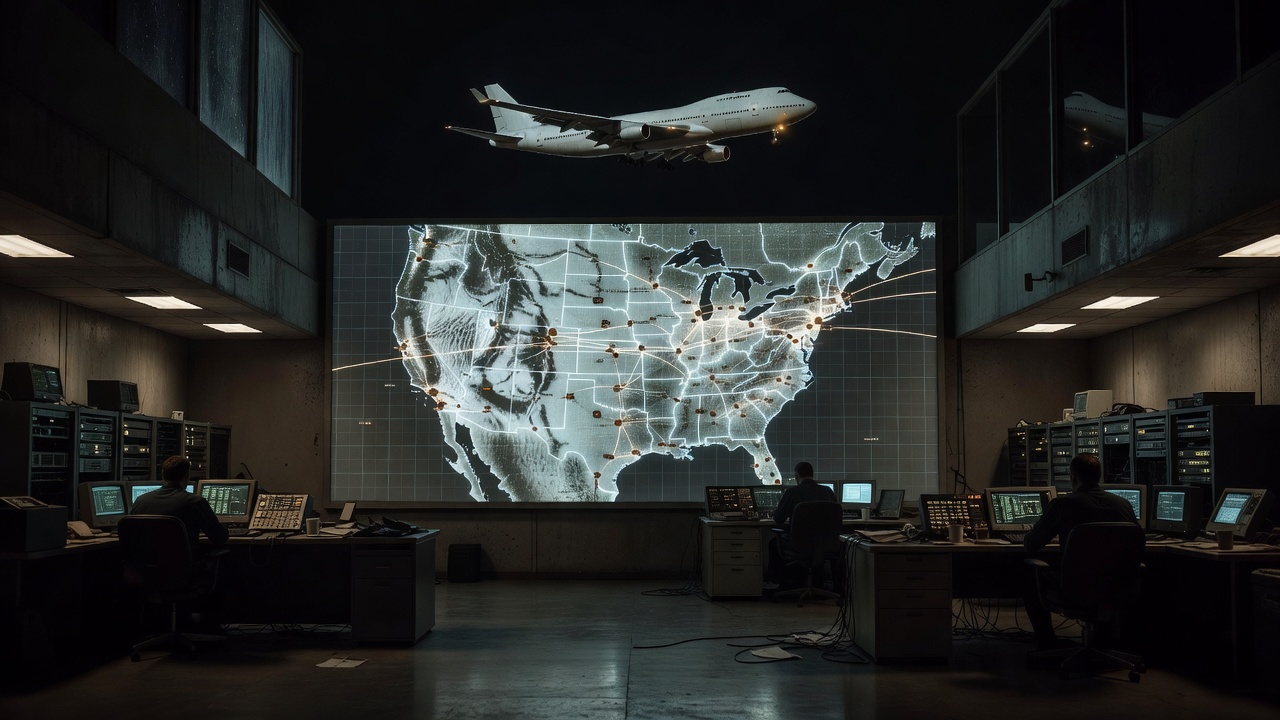
Somewhere over the dark spine of the continent, a jet crosses American airspace without ever planning to touch American soil. No gate. No customs line. No wheels on a runway in Dallas, Denver, or Detroit. And yet, before that aircraft slices past the Rockies or the grids of the Midwest, someone in the security architecture may already have measured the names on board against federal lists. That is the unnerving edge of Secure Flight’s overflight regime: a system built not just for people entering the United States, but for some travelers merely passing above it.
The Case For
A rule built for people who never intended to land
The foundation is not rumor. It is regulation. In the 2008 Secure Flight final rule, TSA said the program would cover domestic flights and international flights “to, from, and overflying the United States.” The rule defined overflights as certain foreign air carrier flights crossing the continental United States, even if those flights never landed here. TSA’s logic was blunt: an aircraft moving through American airspace could still threaten American targets.
That was not an idle line in a dense legal notice. GAO’s public 2014 review of Secure Flight noted that TSA screens passengers on flights “to, from, within, or overflying” the United States and that screening of certain foreign-air-carrier overflights began on October 24, 2012. A separate GAO report on Secure Flight effectiveness described the system’s expansion from simple watchlist matching into a broader risk-based screening architecture. In other words, the program did not stop at people bound for American airports. It matured into a layered pre-screening machine.
The paper trail is public, even if the process feels hidden
TSA’s own privacy materials describe Secure Flight as a pre-boarding screening system using carrier-provided passenger information to identify people who may need enhanced screening or may be blocked from travel. The current DHS Secure Flight privacy documentation lists multiple updates over the years, a quiet reminder that the system has kept evolving long after most travelers stopped paying attention. In 2022, TSA stated publicly that it screens passengers on domestic flights, international inbound and outbound flights, and overflights.
For anyone who tracks the growth of the modern travel-screening state, that matters. It means a person can be evaluated inside the American security perimeter without entering the country at all. It also fits a larger pattern already visible across Conspiracy Realist’s coverage of Secure Flight’s hidden cleared list and the wider government-secrets archive: once a security tool exists, its jurisdiction tends to stretch outward, not inward. First airports. Then more airlines. Then more data. Then more categories of traveler.
From the realist-but-suspicious point of view, overflight screening looks like a revealing tell. If a government claims authority to vet passengers who never planned to set foot on its soil, that says something about how national-security boundaries are now drawn. The border is no longer the line on the map. The border is the data checkpoint.
The Realist’s Eye
Screening is real. The wilder claims still outrun the record.
This is where the temperature has to come down. The public record supports the existence of overflight screening. It does not, by itself, prove a lawless dragnet swallowing every foreign passenger in the sky. The 2008 rule was narrower than internet folklore usually suggests. It carved out exemptions, including flights between two points in Canada or Mexico, and limited “overflights” to specific regulatory categories. That matters. So does the difference between being screened against rules or watchlists and being treated as a named suspect in a criminal file.
GAO also found something less cinematic but more useful: Secure Flight had performance and oversight weaknesses. In 2014, GAO said TSA lacked complete measures for missed matches and misidentifications across all of its high-risk lists. In a separate privacy review, GAO said TSA needed stronger privacy oversight and better tracking of key decisions. Those findings do not prove abuse. They do show that a powerful screening system could expand faster than its accountability tools.
Opacity is not proof, but it is the story
The strongest conspiratorial version of this topic says overflight screening is a hidden sovereignty grab disguised as aviation security. That claim has some emotional force, especially when you read TSA’s rationale that aircraft merely passing through U.S. airspace could threaten “major metropolitan areas and critical infrastructure.” But the available documents frame the system as a legal-security response to airspace risk, not as a secret annexation of every traveler aloft.
Still, the tension remains. Travelers are rarely told much about how these systems classify them. They are not given a neat explanation of what rule fired, what list matched, or how long derived records may linger. And once a screening architecture exists, mission creep is not paranoia. It is a recurring feature of post-9/11 bureaucracy. The same ecosystem that produced list management, redress pipelines, and programs like Silent Partner has already shown how risk rules can operate far from public view.
So the sober conclusion is not that every overflight passenger is trapped in a sinister blacklist. It is that a real and officially documented system extends U.S. security screening into airspace where most people would never assume it reaches, while leaving the public with only partial visibility into how often it is used, how effective it is, and how often innocent travelers get caught in its logic.
What We Know For Certain
- TSA’s 2008 Secure Flight final rule explicitly included certain flights overflying the continental United States.
- GAO reported that Secure Flight screens passengers on flights to, from, within, and overflying the United States.
- GAO stated that screening of certain foreign-air-carrier overflights began on October 24, 2012.
- TSA publicly said in 2022 that it screens domestic, inbound, outbound, and overflight passengers.
- GAO found oversight, privacy, and performance-measure gaps in Secure Flight even after implementation.
The Unanswered Questions
- How many overflight passengers are screened under Secure Flight in a typical year, and how often do those checks trigger enhanced action?
- How often are overflight matches false positives, and how visible are those cases to affected travelers?
- What specific exemptions or bilateral understandings now shape which foreign overflights are covered?
- How long do derivative records tied to overflight screening persist across connected DHS systems?
- How much of Secure Flight’s overflight decision-making still depends on opaque risk rules rather than straightforward watchlist matches?
The Closer — You Decide
The unsettling part is not that the documents are missing. It is that the documents are right there, written in the flat language of rules, assessments, and audits. A passenger can cross American airspace without crossing an American border, and still enter the machinery. Maybe that is prudent aviation security. Maybe it is another quiet example of emergency logic becoming permanent geography. The rule is real. The oversight gaps are real. The reach is real. The evidence is on the table. You decide.