Menu

Shroud of Turin

Shroud of Turin
Shroud of Turin

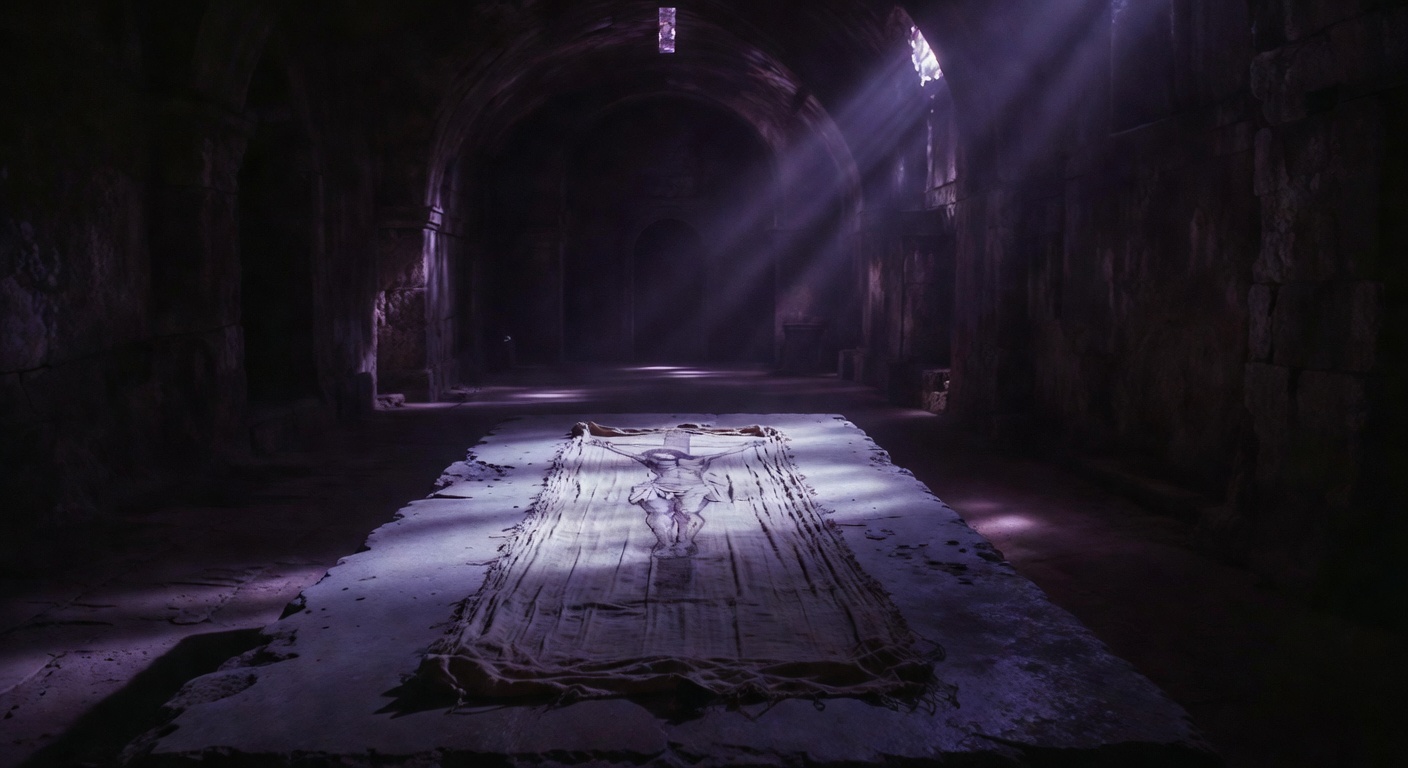
Imagine stumbling upon a piece of linen that looks like it captured the final moments of Jesus Christ—front and back, wounds and all, etched in a way no artist could fake. That’s the Shroud of Turin, a 14-foot-long enigma that’s been torturing scientists, theologians, and skeptics for centuries. Is it the actual burial cloth of the Son of God, zapped into existence by some divine flash during the Resurrection? Or a clever medieval forgery cooked up by a desperate knight to rake in pilgrims’ cash? Buckle up, because we’re diving deep into this rabbit hole, sifting through history, hardcore science, and whispers of conspiracy that refuse to die.

The Shroud’s Shadowy Trail Through History

Let’s start at the beginning—or as close as we can get. The Shroud of Turin didn’t just pop up in a French chapel one day. Its documented history kicks off in 1355 in Lirey, France, when knight Geoffrey de Charny unveiled it like a rockstar’s tour prop. Pilgrims flocked, miracles were claimed, and the local bishop got suspicious enough to accuse it of being painted fakery. But here’s where it gets juicy: de Charny was no ordinary crusader. He fought in the Hundred Years’ War and had ties to the Knights Templar, that shadowy order accused of hoarding relics and secrets from the Holy Land. Coincidence?

Fast-forward through wars, fires, and royal hands. The Shroud bounced from Geoffrey’s family to the House of Savoy, dodging Napoleon’s troops in 1798 (who reportedly stripped it naked for “scientific study”) and surviving a near-miss inferno in 1532 when molten silver scorched its edges—leaving those telltale burn marks and patches by Poor Clare nuns. By 1578, it landed in Turin, Italy, under the Savoy dukes, where it’s been locked in the Cathedral of St. John the Baptist ever since, emerging for rare public displays that draw millions.

But conspiracy realists like us know the official story is too tidy. What about pre-14th century whispers? Some point to the Pray Codex (1192-1195), a Hungarian manuscript showing a cloth with herringbone weave and L-shaped burn holes matching the Shroud exactly. Or the Image of Edessa, a “mandylion” relic described in ancient texts as bearing Christ’s face—transported from Constantinople in 944 AD before vanishing amid the Fourth Crusade sack in 1204. Did Templars smuggle it west? Historian Ian Wilson argues yes in his book The Shroud, linking it to the Hungarian Pray Codex illustration. The dots connect if you squint.

The Science Wars: Carbon Dating Debacle and Beyond

Now, the fireworks: science. In 1988, the Vatican greenlit carbon-14 dating by three top labs—Oxford, Arizona, and Zurich. They snipped a corner sample and dated it to 1260-1390 AD. Boom—medieval fake. Headlines screamed “hoax,” and believers wept. But hold your pitchforks. That test wasn’t bulletproof.

First red flag: the sample came from a repaired edge, woven with cotton (not the Shroud’s pure linen) and coated in dye, per microscopist Walter McCrone. Contamination? Medieval bacteria, smoke from 1532 fire, or even 1973 restoration handling? Statistician Minte Drie reanalyzed the raw data in 2020, pegging a 68% chance the Shroud dates to 34-84 AD if bio-contamination skewed results. Raw data from the labs, released after a 30-year NDA, showed wild variances—Oxford‘s dates jumped 100 years between runs.

Enter the STURP team (Shroud of Turin Research Project), 40+ scientists who poked it in 1978. Their verdict? No pigments, no dyes, no artistic direction. The image is superficial—penetrating just the top 200 nanometers of fibers, like a scorch but without heat distortion. John Heller‘s blood tests? Real human blood, type AB, with bilirubin (from trauma) and nanoparticles matching crucifixion wounds: nail holes in wrists (not palms, per anatomy), scourge marks from a Roman flagrum, even aragonite dirt from Jerusalem limestone.

Recent bombshells? 2017 Italian ENEA study used UV lasers to replicate the image—concluding only “short bursts of vacuum ultraviolet radiation” (like a corona discharge) could do it. No medieval tech matches. LibLab‘s 2022 wide-angle X-ray scattering dated the linen to 55-74 BC, conflicting with carbon but aligning with Christ’s era. And pollen? Max Frei found 58 species, including Gundelia tournefortii from Jerusalem and Zygophyllum dumosum from Dead Sea areas—grains invisible to the naked eye.

| Key Scientific Finding | Implication | Source/Study |

|————————|————-|————–|

| No pigments/dyes | Not painted | STURP 1978 |

| Blood with bilirubin | Real trauma victim | Heller & Adler 1981 |

| UV radiation hypothesis | Beyond medieval tech | ENEA 2017 ENEA Report |

| X-ray dating: 55 BC | 1st century origin | Liberato De Caro 2022 |

| Pollen from Jerusalem | Middle East provenance | Max Frei 1978 |

The carbon dating? Flawed. The image? Anomalous. Science isn’t debunking—it’s deepening the mystery.

Religious Reverence and Relic Connections

For Catholics and beyond, the Shroud is faith’s ultimate mic drop. It doesn’t prove the Resurrection (the Church calls it an “icon,” not relic), but its wounds scream Gospel: crown of thorns, side spear, no broken legs. Popes from John Paul II to Francis venerate it, with Benedict XVI calling it a “mirror of the Gospel.”

Ties to other relics? The Sudarium of Oviedo, a face cloth with matching AB blood and same pollen—carbon-dated older. Together, they suggest a trail from Jerusalem to Europe. Conspiracy angle: Were these hidden by early Christians to evade Roman hunters, resurfacing via Templars who allegedly excavated under Herod’s Temple?

Pop Culture’s Obsession and Modern Twists

The Shroud’s no dusty museum piece—it’s starred in “The Da Vinci Code”, “The Passion of the Christ”, and endless docs. VP-8 Image Analyzer in 1976 revealed 3D encoding, unlike any painting—NASA tech confirmed it. Recent AI scans by Italy’s Padua University (2024) enhanced the face, showing a man ~30-35, Semitic features, beaten to hell.

Skeptics? Joe Nickell claims Leonardo da Vinci vaporography (steam tech). Laughable—Leo was born after 1355. Or artists like Masolino (1420s)—but no replica matches the negativity or 3D.

Down the Rabbit Hole

Ready to spiral further? Here are 5 related deep dives for ConspiracyRealist.com:

1. Sudarium of Oviedo: The bloody face cloth that syncs perfectly with the Shroud—Templar transport or divine duo?

2. Knights Templar Relic Heist: Did they steal Christ’s burial linens from Constantinople in 1204?

3. Image of Edessa: The “living icon” that vanished—Shroud precursor or same cloth folded?

4. Vatican Secret Archives: What’s hidden about the Shroud’s tests and carbon dating cover-up?

5. Resurrection Radiation Theories: Could a burst of energy explain the image—and prove the impossible?

Conclusion: Faith, Science, or Forbidden Knowledge?

The Shroud of Turin isn’t going away. It’s withstood fire, war, and a flawed carbon test, teasing us with blood that bled real, pollen from Calvary, and an image no one can copy. Forgery? Then the world’s greatest artist wasted genius on invisible details. Miracle? Science edges closer every year. As Ian Wilson puts it, it’s “the most important object in the world.” Whatever your belief, it forces the question: What if the impossible is real?

Disclaimer: This article explores historical and scientific debates for informational purposes. ConspiracyRealist.com does not endorse religious claims or conspiracy theories as fact. Always cross-verify sources.

dive down the rabbit hole

Shroud of Turin

S-FX.com
Shroud of Turin

Imagine stumbling upon a piece of linen that looks like it captured the final moments of Jesus Christ—front and back, wounds and all, etched in a way no artist could fake. That’s the Shroud of Turin, a 14-foot-long enigma that’s been torturing scientists, theologians, and skeptics for centuries. Is it the actual burial cloth of the Son of God, zapped into existence by some divine flash during the Resurrection? Or a clever medieval forgery cooked up by a desperate knight to rake in pilgrims’ cash? Buckle up, because we’re diving deep into this rabbit hole, sifting through history, hardcore science, and whispers of conspiracy that refuse to die.

The Shroud’s Shadowy Trail Through History

Let’s start at the beginning—or as close as we can get. The Shroud of Turin didn’t just pop up in a French chapel one day. Its documented history kicks off in 1355 in Lirey, France, when knight Geoffrey de Charny unveiled it like a rockstar’s tour prop. Pilgrims flocked, miracles were claimed, and the local bishop got suspicious enough to accuse it of being painted fakery. But here’s where it gets juicy: de Charny was no ordinary crusader. He fought in the Hundred Years’ War and had ties to the Knights Templar, that shadowy order accused of hoarding relics and secrets from the Holy Land. Coincidence?

Fast-forward through wars, fires, and royal hands. The Shroud bounced from Geoffrey’s family to the House of Savoy, dodging Napoleon’s troops in 1798 (who reportedly stripped it naked for “scientific study”) and surviving a near-miss inferno in 1532 when molten silver scorched its edges—leaving those telltale burn marks and patches by Poor Clare nuns. By 1578, it landed in Turin, Italy, under the Savoy dukes, where it’s been locked in the Cathedral of St. John the Baptist ever since, emerging for rare public displays that draw millions.

But conspiracy realists like us know the official story is too tidy. What about pre-14th century whispers? Some point to the Pray Codex (1192-1195), a Hungarian manuscript showing a cloth with herringbone weave and L-shaped burn holes matching the Shroud exactly. Or the Image of Edessa, a “mandylion” relic described in ancient texts as bearing Christ’s face—transported from Constantinople in 944 AD before vanishing amid the Fourth Crusade sack in 1204. Did Templars smuggle it west? Historian Ian Wilson argues yes in his book The Shroud, linking it to the Hungarian Pray Codex illustration. The dots connect if you squint.

The Science Wars: Carbon Dating Debacle and Beyond

Now, the fireworks: science. In 1988, the Vatican greenlit carbon-14 dating by three top labs—Oxford, Arizona, and Zurich. They snipped a corner sample and dated it to 1260-1390 AD. Boom—medieval fake. Headlines screamed “hoax,” and believers wept. But hold your pitchforks. That test wasn’t bulletproof.

First red flag: the sample came from a repaired edge, woven with cotton (not the Shroud’s pure linen) and coated in dye, per microscopist Walter McCrone. Contamination? Medieval bacteria, smoke from 1532 fire, or even 1973 restoration handling? Statistician Minte Drie reanalyzed the raw data in 2020, pegging a 68% chance the Shroud dates to 34-84 AD if bio-contamination skewed results. Raw data from the labs, released after a 30-year NDA, showed wild variances—Oxford‘s dates jumped 100 years between runs.

Enter the STURP team (Shroud of Turin Research Project), 40+ scientists who poked it in 1978. Their verdict? No pigments, no dyes, no artistic direction. The image is superficial—penetrating just the top 200 nanometers of fibers, like a scorch but without heat distortion. John Heller‘s blood tests? Real human blood, type AB, with bilirubin (from trauma) and nanoparticles matching crucifixion wounds: nail holes in wrists (not palms, per anatomy), scourge marks from a Roman flagrum, even aragonite dirt from Jerusalem limestone.

Recent bombshells? 2017 Italian ENEA study used UV lasers to replicate the image—concluding only “short bursts of vacuum ultraviolet radiation” (like a corona discharge) could do it. No medieval tech matches. LibLab‘s 2022 wide-angle X-ray scattering dated the linen to 55-74 BC, conflicting with carbon but aligning with Christ’s era. And pollen? Max Frei found 58 species, including Gundelia tournefortii from Jerusalem and Zygophyllum dumosum from Dead Sea areas—grains invisible to the naked eye.

| Key Scientific Finding | Implication | Source/Study |

|————————|————-|————–|

| No pigments/dyes | Not painted | STURP 1978 |

| Blood with bilirubin | Real trauma victim | Heller & Adler 1981 |

| UV radiation hypothesis | Beyond medieval tech | ENEA 2017 ENEA Report |

| X-ray dating: 55 BC | 1st century origin | Liberato De Caro 2022 |

| Pollen from Jerusalem | Middle East provenance | Max Frei 1978 |

The carbon dating? Flawed. The image? Anomalous. Science isn’t debunking—it’s deepening the mystery.

Religious Reverence and Relic Connections

For Catholics and beyond, the Shroud is faith’s ultimate mic drop. It doesn’t prove the Resurrection (the Church calls it an “icon,” not relic), but its wounds scream Gospel: crown of thorns, side spear, no broken legs. Popes from John Paul II to Francis venerate it, with Benedict XVI calling it a “mirror of the Gospel.”

Ties to other relics? The Sudarium of Oviedo, a face cloth with matching AB blood and same pollen—carbon-dated older. Together, they suggest a trail from Jerusalem to Europe. Conspiracy angle: Were these hidden by early Christians to evade Roman hunters, resurfacing via Templars who allegedly excavated under Herod’s Temple?

Pop Culture’s Obsession and Modern Twists

The Shroud’s no dusty museum piece—it’s starred in “The Da Vinci Code”, “The Passion of the Christ”, and endless docs. VP-8 Image Analyzer in 1976 revealed 3D encoding, unlike any painting—NASA tech confirmed it. Recent AI scans by Italy’s Padua University (2024) enhanced the face, showing a man ~30-35, Semitic features, beaten to hell.

Skeptics? Joe Nickell claims Leonardo da Vinci vaporography (steam tech). Laughable—Leo was born after 1355. Or artists like Masolino (1420s)—but no replica matches the negativity or 3D.

Down the Rabbit Hole

Ready to spiral further? Here are 5 related deep dives for ConspiracyRealist.com:

1. Sudarium of Oviedo: The bloody face cloth that syncs perfectly with the Shroud—Templar transport or divine duo?

2. Knights Templar Relic Heist: Did they steal Christ’s burial linens from Constantinople in 1204?

3. Image of Edessa: The “living icon” that vanished—Shroud precursor or same cloth folded?

4. Vatican Secret Archives: What’s hidden about the Shroud’s tests and carbon dating cover-up?

5. Resurrection Radiation Theories: Could a burst of energy explain the image—and prove the impossible?

Conclusion: Faith, Science, or Forbidden Knowledge?

The Shroud of Turin isn’t going away. It’s withstood fire, war, and a flawed carbon test, teasing us with blood that bled real, pollen from Calvary, and an image no one can copy. Forgery? Then the world’s greatest artist wasted genius on invisible details. Miracle? Science edges closer every year. As Ian Wilson puts it, it’s “the most important object in the world.” Whatever your belief, it forces the question: What if the impossible is real?

Disclaimer: This article explores historical and scientific debates for informational purposes. ConspiracyRealist.com does not endorse religious claims or conspiracy theories as fact. Always cross-verify sources.

Shroud of Turin

Shroud of Turin

Imagine stumbling upon a piece of linen that looks like it captured the final moments of Jesus Christ—front and back, wounds and all, etched in a way no artist could fake. That’s the Shroud of Turin, a 14-foot-long enigma that’s been torturing scientists, theologians, and skeptics for centuries. Is it the actual burial cloth of the Son of God, zapped into existence by some divine flash during the Resurrection? Or a clever medieval forgery cooked up by a desperate knight to rake in pilgrims’ cash? Buckle up, because we’re diving deep into this rabbit hole, sifting through history, hardcore science, and whispers of conspiracy that refuse to die.

The Shroud’s Shadowy Trail Through History

Let’s start at the beginning—or as close as we can get. The Shroud of Turin didn’t just pop up in a French chapel one day. Its documented history kicks off in 1355 in Lirey, France, when knight Geoffrey de Charny unveiled it like a rockstar’s tour prop. Pilgrims flocked, miracles were claimed, and the local bishop got suspicious enough to accuse it of being painted fakery. But here’s where it gets juicy: de Charny was no ordinary crusader. He fought in the Hundred Years’ War and had ties to the Knights Templar, that shadowy order accused of hoarding relics and secrets from the Holy Land. Coincidence?

Fast-forward through wars, fires, and royal hands. The Shroud bounced from Geoffrey’s family to the House of Savoy, dodging Napoleon’s troops in 1798 (who reportedly stripped it naked for “scientific study”) and surviving a near-miss inferno in 1532 when molten silver scorched its edges—leaving those telltale burn marks and patches by Poor Clare nuns. By 1578, it landed in Turin, Italy, under the Savoy dukes, where it’s been locked in the Cathedral of St. John the Baptist ever since, emerging for rare public displays that draw millions.

But conspiracy realists like us know the official story is too tidy. What about pre-14th century whispers? Some point to the Pray Codex (1192-1195), a Hungarian manuscript showing a cloth with herringbone weave and L-shaped burn holes matching the Shroud exactly. Or the Image of Edessa, a “mandylion” relic described in ancient texts as bearing Christ’s face—transported from Constantinople in 944 AD before vanishing amid the Fourth Crusade sack in 1204. Did Templars smuggle it west? Historian Ian Wilson argues yes in his book The Shroud, linking it to the Hungarian Pray Codex illustration. The dots connect if you squint.

The Science Wars: Carbon Dating Debacle and Beyond

Now, the fireworks: science. In 1988, the Vatican greenlit carbon-14 dating by three top labs—Oxford, Arizona, and Zurich. They snipped a corner sample and dated it to 1260-1390 AD. Boom—medieval fake. Headlines screamed “hoax,” and believers wept. But hold your pitchforks. That test wasn’t bulletproof.

First red flag: the sample came from a repaired edge, woven with cotton (not the Shroud’s pure linen) and coated in dye, per microscopist Walter McCrone. Contamination? Medieval bacteria, smoke from 1532 fire, or even 1973 restoration handling? Statistician Minte Drie reanalyzed the raw data in 2020, pegging a 68% chance the Shroud dates to 34-84 AD if bio-contamination skewed results. Raw data from the labs, released after a 30-year NDA, showed wild variances—Oxford‘s dates jumped 100 years between runs.

Enter the STURP team (Shroud of Turin Research Project), 40+ scientists who poked it in 1978. Their verdict? No pigments, no dyes, no artistic direction. The image is superficial—penetrating just the top 200 nanometers of fibers, like a scorch but without heat distortion. John Heller‘s blood tests? Real human blood, type AB, with bilirubin (from trauma) and nanoparticles matching crucifixion wounds: nail holes in wrists (not palms, per anatomy), scourge marks from a Roman flagrum, even aragonite dirt from Jerusalem limestone.

Recent bombshells? 2017 Italian ENEA study used UV lasers to replicate the image—concluding only “short bursts of vacuum ultraviolet radiation” (like a corona discharge) could do it. No medieval tech matches. LibLab‘s 2022 wide-angle X-ray scattering dated the linen to 55-74 BC, conflicting with carbon but aligning with Christ’s era. And pollen? Max Frei found 58 species, including Gundelia tournefortii from Jerusalem and Zygophyllum dumosum from Dead Sea areas—grains invisible to the naked eye.

| Key Scientific Finding | Implication | Source/Study |

|————————|————-|————–|

| No pigments/dyes | Not painted | STURP 1978 |

| Blood with bilirubin | Real trauma victim | Heller & Adler 1981 |

| UV radiation hypothesis | Beyond medieval tech | ENEA 2017 ENEA Report |

| X-ray dating: 55 BC | 1st century origin | Liberato De Caro 2022 |

| Pollen from Jerusalem | Middle East provenance | Max Frei 1978 |

The carbon dating? Flawed. The image? Anomalous. Science isn’t debunking—it’s deepening the mystery.

Religious Reverence and Relic Connections

For Catholics and beyond, the Shroud is faith’s ultimate mic drop. It doesn’t prove the Resurrection (the Church calls it an “icon,” not relic), but its wounds scream Gospel: crown of thorns, side spear, no broken legs. Popes from John Paul II to Francis venerate it, with Benedict XVI calling it a “mirror of the Gospel.”

Ties to other relics? The Sudarium of Oviedo, a face cloth with matching AB blood and same pollen—carbon-dated older. Together, they suggest a trail from Jerusalem to Europe. Conspiracy angle: Were these hidden by early Christians to evade Roman hunters, resurfacing via Templars who allegedly excavated under Herod’s Temple?

Pop Culture’s Obsession and Modern Twists

The Shroud’s no dusty museum piece—it’s starred in “The Da Vinci Code”, “The Passion of the Christ”, and endless docs. VP-8 Image Analyzer in 1976 revealed 3D encoding, unlike any painting—NASA tech confirmed it. Recent AI scans by Italy’s Padua University (2024) enhanced the face, showing a man ~30-35, Semitic features, beaten to hell.

Skeptics? Joe Nickell claims Leonardo da Vinci vaporography (steam tech). Laughable—Leo was born after 1355. Or artists like Masolino (1420s)—but no replica matches the negativity or 3D.

Down the Rabbit Hole

Ready to spiral further? Here are 5 related deep dives for ConspiracyRealist.com:

1. Sudarium of Oviedo: The bloody face cloth that syncs perfectly with the Shroud—Templar transport or divine duo?

2. Knights Templar Relic Heist: Did they steal Christ’s burial linens from Constantinople in 1204?

3. Image of Edessa: The “living icon” that vanished—Shroud precursor or same cloth folded?

4. Vatican Secret Archives: What’s hidden about the Shroud’s tests and carbon dating cover-up?

5. Resurrection Radiation Theories: Could a burst of energy explain the image—and prove the impossible?

Conclusion: Faith, Science, or Forbidden Knowledge?

The Shroud of Turin isn’t going away. It’s withstood fire, war, and a flawed carbon test, teasing us with blood that bled real, pollen from Calvary, and an image no one can copy. Forgery? Then the world’s greatest artist wasted genius on invisible details. Miracle? Science edges closer every year. As Ian Wilson puts it, it’s “the most important object in the world.” Whatever your belief, it forces the question: What if the impossible is real?

Disclaimer: This article explores historical and scientific debates for informational purposes. ConspiracyRealist.com does not endorse religious claims or conspiracy theories as fact. Always cross-verify sources.

Table of contents