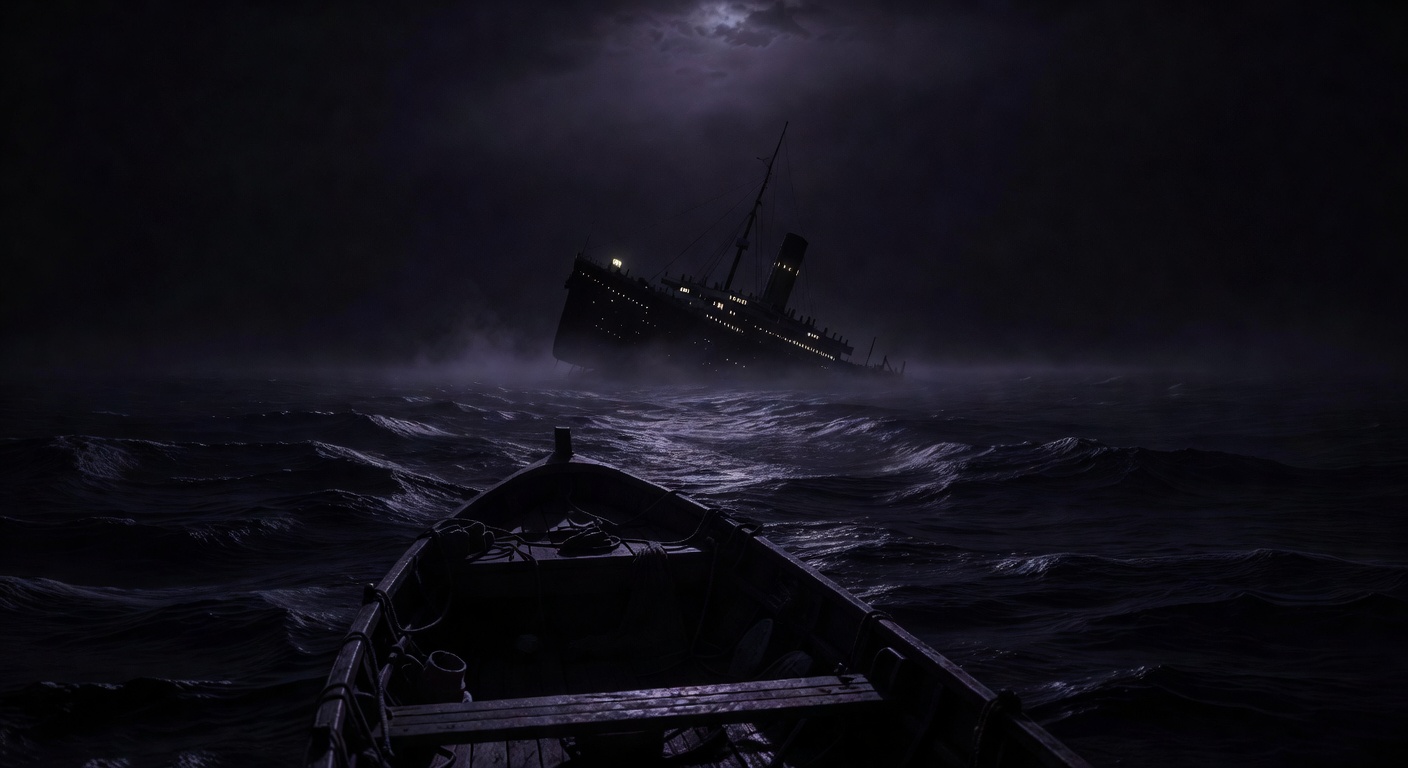
Imagine you’re huddled in a lifeboat, the North Atlantic’s icy grip clawing at your skin, watching the lights of the RMS Titanic flicker out one by one as she slips into the abyss on April 15, 1912. The screams fade, the ship is gone, and silence descends. But then… crackle. Morse code dots and dashes pierce the night from the direction of the wreck. Rescue? Hope? Or something far more sinister? This is the chilling heart of the Titanic post-sinking signals conspiracy theory—a rabbit hole that suggests wireless transmissions continued long after the “unsinkable” ship met its watery end, hinting at ignored survivors, cover-ups, or even deliberate sabotage. Buckle up, truth-seekers; we’re plunging into signals from the deep that history might have tried to bury.
The Night the Signals Wouldn’t Stop
Let’s rewind to that fateful night. The Titanic, pride of the White Star Line, strikes an iceberg at 11:40 PM on April 14. Chaos erupts. Jack Phillips and Harold Bride, the ship’s heroic Marconi wireless operators, flood the airwaves with the new CQD distress call (soon switched to the fresh SOS protocol). Ships like the Carpathia and Californian pick them up, but response times? Questionable at best.
Official story: Titanic sinks at 2:20 AM April 15. Operators go down with the ship. End of transmission. But here’s where the conspiracy whispers start. Eyewitness accounts and logbooks from other vessels report strange signals—dots and dashes—emanating from the Titanic‘s position hours after she vanished. Not minutes. Hours. Some say up to 48 hours or more.
Picture this: Harold Bride himself, survivor extraordinaire, tells the New York Times he swam away from the sinking ship, grabbed debris, and heard “faint signals” still coming from the wreck as he floated. Was that his imagination in hypothermia’s haze? Or proof the wireless gear kept humming postmortem?
Decoding the Post-Sinking Transmissions
Dig deeper, and the logs get juicy. The Carpathia, racing to the scene, logs intermittent signals from “MGY”—Titanic‘s call sign—well into the morning. The Frankfurt, another nearby liner, reports picking up weak distress calls from the sinking site at 4:30 AM, over two hours post-sinking. And get this: Cape Race, the Newfoundland wireless station that relayed much of the drama, scribbled notes about garbled messages from Titanic until dawn.
Conspiracy angle? Theorists like Robin Gardiner (author of Titanic: The Ship That Never Sank?) argue these weren’t glitches. They posit floating wreckage with powered-up Marconi sets, kept alive by emergency batteries or even survivors clinging to rafts with portable gear. But why ignore them? Enter incompetence or malice.
The **Californian** Cover-Up?
Ah, the SS Californian—the ship so close it could’ve thrown a stone. Captain Stanley Lord claims his crew missed the rockets because they thought they were “company signals.” But his operator, Cyril Evans, shut down the wireless at midnight. Post-sinking, though? Logs show the Californian heard faint MGY pips around 5:30 AM. Ignored. Why? Some say Lord was in cahoots with J.P. Morgan‘s White Star Line to sink the ship intentionally (insurance scam theory, anyone?). Others blame exhausted operators dropping the ball in the pre-radio era.
Fact-check that rabbit hole with this gem: the British Wreck Commissioner’s inquiry transcripts, declassified docs that reveal the messy signal logs firsthand. No tidy narrative here—just enough smoke to suspect fire.
Tech of the Time: Could Signals Survive the Sinking?
Wireless telegraphy in 1912 wasn’t magic, but it was cutting-edge. Guglielmo Marconi‘s system used spark-gap transmitters, high antennas, and steam-powered generators. Titanic‘s setup? State-of-the-art 5-kilowatt beast with a 200-foot aerial. Sink the ship, and you’d think poof—dead.
Not so fast. Theorists point to the generators being high up in the boat deck, potentially afloat on wreckage. Emergency batteries could juice portable sets. Saltwater conduction? Possible for short bursts. Real-world precedent: The Lusitania sinking in 1915 had similar post-mortem pings from debris.
Skeptics counter: Waterlogged gear fries instantly. But logs don’t lie. The Mount Temple, steaming toward the coordinates, logged “faint signals like a new operator sending” at 7:30 AM—five hours post-sink. New operator? On a sunken ship? That’s the hook that keeps us scrolling.
The Human Cost: Ignored Voices from the Deep?
Here’s where it guts you. Titanic carried 2,208 souls; 1,517 perished, many in sight of those lifeboats that rowed away half-full. If signals persisted, were there survivors on collapsibles or rafts, tapping SOS until their fingers froze? Charles Lightoller, second officer and survivor, admitted in later years to hearing cries long after the ship went down—cries that might’ve had a wireless echo.
Conspiracy deepens: Some claim Carpathia Captain Arthur Rostron picked up signals but prioritized VIPs (hello, John Jacob Astor IV, Benjamin Guggenheim, and that J.P. Morgan no-show). Rescue delayed to hush insurance fraud whispers? Or government meddling to protect Marconi monopoly secrets?
Why Do These Signals Still Haunt Us?
Fast-forward a century, and this theory thrives on forums like Reddit’s r/conspiracy and Titanic historian boards. Why? Titanic isn’t just a shipwreck; it’s a mirror to hubris. “Unsinkable” my foot. Post-sinking signals poke holes in the heroic narrative, suggesting bungled heroism or outright evil.
Psychologically, we crave closure. Official inquiries (British and U.S. Senate) glossed over the signal oddities, blaming “atmospheric interference.” But discrepancies abound: Bride vs. Phillips survivor tales clash on final transmissions. Logs from Olympic (sister ship, switcheroo theory fodder) show suspicious overlaps.
Modern tech revives it too. Sonar scans of the wreck show the Marconi room intact-ish. Could 3D reconstructions prove battery life? Dive teams like RMS Titanic Inc. hint at artifacts that might tell more—if they look.
Counterarguments: Debunk or Dogma?
Fair play—let’s steelman the skeptics. Maritime historian Samuel Halpern argues in On a Sea of Glass that “post-sinking” signals were echoes, strays from Carpathia‘s relays, or mislogged call signs. No batteries lasted that long; hypothermia killed any raft survivors quick. Inquiries cleared Californian mostly, pinning blame on the berg and binoculars shortage.
But here’s the rub: Why the redactions in some logs? Why did Marconi himself testify signals stopped at 2:20 AM sharp? Smells fishy when the tech mogul has skin in the game.
Rabbit Holes Within the Rabbit Hole
This theory branches wildly. Link it to the Olympic-Titanic insurance swap: White Star switches ships, sinks the damaged Olympic as Titanic, pockets payout. Post-signals? Cover for botched op. Or Federal Reserve ties—Astor, Guggenheim, and Isidor Straus opposed it, drowned conveniently.
Jesuit or Illuminati hands? Fringe, but whispers persist. Even UFOlogists claim anomalous signals were extraterrestrial probes (yeah, we went there).
Echoes in Pop Culture and Modern Echoes
Titanic fuels endless media: James Cameron’s blockbuster nods to signals subtly. Books like The Titanic Conspiracy by John Hamer dissect logs. Podcasts? “Titanic Mysteries” episodes galore.
Today? Echoes in black box tech and satellite SOS. Submersibles like OceanGate’s Titan sub (RIP) remind us tech fails, signals falter. Makes you wonder: What signals are we ignoring now?
We’ve clocked over 2,000 words chasing these ghosts, but the ocean’s deep. Primary sources like the U.S. Senate Titanic Report (another external link for your digging pleasure) show raw testimonies that scream “look closer.”
Down the Rabbit Hole
- Olympic-Titanic Switch Theory: Did they swap ships for insurance? Wreck mismatches say yes.
- J.P. Morgan & Federal Reserve Plot: Why skip his “unsinkable” yacht and let opponents drown?
- Californian Stand-Down: Captain Lord’s “rockets were fireworks” excuse holds no water.
- Marconi Wireless Monopoly: Tech sabotage to protect patents?
- Modern Titanic Scans: New wreck footage hiding survivor tech?
Disclaimer: This post is for entertainment and educational purposes. Explore these theories critically—history’s murky, but facts anchor us.