UNSGM: Biology’s Only Investigation Tool
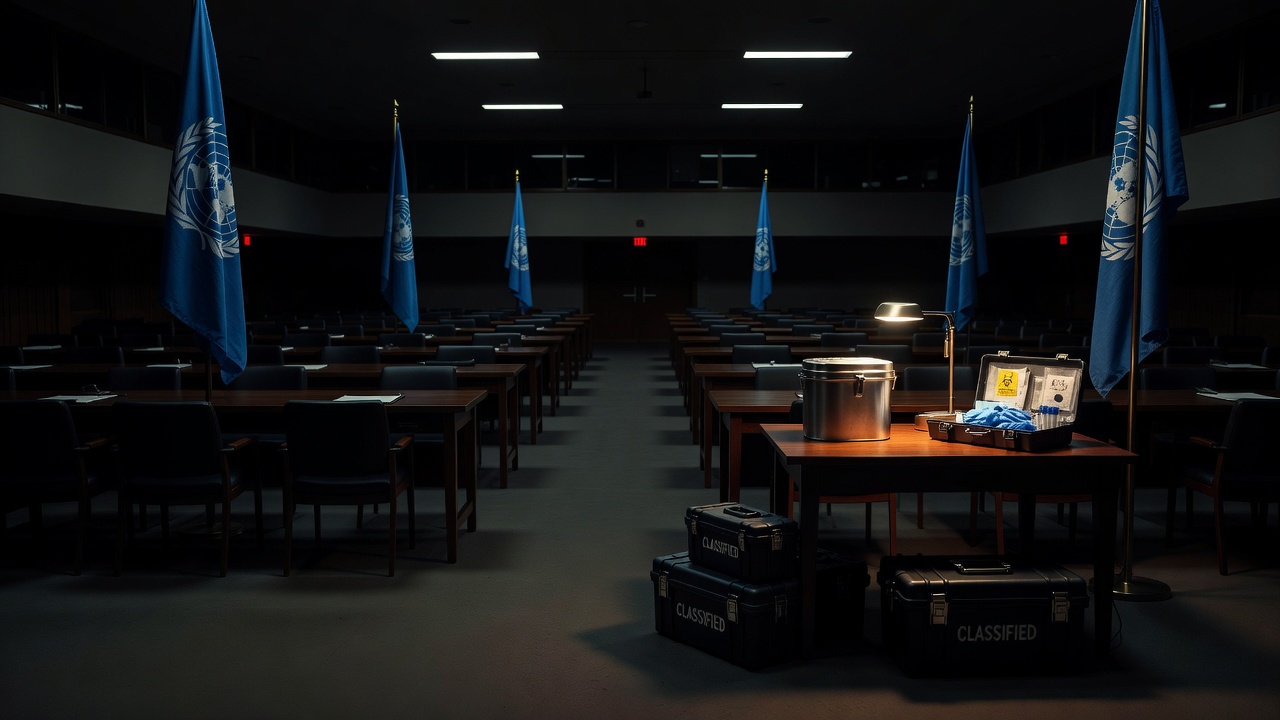
The room is always cleaner in theory. White binders. blue flags. polished desks under international light. Somewhere in that paperwork lives the promise that if a government ever crossed the line and used a biological weapon, the world would not have to guess. It could investigate. It could collect samples, question witnesses, follow the chain of custody, and tell everyone what happened. That promise exists. But in the biological realm, it exists in a strangely ghostlike form: not as a standing watchdog, not as a permanent inspectorate, but as a mechanism that appears only when a state asks for it and politics allow it to breathe.
The Case For
The UN built a mechanism because the treaty never built an enforcer
The strongest argument for taking this issue seriously is that the gap is official, not speculative. The United Nations Office for Disarmament Affairs states that the Secretary-General’s Mechanism for Investigation of Alleged Use of Chemical and Biological Weapons, or UNSGM, was established by General Assembly resolution A/42/37 C in 1987 and reaffirmed by Security Council resolution 620 in 1988. UNODA also states, in plain language, that for the Biological Weapons Convention there is “no equivalent implementing agency,” which makes the UNSGM “the only international mechanism to investigate the alleged use of biological weapons.” That is an extraordinary sentence for a treaty regime built around one of the darkest categories of weapons on Earth.
Security Council resolution 620 matters here because it did more than condemn chemical weapons use in the Iran-Iraq war. The official UN summary of resolution 620 says it encouraged the Secretary-General to carry out prompt investigations, in response to allegations brought by any member state, into possible chemical, biological, or toxin weapons use in violation of the 1925 Geneva Protocol or customary international law. In other words, the mechanism was born from a real crisis and given a real mandate. It was meant to be a door the world could open fast.
But the “door” is not a standing body. It has to be assembled in the dark.
UNODA is equally clear on the weakness. The UNSGM is not a standing investigative body. It relies on rosters of expert consultants, qualified experts, and analytical laboratories nominated by member states and kept ready for short-notice deployment under the guidelines in document A/44/561. As of December 2025, according to UNODA’s January 2026 newsletter, that roster included 660 qualified experts, 131 expert consultants, and 97 analytical laboratories. On paper, that sounds substantial. In practice, it means the biological-weapons investigation system still has to be built at the moment of crisis.
That is where the conspiracy-minded reading begins to write itself. If a biological incident is ambiguous, politically explosive, and time-sensitive, a mechanism that depends on state reporting, ad hoc assembly, access negotiations, and international trust leaves a lot of room for delay. Delay does not prove a cover-up. But delay is exactly where evidence degrades, narratives harden, and deniability grows teeth. It sits comfortably inside the long archive of government secrets and state opacity.
The Realist’s Eye
Biology is harder to police than chemistry, and that is not just an excuse
The realist case starts by admitting something many darker narratives glide past. Biological evidence is harder to interpret than chemical evidence. A suspicious outbreak can resemble nature. A laboratory can be defensive, commercial, medical, or something worse, while using nearly identical equipment. Intent matters. Access matters. Chain of custody matters. And once samples move through contested territory or hostile propaganda environments, the science can be attacked along with the politics.
Switzerland’s Spiez Laboratory, which supports UNSGM readiness, notes that chemical-weapons analysis benefits from strict quality standards developed through the OPCW laboratory network. In the biological field, it says, there are no corresponding controls of the same kind, meaning a UN mission’s biological lab findings could be more easily questioned or rejected.
The mechanism’s weakness is real, but it is not proof of a hidden bioweapons empire
It is also important not to oversell what the absence of a stronger system proves. The fact that the BWC lacks an OPCW-style inspectorate does not automatically mean major powers designed the regime purely to hide active biological arsenals. It may also reflect genuine dual-use problems: vaccine plants, biodefense labs, public-health repositories, and advanced biotech facilities can look alarmingly similar to something more sinister. Governments have long feared that intrusive inspections could expose trade secrets, security-sensitive biodefense work, or innocent research that outsiders might misread.
That leaves us with a narrower, more uncomfortable conclusion. The record shows that the world recognized the need for a mechanism, created one, kept refining its training, and still never turned it into a permanent biological inspectorate. UNODA’s own recent work has focused heavily on biological readiness, from refresher training to biological crime-scene management and transport of infectious substances. That is not what institutions do when the risk is imaginary. It is what they do when the risk is real but the architecture remains incomplete.
The real scandal may not be a secret stockpile lurking behind every outbreak headline. It may be that the international system still relies on an emergency mechanism that must earn trust while a crisis is already underway. If you have followed our recent dives into why the BWC never got its own OPCW and why biology still lacks challenge inspections, this is the same shadow from another angle: the watchdog exists, but only in outline.
What We Know For Certain
- The UNSGM was established by UN General Assembly resolution A/42/37 C in 1987 and reaffirmed by Security Council resolution 620 in 1988.
- UNODA says the UNSGM is not a standing investigative body.
- UNODA says the BWC has no equivalent implementing agency, making the UNSGM the only international mechanism for investigating alleged biological-weapons use.
- Under the mechanism, member states nominate experts and analytical laboratories for short-notice deployment under guidelines contained in A/44/561.
- UNODA’s January 2026 newsletter reported rosters of 660 qualified experts, 131 expert consultants, and 97 analytical laboratories.
The Unanswered Questions
- Would the UNSGM move fast enough in a genuinely contested biological incident, before evidence decayed and political narratives took over?
- How much trust would states place in biological lab findings without OPCW-style quality controls accepted across the board?
- Would a major power allow the kind of access a rigorous UNSGM biological investigation might actually require?
- If the BWC still has no standing inspectorate, what event would finally force governments to build one?
The Closer — You Decide
The unsettling part is not that the world has no mechanism at all. It is that the mechanism it does have for alleged biological-weapons use is temporary, improvised, and politically fragile by design. The mandate is real. The rosters are real. The training is real. So is the gap between having a tool on paper and trusting it in the hour when everything is contaminated, everyone is accusing everyone else, and the evidence is already slipping away. The documents are on the table. The weakness is on the record. You decide.