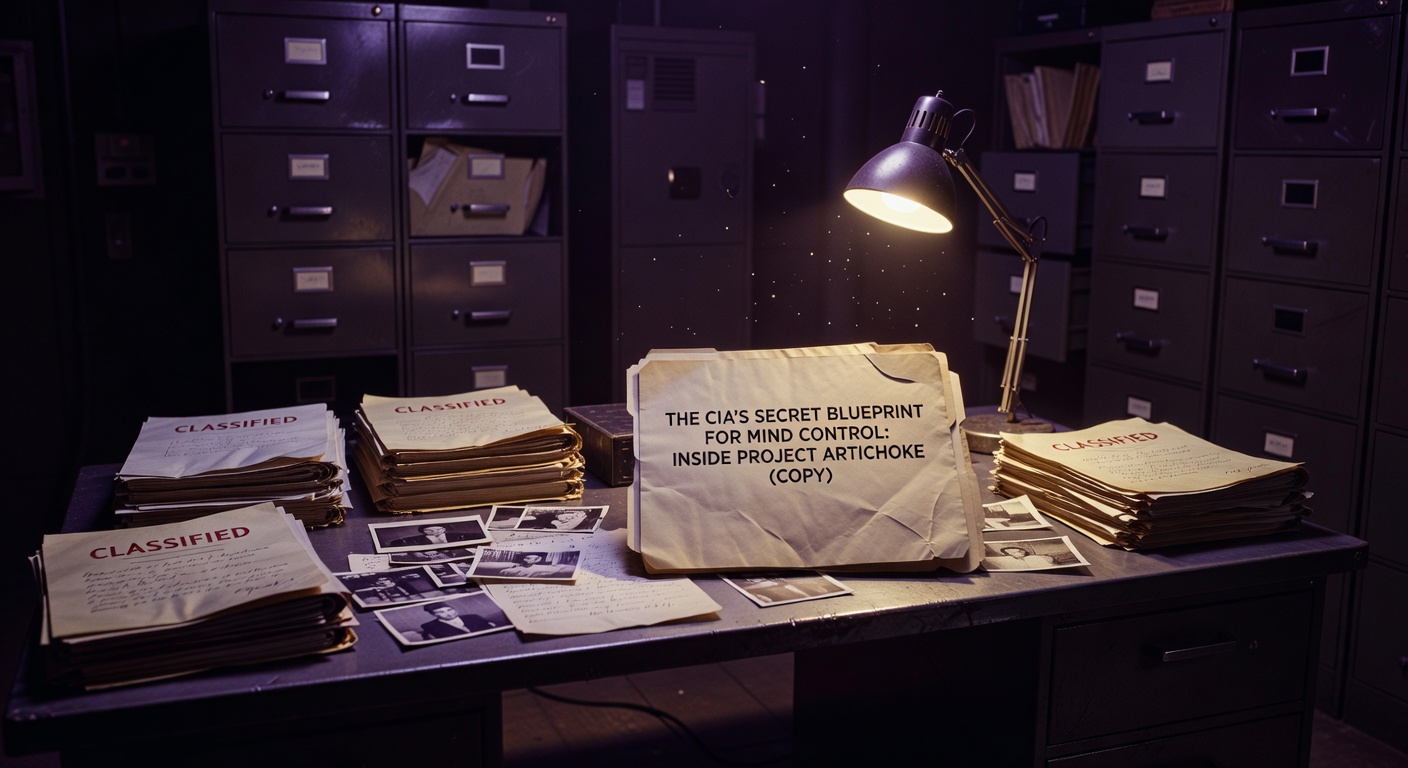
Before MKUltra became the most infamous experiment in American intelligence history, there was something darker, stranger, and far less understood. There was Project Artichoke — and the question it asked should keep you up at night.
A Question No Government Should Ever Ask
Somewhere in the archives of the Central Intelligence Agency, buried beneath decades of redactions and bureaucratic euphemism, sits a memo dated January 1952. It asks, in plain and chilling language:
“Can we get control of an individual to the point where he will do our bidding against his will and even against fundamental laws of nature, such as self-preservation?”
This wasn’t a thought experiment. It wasn’t a philosopher’s riddle. It was an operational question — asked by agents of the United States government, funded by American taxpayers, and answered with years of secret experiments on human beings who never consented to what was being done to them.
This is the story of Project Artichoke: the CIA’s covert Cold War program to crack the human mind wide open, and what happened to the people who got in the way.
The Cold War Paranoia That Started It All
To understand how a democratic government ends up running secret mind control experiments, you have to understand the climate of the early 1950s. The Cold War wasn’t just a geopolitical standoff — it was a psychological war, fought in the shadows, where the rules of conventional warfare didn’t apply.
American intelligence officials were genuinely terrified. Reports were filtering back from the Korean War of U.S. prisoners of war returning home seemingly changed — reciting Communist propaganda, denouncing their own country, appearing almost robotically compliant. The word being whispered in the halls of power was “brainwashing.” The Soviets, it was feared, had cracked some code that American science hadn’t yet discovered. They had found a way to rewrite a man’s mind.
In April 1953, Allen Dulles — the newly appointed director of the CIA — gave a speech to Princeton alumni warning of “brain warfare” and “Soviet brain perversion techniques.” He insisted that non-consensual experimentation was antithetical to American values. Three days later, he approved the launch of MKUltra.
But MKUltra didn’t appear from nowhere. It was the product of a secret lineage — a chain of programs that had been quietly running for years. And the link in that chain that history has most often overlooked is Project Artichoke.
From BLUEBIRD to Artichoke: How a Program Is Born
The story begins in 1949, when a CIA official named Morse Allen — chief of the Office of Security’s Interrogation Research Section — recommended the creation of what he called “security validation teams.” These would be specialized units combining drugs, hypnosis, and the polygraph to interrogate suspected enemy agents and screen CIA personnel for loyalty.
The idea was formalized in April 1950, when DCI Roscoe Hillenkoetter approved the establishment of Project BLUEBIRD — the direct ancestor of Artichoke. BLUEBIRD’s mandate was relatively narrow at first: develop better interrogation techniques. But “better,” in this context, meant something that would make a person talk whether they wanted to or not.
By 1951, things were escalating. A trilateral meeting between U.S., British, and Canadian intelligence services convened to discuss — and this is a direct quote from the declassified minutes — “all matters related to the influence or control of the minds of individuals.” The three allied nations agreed that basic research in this field was “important for cold war operations.” Mind control had officially become a priority for the Western alliance.
That same year, Allen Dulles was elevated to Deputy Director of Central Intelligence. He saw the potential of BLUEBIRD and wanted it expanded. The program got a new name: Project Artichoke. It officially launched on August 20, 1951, operated by the CIA’s Office of Scientific Intelligence.
The name was deliberately mundane — a vegetable, a non-word, something that would mean nothing to anyone who stumbled across it. That was the point.
What They Were Actually Doing
Project Artichoke wasn’t just about interrogation. It was about control — total, absolute, and ideally invisible control of the human mind. The program’s scope was breathtaking in its ambition and horrifying in its methods.
Artichoke teams experimented with a cocktail of substances that reads like a pharmacological nightmare: LSD, sodium pentothal (the so-called “truth serum”), Desoxyn (a stimulant), cocaine, heroin, peyote, and mescaline. Of these, LSD increasingly emerged as the most promising candidate — a drug so powerful and so disorienting that it seemed to dissolve the barriers between a person’s conscious resistance and their deepest secrets.
One CIA agent, dosed without his knowledge, was kept on LSD continuously for 77 days. Seventy-seven days. The psychological damage from a single dose can last weeks. What 77 consecutive days of LSD does to a human mind is almost unimaginable.
Beyond drugs, the program deployed hypnosis — not the stage-show variety, but a serious, clinical application aimed at inducing regression, planting suggestions, and creating amnesia on command. Subjects were placed in total isolation, subjected to electroshock, exposed to monotonous sounds and sensory deprivation, and in some documented cases, even neurosurgery was listed as a potential tool.
The program also looked outward — at biological weapons. Declassified memos reveal that Artichoke researchers were investigating dengue fever and other diseases as potential “short-term and long-term incapacitating agents.” The line between interrogation program and weapons program was blurring fast.
And crucially, the experiments weren’t confined to Langley. Overseas operations were conducted across Europe, Japan, Southeast Asia, and the Philippines. Teams were instructed to “conduct at the overseas bases operational experiments utilizing aliens as subjects.” In plain English: foreign nationals, with no legal protections, no knowledge of what was being done to them, and no recourse.
By 1952, the CIA’s Security Office was already reporting “successful” ARTICHOKE interrogations — specifically, on Russian agents suspected of being double agents. The technique used: heavy doses of sodium pentothal combined with Desoxyn, followed by hypnosis to induce regression and, in at least one case, total amnesia.
The Men Behind the Curtain
Every dark program has its architects. Project Artichoke had several.
Morse Allen was the true believer — the man who had pushed for this kind of research since 1949 and who ran BLUEBIRD’s early experiments with the zeal of a convert. He was fascinated by hypnosis in particular, reportedly practicing on CIA secretaries to test whether he could get them to follow post-hypnotic suggestions.
Allen Dulles was the political enabler — the man with enough vision, ambition, and Cold War conviction to take these programs from research curiosities to full-scale operations. He would go on to authorize MKUltra in 1953, making him the godfather of the CIA’s entire mind control enterprise.
But the most consequential figure in the Artichoke story — and arguably in the entire history of American intelligence — was Sidney Gottlieb.
Gottlieb was the CIA’s chief chemist, head of the Technical Services Staff (TSS), and the man who would eventually become the director of MKUltra. He was, by all accounts, a deeply contradictory figure: a man who raised goats, practiced folk dancing, and held a PhD from Caltech — and who also spent decades orchestrating some of the most ethically catastrophic experiments in American history. His biographer Stephen Kinzer titled his book about Gottlieb Poisoner in Chief — and the title is not hyperbole.
In 1952, Gottlieb met with George White, a supervisor with the Federal Bureau of Narcotics, and recruited him as a CIA consultant. White would go on to run the CIA’s network of safehouses — apartments fitted with two-way mirrors and surveillance equipment — where unwitting subjects were drugged and observed. His later role in Operation Midnight Climax, the MKUltra subproject that used sex workers to lure unsuspecting men into drugged encounters, is one of the more sordid chapters in this entire saga.
Overseeing the operational side of Artichoke was Paul F. Gaynor, a former U.S. Army brigadier general turned CIA research staff agent. He was the program’s day-to-day manager — the man who turned memos into missions.
The Manchurian Candidate Memo
If there is a single document that crystallizes what Project Artichoke was truly reaching for, it’s a declassified CIA memo dated January 22, 1954 — now publicly available through the National Security Archive.
The memo asks, with bureaucratic directness that is somehow more chilling than any dramatic phrasing could be:
“Can an individual of redacted descent be made to perform an act of attempted assassination involuntarily under the influence of ARTICHOKE?”
The target: “a prominent redacted politician or if necessary, against an American official.” A handwritten notation next to the American official option reads: “simulated only.”
The plan was specific. The subject — a former CIA asset who had stopped cooperating — was a known heavy drinker. The proposal was to drug him through an alcoholic cocktail at a social gathering, apply hypnosis, and program him to attempt an assassination at a later date. After the attempt, the subject would be “taken into custody by the redacted Government and thereby disposed of.”
The memo concluded that a hypnotized assassination attempt “probably” could not be reliably executed under the operational constraints. But it also noted — and this is the part that should give you pause — that if CIA headquarters issued the order and provided greater access, “the ARTICHOKE Team would undertake the problem.” A final handwritten notation confirmed: “This would be made available when and if required.”
This wasn’t a rejected proposal. It was a deferred one.
Richard Condon published his novel The Manchurian Candidate in 1959 — five years after this memo was written. The book imagines an American soldier brainwashed into becoming an unwitting assassin. Condon always insisted it was fiction. Given what we now know, that distinction feels uncomfortably thin.
Frank Olson: The Man Who Knew Too Much
No account of Project Artichoke is complete without the story of Frank Olson — and it is a story that remains, to this day, officially unresolved.
Olson was a bacteriologist and biological warfare scientist working at Fort Detrick in Maryland, the U.S. Army’s center for biological weapons research. He was brilliant, well-regarded, and deeply embedded in the most classified programs the American government ran. In May 1952, he was appointed to the committee overseeing Project Artichoke.
What Olson saw in that role would haunt him.
He traveled to overseas CIA safe houses — black sites in Europe where the Artichoke program was being applied to real human beings. According to his coworker Norman Cournoyer, Olson witnessed interrogation sessions where subjects “were interrogated to death” — experimental methods combining drugs, hypnosis, and torture, pushed past the point of no return. He also came to believe, based on what he had seen, that the United States had used biological weapons during the Korean War.
By the summer of 1953, Olson was a changed man. He was disturbed, conflicted, and increasingly vocal about his discomfort. In the world of black-budget CIA programs, that made him something more dangerous than a liability. It made him a threat.
On the evening of November 19, 1953, Olson attended a semi-monthly retreat at Deep Creek Lake in rural Maryland — a gathering of men closest to the MKUltra program. Sidney Gottlieb and his deputy, Robert Lashbrook, covertly spiked the after-dinner liqueur with LSD. Olson, who had no idea what was happening to him, began experiencing a severe psychological crisis.
The next morning, he returned home to his wife and told her: “I’ve made a terrible mistake.”
Nine days later, at approximately 2 a.m. on November 28, 1953 — Thanksgiving weekend — Frank Olson plunged from the tenth-floor window of room 1018A at the Hotel Statler in New York City. Robert Lashbrook was in the room. The hotel’s night manager later noted he had never, in all his years in the hotel business, seen a case where someone “got up in the middle of the night, ran across a dark room in his underwear, avoiding two beds, and dove through a closed window with the shade and curtains drawn.”
The hotel switchboard operator reported overhearing a call from the room shortly after the fall. The voice said: “Well, he’s gone.” The reply: “Well, that’s too bad.”
The official ruling: suicide.
For more than two decades, Olson’s family was told he had jumped — a man undone by stress and instability. It wasn’t until 1975, when the Rockefeller Commission revealed the CIA’s covert drug programs, that the family learned Frank had been secretly dosed with LSD nine days before his death. President Gerald Ford and CIA Director William Colby issued apologies. The family received a settlement of $750,000.
But Frank’s son, Eric Olson, was not satisfied. In 1994, he had his father’s body exhumed. A second autopsy, conducted by forensic scientist James Starrs of George Washington University, found something the original 1953 examination had missed: a large hematoma on the left side of Frank’s head, and a significant chest injury. Starrs’s team concluded these blunt-force traumas had likely occurred before the fall. Starrs himself called the evidence “rankly and starkly suggestive of homicide.”
Eric Olson has spent decades pointing to a passage in a CIA assassination manual that reads: “The most efficient accident, in simple assassination, is a fall of 75 feet or more onto a hard surface.”
Room 1018A was on the tenth floor.
The Netflix miniseries Wormwood (2017), directed by Errol Morris, examined Olson’s death in meticulous detail. Journalist Seymour Hersh stated in the series that Olson was the victim of a government security process to identify and eliminate domestic dissidents — though he could not name his sources. Scholar Michael Ignatieff, writing in The New York Review of Books, concluded that Allen Dulles, Richard Helms, and others at the highest levels of American government ordered Olson’s death because he “knew too much about U.S. biological warfare during the Korean War and about the torture and execution of Soviet agents and ex-Nazi ‘expendables’ in black sites in Europe.”
No one has ever been charged with Frank Olson’s death.
The Unraveling: How Congress Finally Pulled Back the Curtain
Project Artichoke was eventually absorbed into and superseded by Project MKUltra, which launched in 1953 under Sidney Gottlieb and ran for two decades, spawning over 150 subprojects across 80 institutions — universities, hospitals, prisons, and mental health facilities — most of which had no idea they were working for the CIA.
The whole apparatus began to unravel in 1973, when Gottlieb — sensing that congressional investigators were closing in — ordered the destruction of MKUltra’s files. Thousands of documents were shredded. The paper trail was, for the most part, gone.
But not entirely.
In 1977, a CIA archivist discovered a cache of MKUltra financial records that had been misfiled and thus escaped the purge. Those documents triggered the 1977 Senate hearings, led by Senator Edward Kennedy, that finally brought the full scope of the CIA’s mind control programs into public view. CIA staffers, when pressed for details, claimed memory loss. The irony was not lost on observers.
The Church Committee — the Senate select committee that investigated CIA abuses throughout the mid-1970s — documented a pattern of behavior that went far beyond rogue actors or isolated incidents. This was institutional. This was policy.
In December 2024, the National Security Archive and ProQuest published a new scholarly collection compiling more than 1,200 essential documents on CIA behavior control experiments — including newly discovered Artichoke and BLUEBIRD materials. The research is still ongoing. The full picture is still coming into focus.
What We Still Don’t Know
Here is what the declassified record confirms: Project Artichoke was real. It used drugs, hypnosis, isolation, electroshock, and biological agents on human beings without their consent. It operated on foreign soil with foreign nationals as subjects. It explicitly explored the possibility of creating an unwitting assassin. And a man who witnessed its darkest operations died under circumstances that a forensic scientist called “suggestive of homicide.”
Here is what remains unknown: How many people were subjected to Artichoke experiments? How many of those experiments were conducted overseas, beyond any legal or ethical oversight? Were any of the assassination scenarios ever actually executed? And what happened to the documents that Sidney Gottlieb didn’t destroy?
The CIA has released thousands of pages through FOIA requests — you can browse them yourself at the CIA’s Electronic Reading Room — but significant portions remain redacted, withheld, or simply missing.
The question Artichoke asked in 1952 — can we control a human being against their own will? — was never answered with a clean “no.” It was answered with decades of experimentation, a trail of damaged lives, at least one suspicious death, and a file room that someone thought important enough to burn.
A Thought to Leave You With
We tend to think of conspiracy theories as the province of the paranoid — elaborate fictions constructed by people who can’t accept the mundane randomness of history. But Project Artichoke is a reminder that sometimes, the conspiracy is in the files. Sometimes, the government really was doing what the most alarmed voices claimed it was doing.
The question isn’t whether institutions are capable of this kind of darkness. We know they are. The question is what they’re capable of that we haven’t declassified yet.
Sleep tight.
Down the Rabbit Hole
Fascinated? Here are five related stories worth exploring next.
- Project MKUltra: The Full Story — Artichoke’s successor ran for 20 years, encompassed 150+ subprojects, and experimented on unwitting Americans from prisoners to housewives. The scale makes Artichoke look like a pilot program.
- Sidney Gottlieb: The CIA’s Poisoner in Chief — The chemist who ran both Artichoke and MKUltra was one of the most powerful and least-known figures in Cold War history. His story is equal parts brilliant and monstrous.
- Operation Midnight Climax: The CIA’s San Francisco Safe Houses — George White ran CIA-funded apartments where sex workers lured unsuspecting men and dosed them with LSD while agents watched from behind two-way mirrors. It sounds like fiction. It wasn’t.
- The Death of Frank Olson: Murder or Suicide? — Forty years after his death, a second autopsy found evidence of blunt-force trauma that predated his fall. His son Eric has never stopped asking questions — and the CIA has never fully answered them.
- Project BLUEBIRD: The Program That Started It All — Before Artichoke, before MKUltra, there was BLUEBIRD — the CIA’s first formal attempt to weaponize the human mind. Understanding BLUEBIRD is the key to understanding everything that came after.
⚠️ Disclaimer: This article is intended for entertainment and educational exploration only. The historical events, programs, and figures described are drawn from declassified government documents, congressional records, and credible journalistic and academic sources — all of which are linked throughout the text. The framing and narrative interpretation are the author’s own. Readers are strongly encouraged to consult primary sources, form their own conclusions, and approach all historical claims — including those made here — with healthy critical thinking. The goal of this post is to illuminate, not to alarm, and to invite curiosity, not to confirm any particular worldview.