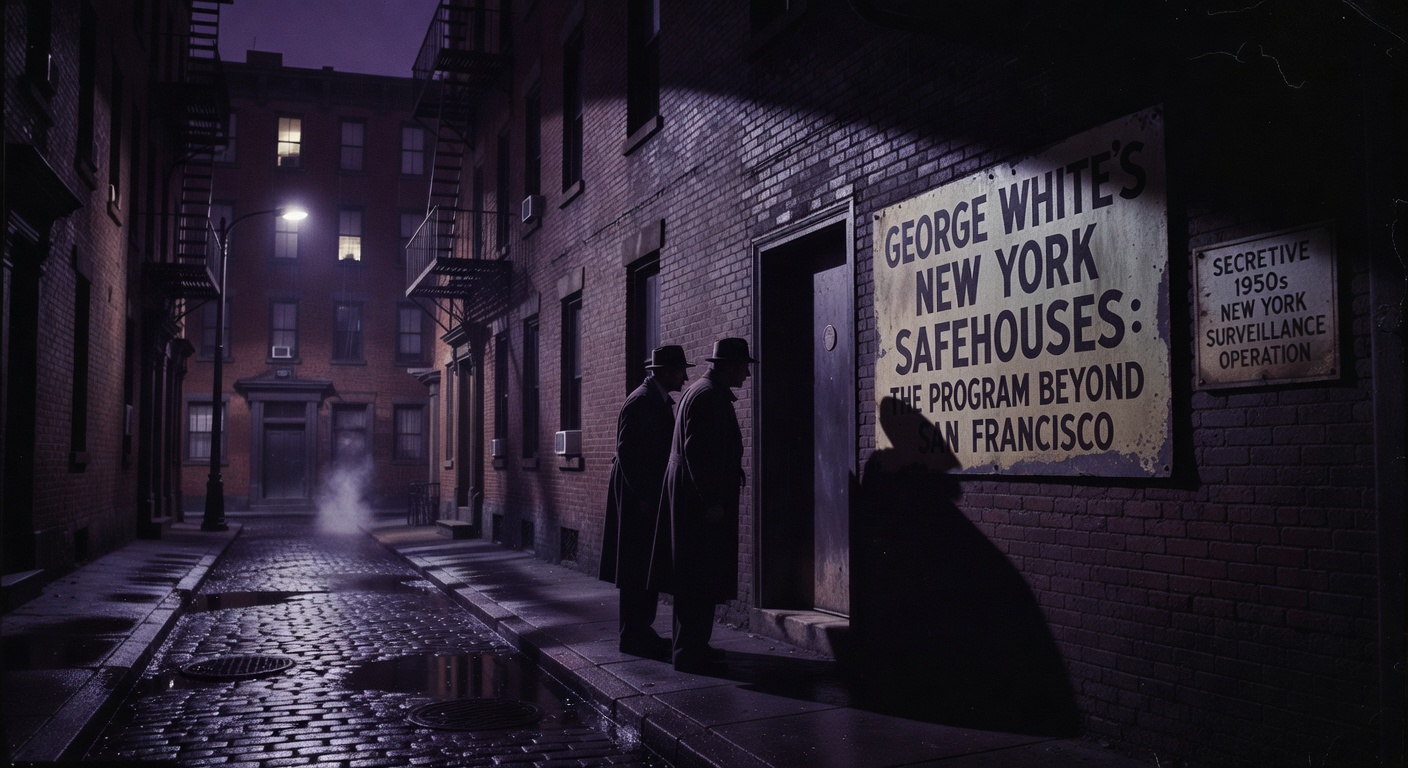
It was 1952, and somewhere in the heart of New York City, a man who had spent years hunting down drug kingpins for the Federal Bureau of Narcotics was doing something else entirely. He was perched behind a one-way mirror, nursing a martini, watching strangers stumble through altered states of consciousness they never consented to. The man was George Hunter White. The program was MKULTRA. And what happened in those Manhattan apartments remains one of the most disturbing chapters in American intelligence history.
Most people who have heard of Operation Midnight Climax know the San Francisco version — the Fisherman’s Wharf safehouses, the prostitutes hired to lure in unsuspecting men, the LSD slipped into drinks while CIA observers watched from behind mirrored glass. It is a story that has made its way into documentaries and history books. But the New York chapter? That one tends to get overlooked. That one deserves its own reckoning.
Who Was George Hunter White?
Before he became the CIA’s most enthusiastic civilian contractor, George White had built a reputation as a hard-charging, hard-drinking federal narcotics agent. He had worked with the OSS — the wartime precursor to the CIA — during World War II, training agents in the art of interrogation and running counter-intelligence operations across Europe and Asia. By the late 1940s, he was back stateside as a senior agent with the Federal Bureau of Narcotics (FBN), a man who moved comfortably in the shadows between law enforcement and intelligence.
White was not, by any measure, a man who colored inside the lines. Former colleagues described him as brilliant and reckless in equal measure — a man who could disarm a suspect with charm one moment and intimidate a room with sheer presence the next. He drank prodigiously, kept unusual hours, and cultivated a network of informants that stretched from Manhattan jazz clubs to San Francisco waterfront bars. He was, in short, exactly the kind of operative the CIA’s Technical Services Staff was looking for when it began casting about for someone to run its street-level drug experiments.
The man who brought White into the fold was Sidney Gottlieb — the CIA’s brilliant, morally elastic chemist who ran MKULTRA from its inception in 1953 until its quiet dismantlement in 1973. Gottlieb believed that LSD and other psychoactive compounds could serve as tools of behavioral control — that with the right substance and the right conditions, you could make a man tell the truth, forget what he knew, or become someone else entirely. He needed someone to test that theory on real human beings. White was his answer.
The San Francisco Blueprint
The more famous of White’s operations was Operation Midnight Climax in San Francisco, which ran through the late 1950s and into the early 1960s. White rented safehouses — most famously at 225 Chestnut Street in the Telegraph Hill neighborhood — and furnished them with one-way mirrors, concealed microphones, and an atmosphere designed to put visitors at ease. Working women hired through White’s informant network would bring men back to the apartments, and those men would unknowingly be dosed with LSD. White would observe from behind the mirror, taking notes, filing reports back to Gottlieb and the Technical Services Staff.
The ostensible scientific goal was to study how ordinary people responded to LSD — whether it loosened inhibitions, compromised judgment, made subjects more susceptible to suggestion or manipulation. In practice, it was a systematic program of non-consensual human experimentation, conducted on people who had no idea they were subjects in a federal research program.
But the San Francisco operation, as infamous as it became, was actually the second act. New York came first.
The New York Safehouses: Ground Zero
George White established his first CIA-linked safehouse operation in New York City beginning around 1952 — before MKULTRA was even officially chartered in April 1953. This was under the predecessor program known as Project ARTICHOKE, which itself grew out of the earlier Project BLUEBIRD. The CIA’s interest in mind control and chemical interrogation predated MKULTRA by several years, and New York was its earliest urban laboratory.
White operated out of at least two documented New York locations. One was an apartment at 81 Bedford Street in Greenwich Village — a location that, in the early 1950s, sat at the heart of New York’s bohemian counterculture, surrounded by jazz venues, artists’ studios, and a transient population that made for what intelligence professionals would coldly call a “target-rich environment.” Another documented location was at the Jefferson Hotel in Manhattan, though the full scope of New York operations may have involved additional sites whose records were later destroyed.
The Greenwich Village apartment was fitted out in a manner similar to what White would later replicate in San Francisco — two-way mirrors, recording equipment, and an atmosphere calibrated to make visitors feel at ease. White, often operating under the alias “Morgan Hall,” would play the role of the genial host. He entertained. He poured drinks. And sometimes, those drinks contained LSD, mescaline, or other experimental compounds that the CIA’s Technical Services Staff was eager to study in real-world conditions.
The Methods: Cold War Science Meets Street-Level Surveillance
To understand what happened in those apartments, you have to understand the Cold War anxiety that animated the program. American intelligence officials were genuinely alarmed by what they believed Soviet and Chinese operatives were doing with psychological manipulation. The Korean War had produced American POWs who seemed, in some cases, to have been ideologically “turned” by their captors — a phenomenon that American newspapers were calling “brainwashing.” The CIA was desperate to understand whether such techniques were real, and whether they could be replicated or countered.
LSD had been synthesized by Swiss chemist Albert Hofmann in 1943, and by the early 1950s it was circulating through psychiatric research circles as a potential treatment for various mental health conditions — and as a curiosity with poorly understood properties. Some researchers believed it could induce a temporary psychosis that might make subjects more susceptible to interrogation. Others thought it might function as a truth serum. The CIA wanted answers, and it wanted them on human subjects, not laboratory rats.
White’s New York operation provided exactly that. Subjects — typically drawn from the margins of society, people whose disappearance or aberrant behavior would not attract official attention — were brought to the apartments through various means. Some were lured through White’s network of criminal informants. Some were sex workers or their clients. Some may have simply been people White encountered through his narcotics enforcement work, individuals whose legal vulnerability made them easy to manipulate. None of them, as far as documented records show, gave meaningful informed consent to what was about to happen to them.
Once inside, they would be dosed and observed. White filed reports. The CIA’s analysts reviewed the results. And the program continued.
White’s Personality and the Culture of Impunity
What makes the New York and San Francisco operations particularly disturbing — beyond the obvious ethical violations — is what the documentary record reveals about George White’s state of mind during the operations. In a 1971 letter to Sidney Gottlieb, written after the programs had ended, White reflected on his years running the safehouses with a candor that is, in retrospect, staggering.
“I was a very minor missionary, actually a heretic,” he wrote, “but I toiled wholeheartedly in the vineyards because it was fun, fun, fun. Where else could a red-blooded American boy lie, kill, cheat, steal, rape and pillage with the sanction and blessing of the All-Highest?”
That letter — referenced in the Senate Select Committee’s 1977 hearings on MKULTRA — tells you something important about the culture that made these programs possible. White did not see himself as a scientist conducting rigorous research. He saw himself as an agent given license to do things that ordinary moral frameworks would prohibit, and he enjoyed it. The safehouse operations were, for him, an adventure — a continuation of the wartime atmosphere in which normal rules were suspended in the name of national security.
This tells us something about how such programs survive institutional scrutiny: they don’t, really. They survive by operating in the margins, staffed by people who find meaning in the transgression itself, shielded by classification and plausible deniability from anyone who might raise objections.
Sidney Gottlieb and the MKULTRA Architecture
George White was the instrument, but Sidney Gottlieb was the architect. Gottlieb ran the CIA’s Technical Services Staff and oversaw MKULTRA — a sprawling network of subprojects that, at its peak, involved over 80 institutions including universities, hospitals, prisons, and pharmaceutical companies. The stated goal was always the same: find a reliable method of behavioral control that could be used against enemy agents, or used to make American intelligence officers resistant to enemy manipulation.
The New York and San Francisco operations were subprojects within MKULTRA’s larger structure — specifically, they were part of what the CIA internally called “covert testing of materials on unwitting U.S. citizens.” The phrase is bureaucratic and bloodless. What it means, in practice, is dosing people without their knowledge and watching what happens.
Gottlieb would later testify, under congressional questioning, that he had doubts about the ethics of the program even as it was running — that he had believed the potential national security benefits outweighed the costs, but that in retrospect he was not sure. He was never prosecuted. He retired to a farm in Virginia, practiced yoga, and died in 1999. George White had died in 1975, never having faced legal consequences for his role in the operations.
How It Was Uncovered: The Church Committee and FOIA
The MKULTRA program remained largely secret until 1973, when CIA Director Richard Helms — apparently anticipating congressional scrutiny in the post-Watergate political climate — ordered the destruction of MKULTRA records. The order was carried out, and most of the program’s documentation went into shredders.
What saved the historical record was a bureaucratic accident. A cache of around 20,000 documents related to MKULTRA had been misfiled in a financial records building at the CIA’s Rockville, Maryland facility rather than at headquarters — and they escaped Helms’s destruction order. These documents were discovered in 1977 in response to a Freedom of Information Act request filed by journalist John Marks, whose subsequent book The Search for the Manchurian Candidate (1979) became the definitive early account of the program.
Those documents, combined with the testimony produced by the Church Committee — the Senate Select Committee to Study Governmental Operations with Respect to Intelligence Activities, which investigated intelligence abuses between 1975 and 1976 — provided the foundation for what we now know about MKULTRA and the safehouse operations. The 1977 Senate hearings specifically on MKULTRA, chaired by Senator Ted Kennedy, produced further testimony from CIA officials and former participants.
The picture that emerged was damning. Non-consensual human experimentation. Deliberate destruction of evidence. Oversight failures at every level of the executive branch. And victims — people dosed with powerful psychoactive substances without their knowledge — who had no legal recourse because the government successfully argued, in subsequent civil cases, that national security interests prevented the disclosure of information necessary to establish their claims.
Legacy and Ethical Reckoning
The New York safehouses of George White represent a particular kind of institutional failure — one that occurred not because the people involved were uniquely evil, but because they operated inside a system that had temporarily suspended the ethical constraints that normally govern human research.
The Nuremberg Code, drafted in 1947 in the aftermath of Nazi medical experiments, explicitly prohibited non-consensual human experimentation. The United States was a signatory to its principles. The CIA violated those principles knowingly, categorizing its subjects as enemy combatants, criminals, or social outcasts whose rights could be set aside in the name of national security.
The victims of the New York and San Francisco operations have never been fully identified. Some of them may not have known they were ever part of an experiment. Some of them may have attributed the strange episodes they experienced to mental illness or drug use. Some of them are almost certainly dead. Their names are not in the records that survived, because White and Gottlieb operated with deliberate opacity, and because Helms ordered what records there were destroyed.
What remains is fragmentary and unsettling — a glimpse through a shattered window at something that the American government did to its own citizens, in a Greenwich Village apartment, under the cover of Cold War necessity.
The question worth sitting with is not simply whether this could happen again. The relevant institutions and oversight mechanisms exist today precisely because this happened. The deeper question is: what happened to the people in those apartments — the ones we will never be able to name, whose experiences we can only infer from the observations of a man who described his work as “fun, fun, fun”? History has recorded the perpetrators’ names. It has not recorded their victims’.
Down the Rabbit Hole
If the George White safehouses have you pulling at threads, here are some related rabbit holes worth exploring:
- Operation Midnight Climax: The San Francisco Files — A deeper look at the Chestnut Street safehouse operations and the network of informants and working women who unknowingly served as instruments of CIA research.
- Sidney Gottlieb: The Poisoner-in-Chief — The extraordinary story of the CIA’s master chemist, who also ran assassination programs targeting foreign leaders, and how he lived out his final years on a rural Virginia farm, apparently at peace.
- Frank Olson and the Hotel Statler Window — The mysterious death of a Fort Detrick biological warfare researcher who was dosed with LSD at a CIA retreat in 1953 and fell from a New York hotel window nine days later. Suicide, accident, or something else?
- The Church Committee: When Congress Looked at the CIA — The 1975-76 Senate investigation that blew open the intelligence community’s post-war abuses, from assassination plots to domestic surveillance programs targeting American citizens.
- Project ARTICHOKE and Project BLUEBIRD: Before MKULTRA — The CIA’s earlier mind control research programs that preceded MKULTRA and laid the groundwork for the safehouse experiments — including early experiments on prisoners and psychiatric patients.
Disclaimer: This article is produced for educational and entertainment purposes. The historical information presented is drawn from declassified government documents, congressional testimony, and reputable investigative journalism. It is not intended to constitute legal, psychological, or professional advice of any kind.