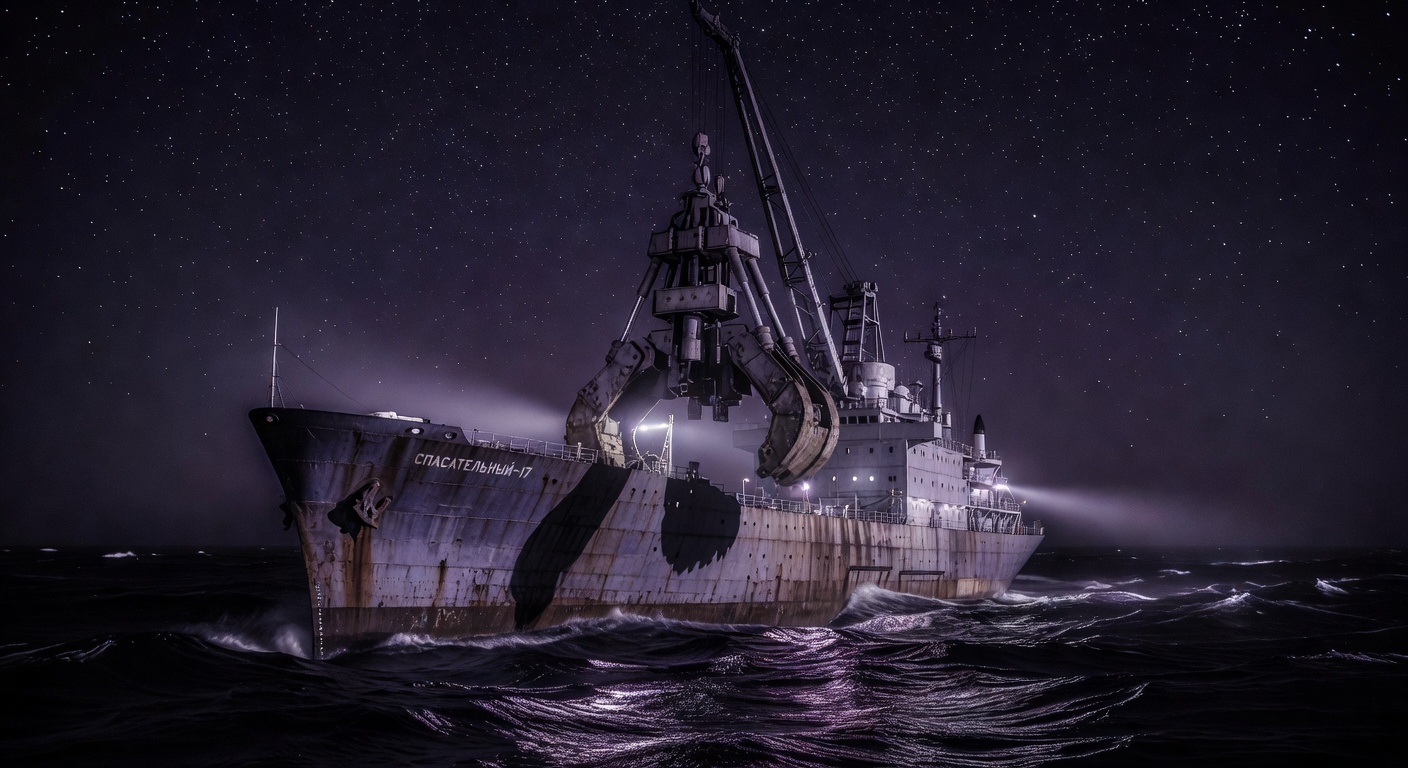
In the summer of 1974, a massive ship called the Glomar Explorer sat in the middle of the Pacific Ocean, approximately 1,500 miles northwest of Hawaii. To the casual observer — and to a Soviet surveillance vessel that periodically circled nearby — the ship appeared to be engaged in deep-sea mining operations, part of a commercial venture funded by eccentric billionaire Howard Hughes. But the Glomar Explorer wasn’t mining the seabed. Three miles beneath the surface, a giant mechanical claw was slowly, painstakingly attempting to retrieve a sunken Soviet nuclear submarine. The operation was called Project AZORIAN, and it remains one of the most audacious covert missions in the history of American intelligence.
The K-129: A Ghost in the Pacific
The story begins on March 8, 1968, when a Soviet Golf II-class submarine designated K-129 disappeared somewhere in the North Pacific Ocean. The Soviet submarine carried three nuclear ballistic missiles, two nuclear torpedoes, and a crew of 98 men. It simply vanished — no distress call, no wreckage, no explanation.
The Soviet Navy launched a massive search operation but found nothing. What they didn’t know — what the Soviets would not learn for decades — was that the U.S. Navy had been listening. The American SOSUS (Sound Surveillance System), a vast undersea network of hydrophones designed to track Soviet submarine movements, had detected an anomalous acoustic event consistent with the K-129’s disappearance. Using triangulation data from multiple SOSUS stations, American analysts were able to pinpoint the approximate location where the submarine had gone down.
When the USS Halibut, a specially configured spy submarine, was dispatched to investigate, it found the K-129 lying at a depth of approximately 16,500 feet — nearly three miles below the surface. The submarine was broken into sections but largely intact. And aboard that submarine, the CIA believed, were extraordinary intelligence treasures: nuclear warhead designs, cryptographic equipment, communications codebooks, and — potentially — insight into the nature of the catastrophic failure that had destroyed the vessel.
The Impossible Decision: Raise a Submarine from Three Miles Down
The idea that the CIA floated — literally — was to raise the K-129 from the ocean floor. The CIA’s Deputy Director for Science and Technology, Carl Duckett, championed the concept despite nearly universal skepticism from the engineering community. Nothing remotely approaching this scale of deep-sea salvage had ever been attempted. The physics were nearly prohibitive. The secrecy requirements were absolute — if the Soviets discovered what the U.S. was attempting, the diplomatic consequences would be severe, and the operation would be immediately abandoned.
Nevertheless, President Richard Nixon authorized the project in 1970. The classified operation was given the cover name Project AZORIAN (though it has often been misreported as “Project Jennifer” — the name of the CIA’s security plan for the operation). A budget of $350 million was allocated — an extraordinary sum in 1970 dollars, equivalent to roughly $2.7 billion today.
Enter Howard Hughes and the Glomar Explorer
The cover story that the CIA developed was a masterpiece of misdirection. The Agency approached Howard Hughes, the famously reclusive billionaire who already had extensive classified relationships with the U.S. government through his aerospace and defense contracting businesses. Hughes agreed to serve as the public face of the operation — which was presented to the world as a Hughes Mining Barge project to commercially mine manganese nodules from the ocean floor.
The cover was actually plausible. Deep-sea mineral extraction was a genuine emerging industry in the early 1970s, and Hughes’s eccentricity made him a credible figure for bizarre commercial ventures. A massive specialized ship was constructed for the operation — the Glomar Explorer — and presented publicly as a commercial mining vessel. Inside its hidden moon pool (a concealed opening in the hull), engineers installed a massive mechanical claw system called the Heavy Lift System, capable of gripping and raising objects from extreme depths using a series of interconnected pipe segments that would be assembled and extended like a giant mechanical straw reaching to the ocean floor.
The engineering challenges were unprecedented. The pipe string alone would weigh 14,000 tons when fully assembled. The capture vehicle — the claw — weighed 2,000 tons. The forces involved were at the absolute edge of what materials science could manage. Global Marine and a consortium of defense contractors spent years solving problems that had never been encountered before.
The Mission Itself: Summer 1974
The Glomar Explorer arrived on station in June 1974. For weeks, the crew — a mixture of genuine ocean engineers and CIA officers — worked in extraordinary conditions, concealing their real activities from the Soviet surveillance ship that periodically appeared in the area. The Soviets apparently accepted the cover story; their vessel never interfered with the operation.
The capture vehicle descended to the ocean floor and successfully gripped a section of the K-129. The recovery began. Three miles of pipe were carefully drawn up, inch by inch, toward the surface. And then — disaster.
At approximately 6,700 feet below the surface, something catastrophic happened. Three of the capture vehicle’s eight claws failed. The section of submarine being raised — believed to contain the forward torpedo compartment — broke apart. The majority of what had been recovered fell back to the ocean floor. Only a portion of the submarine — roughly 38 feet of the forward section — made it into the Glomar Explorer’s moon pool.
What the CIA actually recovered from that section remains partially classified. Official accounts state that the recovered section contained the bodies of six Soviet sailors, who were given a military burial at sea, and various equipment and documents. Whether any nuclear weapons materials or cryptographic devices were recovered has never been definitively confirmed by official sources.
The Cover Breaks
The operation might have remained secret indefinitely — but a burglary changed everything. In June 1974, just as the Glomar Explorer was on station in the Pacific, the Summa Corporation (Hughes’s company) offices in Los Angeles were broken into by thieves. Among the documents stolen was a memorandum describing the real purpose of the Glomar Explorer project.
The thieves apparently didn’t initially understand what they had. But eventually, word reached journalist Seymour Hersh of the New York Times and Jack Anderson, a prominent syndicated columnist. The CIA made an extraordinary and unprecedented request: they asked both journalists to suppress the story in the name of national security — specifically, to allow a second recovery attempt that was being planned.
Anderson declined to kill the story and broadcast a version of it on his radio program in February 1975. Other outlets then began reporting. The secret was out. The CIA’s cover story — the “Glomar Response” (“We can neither confirm nor deny”) — entered the legal lexicon as journalists filed Freedom of Information Act requests for more information.
The Glomar Response and Its Legacy
The phrase “we can neither confirm nor deny” — now known formally as the Glomar Response or Glomarization — has become a standard government tool for responding to FOIA requests about classified programs. When an agency invokes the Glomar Response, it refuses to confirm or deny the existence of records on a given subject, asserting that even acknowledging the existence of such records would reveal classified information.
The legal battle over Project AZORIAN documents extended for decades. The CIA eventually declassified a partial history of the project in 2010, available through the CIA’s Freedom of Information Act Reading Room. It confirmed the broad outlines of the operation while leaving key questions — particularly about what was actually recovered — unanswered.
What Did They Really Find?
The unanswered question at the center of Project AZORIAN is what, exactly, the CIA recovered. The official account — that only the forward torpedo compartment was brought up, containing bodies and limited materials — is disputed by some researchers who believe the recovery was more successful than admitted.
Submarine expert and author Norman Polmar, who has studied Project AZORIAN extensively, has noted that the CIA has been inconsistent about what was recovered. Some former CIA officers have suggested that cryptographic materials were among the items retrieved. Others have speculated that at least one nuclear warhead may have been recovered.
The burial at sea of the six Soviet sailors — filmed on 16mm film by the CIA and later shared with the Russian government after the Cold War — has been described as genuinely respectful, suggesting the CIA maintained a certain dignity even in the midst of this remarkable act of Cold War espionage.
Down the Rabbit Hole
Project AZORIAN opens doors to some extraordinary Cold War rabbit holes:
- The K-129 Sinking: What actually caused the K-129 to sink? Soviet negligence? A mechanical failure? Some researchers have controversially argued that a U.S. submarine may have been involved in a collision that sent K-129 to the bottom.
- Project JENNIFER vs. AZORIAN: The confusion between these two code names was deliberate — a CIA disinformation technique. How many other Cold War operations have been successfully misnamed in the public record?
- Howard Hughes: Intelligence Asset? Hughes had extensive classified relationships with the U.S. government going back to the 1940s. How deep did those relationships go, and what role did he really play in CIA operations beyond Glomar?
- The Second Recovery Attempt: The CIA was planning a second mission to retrieve the rest of the K-129 when the secret broke. What might they have found?
- The Glomar Response in Court: Legal battles over the Glomar doctrine have shaped FOIA law for decades. How has this submarine heist from 1974 affected your ability to access government information today?
Disclaimer: This article is intended for educational and entertainment purposes. Project AZORIAN is a documented historical CIA operation, partially declassified. Speculation about what was recovered and related theories are presented as historical rabbit holes, not verified claims. Conspiracy Realist encourages readers to explore primary sources and form their own conclusions.