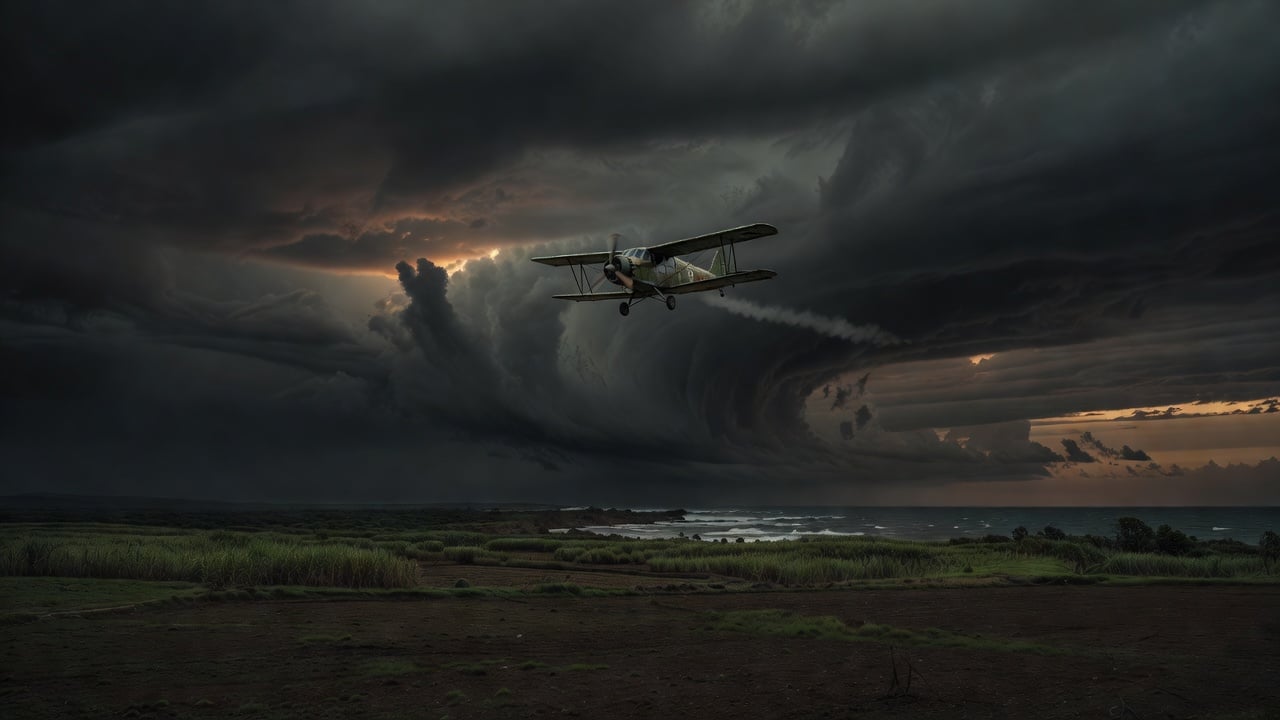
The plane crossed Cuban airspace in daylight, ordinary enough to disappear into paperwork. Months later, the story came back with teeth. Havana said a U.S. State Department aircraft had released an unknown substance over the island in October 1996, and that the crop pest Thrips palmi appeared soon after. Washington called the accusation outrageous disinformation. Most stories like that die in press briefings. This one went somewhere stranger. In 1997, Cuba forced the Biological Weapons Convention to do what treaties almost never do on command: stop the room, call the states together, and ask whether an alleged biological attack had actually happened.
The Case For
Why Cuba’s accusation landed harder than a press stunt
The case for taking Cuba’s complaint seriously begins with the paper trail. In a June 1997 letter circulated to the UN General Assembly, Cuba’s permanent representative transmitted a technical report arguing that investigators linked the appearance of Thrips palmi in Cuba with “a high degree of certainty” to the discharge of unknown substances from a U.S. aircraft over Cuban territory on 21 October 1996. Cuba did not present the event as rumor. It framed it as a documented overflight involving a specific aircraft type, a specific route, and a specific dispute over what the plane was capable of carrying.
The technical logic of the complaint also mattered. Cuba argued that the aircraft had been described as a “ferry flight,” which, in its reading, should have meant no operational payload in the herbicide tank. It rejected the U.S. explanation that the pilot merely used a smoke generator after spotting another aircraft nearby, saying that was not a standard method under instrument flight rules and claiming Havana had radio recordings of the exchanges with air traffic control. Even if that did not prove a biological release, it gave the accusation structure.
The treaty itself treated the allegation as serious enough to hear out
Then came the part conspiracy-minded readers never forget: the complaint was serious enough to trigger the Biological Weapons Convention’s formal machinery. The official report of the August 1997 formal consultative meeting shows that states parties convened in Geneva from 25 to 27 August at Cuba’s request, under the chairmanship of Ambassador Ian Soutar of the United Kingdom. Cuba and the United States both presented statements, and some states later said the short meeting had not resolved all ambiguous or unresolved matters.
It also did not end in the room. The report states that governments were invited to submit further observations, including views from national technical experts, by 27 September. According to the UN Library & Archives Geneva guide, 13 states parties did exactly that, and the chairman plus six vice-chairs continued consulting through the end of the year. For believers, that matters because the process still could not deliver a definitive public exoneration that made the whole episode vanish.
The Realist’s Eye
Presence is not proof, and ambiguity is not guilt
Now for the harder truth. None of that proves the United States dispersed Thrips palmi over Cuba. The official BWC meeting report is careful on that point. It records that some states thought the meeting had not fully resolved all ambiguities, while others believed the obligation to consult had been fulfilled by holding the meeting itself. That is not a split between guilty and innocent. It is a split over whether enough information had been exchanged in the time available.
The broader record cuts against any clean conspiracy verdict. A U.S. State Department statement from 6 May 1997 flatly denied the allegation, said the aircraft was en route to Colombia for narcotics crop eradication, and claimed the pilot used a smoke generator after seeing a Cubana aircraft below him. The State Department also said that on long flights the aircraft’s spray tanks were used for fuel, making the dispersal scenario impossible as described. Later, the State Department’s own 1997 compliance report to Congress repeated that the allegation was “completely unfounded and false” and said there was no evidence linking the infestation to the overflight.
What the final outcome actually said
The biggest problem for the theory is the outcome itself. The public 1997 consultative-meeting report was procedural, not a finding of culpability. Later summaries from the UN Library guide, the U.S. compliance report, and James Revill’s UNIDIR analysis of Article V all converge on the same point: the year-end process reached no “definitive conclusion.” That phrase matters. It does not mean the accusation was validated and buried. It means the available material did not establish a conclusive answer.
There is a second realism check. Thrips palmi was not a science-fiction organism appearing from nowhere. It was already known in the Caribbean region and in Florida by the early 1990s, which weakens any claim that its appearance in Cuba automatically implied deliberate release. Presence alone cannot establish delivery method. A pest can spread through trade, plant material, packaging, weather patterns, or other ordinary pathways. Once you strip away the Cold War mood, the central evidence problem becomes brutally simple: a disputed overflight and a later infestation do not, by themselves, prove causation.
That is what makes this episode so unsettling. If you have followed the broader weaknesses of BWC Article V, you already know the treaty is built to force consultation, not certainty. And if you track the wider government-secrets archive, the pattern will feel familiar. Here, the system could gather diplomats, but it could not reconstruct the event in a way that settled the argument for everyone watching.
What We Know For Certain
- Cuba formally accused the United States of releasing an unknown substance from a State Department aircraft over Cuban territory in October 1996.
- Cuba invoked Article V of the Biological Weapons Convention in 1997, leading to a formal consultative meeting in Geneva from 25 to 27 August 1997.
- The United States publicly denied the allegation and said the aircraft was on a narcotics-related transit flight to Colombia.
- The consultative process continued after the August meeting with additional state submissions and technical observations.
- The public year-end outcome reported that no definitive conclusion had been reached regarding Cuba’s concerns.
The Unanswered Questions
- What technical evidence, if any, was exchanged privately in Geneva that never entered the public record?
- Could a stronger verification regime have tested the aircraft-capability and pest-dispersal claims more decisively?
- How much did the passage of time between the overflight and the consultations undermine any chance of a conclusive finding?
- Did the secrecy of the process protect diplomacy, or did it preserve doubt that a fuller public record might have narrowed?
The Closer — You Decide
Most treaty disputes die in jargon. This one survived because the bones of it are real: a flight path, an infestation, a formal accusation, a Geneva meeting, and a final answer that never fully arrived. Maybe that is proof of a hidden act no one wanted to name. Maybe it is proof that biological allegations are among the hardest claims on earth to settle once politics gets in the bloodstream. The documents are real. The ambiguity is real too. The evidence is on the table. You decide.