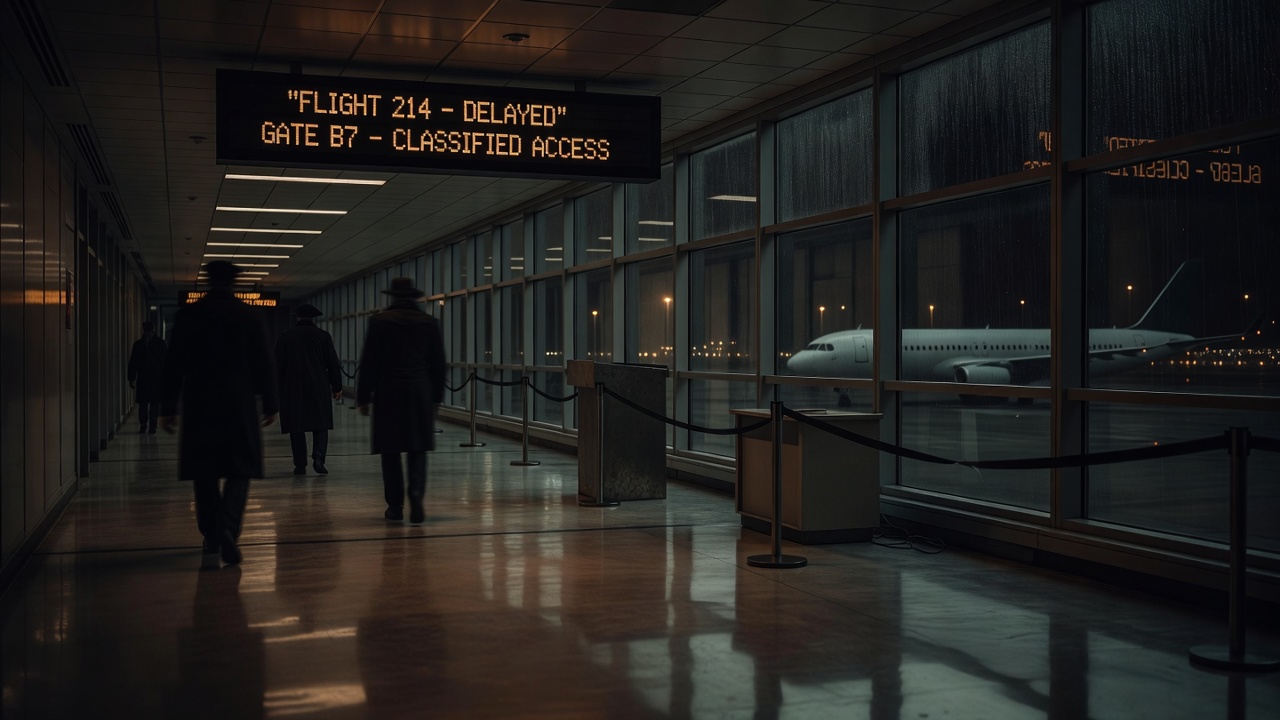
There is a moment in every airport when the performance changes. The public part is bright, procedural, almost comforting: passports, scanners, duty-free light. Then there is the layer behind it—the part the traveler never really sees. A quiet conversation at the gate. A plainclothes officer watching the boarding lane. A name pushed across a screen from a targeting center thousands of miles away. No handcuffs. No public accusation. Sometimes not even an explanation. Just a seat that suddenly stops belonging to you. That is the atmosphere around CBP’s Joint Security Program: a system built to intervene before wheels-up, far from any American border booth.
The Case For
A border moved offshore
If you wanted to make the strongest case that the Joint Security Program is more than routine travel security, the first fact is simple: it moves U.S. enforcement power into foreign airports without the formal visibility of full preclearance. According to a 2017 Government Accountability Office report on CBP predeparture programs, the Joint Security Program, or JSP, operated alongside the Immigration Advisory Program at foreign airports using unarmed, plainclothes CBP officers who worked with airlines and host-country officials to identify high-risk travelers before they boarded U.S.-bound flights. GAO said these officers could question travelers, review documents, and issue no-board recommendations while travelers were still overseas.
That matters because the practical effect could look a lot like a border decision made before the border ever appeared. In fiscal year 2015, GAO reported that CBP’s predeparture programs identified and interdicted more than 22,000 high-risk air travelers overall, and that IAP, JSP, and the Regional Carrier Liaison Groups together produced 11,589 no-board recommendations for roughly 88 million U.S.-bound travelers. In plain language: thousands of people were stopped before boarding, and part of that machinery existed outside the public-facing customs hall most travelers imagine as the real checkpoint.
The no-board power that was not quite a power
CBP’s own public testimony adds to the eerie shape of the system. In archived 2013 House testimony from Acting Deputy Commissioner Kevin McAleenan, CBP described IAP and JSP as overseas programs designed to stop high-risk passengers before departure and identified JSP locations in Mexico City and Panama City. The testimony said the programs had already prevented 18,366 high-risk or improperly documented passengers from boarding since inception, while saving both government processing costs and airline fines.
To a realist with a conspiratorial streak, the revealing part is the structure itself. JSP officers were not uniformed inspectors at a fixed U.S. checkpoint. They were plainclothes personnel operating inside foreign airports, supported by the National Targeting Center’s data analysis and watchlist matching. Airlines technically made the final boarding decision, but GAO reported that carriers almost always followed CBP’s recommendations. That creates the outline of a system that can function like an invisible veto—advisory on paper, decisive in practice.
It also fits the broader arc of our previous look at the Immigration Advisory Program’s hidden no-board network and the wider archive of government-secrets investigations. The state does not always need a dramatic ban when it can build a quiet chokepoint instead.
The Realist’s Eye
Security layering is not the same thing as secret law
Now the pressure test. The strongest counterargument is that JSP is not a rogue off-books program at all. It is documented in GAO oversight, described in congressional testimony, and framed as one layer in a post-9/11 aviation security model. CBP’s stated rationale is not hidden: stop dangerous or inadmissible travelers as early as possible, ideally before they ever board an aircraft bound for the United States. From that view, moving screening upstream is not sinister mission creep. It is basic risk management.
There is also an important legal distinction. GAO said JSP officers could not make formal admissibility determinations, conduct full border inspections, or compel an airline to refuse transport. The final decision remained with the carrier. That does not make the program toothless, but it does complicate the idea that CBP simply projected direct sovereign power into another country’s terminal without limits.
What the public record does not prove
The harder problem for the conspiracy reading is evidence. Public sources establish that JSP existed, that it relied on data-driven targeting, and that airlines usually complied with no-board recommendations. What they do not establish is a broad pattern of arbitrary political targeting, secret blacklisting outside existing watchlist systems, or widespread abuse unique to JSP itself. Those are serious claims, and the available official record does not document them clearly.
GAO actually highlighted a different weakness: measurement. The watchdog found that CBP had not fully evaluated the overall effectiveness of its predeparture programs with proper performance baselines. That is troubling, but it is not the same as proving misconduct. It suggests a security apparatus that was powerful and imperfectly audited, not necessarily one caught running a covert dragnet beyond all oversight.
There is another limitation. Many of the operational details remain generalized in public. We know the program locations discussed in key sources. We know plainclothes officers worked with carriers and host governments. We know recommendations were usually honored. But the exact thresholds for a referral, the frequency of false positives, and the remedies available to wrongly flagged travelers remain harder to see from open reporting alone. That opacity feeds suspicion, but opacity by itself is not proof.
What We Know For Certain
- GAO reported that CBP operated the Joint Security Program at two foreign airports as part of its predeparture screening architecture.
- GAO said JSP and IAP officers were unarmed, plainclothes CBP personnel working with airlines and host-country officials.
- Public CBP testimony in 2013 identified JSP locations in Mexico City and Panama City.
- GAO found that airlines almost always followed IAP and JSP no-board recommendations.
- GAO also found CBP had not fully evaluated the effectiveness of these predeparture programs using established performance baselines.
The Unanswered Questions
- What specific criteria most often triggered a JSP no-board recommendation in practice?
- How many travelers were wrongly flagged, and what recourse did they actually have before departure?
- How much discretion did host-country officials or airline personnel exercise once CBP made a recommendation?
- What records of JSP encounters are retained, and which of those records are accessible through FOIA or Privacy Act requests?
- How far has the model expanded or changed since the public sources most often cited by researchers?
The Closer — You Decide
The Joint Security Program does not need science-fiction theatrics to feel unsettling. The plainclothes officers were real. The no-board recommendations were real. The architecture that pushed the border outward into foreign terminals was real too. What remains harder to pin down is where prudent aviation security ended and quiet, low-visibility control began. That line matters. It always has. The documents are on the table, and so are the gaps between them. You decide.