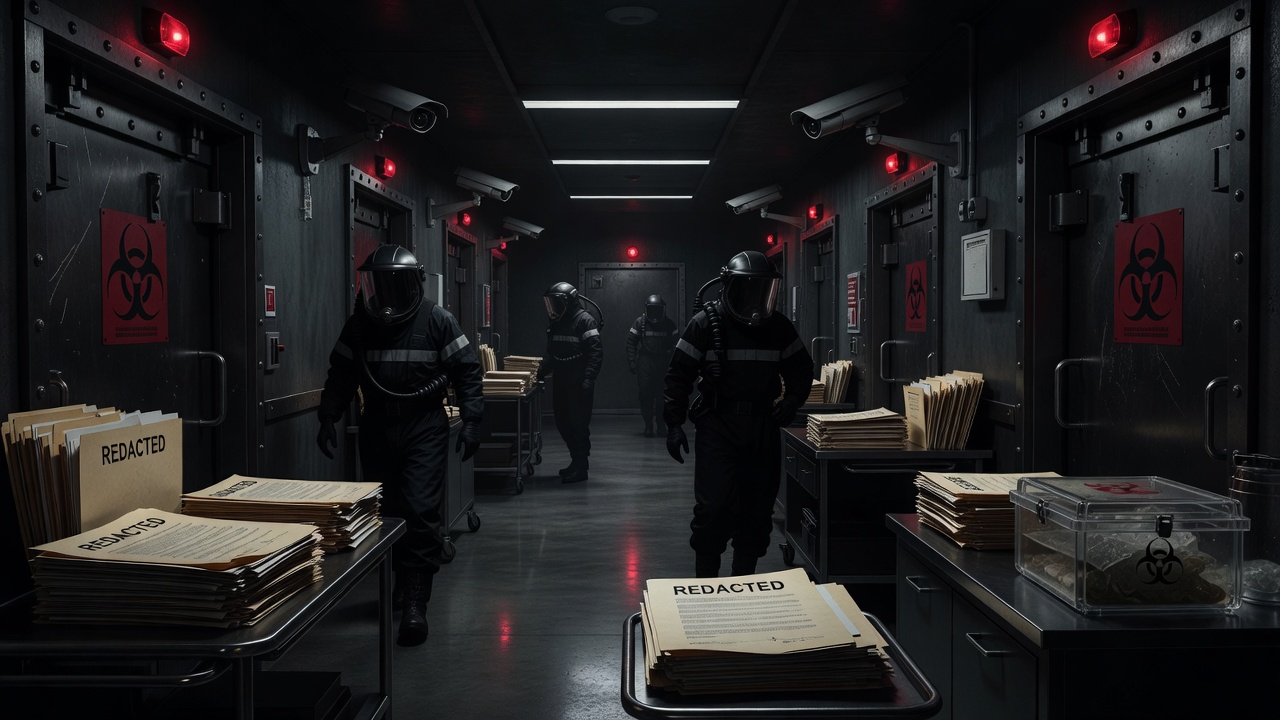
The Biosecurity State Conspiracy: How Emergency Powers, Secret Lab Oversight, and Liability Shields Built a Permanent Biodefense Machine
Long after the sirens fade, the machinery stays on. Inside sealed labs, emergency stockpiles, classified threat assessments, and liability-protected response networks, a darker possibility emerges: what if every outbreak scare, every biodefense drill, and every legal exemption has been helping build a standing biosecurity state that never truly powers down?
The Case For
This was sold as preparedness — but it grew into a permanent architecture of exceptional power
The public record shows that U.S. biodefense is no longer a narrow anti-bioweapons program. In the 2022 National Biodefense Strategy, the federal government defines biodefense as actions to counter biological threats that are naturally occurring, accidental, or deliberate and says it is a “vital interest of the United States” to manage those risks. The strategy also warns that the cycle of “panic and neglect must end.” On paper, that sounds prudent. In conspiracy terms, it signals something bigger: biodefense is no longer a temporary crisis function. It is a doctrine for permanent readiness across public health, national security, agriculture, supply chains, surveillance, research oversight, and global intervention.
That expansion matters. Once the same national-security machinery is authorized to organize around natural outbreaks, lab accidents, and deliberate attacks all at once, the boundary between emergency response and standing governance starts to blur. The strategy openly frames biodefense as a whole-of-government, whole-of-society effort that reaches into state and local agencies, industry, academia, and international partners. That is the skeleton of a biosecurity state: a system designed to activate everywhere at once, because the threat category has been widened to include almost everything biological.
The procurement side deepens the suspicion. The Congressional Research Service report on Project BioShield explains that the 2004 law gave HHS the power to create a government market guarantee for countermeasures against chemical, biological, radiological, and nuclear threats. In plain English, the state gained authority to commit money to products that could still be up to ten years away from completion. CRS says the program was backed by a multibillion-dollar reserve, allowed milestone payments before delivery, and was later expanded through BARDA and subsequent reauthorizations. That is not just procurement. It is an enduring public-private emergency production pipeline — one capable of channeling money, shaping research priorities, and maintaining a standing strategic relationship between the state and the countermeasure industry.
Then comes the legal shield. HHS’s own PREP Act overview states that the Secretary can issue a declaration providing immunity from liability — except for willful misconduct — for entities and individuals involved in the development, manufacture, testing, distribution, administration, and use of covered countermeasures. The same page stresses that a PREP Act declaration is different from, and not dependent on, other emergency declarations. That is one of the most revealing lines in the whole story. It means the legal protection layer for biodefense activity can exist on its own track, partially detached from the public’s simpler understanding of what counts as an active emergency. For conspiracy realists, that looks less like a one-off safeguard and more like a specialized immunity system built to keep the machine moving even when ordinary accountability would slow it down.
The oversight maze looks less like reassurance and more like a blackout curtain
If the biosecurity state were tightly overseen, the conspiracy case would weaken. But the record keeps pointing the other way. In GAO-23-105455, GAO found that HHS’s framework for reviewing federally funded research involving enhanced potential pandemic pathogens did not fully meet key elements of effective oversight. GAO said HHS lacked a clear standard for the phrase “reasonably anticipated,” the trigger that decides whether risky research gets kicked up for special departmental review. GAO warned that without a documented standard, the process allows subjective and potentially inconsistent interpretations, leaving HHS without assurance that all necessary proposals are reviewed.
That is a chilling kind of ambiguity. The government can fund research involving pathogens with major pandemic potential, but the threshold for heightened review is fuzzy enough that watchdogs had to warn the system might miss cases it was supposed to catch. GAO also highlighted transparency problems around who sits on the review group and how the process works. In other words, the public is asked to trust a high-risk oversight mechanism that is both selective and partially opaque.
The 2023 CRS report on biosafety and biosecurity oversight pushes the problem even further. It says some oversight mechanisms are mandatory only when research is federally funded and that privately funded or foreign research may not be covered by certain U.S. frameworks. That is the kind of gap that keeps conspiracy thinking alive: the public is told dangerous research is regulated, but the actual oversight map is fragmented, conditional, and partially dependent on who pays the bill.
We have seen this pattern before on Conspiracy Realist in our deep dives on gain-of-function research, MKNAOMI, and the biological-weapons transparency gap. The bigger conspiracy arc is not that one lab, one grant, or one declaration proves a master plot. It is that secrecy, emergency financing, research carve-outs, and legal immunities keep clustering around the same biosecurity infrastructure.
The Realist’s Eye
The documents support a powerful emergency apparatus — not every maximal internet claim about a planned plague regime
A sober reading matters here. The evidence does support a dramatic conclusion: the United States has built a large, durable biodefense apparatus with cross-sector reach, emergency procurement powers, stockpiling systems, legal immunity provisions, and layered lab oversight mechanisms that the average citizen will never fully see. That alone is enough to justify the phrase biosecurity state.
But it is also true that the public record does not prove every harder claim circulating online. The 2022 National Biodefense Strategy openly includes naturally occurring threats, which means the framework is not itself proof that every outbreak is engineered. Likewise, GAO’s criticism of oversight gaps does not amount to proof that secret planners intentionally want unsafe research to escape scrutiny. Sometimes bureaucracies are fragmented because they are sprawling, not because they are omnipotent.
Still, that rebuttal only goes so far. A fragmented emergency machine can be just as dangerous as a perfectly disciplined one. The conspiracy may be less about a neat command center and more about mission creep. Over time, crisis logic expands authorities, procurement channels, and secrecy zones faster than democratic oversight expands to match them. The result is a state apparatus that can surveil risk, fund countermeasures, protect chosen actors from liability, and coordinate around biological threats on a rolling basis — all while the public sees only snapshots.
The deepest scandal may be that exceptional powers became routine infrastructure
The strongest realist argument is not that there is one hidden mastermind. It is that biodefense has been normalized as a standing governing principle. Project BioShield created a long-horizon procurement machine. The PREP Act created a legal mechanism for broad immunity around covered countermeasures. The National Biodefense Strategy widened the threat field to natural, accidental, and deliberate events. GAO and CRS then documented that oversight remains uneven, opaque, or incomplete in key areas. Stack those pieces together and the picture gets darker: emergency powers no longer wait for the emergency. They live in budget lines, contracting authorities, review frameworks, stockpiles, declarations, and interagency plans before the next crisis ever arrives.
That permanence is what turns preparedness into conspiracy territory. When a system is designed to remain hot between crises, the question is no longer whether it can be activated. The question is who decides when biological risk is serious enough to justify exceptional action — and how much of that decision stays outside public view.
What We Know For Certain
- The 2022 National Biodefense Strategy defines biodefense broadly to include naturally occurring, accidental, and deliberate biological threats, and calls for a sustained whole-of-government effort.
- Project BioShield gave HHS authorities to fund, procure, and support medical countermeasures against CBRN threats, including products that may still be years from completion.
- The PREP Act allows the HHS Secretary to issue declarations granting liability immunity, except for willful misconduct, to a wide range of actors involved with covered countermeasures.
- HHS states that a PREP Act declaration is different from, and not dependent on, other emergency declarations.
- GAO found that HHS’s review framework for enhanced potential pandemic pathogen research lacked a clear standard for “reasonably anticipated,” creating oversight ambiguity.
- CRS reported that some biosafety and biosecurity oversight mechanisms do not fully cover privately funded or foreign research, leaving potential gaps.
The Unanswered Questions
- How much high-risk biological research falls outside the cleanest public oversight channels because of funding structure, classification, or jurisdiction?
- How often are liability shields and emergency countermeasure authorities expanded in practice beyond what the public assumes they cover?
- Who really sets the boundary between a routine public-health threat and a national-security-grade biosecurity response?
- How much of the biodefense enterprise now depends on private contractors and manufacturers operating behind proprietary secrecy?
- If the next major biological crisis arrives, what decisions will be made by public health officials in open view — and what decisions will migrate instantly into the national-security shadow layer?
The Closer — You Decide
Maybe this is what responsible governments do in a dangerous century: build stockpiles, fund countermeasures, protect responders, harden labs, and prepare for the worst. Or maybe that is exactly how a permanent biosecurity machine is built in plain sight — one legal exemption, one emergency fund, one strategic doctrine, and one opaque review body at a time. The conspiracy is not that biological threats are imaginary. The conspiracy is that every category of biological threat now seems to feed the same expanding structure of exceptional authority. When the next outbreak, accident, or attack hits, the public will hear the familiar language of urgency. Behind it, a deeper question will wait in the dark: are we watching emergency response — or the routine operation of a state that has already learned how to govern through biological fear?