Menu

The Outbreak Attribution Conspiracy: Why the World Still Cannot Quickly Tell a Natural Epidemic From a Biological Attack

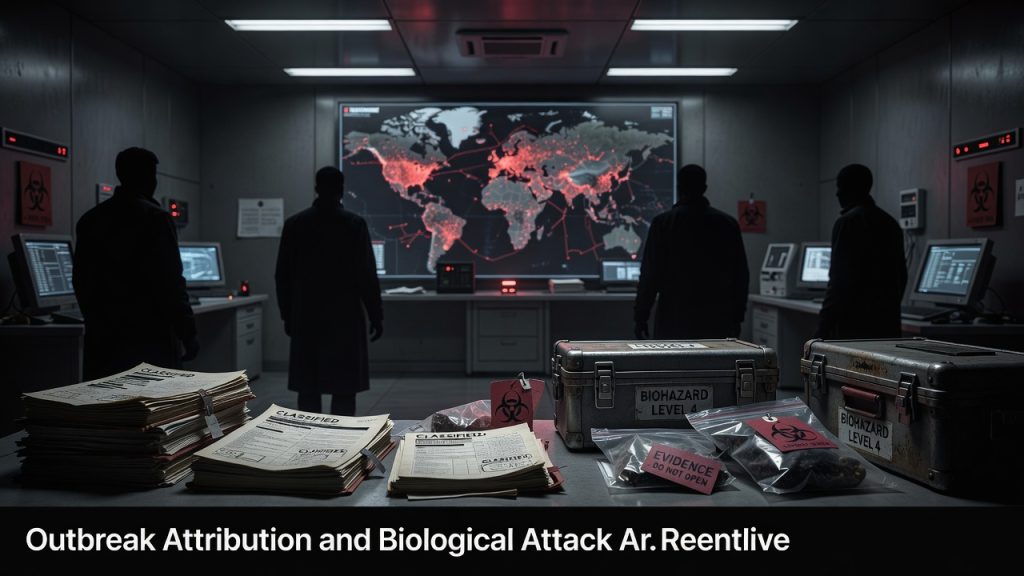
Faceless officials in a dark emergency operations room studying outbreak maps and redacted dossiers symbolizing the outbreak attribution conspiracy — ConspiracyRealist.com

The Outbreak Attribution Conspiracy: Why the World Still Cannot Quickly Tell a Natural Epidemic From a Biological Attack

A border town wakes to sirens, sealed wards, and rumors moving faster than the pathogen itself. Before the first lab report is finalized, governments are already trading accusations, broadcasters are choosing villains, and intelligence services are gaming the fallout. In that gap between outbreak and certainty, something darker takes shape: a world where the most dangerous biological event may not be the disease alone, but the system’s chronic inability to prove who—or what—set it loose before the narrative hardens into geopolitics.

The Case For

The conspiracy theory is simple: the global system was built to live with ambiguity, even when ambiguity is exactly what makes biological coercion possible

The official architecture sounds reassuring. The United Nations Office for Disarmament Affairs says the Biological Weapons Convention prohibits the development, production, acquisition, transfer, stockpiling, and use of biological and toxin weapons. UNODA also stresses a darker operational reality: if a suspicious disease event occurs, it can be difficult to determine whether the cause was nature, an accident, sabotage, terrorism, or biological warfare. That is not a fringe claim. It is the central vulnerability written into the official record.

That vulnerability is where the conspiracy frame begins. If a hostile actor wanted to weaponize uncertainty instead of merely weaponizing a pathogen, biology offers perfect cover. Outbreaks emerge in real time, evidence degrades, and the same laboratories, supply chains, and surveillance systems used for legitimate public health can also sit adjacent to biodefense, dual-use research, or covert capability. By the time investigators agree on the basics, states may already have locked into competing stories that serve military, diplomatic, or domestic agendas.

A 2025 Emerging Infectious Diseases article from an international group of experts put the problem in blunt terms: without clarity on whether an outbreak is natural, accidental, or deliberate, outbreaks of ambiguous origin can trigger speculation about a purposeful biological attack, especially in conflict settings shaped by misinformation and disinformation. The authors also note that the Biological Weapons Convention itself does not provide a standing investigative mandate for alleged use. Article VI allows a state to lodge a complaint with the UN Security Council, but the paper says there is no mechanism requiring the Council to act—and when Russia invoked Article VI in 2022, the Security Council did not accept the request for an investigation.

The only internationally independent mechanism exists—but even that reveals how late truth may arrive

The fallback tool is the United Nations Secretary-General’s Mechanism, or UNSGM. According to Germany’s Robert Koch Institute, the UNSGM is the only mechanism that can legitimize and carry out an internationally independent investigation in the event of suspected biological weapons use. The CDC article says a mission team is supposed to be dispatched within 48 hours after the UN Secretary-General decides to launch an investigation. That sounds fast—until you remember everything that has to happen first: a state must request action, the Secretary-General must decide to act, access must be secured, multinational experts must deploy, samples must be collected, and the evidence chain has to survive the fog of crisis and politics.

In other words, the official system does not eliminate uncertainty at the speed of rumor. It chases uncertainty after it has already escaped. That is the heart of the bigger conspiracy arc. Maybe no secret cabal designed biological attribution to fail. But the structure that exists is remarkably well suited to a world where blame can be manipulated, delayed, or permanently contested. We have seen adjacent pieces of that pattern in our coverage of the biosecurity state, the invisible arsenal conspiracy, and the broader government secrets archive. The recurring theme is not simply danger. It is danger wrapped in delayed visibility.

The Realist’s Eye

The evidence supports a dangerous attribution gap—but that is not the same thing as proof that outbreaks are being secretly engineered and disguised

A grounded reading has to separate institutional weakness from intentional design. The strongest documented claim is that biological attribution is technically and politically hard. The weakest unsupported leap is that every ambiguous outbreak is therefore evidence of a hidden bioweapons program. Open-source evidence does not justify that leap.

The same CDC paper that highlights the danger also points to ordinary epidemiology. It notes that suspicious disease narratives can surge around outbreaks that are ultimately traced to natural causes, such as the Legionnaires’ outbreak in Poland and the 2022 Ebola outbreak in Uganda. That matters. Suspicion is not proof. In a high-fear information environment, people can read pattern into chaos, especially when disease appears near a war zone, a research hub, or a geopolitical fault line.

There is also a practical reason governments resist easy attribution claims: the biology is messy. UNODA notes that suspicious events may be hard to distinguish among nature, accident, sabotage, terrorism, or warfare. The difference between those categories is not philosophical. It can hinge on genomic evidence, environmental sampling, epidemiological reconstruction, chain-of-custody integrity, access to facilities, and honest disclosure from states that may have every reason to conceal errors or shape the story. Even a capable international team can struggle if a site is contaminated, delayed, or politically stage-managed before inspectors arrive.

The more sober conclusion is not that the world is hiding a solved mystery. It is that the world may be structurally unprepared for an unsolved one. The RKI’s own description of ongoing UNSGM training and field exercises suggests the mechanism needs continuous preparation because investigating alleged biological weapons use is operationally difficult, multinational, and stressful. The 2025 CDC assessment concluded that the mechanism is well placed to investigate suspicious outbreaks, but still needs improvement in deployment speed, planning, sampling, interviewing, logistics, communication, and training frequency. That is not evidence of a master plan. It is evidence that one of humanity’s most serious taboo threats still depends on a system that experts are actively trying to make more ready.

So the realist tension remains. Maybe the attribution gap is an unavoidable consequence of biology itself. Or maybe states have accepted that ambiguity because ambiguity preserves room to deny, deflect, accuse, and maneuver. The documents do not prove which interpretation is right. They do prove that the gap is real—and that in a crisis, whoever controls the first credible story may enjoy a decisive advantage before the full evidence ever lands.

What We Know For Certain

  • UNODA states that the Biological Weapons Convention prohibits the development, production, acquisition, transfer, stockpiling, and use of biological and toxin weapons.
  • UNODA also states that in a suspicious disease event, it can be difficult to determine whether the cause was natural, accidental, sabotage, terrorism, or biological warfare.
  • The 2025 CDC article says the BWC does not itself provide a standing mandate to investigate alleged biological weapons use and that Article VI depends on the UN Security Council.
  • The same CDC article says Russia invoked Article VI in 2022 and that the Security Council did not accept the request for an investigation.
  • RKI states that the UNSGM is the only mechanism that can legitimize and conduct an internationally independent investigation of suspected biological weapons use.

The Unanswered Questions

  • If a suspicious outbreak erupted in a conflict zone tomorrow, could any international body establish a trusted account of its origin before competing state narratives overwhelmed the evidence?
  • How many hours or days of delay are enough to permanently compromise sample integrity, witness testimony, and public trust in a biological investigation?
  • Would states support a stronger standing attribution regime if it meant exposing sensitive biodefense labs, supply chains, and proprietary research to outside scrutiny?
  • How often do governments privately plan for deliberate biological scenarios while publicly relying on institutions that still struggle to prove intent quickly?
  • In the next global panic, will the decisive weapon be the pathogen itself—or the information vacuum surrounding its origin?

The Closer — You Decide

Maybe the outbreak attribution conspiracy is nothing more than a brutal fact of modern biology: some truths take time, and disease moves faster than certainty. But maybe that delay has become its own form of strategic cover, a gray zone where states can posture, deflect, and accuse while investigators race a clock they were never built to beat. The files are real. The institutional gaps are real. And if the next ambiguous outbreak becomes a geopolitical firestorm before the evidence is settled, that will not be paranoia. It will be the system performing exactly as designed—or exactly as neglected. The evidence is on the table. You decide.

dive down the rabbit hole

The Outbreak Attribution Conspiracy: Why the World Still Cannot Quickly Tell a Natural Epidemic From a Biological Attack

S-FX.com
Faceless officials in a dark emergency operations room studying outbreak maps and redacted dossiers symbolizing the outbreak attribution conspiracy — ConspiracyRealist.com

The Outbreak Attribution Conspiracy: Why the World Still Cannot Quickly Tell a Natural Epidemic From a Biological Attack

A border town wakes to sirens, sealed wards, and rumors moving faster than the pathogen itself. Before the first lab report is finalized, governments are already trading accusations, broadcasters are choosing villains, and intelligence services are gaming the fallout. In that gap between outbreak and certainty, something darker takes shape: a world where the most dangerous biological event may not be the disease alone, but the system’s chronic inability to prove who—or what—set it loose before the narrative hardens into geopolitics.

The Case For

The conspiracy theory is simple: the global system was built to live with ambiguity, even when ambiguity is exactly what makes biological coercion possible

The official architecture sounds reassuring. The United Nations Office for Disarmament Affairs says the Biological Weapons Convention prohibits the development, production, acquisition, transfer, stockpiling, and use of biological and toxin weapons. UNODA also stresses a darker operational reality: if a suspicious disease event occurs, it can be difficult to determine whether the cause was nature, an accident, sabotage, terrorism, or biological warfare. That is not a fringe claim. It is the central vulnerability written into the official record.

That vulnerability is where the conspiracy frame begins. If a hostile actor wanted to weaponize uncertainty instead of merely weaponizing a pathogen, biology offers perfect cover. Outbreaks emerge in real time, evidence degrades, and the same laboratories, supply chains, and surveillance systems used for legitimate public health can also sit adjacent to biodefense, dual-use research, or covert capability. By the time investigators agree on the basics, states may already have locked into competing stories that serve military, diplomatic, or domestic agendas.

A 2025 Emerging Infectious Diseases article from an international group of experts put the problem in blunt terms: without clarity on whether an outbreak is natural, accidental, or deliberate, outbreaks of ambiguous origin can trigger speculation about a purposeful biological attack, especially in conflict settings shaped by misinformation and disinformation. The authors also note that the Biological Weapons Convention itself does not provide a standing investigative mandate for alleged use. Article VI allows a state to lodge a complaint with the UN Security Council, but the paper says there is no mechanism requiring the Council to act—and when Russia invoked Article VI in 2022, the Security Council did not accept the request for an investigation.

The only internationally independent mechanism exists—but even that reveals how late truth may arrive

The fallback tool is the United Nations Secretary-General’s Mechanism, or UNSGM. According to Germany’s Robert Koch Institute, the UNSGM is the only mechanism that can legitimize and carry out an internationally independent investigation in the event of suspected biological weapons use. The CDC article says a mission team is supposed to be dispatched within 48 hours after the UN Secretary-General decides to launch an investigation. That sounds fast—until you remember everything that has to happen first: a state must request action, the Secretary-General must decide to act, access must be secured, multinational experts must deploy, samples must be collected, and the evidence chain has to survive the fog of crisis and politics.

In other words, the official system does not eliminate uncertainty at the speed of rumor. It chases uncertainty after it has already escaped. That is the heart of the bigger conspiracy arc. Maybe no secret cabal designed biological attribution to fail. But the structure that exists is remarkably well suited to a world where blame can be manipulated, delayed, or permanently contested. We have seen adjacent pieces of that pattern in our coverage of the biosecurity state, the invisible arsenal conspiracy, and the broader government secrets archive. The recurring theme is not simply danger. It is danger wrapped in delayed visibility.

The Realist’s Eye

The evidence supports a dangerous attribution gap—but that is not the same thing as proof that outbreaks are being secretly engineered and disguised

A grounded reading has to separate institutional weakness from intentional design. The strongest documented claim is that biological attribution is technically and politically hard. The weakest unsupported leap is that every ambiguous outbreak is therefore evidence of a hidden bioweapons program. Open-source evidence does not justify that leap.

The same CDC paper that highlights the danger also points to ordinary epidemiology. It notes that suspicious disease narratives can surge around outbreaks that are ultimately traced to natural causes, such as the Legionnaires’ outbreak in Poland and the 2022 Ebola outbreak in Uganda. That matters. Suspicion is not proof. In a high-fear information environment, people can read pattern into chaos, especially when disease appears near a war zone, a research hub, or a geopolitical fault line.

There is also a practical reason governments resist easy attribution claims: the biology is messy. UNODA notes that suspicious events may be hard to distinguish among nature, accident, sabotage, terrorism, or warfare. The difference between those categories is not philosophical. It can hinge on genomic evidence, environmental sampling, epidemiological reconstruction, chain-of-custody integrity, access to facilities, and honest disclosure from states that may have every reason to conceal errors or shape the story. Even a capable international team can struggle if a site is contaminated, delayed, or politically stage-managed before inspectors arrive.

The more sober conclusion is not that the world is hiding a solved mystery. It is that the world may be structurally unprepared for an unsolved one. The RKI’s own description of ongoing UNSGM training and field exercises suggests the mechanism needs continuous preparation because investigating alleged biological weapons use is operationally difficult, multinational, and stressful. The 2025 CDC assessment concluded that the mechanism is well placed to investigate suspicious outbreaks, but still needs improvement in deployment speed, planning, sampling, interviewing, logistics, communication, and training frequency. That is not evidence of a master plan. It is evidence that one of humanity’s most serious taboo threats still depends on a system that experts are actively trying to make more ready.

So the realist tension remains. Maybe the attribution gap is an unavoidable consequence of biology itself. Or maybe states have accepted that ambiguity because ambiguity preserves room to deny, deflect, accuse, and maneuver. The documents do not prove which interpretation is right. They do prove that the gap is real—and that in a crisis, whoever controls the first credible story may enjoy a decisive advantage before the full evidence ever lands.

What We Know For Certain

  • UNODA states that the Biological Weapons Convention prohibits the development, production, acquisition, transfer, stockpiling, and use of biological and toxin weapons.
  • UNODA also states that in a suspicious disease event, it can be difficult to determine whether the cause was natural, accidental, sabotage, terrorism, or biological warfare.
  • The 2025 CDC article says the BWC does not itself provide a standing mandate to investigate alleged biological weapons use and that Article VI depends on the UN Security Council.
  • The same CDC article says Russia invoked Article VI in 2022 and that the Security Council did not accept the request for an investigation.
  • RKI states that the UNSGM is the only mechanism that can legitimize and conduct an internationally independent investigation of suspected biological weapons use.

The Unanswered Questions

  • If a suspicious outbreak erupted in a conflict zone tomorrow, could any international body establish a trusted account of its origin before competing state narratives overwhelmed the evidence?
  • How many hours or days of delay are enough to permanently compromise sample integrity, witness testimony, and public trust in a biological investigation?
  • Would states support a stronger standing attribution regime if it meant exposing sensitive biodefense labs, supply chains, and proprietary research to outside scrutiny?
  • How often do governments privately plan for deliberate biological scenarios while publicly relying on institutions that still struggle to prove intent quickly?
  • In the next global panic, will the decisive weapon be the pathogen itself—or the information vacuum surrounding its origin?

The Closer — You Decide

Maybe the outbreak attribution conspiracy is nothing more than a brutal fact of modern biology: some truths take time, and disease moves faster than certainty. But maybe that delay has become its own form of strategic cover, a gray zone where states can posture, deflect, and accuse while investigators race a clock they were never built to beat. The files are real. The institutional gaps are real. And if the next ambiguous outbreak becomes a geopolitical firestorm before the evidence is settled, that will not be paranoia. It will be the system performing exactly as designed—or exactly as neglected. The evidence is on the table. You decide.

The Outbreak Attribution Conspiracy: Why the World Still Cannot Quickly Tell a Natural Epidemic From a Biological Attack

Faceless officials in a dark emergency operations room studying outbreak maps and redacted dossiers symbolizing the outbreak attribution conspiracy — ConspiracyRealist.com

The Outbreak Attribution Conspiracy: Why the World Still Cannot Quickly Tell a Natural Epidemic From a Biological Attack

A border town wakes to sirens, sealed wards, and rumors moving faster than the pathogen itself. Before the first lab report is finalized, governments are already trading accusations, broadcasters are choosing villains, and intelligence services are gaming the fallout. In that gap between outbreak and certainty, something darker takes shape: a world where the most dangerous biological event may not be the disease alone, but the system’s chronic inability to prove who—or what—set it loose before the narrative hardens into geopolitics.

The Case For

The conspiracy theory is simple: the global system was built to live with ambiguity, even when ambiguity is exactly what makes biological coercion possible

The official architecture sounds reassuring. The United Nations Office for Disarmament Affairs says the Biological Weapons Convention prohibits the development, production, acquisition, transfer, stockpiling, and use of biological and toxin weapons. UNODA also stresses a darker operational reality: if a suspicious disease event occurs, it can be difficult to determine whether the cause was nature, an accident, sabotage, terrorism, or biological warfare. That is not a fringe claim. It is the central vulnerability written into the official record.

That vulnerability is where the conspiracy frame begins. If a hostile actor wanted to weaponize uncertainty instead of merely weaponizing a pathogen, biology offers perfect cover. Outbreaks emerge in real time, evidence degrades, and the same laboratories, supply chains, and surveillance systems used for legitimate public health can also sit adjacent to biodefense, dual-use research, or covert capability. By the time investigators agree on the basics, states may already have locked into competing stories that serve military, diplomatic, or domestic agendas.

A 2025 Emerging Infectious Diseases article from an international group of experts put the problem in blunt terms: without clarity on whether an outbreak is natural, accidental, or deliberate, outbreaks of ambiguous origin can trigger speculation about a purposeful biological attack, especially in conflict settings shaped by misinformation and disinformation. The authors also note that the Biological Weapons Convention itself does not provide a standing investigative mandate for alleged use. Article VI allows a state to lodge a complaint with the UN Security Council, but the paper says there is no mechanism requiring the Council to act—and when Russia invoked Article VI in 2022, the Security Council did not accept the request for an investigation.

The only internationally independent mechanism exists—but even that reveals how late truth may arrive

The fallback tool is the United Nations Secretary-General’s Mechanism, or UNSGM. According to Germany’s Robert Koch Institute, the UNSGM is the only mechanism that can legitimize and carry out an internationally independent investigation in the event of suspected biological weapons use. The CDC article says a mission team is supposed to be dispatched within 48 hours after the UN Secretary-General decides to launch an investigation. That sounds fast—until you remember everything that has to happen first: a state must request action, the Secretary-General must decide to act, access must be secured, multinational experts must deploy, samples must be collected, and the evidence chain has to survive the fog of crisis and politics.

In other words, the official system does not eliminate uncertainty at the speed of rumor. It chases uncertainty after it has already escaped. That is the heart of the bigger conspiracy arc. Maybe no secret cabal designed biological attribution to fail. But the structure that exists is remarkably well suited to a world where blame can be manipulated, delayed, or permanently contested. We have seen adjacent pieces of that pattern in our coverage of the biosecurity state, the invisible arsenal conspiracy, and the broader government secrets archive. The recurring theme is not simply danger. It is danger wrapped in delayed visibility.

The Realist’s Eye

The evidence supports a dangerous attribution gap—but that is not the same thing as proof that outbreaks are being secretly engineered and disguised

A grounded reading has to separate institutional weakness from intentional design. The strongest documented claim is that biological attribution is technically and politically hard. The weakest unsupported leap is that every ambiguous outbreak is therefore evidence of a hidden bioweapons program. Open-source evidence does not justify that leap.

The same CDC paper that highlights the danger also points to ordinary epidemiology. It notes that suspicious disease narratives can surge around outbreaks that are ultimately traced to natural causes, such as the Legionnaires’ outbreak in Poland and the 2022 Ebola outbreak in Uganda. That matters. Suspicion is not proof. In a high-fear information environment, people can read pattern into chaos, especially when disease appears near a war zone, a research hub, or a geopolitical fault line.

There is also a practical reason governments resist easy attribution claims: the biology is messy. UNODA notes that suspicious events may be hard to distinguish among nature, accident, sabotage, terrorism, or warfare. The difference between those categories is not philosophical. It can hinge on genomic evidence, environmental sampling, epidemiological reconstruction, chain-of-custody integrity, access to facilities, and honest disclosure from states that may have every reason to conceal errors or shape the story. Even a capable international team can struggle if a site is contaminated, delayed, or politically stage-managed before inspectors arrive.

The more sober conclusion is not that the world is hiding a solved mystery. It is that the world may be structurally unprepared for an unsolved one. The RKI’s own description of ongoing UNSGM training and field exercises suggests the mechanism needs continuous preparation because investigating alleged biological weapons use is operationally difficult, multinational, and stressful. The 2025 CDC assessment concluded that the mechanism is well placed to investigate suspicious outbreaks, but still needs improvement in deployment speed, planning, sampling, interviewing, logistics, communication, and training frequency. That is not evidence of a master plan. It is evidence that one of humanity’s most serious taboo threats still depends on a system that experts are actively trying to make more ready.

So the realist tension remains. Maybe the attribution gap is an unavoidable consequence of biology itself. Or maybe states have accepted that ambiguity because ambiguity preserves room to deny, deflect, accuse, and maneuver. The documents do not prove which interpretation is right. They do prove that the gap is real—and that in a crisis, whoever controls the first credible story may enjoy a decisive advantage before the full evidence ever lands.

What We Know For Certain

  • UNODA states that the Biological Weapons Convention prohibits the development, production, acquisition, transfer, stockpiling, and use of biological and toxin weapons.
  • UNODA also states that in a suspicious disease event, it can be difficult to determine whether the cause was natural, accidental, sabotage, terrorism, or biological warfare.
  • The 2025 CDC article says the BWC does not itself provide a standing mandate to investigate alleged biological weapons use and that Article VI depends on the UN Security Council.
  • The same CDC article says Russia invoked Article VI in 2022 and that the Security Council did not accept the request for an investigation.
  • RKI states that the UNSGM is the only mechanism that can legitimize and conduct an internationally independent investigation of suspected biological weapons use.

The Unanswered Questions

  • If a suspicious outbreak erupted in a conflict zone tomorrow, could any international body establish a trusted account of its origin before competing state narratives overwhelmed the evidence?
  • How many hours or days of delay are enough to permanently compromise sample integrity, witness testimony, and public trust in a biological investigation?
  • Would states support a stronger standing attribution regime if it meant exposing sensitive biodefense labs, supply chains, and proprietary research to outside scrutiny?
  • How often do governments privately plan for deliberate biological scenarios while publicly relying on institutions that still struggle to prove intent quickly?
  • In the next global panic, will the decisive weapon be the pathogen itself—or the information vacuum surrounding its origin?

The Closer — You Decide

Maybe the outbreak attribution conspiracy is nothing more than a brutal fact of modern biology: some truths take time, and disease moves faster than certainty. But maybe that delay has become its own form of strategic cover, a gray zone where states can posture, deflect, and accuse while investigators race a clock they were never built to beat. The files are real. The institutional gaps are real. And if the next ambiguous outbreak becomes a geopolitical firestorm before the evidence is settled, that will not be paranoia. It will be the system performing exactly as designed—or exactly as neglected. The evidence is on the table. You decide.

Table of contents