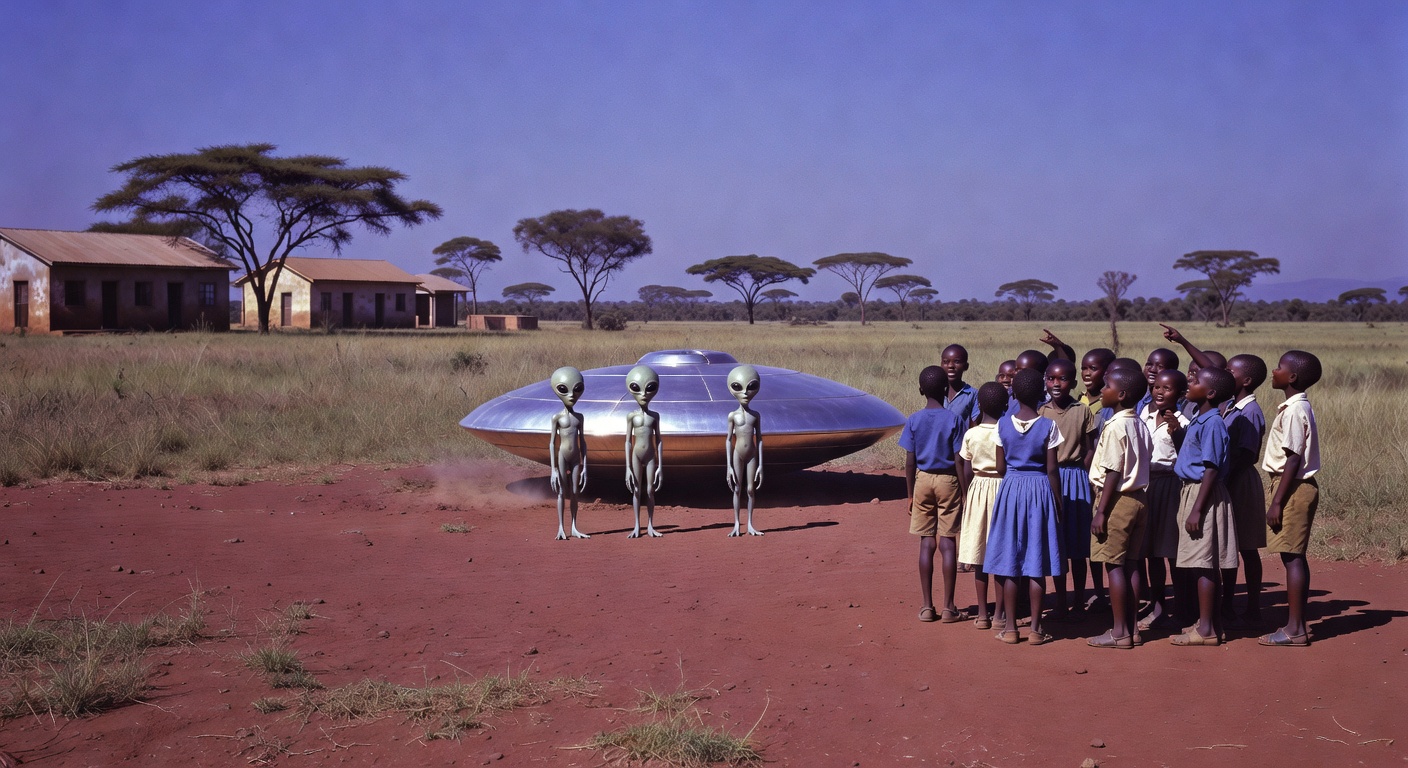
Night roads have a way of compressing reality. The familiar becomes theatrical, headlights carve tunnels through darkness, and one strange light in the distance can reshape an entire life. In September 16, 1994, in Ruwa, Zimbabwe, 62 children at Ariel School entered exactly that kind of zone: a liminal hour where ordinary assumptions failed. What makes this story endure is not just the spectacle, but the paper trail: interviews, chronology, witness behavior, and years of argument that never quite closed the file. This is the pattern at the heart of modern UFO lore—events that resist easy proof yet refuse to disappear. Cases like Project Blue Book and Roswell linger for similar reasons, but this one remains unusually intimate. It starts with a car ride, a few missing miles, and questions that only multiplied.
The Night the Timeline Broke
By all available accounts, the core event begins as a routine return trip and then fractures into anomaly. a recess-time encounter with a landed craft and beings near the school grounds appears in witness narratives as a sequence rather than a single dramatic instant: an odd object at distance, repeated visual reacquisition, mounting fear, and finally a discontinuity in time and memory. Investigators across decades have stressed the same foundational issue: timelines that should be simple become slippery under scrutiny. That ambiguity fuels both believers and skeptics. For one side, the uncertainty is exactly what trauma and extraordinary events look like. For the other, memory reconstruction and social influence explain the same pattern. Either way, the break in continuity is the central engine of the case, and the reason it remains a template for later reports of abduction, contact, or controlled encounter.
Evidence, Artifacts, and the Forensic Gray Zone
The file includes independent drawings, repeated interviews, and later testimony in adulthood. None of these artifacts, standing alone, can force a verdict. Together, they create what investigators call a structured mystery: a set of clues that point in overlapping directions without collapsing into certainty. This is where serious UFO research tends to live—not in certainty, but in consistency. Witnesses describe sensations, effects, and sequence details that remain stable over time; physical traces exist but can be interpreted multiple ways; official records contain enough information to sustain inquiry but not enough to settle it. That tension has also defined modern disclosure-era stories like Immaculate Constellation and AATIP, where documentation and uncertainty co-exist.
Witness Credibility: Why This Case Traveled So Far
In controversial encounter cases, credibility is often treated like a binary switch—either perfect or worthless. Real investigations are subtler. Here, observers repeatedly returned to background factors: personal reputation, social standing, prior behavior, and whether witnesses appeared to gain from the story. The principal witnesses in this file were widely described as responsible, community-rooted, and initially reluctant to become public symbols. That profile does not prove the extraordinary claim; it does, however, complicate easy dismissal. For that reason, the case became a benchmark in discussions of high-strangeness testimony, and later narratives—from The Nimitz Encounter to Tehran 1976—have been measured against its witness dynamics.
Interview Methods, Memory, and Controversy
No serious treatment can avoid the methodological fight: how much weight should be given to delayed recall, suggestibility concerns, and interview techniques such as hypnosis? In this case, clinicians and investigators used structured sessions to recover fragmented memory, producing dramatic narratives that shaped public imagination. Critics argue that these methods can unintentionally create coherent stories from uncertain fragments. Defenders counter that the sessions revealed independent consistencies difficult to script. Both positions deserve attention. The modern lesson is not to romanticize or discard recovered memory wholesale, but to triangulate it with chronology, behavioral evidence, and contemporaneous documents. That standard has become essential in evaluating cases linked to Skinwalker Ranch and historical files like Project Sign/Grudge.
The Cultural Shockwave
After this event entered media circulation, it changed the language of the UFO conversation. Themes that now feel familiar—missing time, non-human exam rooms, symbolic star maps, psychological residue, and long-tail witness trauma—moved from fringe motifs into mainstream speculation. Television specials, paperback investigations, and talk-radio circuits amplified the file into archetype. But simplification came at a cost. Complex timelines were reduced to punchlines, and unresolved details were flattened into certainty by both camps. A better approach is to treat the case as a historical hinge: a moment when public culture began merging Cold War anxiety, space-age imagination, and personal testimony into a single narrative form. In that sense, it belongs in the same lineage as Ancient Astronaut debates and technology-centered rumors explored in reverse-engineering narratives.
Competing Explanations That Still Matter
Three broad explanations still dominate: misidentification layered with fear, psychologically mediated reconstruction after an unusual event, or a genuinely anomalous encounter with unknown agency. The first model emphasizes environmental conditions, fatigue, and expectation effects. The second foregrounds stress, dream contamination, and interview amplification. The third argues that recurring structural similarities across cases are too specific and too global to dismiss as coincidence. None is airtight. The enduring value of this file is that it forces us to compare explanatory frameworks instead of declaring instant victory. That same analytical discipline is useful when reviewing other high-visibility incidents, including the Phoenix Lights and the Belgium wave.
Documents Worth Reading Before You Decide
If you want to evaluate the case rather than inherit someone else’s conclusion, start with primary and near-primary material. Useful entry points include Ariel Phenomenon documentary references; BBC reporting on witness follow-ups; Harvard Gazette profile of John Mack. Place those against broader official-era records, such as the U.S. National Archives UFO holdings, then compare reporting style, evidentiary thresholds, and witness treatment across decades. You may still land on uncertainty, but it will be informed uncertainty—the only honest destination in many legacy UFO files.
How This Case Connects to the Broader Rabbit Hole
One reason this encounter remains magnetized in public memory is that it links outward in every direction: to official secrecy claims, to contact narratives, to military-adjacent sightings, and to recurring myths about hidden committees or recovered craft. Follow that thread and you quickly land in adjacent dossiers such as Rendlesham Forest Ufo Incident | Majestic 12 Secret Ufo Committee | Kecksburg Ufo Crash 1965 | Project Grudge Sign Ufo Suppression | 1952 Washington Dc Ufo Flap. You also intersect with this batch’s related investigations: Betty Barney Hill Alien Abduction | Travis Walton Alien Abduction | Valentich Disappearance Ufo Pilot. Taken together, these stories map a recurring architecture—ordinary people, extraordinary perception, institutional ambiguity, and decades of unresolved debate.
Conclusion: A Case That Refuses to Collapse
More than half a century later, the case still resists neat closure. That is exactly why it matters. It is neither clean proof nor disposable folklore; it is a durable anomaly built from testimony, traces, and unresolved institutional context. Whatever conclusion you favor, this file rewards disciplined curiosity. Read skeptically, compare sources, and track where confidence rises versus where it merely feels comfortable. In the world of UFO history, that distinction is everything. The most responsible position may be the hardest one: to hold possibility and doubt at the same time, while staying honest about what the record can—and cannot—carry.
Investigative Timeline: What Happened Before and After
When researchers revisit this file, one of the strongest approaches is timeline discipline. What was reported immediately, what emerged later, and which claims appear only after media attention? In this case, the early layer contains the core shock, emotional aftereffects, and practical actions taken by witnesses. The middle layer adds interviews, outside interpretation, and competing reconstructions. The late layer brings documentaries, books, and internet retellings that can both preserve and distort the record. This is why chronology matters more than viral summaries. It helps separate contemporaneous observations from inherited mythology. The same method clarified key discrepancies in Socorro and in military-era files discussed beside the 1952 Washington flap. If you keep the layers distinct, the case becomes harder to sensationalize and easier to analyze.
Media Amplification and the Price of Fame
Once a case crosses into mass media, it changes. Reporters condense, producers dramatize, and audiences demand clarity where none may exist. In practical terms, that means subtle witness uncertainty often gets edited out, while the most cinematic details get repeated until they feel indisputable. For UFO history, this pattern is almost universal. We saw it with Kenneth Arnold, with the Phoenix Lights, and with modern disclosure hearings that are clipped into thirty-second certainties. The smartest way to read any famous encounter is to ask: what did the first witnesses actually say, in their own words, before the cultural machine optimized the narrative for ratings?
Patterns Across Global Encounter Reports
Even with regional differences, global encounter reports show recurring architecture: unusual light behavior, altered perception of time, electromagnetic oddities, physiological stress, and long-term psychological impact. Whether that pattern reflects a shared external phenomenon or the limits of human perception under stress remains open. But pattern recognition does matter. It allows comparison across geography and decades, from Shag Harbour to Rendlesham to rural civilian reports. This case sits squarely inside that architecture, which is why it remains relevant in present-day conversations about unidentified anomalous phenomena. It is not an isolated story. It is part of a repeating grammar.
What Skeptics Get Right — and What They Miss
A rigorous skeptical lens is essential. It catches timeline drift, social reinforcement effects, financial incentives, and confirmation bias. Without skepticism, investigation collapses into fandom. But skepticism can also overreach when it assumes every unresolved point equals error or deceit. Some events remain unresolved because data is incomplete, not because witnesses are dishonest. The most productive posture combines hard questions with epistemic humility: challenge details, verify records, and still admit when the final answer is unavailable. That balance is precisely what public discourse on UAPs needs now, especially as legacy cases are reinterpreted through modern defense and intelligence debates.
Why the Story Endures
Cases survive generations when they occupy a narrow corridor between plausible testimony and elusive proof. This one does. It carries personal stakes, investigative depth, and a durable emotional charge that refuses to go flat. It also invites bigger questions: How do institutions handle anomalous reports? How should journalism cover extraordinary claims responsibly? And what happens to witnesses who become permanent symbols of an unresolved event? As long as those questions remain alive, this file will remain active in the public imagination—not as settled history, but as an open case in the anthropology of belief, evidence, and mystery.
Down the Rabbit Hole
- Article Idea: [Dr. Benjamin Simon] and the ethics of hypnosis in high-strangeness investigations.
- Article Idea: Comparing [missing time] reports from 1961 to modern cockpit and military witness accounts.
- Article Idea: Mapping [Zeta Reticuli] claims against astronomy history and pop-culture transmission.
- Article Idea: Why community reputation can both strengthen and distort witness credibility in UFO cases.
- Article Idea: A timeline bridge from this file to Majestic-12 era secrecy narratives.
Disclaimer: This article is for entertainment and educational exploration. Readers are encouraged to research these topics independently and form their own conclusions.