

It’s in your diet soda. Your sugar-free gum. Your “light” yogurt. Your packets of NutraSweet. Your tabletop sweetener. It’s in thousands of products marketed as healthier alternatives to sugar, and hundreds of millions of people consume it every day without a second thought.
But the story of how aspartame came to be in all of those products — the regulatory battles, the political interference, the scientific disputes that have never fully resolved — is one of the strangest and most troubling tales in the history of food safety regulation in America.
It involves a controversial scientist, a revolving door between industry and government, a future Secretary of Defense, and a regulatory process that was overturned at the highest levels. And it raises questions that, decades later, haven’t been definitively answered about what exactly aspartame does to the human body.
The Accidental Discovery
The story begins in 1965, when a chemist named James Schlatter, working for G.D. Searle & Company, accidentally discovered aspartame. He was working on an anti-ulcer drug and contaminated his hand with a compound he’d synthesized. When he licked his finger to pick up a piece of paper, he noticed an intense sweetness. The compound — a dipeptide made of two amino acids, aspartic acid and phenylalanine, with a methanol molecule attached — was approximately 200 times sweeter than sugar.
Searle recognized immediately that they had something potentially very valuable. Diet culture was growing. Sugar substitutes were in demand. They began the process of seeking FDA approval for their new sweetener.
What followed was a regulatory saga that would span more than a decade and a half, involve allegations of data manipulation, congressional investigations, a federal grand jury, and — at the critical moment — a dramatic political intervention.
The Science Gets Ugly
To win FDA approval, Searle needed to demonstrate that aspartame was safe. They conducted animal studies — as required — and submitted the results to the FDA. Almost immediately, questions arose about the quality of that research.
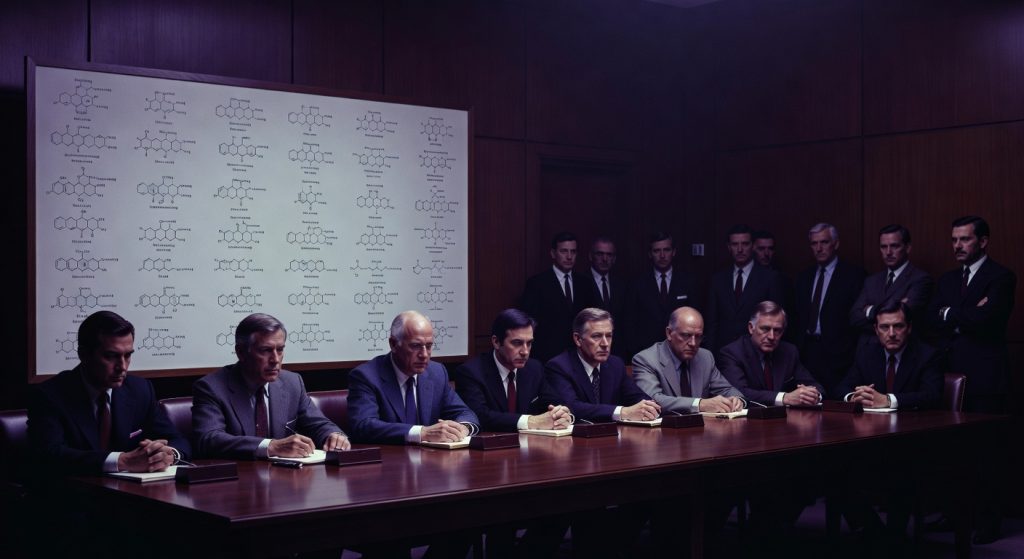
An FDA task force assigned to review Searle’s safety studies in 1975 found what it described as serious problems: studies that appeared to have been altered after the fact, data that didn’t match actual lab animals, tumors that were discovered, removed, and not reported, and animals that died and were recorded as still alive. The task force report described a pattern of “failure to report adverse effects” and questioned the integrity of the entire submission.
The FDA sent the case to the U.S. Attorney’s Office for possible criminal prosecution. A federal grand jury was convened to investigate G.D. Searle. Then something curious happened: the grand jury investigation dragged on for years. Key statutes of limitations expired. The lead prosecutor, Samuel Skinner, left the U.S. Attorney’s office — and took a job at the law firm representing Searle. The investigation quietly died.
In 1977, FDA Commissioner Alexander Schmidt referred Searle’s data to a Public Board of Inquiry — a formal scientific review body. When that board convened, it concluded that aspartame should not be approved until further studies on its potential to cause brain tumors were conducted. The Board found the existing evidence concerning enough that it recommended against approval.
At this point, aspartame had been kept off the market for over a decade due to legitimate scientific concerns. And then came 1981.
Enter Donald Rumsfeld
In 1977, before becoming a government official, Donald Rumsfeld — who would later serve as Secretary of Defense under both Gerald Ford and George W. Bush — became the CEO of G.D. Searle & Company. He had been brought in to turn the struggling pharmaceutical company around.
According to multiple accounts, including testimony from former Searle employees, Rumsfeld told his team that he would get aspartame approved — not through science, but through political means. He would call in political favors. He had the connections to do it.
What happened next is documented: Ronald Reagan was inaugurated in January 1981. Reagan’s transition team — of which Rumsfeld was a member — had a role in selecting the new FDA Commissioner. That Commissioner, Arthur Hull Hayes Jr., took office in April 1981.
In July 1981, Hayes overruled the FDA’s own Public Board of Inquiry and approved aspartame for use in dry foods. In 1983, he extended that approval to carbonated beverages — making possible the diet soda explosion of the 1980s. Shortly after approving aspartame for carbonated beverages, Hayes left the FDA. He took a position as a senior scientific consultant at Burson-Marsteller — the public relations firm retained by NutraSweet, the company Searle created to market aspartame.
The revolving door had spun. Beautifully, profitably, and on schedule.
The Science That Won’t Go Away
Supporters of aspartame point to the extensive research conducted since its approval and argue it is one of the most thoroughly studied food additives in history. Regulatory agencies in Europe, Japan, Australia, and dozens of other countries have reviewed the evidence and concluded it is safe at typical consumption levels.
But the dissenting science hasn’t gone away. The controversy has centered on several areas:
Brain Tumors
The FDA’s own review board was concerned about aspartame’s potential to cause brain tumors in animals. In 1996, a paper published in the Journal of Neuropathology and Experimental Neurology noted that the rise in brain tumor rates in the United States since 1984 roughly correlated with the introduction of aspartame into the food supply. The paper’s methodology was disputed, but the question never fully disappeared from the scientific literature.
Methanol and Formaldehyde
When aspartame is metabolized, it breaks down into aspartic acid, phenylalanine, and methanol. Methanol — wood alcohol — is subsequently converted to formaldehyde in the body. Defenders of aspartame note that many foods, including fruit juices, contain higher levels of methanol than typical aspartame consumption would produce. Critics argue that the methanol from aspartame is delivered without the protective cofactors present in natural foods, making it more bioavailable and potentially harmful.
The Ramazzini Studies
Between 2005 and 2010, the European Ramazzini Foundation published several large animal studies suggesting that aspartame, even at doses below the acceptable daily intake, caused significant increases in lymphomas, leukemias, and other cancers in rats — particularly females. The European Food Safety Authority reviewed these studies and disputed their methodology. The back-and-forth has never fully resolved.
The WHO Classification
In July 2023, the International Agency for Research on Cancer (IARC), the cancer research arm of the World Health Organization, classified aspartame as “possibly carcinogenic to humans” — Group 2B. This classification, notably, is used when there is some evidence of carcinogenicity but it is not conclusive. The JECFA, a separate WHO-FAO expert committee, simultaneously concluded that the acceptable daily intake did not need to change. In other words: possibly cancer-causing, but probably fine if you don’t drink too much of it. Not exactly a ringing endorsement.
Who Profits from the Confusion?
The aspartame market is enormous. The global artificial sweetener market is worth tens of billions of dollars, and aspartame is one of its foundations. Companies that produce aspartame and products containing it have significant financial incentives to fund research that produces favorable results — and significant incentives to challenge or discredit research that doesn’t.
This doesn’t mean all positive research on aspartame is corrupt or that all negative research is reliable. But it does mean that the scientific debate on aspartame has played out in a financial and political environment where neutrality is genuinely difficult to achieve. Industry-funded studies on food additives have consistently shown more favorable results than independently funded ones — a pattern documented across numerous food safety controversies.
The Regulatory Capture Pattern
The aspartame approval story fits into a broader pattern of what political scientists call regulatory capture — the process by which regulatory agencies come to serve the interests of the industries they are supposed to regulate, rather than the public.
The pattern is depressingly consistent: a company produces a product with commercial potential; studies raise safety questions; the company challenges or works around the concerns; political connections are deployed at critical decision points; key regulators depart for industry jobs; the product is approved; the scientific debate continues for decades; nothing is ever definitively resolved; the product remains on the market and generates billions in revenue.
Aspartame isn’t unique in this pattern. It’s the template.
Conclusion: The Unanswered Question
After more than four decades on the market, consumed by billions of people, the definitive answer to “is aspartame safe?” remains genuinely contested. Not because all scientists are incompetent, but because the process by which it was approved was compromised from the beginning, and the commercial stakes in maintaining its approval have always been enormous enough to fund perpetual uncertainty.
What we know for certain: the original approval process was deeply flawed. The science that raised concerns was suppressed or bypassed. A political operative from the food industry became FDA Commissioner and approved the sweetener over his own agency’s scientific board’s objections. He then went to work for the company marketing that sweetener.
Whether that matters for your personal health is a question you’ll have to answer for yourself. But it matters enormously for understanding how decisions about what goes into your food get made — and who those decisions really serve.
Down the Rabbit Hole
- Saccharin’s Near-Ban: In 1977, the FDA proposed banning saccharin after animal studies showed cancer links. Congress immediately passed a moratorium. Who lobbied for that moratorium?
- Splenda and the Chlorine Question: Sucralose is made by chlorinating sugar. The FDA approved it based on company-submitted studies. Sound familiar?
- The Stevia Suppression: For decades, the FDA actively blocked imports of stevia as a sweetener — while approving aspartame. Who benefited?
- GRAS: Generally Recognized as Safe: Thousands of food additives are self-affirmed as safe by manufacturers, with no FDA review required. How many have actually been tested?
- G.D. Searle’s Other Controversies: Before aspartame, Searle had other troubled drug approvals. The FDA investigation in 1975 wasn’t just about one sweetener.
Disclaimer: This article is intended for educational and entertainment purposes. The Conspiracy Realist presents documented facts, credible reporting, and open questions for readers to explore independently. Draw your own conclusions.


