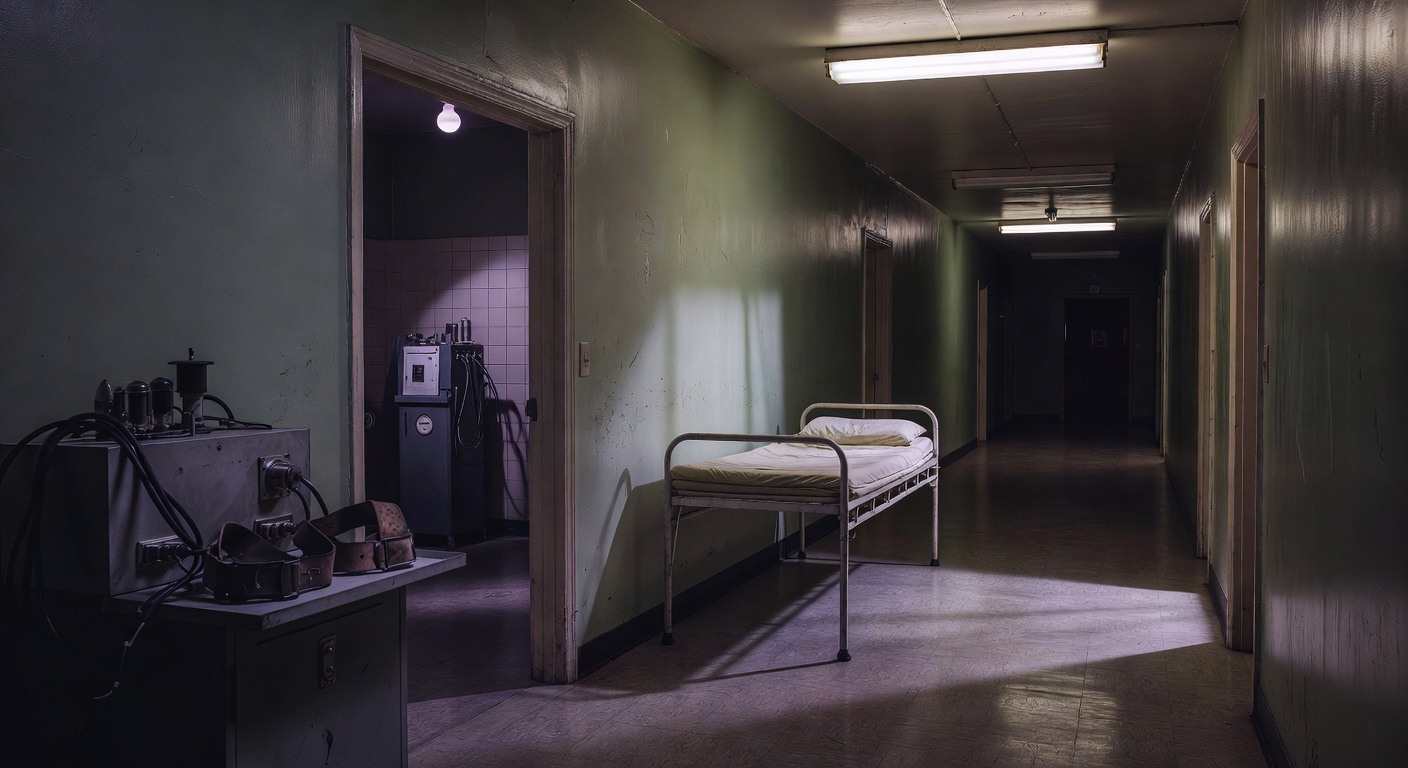
Imagine a treatment so aggressive, so physically brutal, that patients had to be physically restrained while electricity surged through their brains, causing violent full-body seizures. Or a surgical procedure performed with tools resembling an ice pick, inserted through a patient’s eye socket to sever the connections between the frontal lobe and the rest of the brain — sometimes performed in an office, on an assembly-line basis, on patients who had no meaningful ability to consent.
Now imagine that these weren’t fringe procedures performed by rogue practitioners. They were mainstream medicine. They were celebrated in medical journals. They won their inventors prestigious awards, including the Nobel Prize. They were performed on tens of thousands of Americans — many of them not because they were dangerous to others, but because they were inconvenient, nonconforming, or simply unwanted.
This is not ancient history. This is American psychiatry in the twentieth century — and the questions it raises about who gets to define “mental illness” and what society is willing to do to people who don’t fit the mold haven’t fully been answered.
The Lobotomy: A Nobel Prize for Brain Destruction
The lobotomy was invented by Portuguese neurologist António Egas Moniz in 1935. His procedure — originally called a leucotomy — involved drilling holes in the skull and severing white matter fibers in the prefrontal cortex. Moniz believed that mental illness was caused by fixed patterns of thought that could be disrupted by cutting the neural connections that sustained them. He had no real evidence for this theory. He tried it anyway.
Early results were reported as favorable. Patients who had been agitated or violent became calm. What Moniz didn’t emphasize was that they also became passive, diminished, emotionally flat — in many cases, recognizably not themselves. Families described getting back bodies without souls. But in the medical culture of the 1930s, turning a difficult patient into a manageable one was considered therapeutic success.
In 1949, Moniz was awarded the Nobel Prize in Physiology or Medicine. By that point, the lobotomy had already arrived in America, where it would be transformed into something even more disturbing.
Walter Freeman and the Ice Pick Lobotomy
No figure in American psychiatric history is more simultaneously fascinating and horrifying than Walter Freeman. A neurologist at George Washington University, Freeman became the chief advocate and practitioner of lobotomy in the United States — ultimately performing over 3,400 of the procedures himself.
Freeman didn’t invent the lobotomy. But he industrialized it. He developed what he called the “transorbital lobotomy” — a variation that required no surgery at all, in the traditional sense. The instrument was inserted through the eye socket, above the eyeball, into the prefrontal lobe. A few lateral sweeps of the instrument severed the target tissue. The procedure took ten minutes. It could be done under electroconvulsive therapy to briefly render the patient unconscious, without a full surgical suite, without a neurosurgeon present.
Freeman conducted road trips across America, performing lobotomies at state psychiatric institutions, sometimes dozens in a single day. He called it the “Operation Icepick Tour.” He was photographed performing the procedure with a theatrical flourish, sometimes with both hands simultaneously. His traveling kit included a special case for his transorbital instruments, which he carried with him everywhere.
The patients were frequently people who had never had the opportunity to meaningfully consent — involuntarily committed patients, people too sedated to understand what was happening, children. One of Freeman’s patients was a 12-year-old boy. Another was a woman named Rosemary Kennedy — sister of the future president — who was 23 years old when her father, Joseph Kennedy Sr., arranged for Freeman to perform the procedure on her without her knowledge. Rosemary, who had a mild intellectual disability and reportedly mood issues, emerged from the procedure unable to speak clearly, incontinent, and requiring institutional care for the rest of her life. She was hidden from public view for decades.
Who Was Being Lobotomized?
Looking at the patient populations who received lobotomies in America tells a revealing story about what the procedure was really for.
Yes, some patients had severe psychotic disorders. But the procedure was also routinely used on people diagnosed with depression, anxiety, “homosexuality” (then classified as a mental disorder), “excessive emotionality,” and what we might today recognize as post-traumatic stress disorder. Women were lobotomized at higher rates than men. Institutional patients — people with no advocates, no resources, no ability to refuse — were disproportionately targeted.
At state psychiatric hospitals, lobotomies were frequently used as a management tool. Agitated patients who were difficult to handle became compliant. Violence on wards decreased. Staff workloads dropped. The “therapeutic” justification was convenient cover for what was, in practice, a tool of institutional control.
Veterans returning from World War II with what we now understand as PTSD were lobotomized in significant numbers. The VA system performed thousands of lobotomies on traumatized veterans. The men who survived combat came home to have their frontal lobes severed because American medicine didn’t know what to do with their trauma.
Electroconvulsive Therapy: The Shock That Never Went Away
Electroconvulsive therapy — ECT, commonly called electroshock — was developed by Italian physicians Ugo Cerletti and Lucio Bini in 1938. It works by passing electrical current through the brain to induce a grand mal seizure. The original procedure was performed without anesthesia or muscle relaxants. Patients were conscious. The seizures were violent enough to cause broken bones and dislocated shoulders. Patients who had undergone it described the experience as terrifying — a sensation of explosive force in the skull, then unconsciousness, then waking with no memory of what had happened.
ECT was embraced enthusiastically by American psychiatry in the 1940s and 1950s. It spread rapidly through state hospital systems. And like the lobotomy, it was used on patient populations whose “mental illness” was at least partly defined by social nonconformity — women diagnosed with hysteria, gay men subjected to “reparative” treatments, political dissidents, anyone deemed unsuitably difficult by institutional authorities.
The film One Flew Over the Cuckoo’s Nest (1975) brought ECT’s history to mass audiences, depicting it as an instrument of punishment and control — which, in many documented cases, it had been. Ernest Hemingway, who underwent ECT treatment at the Mayo Clinic shortly before his death in 1961, reportedly told a friend: “Well, what is the sense of ruining my head and erasing my memory, which is my capital, and putting me out of business? It was a brilliant cure but we lost the patient.”
ECT has been significantly modernized since those early decades. Contemporary ECT uses general anesthesia and muscle relaxants, targets specific brain regions, and is performed in carefully controlled settings. It remains controversial, but modern practitioners argue it is dramatically different from its mid-century form.
Whether that argument fully accounts for its history is another question.
The DSM: Who Decides What’s Crazy?
The history of physical psychiatric interventions can’t be understood separately from the history of psychiatric diagnosis — and the Diagnostic and Statistical Manual of Mental Disorders (DSM), the document that defines what counts as mental illness in America.
The DSM has gone through five major editions since 1952. Each edition reflects not just scientific understanding, but the social values and power dynamics of its era. Homosexuality was listed as a mental disorder in the DSM until 1973 — when it was removed not primarily because of new scientific evidence, but because of sustained advocacy by gay rights activists and changing social attitudes.
According to the documented history, the decision was ultimately put to a membership vote in the American Psychiatric Association — a remarkable acknowledgment that the classification was at least as much social judgment as medical diagnosis. That means thousands of people were institutionalized, lobotomized, and subjected to aversion therapy for a “disorder” that was voted out of existence by a professional association.
What other current diagnoses are similarly contingent on social consensus rather than biological fact? The question is not rhetorical.
The Institutional Interest in Compliance
There is an uncomfortable through-line in the history of invasive psychiatric treatment: the procedures that were most widely adopted were the ones that produced the most compliant patients, not the ones that produced the most recovered patients.
Lobotomy didn’t cure mental illness. It suppressed the behavior that institutions found problematic. ECT, in its original form, produced profound amnesia — patients forgot why they were upset, forgot their grievances, forgot large portions of their lives. This was called a treatment. The fact that it made difficult people easier to manage was treated as incidental.
When pharmaceutical antipsychotics arrived in the 1950s — first chlorpromazine, marketed as Thorazine — they rapidly displaced lobotomy and dramatically reduced ECT. But critics noted that the drugs, like the physical interventions before them, were valued at least partly for their ability to produce docile, manageable patients. The critique of psychiatry as a tool of social control didn’t end with the lobotomy; it evolved.
Conclusion: The Pattern That Persists
The era of mass lobotomies is over. Walter Freeman died in 1972, discredited and stripped of his hospital privileges after one of his patients died following a third procedure. The Nobel Prize awarded to Moniz has never been revoked, though calls for its rescission continue. ECT in its modern form bears little resemblance to what was done in state hospitals in the 1940s.
But the underlying questions haven’t been resolved. Who gets to define mental illness? What are the limits of treatment performed on people who cannot meaningfully consent? How do we distinguish genuine therapy from social control wearing a medical disguise? What happens when the financial incentives of the pharmaceutical industry align with the institutional interests of psychiatry?
History offers a warning: when medicine and power converge on the bodies of the vulnerable, the results are rarely what they’re advertised to be.
Down the Rabbit Hole
- MK-Ultra and Psychiatry: The CIA’s mind control program used unwitting psychiatric patients as experimental subjects. Which institutions participated?
- Psychiatric Diagnosis as Political Tool: In the Soviet Union, psychiatry was explicitly used to suppress dissidents. Have similar practices occurred in Western democracies?
- Rosemary Kennedy’s Hidden Story: The Kennedy family concealed Rosemary’s lobotomy for decades. Who else’s story has been suppressed?
- The Antipsychotic Epidemic: Modern antipsychotics are prescribed to millions, including children. What do we know about their long-term neurological effects?
- Forced Psychiatric Treatment Today: Involuntary commitment and forced medication remain legal in all 50 states. Who are the people most likely to be subjected to them?
Disclaimer: This article is intended for educational and entertainment purposes. The Conspiracy Realist presents documented facts, credible reporting, and open questions for readers to explore independently. Draw your own conclusions.