Menu

Bohemian Grove: Inside the Elite’s Secret Retreat

Bohemian Grove: Inside the Elite’s Secret Retreat

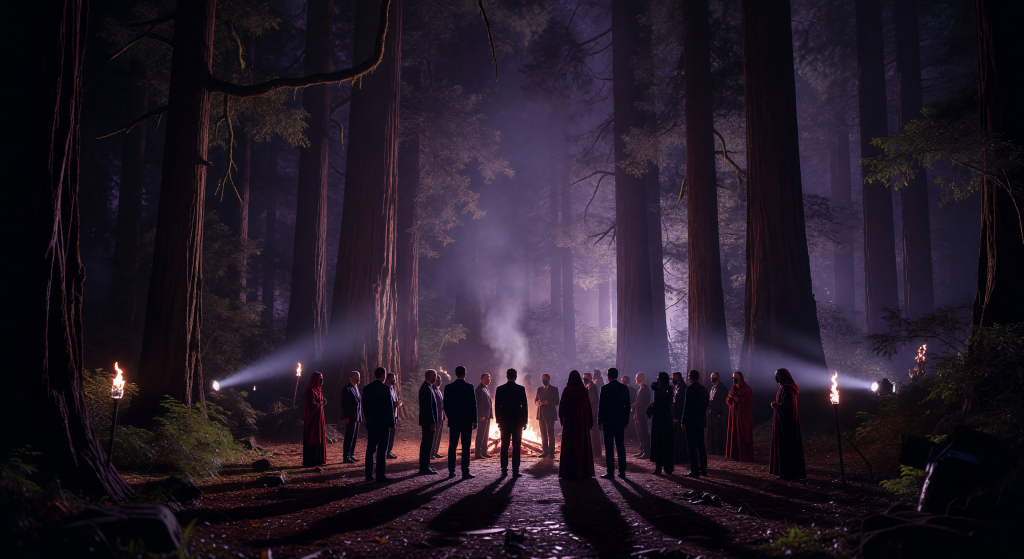
Every July, deep in the ancient redwood forests of Sonoma County, California, something extraordinary happens — something that very few people on Earth will ever witness firsthand. Roughly 2,500 of the most powerful men in the world gather on a 2,700-acre private estate for two and a half weeks of what they call “fellowship.” Presidents and defense contractors. Oil billionaires and tech moguls. Generals and diplomats. They arrive in private jets, settle into their assigned encampments among the towering trees, and for a brief window each summer, the rules of the outside world — accountability, transparency, the press — simply don’t apply.

Welcome to the Bohemian Grove.

If you’ve never heard of it, that’s partly by design. And if you’ve heard of it but dismissed it as fringe paranoia, you might want to reconsider. Because unlike so many conspiracy theories that live entirely in the shadows of speculation, the Bohemian Grove is documented. It has been written about in mainstream publications. It has been filmed. Former presidents have talked about it on the record. And yet, somehow, it remains one of the most underreported gatherings of elite power in American history.

The Club That Became a Kingdom

The story begins in 1872 in San Francisco, where a group of journalists, artists, and intellectuals founded the Bohemian Club as a social retreat — a place for creative men to escape the grind of daily life. In its early years, the club hosted writers and performers; even Mark Twain was a guest. But wealth has a way of reshaping things. As the decades passed, San Francisco’s business and political elite began to dominate the membership rolls, gradually transforming what had been a bohemian arts circle into one of the most exclusive private clubs on the planet.

In 1899, the club purchased its now-legendary property along the Russian River in Monte Rio, California — a vast tract of old-growth coastal redwood forest that would become known simply as “the Grove.” What began as a summer camping trip for members evolved into the annual Summer Encampment, a two-and-a-half-week gathering that has taken place every July without interruption for well over a century.

Today, membership in the Bohemian Club is by invitation only, with a waitlist that can stretch for decades. The club counts over 2,500 members, organized across 118 individual “camps” spread throughout the Grove’s redwood groves — each camp with its own culture, traditions, and hierarchy. Membership is exclusively male, a policy the club has defended vigorously against legal challenges, arguing that its all-male status is essential to its character. Women have been allowed as performing artists and staff, but never as members or invited guests in the traditional sense.

A Guest List That Reads Like a History Book

What makes the Bohemian Grove more than just a rich men’s camping trip is who attends. The guest list over the decades reads like a who’s-who of American power — not just wealthy individuals, but the specific people who have shaped U.S. and global policy for generations.

Richard Nixon was a member and longtime attendee. So were Ronald Reagan and George H.W. Bush, who both reportedly cemented political alliances at the Grove before their respective presidential campaigns. George W. Bush has been linked to the Grove as well. Henry Kissinger, arguably the most influential foreign policy architect of the twentieth century, is a member. So are Colin Powell, Donald Rumsfeld, members of the Rockefeller family, and a rotating cast of CEOs from the country’s largest defense contractors, banks, and energy companies.

The point isn’t merely that powerful people like to vacation together — it’s that they vacation together, away from cameras, away from journalists, away from the public they ostensibly serve. The informal conversations that happen over campfire drinks and nature walks in a place like this don’t get recorded in congressional minutes or corporate filings. They happen in a space deliberately designed to feel consequence-free.

The Lakeside Talks: Off the Record, On the Agenda

One of the Grove’s most consequential traditions is the Lakeside Talks — informal policy speeches delivered to assembled members on the shores of the Grove’s lake. These are not cocktail party chatter. They are substantive addresses on major policy questions: national security, energy, economic strategy, foreign affairs. Speakers have included sitting cabinet members, military brass, and heads of major institutions.

The catch? Lakeside Talks are explicitly off the record. No press. No transcripts distributed publicly. No accountability to anyone outside the Grove’s membership. Whatever is said under those redwoods, stays under those redwoods.

The most striking historical claim surrounding these talks involves the Manhattan Project. According to historical accounts, key early discussions about the development of the atomic bomb — what would become the most consequential weapons program in human history — allegedly took place at the Bohemian Grove in 1942. The New York Times reported in 1999 that physicist Ernest Lawrence and other scientists used the Grove’s informal atmosphere to pitch the bomb program to key government and military figures. If accurate, that means one of the most fateful decisions in human history was first sold not in a Senate hearing room or a White House briefing, but around a campfire in Northern California.

The Cremation of Care: Theater or Something More?

Every encampment begins with the same ritual. As darkness falls on the first night, members gather at the base of a forty-foot concrete owl statue on the shores of the lake. Torchbearers in hooded robes process through the trees. A barge carrying a small wooden effigy — representing “Dull Care,” the burdens and worries of the outside world — is poled across the dark water. The effigy is placed before the owl altar, and amid theatrical fire and music, it is burned.

This is the Cremation of Care ceremony, and it has been the Grove’s opening ritual for well over a hundred years.

The club insists it’s nothing more than elaborate theater — a symbolic, somewhat tongue-in-cheek way of telling members to leave their troubles at the gate and enjoy their vacation. The owl, they say, is simply the club’s mascot, borrowed loosely from classical symbolism of wisdom. The robes are costumes, not vestments. The burning effigy is dramaturgy, not occultism.

Maybe. But you can see how this looks to anyone paying attention from the outside: the world’s most powerful men, in hooded robes, performing a fire ritual before a giant stone idol, in a forest that outsiders are not permitted to enter. Even if the ceremony is purely theatrical, its aesthetics have done the Bohemian Club’s public relations no favors.

The person most responsible for bringing this ceremony to mass public attention is Alex Jones, the controversial radio host and conspiracy media figure. In the summer of 2000, Jones and documentary filmmaker Mike Hanson infiltrated the Grove by posing as members and managed to film the Cremation of Care ceremony with a hidden camera. The footage, which Jones released as a documentary, went viral in early internet circles and has been viewed millions of times since. Whatever one thinks of Jones as a media figure, the footage itself is not disputed — the ceremony is real, and it looks exactly as strange as you’d expect.

But Jones wasn’t the first to crack open the Grove’s secrecy. In 1989, journalist Philip Weiss published a detailed account in Spy Magazine after he too managed to slip inside the encampment. His piece, rich with on-the-ground observation, described the camping culture, the power dynamics between camps, the drinking, the networking, and yes, the ceremony. It remains one of the most thorough journalistic accounts of what actually happens at the Grove — and it predates the internet age that would have made it a far bigger story.

Nixon Said the Quiet Part Loud

If you’re looking for a single document that cuts through the club’s “it’s just a camping trip” defense, look no further than Richard Nixon’s White House tapes. In a recorded conversation from 1971, Nixon can be heard discussing the Bohemian Grove in rather colorful terms. He described the atmosphere as “the most faggy goddamn thing you could ever imagine,” a comment that reveals two things simultaneously: that he was quite familiar with the Grove’s culture, and that the Grove’s reputation for uninhibited behavior among powerful men was well-established even in the early 1970s.

Nixon’s candid remarks do more to confirm the Grove’s significance than almost any outside reporting. Here was a sitting president, speaking privately, treating the Grove as a known cultural reference point — not a fringe curiosity, but an institution embedded in the lives of America’s political class.

The Questions That Won’t Go Away

So what’s actually going on at the Bohemian Grove? The honest answer is: probably a mix of things, some mundane and some genuinely troubling — not because of satanic rituals, but because of something more prosaic and arguably more dangerous.

Think about what the Grove actually provides: a completely private, off-the-record space where the people who run American defense contractors can sit next to the people who allocate the defense budget. Where the heads of major banks can informally consult with the officials who regulate them. Where future presidents can audition their ideas before the men whose money and connections will determine whether those ideas become campaigns. All of it happening outside any formal accountability structure, away from FOIA requests, away from lobbying disclosure laws, away from the press.

The gender exclusion policy compounds these concerns. The Bohemian Club has fought legal battles to maintain its all-male membership, and while private clubs have certain legal protections for exclusivity, the optics of the world’s most powerful men deliberately creating a space where women — half of humanity — are categorically excluded from the conversations that shape policy is worth noting. Some argue this isn’t incidental to the Grove’s culture but central to it: a throwback to an older model of power that was always exclusively masculine.

There’s also the question of democratic accountability. In a healthy democracy, the people who hold public power are supposed to be accountable to the public. The Bohemian Grove is specifically designed to be a space where that accountability is suspended. When a senator and a defense contractor share a cabin for two weeks and develop the kind of rapport that only comes from personal proximity, what happens to the arm’s-length relationship that oversight requires?

None of this requires lizard people or Satanism to be concerning. The mundane version — powerful people building relationships and aligning interests in a private space deliberately shielded from public scrutiny — is troubling enough on its own terms.

What We Know, What We Don’t

Here is what is not in serious dispute: The Bohemian Club exists. It has existed since 1872. Its annual Summer Encampment at the Grove has brought together American and global elites for over a century. The Lakeside Talks happen and are off the record. The Cremation of Care ceremony happens and involves hooded figures and a burning effigy before a giant owl. Former presidents, cabinet secretaries, military leaders, and captains of industry attend. The Manhattan Project discussions may have been seeded there. Alex Jones filmed the ceremony in 2000. Philip Weiss documented the Grove’s culture for Spy Magazine in 1989.

What remains murky: the substance of those Lakeside Talks, the nature of the decisions shaped by Grove relationships, the full membership roster, and the degree to which the Grove functions as a genuine policy-shaping institution versus an elaborate social club for men who happen to also be powerful.

The Bohemian Club would like you to believe it’s the latter. Given the documented history, you’re entitled to your own assessment.

Down the Rabbit Hole

If the Bohemian Grove has you thinking about the wider landscape of elite secrecy, here are five threads worth pulling:

  • The Bilderberg Group: The annual invitation-only conference of Western political and business elites — similar in spirit to the Grove, but international in scope. Also off the record. Also not covered nearly enough by mainstream media.
  • The Manhattan Project’s Secret History: How did one of the most consequential weapons programs in human history get organized, funded, and kept secret for years? The Bohemian Grove connection is just one thread in a larger story about how power operates outside formal channels.
  • The Council on Foreign Relations: The influential New York think tank whose membership overlaps substantially with Bohemian Club rolls. What is the CFR’s actual role in shaping U.S. foreign policy?
  • The Skull and Bones Society: Yale’s infamous secret society has produced presidents, CIA directors, and Supreme Court justices. What do elite secret societies teach us about how American power gets transmitted across generations?
  • Alex Jones and the Infiltration Documentary: Whatever your opinion of Jones, the 2000 infiltration of the Grove was a genuine act of guerrilla journalism. A closer look at how the footage was obtained, how it was received, and how it shaped conspiracy culture in the early internet era is its own fascinating story.

This article is published for entertainment and educational purposes. The facts cited are drawn from public reporting, historical accounts, and declassified materials. As always, do your own research and form your own conclusions.

Related Reads

dive down the rabbit hole

Bohemian Grove: Inside the Elite’s Secret Retreat

Conspiracy Realist
Bohemian Grove: Inside the Elite’s Secret Retreat

Every July, deep in the ancient redwood forests of Sonoma County, California, something extraordinary happens — something that very few people on Earth will ever witness firsthand. Roughly 2,500 of the most powerful men in the world gather on a 2,700-acre private estate for two and a half weeks of what they call “fellowship.” Presidents and defense contractors. Oil billionaires and tech moguls. Generals and diplomats. They arrive in private jets, settle into their assigned encampments among the towering trees, and for a brief window each summer, the rules of the outside world — accountability, transparency, the press — simply don’t apply.

Welcome to the Bohemian Grove.

If you’ve never heard of it, that’s partly by design. And if you’ve heard of it but dismissed it as fringe paranoia, you might want to reconsider. Because unlike so many conspiracy theories that live entirely in the shadows of speculation, the Bohemian Grove is documented. It has been written about in mainstream publications. It has been filmed. Former presidents have talked about it on the record. And yet, somehow, it remains one of the most underreported gatherings of elite power in American history.

The Club That Became a Kingdom

The story begins in 1872 in San Francisco, where a group of journalists, artists, and intellectuals founded the Bohemian Club as a social retreat — a place for creative men to escape the grind of daily life. In its early years, the club hosted writers and performers; even Mark Twain was a guest. But wealth has a way of reshaping things. As the decades passed, San Francisco’s business and political elite began to dominate the membership rolls, gradually transforming what had been a bohemian arts circle into one of the most exclusive private clubs on the planet.

In 1899, the club purchased its now-legendary property along the Russian River in Monte Rio, California — a vast tract of old-growth coastal redwood forest that would become known simply as “the Grove.” What began as a summer camping trip for members evolved into the annual Summer Encampment, a two-and-a-half-week gathering that has taken place every July without interruption for well over a century.

Today, membership in the Bohemian Club is by invitation only, with a waitlist that can stretch for decades. The club counts over 2,500 members, organized across 118 individual “camps” spread throughout the Grove’s redwood groves — each camp with its own culture, traditions, and hierarchy. Membership is exclusively male, a policy the club has defended vigorously against legal challenges, arguing that its all-male status is essential to its character. Women have been allowed as performing artists and staff, but never as members or invited guests in the traditional sense.

A Guest List That Reads Like a History Book

What makes the Bohemian Grove more than just a rich men’s camping trip is who attends. The guest list over the decades reads like a who’s-who of American power — not just wealthy individuals, but the specific people who have shaped U.S. and global policy for generations.

Richard Nixon was a member and longtime attendee. So were Ronald Reagan and George H.W. Bush, who both reportedly cemented political alliances at the Grove before their respective presidential campaigns. George W. Bush has been linked to the Grove as well. Henry Kissinger, arguably the most influential foreign policy architect of the twentieth century, is a member. So are Colin Powell, Donald Rumsfeld, members of the Rockefeller family, and a rotating cast of CEOs from the country’s largest defense contractors, banks, and energy companies.

The point isn’t merely that powerful people like to vacation together — it’s that they vacation together, away from cameras, away from journalists, away from the public they ostensibly serve. The informal conversations that happen over campfire drinks and nature walks in a place like this don’t get recorded in congressional minutes or corporate filings. They happen in a space deliberately designed to feel consequence-free.

The Lakeside Talks: Off the Record, On the Agenda

One of the Grove’s most consequential traditions is the Lakeside Talks — informal policy speeches delivered to assembled members on the shores of the Grove’s lake. These are not cocktail party chatter. They are substantive addresses on major policy questions: national security, energy, economic strategy, foreign affairs. Speakers have included sitting cabinet members, military brass, and heads of major institutions.

The catch? Lakeside Talks are explicitly off the record. No press. No transcripts distributed publicly. No accountability to anyone outside the Grove’s membership. Whatever is said under those redwoods, stays under those redwoods.

The most striking historical claim surrounding these talks involves the Manhattan Project. According to historical accounts, key early discussions about the development of the atomic bomb — what would become the most consequential weapons program in human history — allegedly took place at the Bohemian Grove in 1942. The New York Times reported in 1999 that physicist Ernest Lawrence and other scientists used the Grove’s informal atmosphere to pitch the bomb program to key government and military figures. If accurate, that means one of the most fateful decisions in human history was first sold not in a Senate hearing room or a White House briefing, but around a campfire in Northern California.

The Cremation of Care: Theater or Something More?

Every encampment begins with the same ritual. As darkness falls on the first night, members gather at the base of a forty-foot concrete owl statue on the shores of the lake. Torchbearers in hooded robes process through the trees. A barge carrying a small wooden effigy — representing “Dull Care,” the burdens and worries of the outside world — is poled across the dark water. The effigy is placed before the owl altar, and amid theatrical fire and music, it is burned.

This is the Cremation of Care ceremony, and it has been the Grove’s opening ritual for well over a hundred years.

The club insists it’s nothing more than elaborate theater — a symbolic, somewhat tongue-in-cheek way of telling members to leave their troubles at the gate and enjoy their vacation. The owl, they say, is simply the club’s mascot, borrowed loosely from classical symbolism of wisdom. The robes are costumes, not vestments. The burning effigy is dramaturgy, not occultism.

Maybe. But you can see how this looks to anyone paying attention from the outside: the world’s most powerful men, in hooded robes, performing a fire ritual before a giant stone idol, in a forest that outsiders are not permitted to enter. Even if the ceremony is purely theatrical, its aesthetics have done the Bohemian Club’s public relations no favors.

The person most responsible for bringing this ceremony to mass public attention is Alex Jones, the controversial radio host and conspiracy media figure. In the summer of 2000, Jones and documentary filmmaker Mike Hanson infiltrated the Grove by posing as members and managed to film the Cremation of Care ceremony with a hidden camera. The footage, which Jones released as a documentary, went viral in early internet circles and has been viewed millions of times since. Whatever one thinks of Jones as a media figure, the footage itself is not disputed — the ceremony is real, and it looks exactly as strange as you’d expect.

But Jones wasn’t the first to crack open the Grove’s secrecy. In 1989, journalist Philip Weiss published a detailed account in Spy Magazine after he too managed to slip inside the encampment. His piece, rich with on-the-ground observation, described the camping culture, the power dynamics between camps, the drinking, the networking, and yes, the ceremony. It remains one of the most thorough journalistic accounts of what actually happens at the Grove — and it predates the internet age that would have made it a far bigger story.

Nixon Said the Quiet Part Loud

If you’re looking for a single document that cuts through the club’s “it’s just a camping trip” defense, look no further than Richard Nixon’s White House tapes. In a recorded conversation from 1971, Nixon can be heard discussing the Bohemian Grove in rather colorful terms. He described the atmosphere as “the most faggy goddamn thing you could ever imagine,” a comment that reveals two things simultaneously: that he was quite familiar with the Grove’s culture, and that the Grove’s reputation for uninhibited behavior among powerful men was well-established even in the early 1970s.

Nixon’s candid remarks do more to confirm the Grove’s significance than almost any outside reporting. Here was a sitting president, speaking privately, treating the Grove as a known cultural reference point — not a fringe curiosity, but an institution embedded in the lives of America’s political class.

The Questions That Won’t Go Away

So what’s actually going on at the Bohemian Grove? The honest answer is: probably a mix of things, some mundane and some genuinely troubling — not because of satanic rituals, but because of something more prosaic and arguably more dangerous.

Think about what the Grove actually provides: a completely private, off-the-record space where the people who run American defense contractors can sit next to the people who allocate the defense budget. Where the heads of major banks can informally consult with the officials who regulate them. Where future presidents can audition their ideas before the men whose money and connections will determine whether those ideas become campaigns. All of it happening outside any formal accountability structure, away from FOIA requests, away from lobbying disclosure laws, away from the press.

The gender exclusion policy compounds these concerns. The Bohemian Club has fought legal battles to maintain its all-male membership, and while private clubs have certain legal protections for exclusivity, the optics of the world’s most powerful men deliberately creating a space where women — half of humanity — are categorically excluded from the conversations that shape policy is worth noting. Some argue this isn’t incidental to the Grove’s culture but central to it: a throwback to an older model of power that was always exclusively masculine.

There’s also the question of democratic accountability. In a healthy democracy, the people who hold public power are supposed to be accountable to the public. The Bohemian Grove is specifically designed to be a space where that accountability is suspended. When a senator and a defense contractor share a cabin for two weeks and develop the kind of rapport that only comes from personal proximity, what happens to the arm’s-length relationship that oversight requires?

None of this requires lizard people or Satanism to be concerning. The mundane version — powerful people building relationships and aligning interests in a private space deliberately shielded from public scrutiny — is troubling enough on its own terms.

What We Know, What We Don’t

Here is what is not in serious dispute: The Bohemian Club exists. It has existed since 1872. Its annual Summer Encampment at the Grove has brought together American and global elites for over a century. The Lakeside Talks happen and are off the record. The Cremation of Care ceremony happens and involves hooded figures and a burning effigy before a giant owl. Former presidents, cabinet secretaries, military leaders, and captains of industry attend. The Manhattan Project discussions may have been seeded there. Alex Jones filmed the ceremony in 2000. Philip Weiss documented the Grove’s culture for Spy Magazine in 1989.

What remains murky: the substance of those Lakeside Talks, the nature of the decisions shaped by Grove relationships, the full membership roster, and the degree to which the Grove functions as a genuine policy-shaping institution versus an elaborate social club for men who happen to also be powerful.

The Bohemian Club would like you to believe it’s the latter. Given the documented history, you’re entitled to your own assessment.

Down the Rabbit Hole

If the Bohemian Grove has you thinking about the wider landscape of elite secrecy, here are five threads worth pulling:

  • The Bilderberg Group: The annual invitation-only conference of Western political and business elites — similar in spirit to the Grove, but international in scope. Also off the record. Also not covered nearly enough by mainstream media.
  • The Manhattan Project’s Secret History: How did one of the most consequential weapons programs in human history get organized, funded, and kept secret for years? The Bohemian Grove connection is just one thread in a larger story about how power operates outside formal channels.
  • The Council on Foreign Relations: The influential New York think tank whose membership overlaps substantially with Bohemian Club rolls. What is the CFR’s actual role in shaping U.S. foreign policy?
  • The Skull and Bones Society: Yale’s infamous secret society has produced presidents, CIA directors, and Supreme Court justices. What do elite secret societies teach us about how American power gets transmitted across generations?
  • Alex Jones and the Infiltration Documentary: Whatever your opinion of Jones, the 2000 infiltration of the Grove was a genuine act of guerrilla journalism. A closer look at how the footage was obtained, how it was received, and how it shaped conspiracy culture in the early internet era is its own fascinating story.

This article is published for entertainment and educational purposes. The facts cited are drawn from public reporting, historical accounts, and declassified materials. As always, do your own research and form your own conclusions.

Related Reads

Bohemian Grove: Inside the Elite’s Secret Retreat

Bohemian Grove: Inside the Elite’s Secret Retreat

Every July, deep in the ancient redwood forests of Sonoma County, California, something extraordinary happens — something that very few people on Earth will ever witness firsthand. Roughly 2,500 of the most powerful men in the world gather on a 2,700-acre private estate for two and a half weeks of what they call “fellowship.” Presidents and defense contractors. Oil billionaires and tech moguls. Generals and diplomats. They arrive in private jets, settle into their assigned encampments among the towering trees, and for a brief window each summer, the rules of the outside world — accountability, transparency, the press — simply don’t apply.

Welcome to the Bohemian Grove.

If you’ve never heard of it, that’s partly by design. And if you’ve heard of it but dismissed it as fringe paranoia, you might want to reconsider. Because unlike so many conspiracy theories that live entirely in the shadows of speculation, the Bohemian Grove is documented. It has been written about in mainstream publications. It has been filmed. Former presidents have talked about it on the record. And yet, somehow, it remains one of the most underreported gatherings of elite power in American history.

The Club That Became a Kingdom

The story begins in 1872 in San Francisco, where a group of journalists, artists, and intellectuals founded the Bohemian Club as a social retreat — a place for creative men to escape the grind of daily life. In its early years, the club hosted writers and performers; even Mark Twain was a guest. But wealth has a way of reshaping things. As the decades passed, San Francisco’s business and political elite began to dominate the membership rolls, gradually transforming what had been a bohemian arts circle into one of the most exclusive private clubs on the planet.

In 1899, the club purchased its now-legendary property along the Russian River in Monte Rio, California — a vast tract of old-growth coastal redwood forest that would become known simply as “the Grove.” What began as a summer camping trip for members evolved into the annual Summer Encampment, a two-and-a-half-week gathering that has taken place every July without interruption for well over a century.

Today, membership in the Bohemian Club is by invitation only, with a waitlist that can stretch for decades. The club counts over 2,500 members, organized across 118 individual “camps” spread throughout the Grove’s redwood groves — each camp with its own culture, traditions, and hierarchy. Membership is exclusively male, a policy the club has defended vigorously against legal challenges, arguing that its all-male status is essential to its character. Women have been allowed as performing artists and staff, but never as members or invited guests in the traditional sense.

A Guest List That Reads Like a History Book

What makes the Bohemian Grove more than just a rich men’s camping trip is who attends. The guest list over the decades reads like a who’s-who of American power — not just wealthy individuals, but the specific people who have shaped U.S. and global policy for generations.

Richard Nixon was a member and longtime attendee. So were Ronald Reagan and George H.W. Bush, who both reportedly cemented political alliances at the Grove before their respective presidential campaigns. George W. Bush has been linked to the Grove as well. Henry Kissinger, arguably the most influential foreign policy architect of the twentieth century, is a member. So are Colin Powell, Donald Rumsfeld, members of the Rockefeller family, and a rotating cast of CEOs from the country’s largest defense contractors, banks, and energy companies.

The point isn’t merely that powerful people like to vacation together — it’s that they vacation together, away from cameras, away from journalists, away from the public they ostensibly serve. The informal conversations that happen over campfire drinks and nature walks in a place like this don’t get recorded in congressional minutes or corporate filings. They happen in a space deliberately designed to feel consequence-free.

The Lakeside Talks: Off the Record, On the Agenda

One of the Grove’s most consequential traditions is the Lakeside Talks — informal policy speeches delivered to assembled members on the shores of the Grove’s lake. These are not cocktail party chatter. They are substantive addresses on major policy questions: national security, energy, economic strategy, foreign affairs. Speakers have included sitting cabinet members, military brass, and heads of major institutions.

The catch? Lakeside Talks are explicitly off the record. No press. No transcripts distributed publicly. No accountability to anyone outside the Grove’s membership. Whatever is said under those redwoods, stays under those redwoods.

The most striking historical claim surrounding these talks involves the Manhattan Project. According to historical accounts, key early discussions about the development of the atomic bomb — what would become the most consequential weapons program in human history — allegedly took place at the Bohemian Grove in 1942. The New York Times reported in 1999 that physicist Ernest Lawrence and other scientists used the Grove’s informal atmosphere to pitch the bomb program to key government and military figures. If accurate, that means one of the most fateful decisions in human history was first sold not in a Senate hearing room or a White House briefing, but around a campfire in Northern California.

The Cremation of Care: Theater or Something More?

Every encampment begins with the same ritual. As darkness falls on the first night, members gather at the base of a forty-foot concrete owl statue on the shores of the lake. Torchbearers in hooded robes process through the trees. A barge carrying a small wooden effigy — representing “Dull Care,” the burdens and worries of the outside world — is poled across the dark water. The effigy is placed before the owl altar, and amid theatrical fire and music, it is burned.

This is the Cremation of Care ceremony, and it has been the Grove’s opening ritual for well over a hundred years.

The club insists it’s nothing more than elaborate theater — a symbolic, somewhat tongue-in-cheek way of telling members to leave their troubles at the gate and enjoy their vacation. The owl, they say, is simply the club’s mascot, borrowed loosely from classical symbolism of wisdom. The robes are costumes, not vestments. The burning effigy is dramaturgy, not occultism.

Maybe. But you can see how this looks to anyone paying attention from the outside: the world’s most powerful men, in hooded robes, performing a fire ritual before a giant stone idol, in a forest that outsiders are not permitted to enter. Even if the ceremony is purely theatrical, its aesthetics have done the Bohemian Club’s public relations no favors.

The person most responsible for bringing this ceremony to mass public attention is Alex Jones, the controversial radio host and conspiracy media figure. In the summer of 2000, Jones and documentary filmmaker Mike Hanson infiltrated the Grove by posing as members and managed to film the Cremation of Care ceremony with a hidden camera. The footage, which Jones released as a documentary, went viral in early internet circles and has been viewed millions of times since. Whatever one thinks of Jones as a media figure, the footage itself is not disputed — the ceremony is real, and it looks exactly as strange as you’d expect.

But Jones wasn’t the first to crack open the Grove’s secrecy. In 1989, journalist Philip Weiss published a detailed account in Spy Magazine after he too managed to slip inside the encampment. His piece, rich with on-the-ground observation, described the camping culture, the power dynamics between camps, the drinking, the networking, and yes, the ceremony. It remains one of the most thorough journalistic accounts of what actually happens at the Grove — and it predates the internet age that would have made it a far bigger story.

Nixon Said the Quiet Part Loud

If you’re looking for a single document that cuts through the club’s “it’s just a camping trip” defense, look no further than Richard Nixon’s White House tapes. In a recorded conversation from 1971, Nixon can be heard discussing the Bohemian Grove in rather colorful terms. He described the atmosphere as “the most faggy goddamn thing you could ever imagine,” a comment that reveals two things simultaneously: that he was quite familiar with the Grove’s culture, and that the Grove’s reputation for uninhibited behavior among powerful men was well-established even in the early 1970s.

Nixon’s candid remarks do more to confirm the Grove’s significance than almost any outside reporting. Here was a sitting president, speaking privately, treating the Grove as a known cultural reference point — not a fringe curiosity, but an institution embedded in the lives of America’s political class.

The Questions That Won’t Go Away

So what’s actually going on at the Bohemian Grove? The honest answer is: probably a mix of things, some mundane and some genuinely troubling — not because of satanic rituals, but because of something more prosaic and arguably more dangerous.

Think about what the Grove actually provides: a completely private, off-the-record space where the people who run American defense contractors can sit next to the people who allocate the defense budget. Where the heads of major banks can informally consult with the officials who regulate them. Where future presidents can audition their ideas before the men whose money and connections will determine whether those ideas become campaigns. All of it happening outside any formal accountability structure, away from FOIA requests, away from lobbying disclosure laws, away from the press.

The gender exclusion policy compounds these concerns. The Bohemian Club has fought legal battles to maintain its all-male membership, and while private clubs have certain legal protections for exclusivity, the optics of the world’s most powerful men deliberately creating a space where women — half of humanity — are categorically excluded from the conversations that shape policy is worth noting. Some argue this isn’t incidental to the Grove’s culture but central to it: a throwback to an older model of power that was always exclusively masculine.

There’s also the question of democratic accountability. In a healthy democracy, the people who hold public power are supposed to be accountable to the public. The Bohemian Grove is specifically designed to be a space where that accountability is suspended. When a senator and a defense contractor share a cabin for two weeks and develop the kind of rapport that only comes from personal proximity, what happens to the arm’s-length relationship that oversight requires?

None of this requires lizard people or Satanism to be concerning. The mundane version — powerful people building relationships and aligning interests in a private space deliberately shielded from public scrutiny — is troubling enough on its own terms.

What We Know, What We Don’t

Here is what is not in serious dispute: The Bohemian Club exists. It has existed since 1872. Its annual Summer Encampment at the Grove has brought together American and global elites for over a century. The Lakeside Talks happen and are off the record. The Cremation of Care ceremony happens and involves hooded figures and a burning effigy before a giant owl. Former presidents, cabinet secretaries, military leaders, and captains of industry attend. The Manhattan Project discussions may have been seeded there. Alex Jones filmed the ceremony in 2000. Philip Weiss documented the Grove’s culture for Spy Magazine in 1989.

What remains murky: the substance of those Lakeside Talks, the nature of the decisions shaped by Grove relationships, the full membership roster, and the degree to which the Grove functions as a genuine policy-shaping institution versus an elaborate social club for men who happen to also be powerful.

The Bohemian Club would like you to believe it’s the latter. Given the documented history, you’re entitled to your own assessment.

Down the Rabbit Hole

If the Bohemian Grove has you thinking about the wider landscape of elite secrecy, here are five threads worth pulling:

  • The Bilderberg Group: The annual invitation-only conference of Western political and business elites — similar in spirit to the Grove, but international in scope. Also off the record. Also not covered nearly enough by mainstream media.
  • The Manhattan Project’s Secret History: How did one of the most consequential weapons programs in human history get organized, funded, and kept secret for years? The Bohemian Grove connection is just one thread in a larger story about how power operates outside formal channels.
  • The Council on Foreign Relations: The influential New York think tank whose membership overlaps substantially with Bohemian Club rolls. What is the CFR’s actual role in shaping U.S. foreign policy?
  • The Skull and Bones Society: Yale’s infamous secret society has produced presidents, CIA directors, and Supreme Court justices. What do elite secret societies teach us about how American power gets transmitted across generations?
  • Alex Jones and the Infiltration Documentary: Whatever your opinion of Jones, the 2000 infiltration of the Grove was a genuine act of guerrilla journalism. A closer look at how the footage was obtained, how it was received, and how it shaped conspiracy culture in the early internet era is its own fascinating story.

This article is published for entertainment and educational purposes. The facts cited are drawn from public reporting, historical accounts, and declassified materials. As always, do your own research and form your own conclusions.

Related Reads

Table of contents