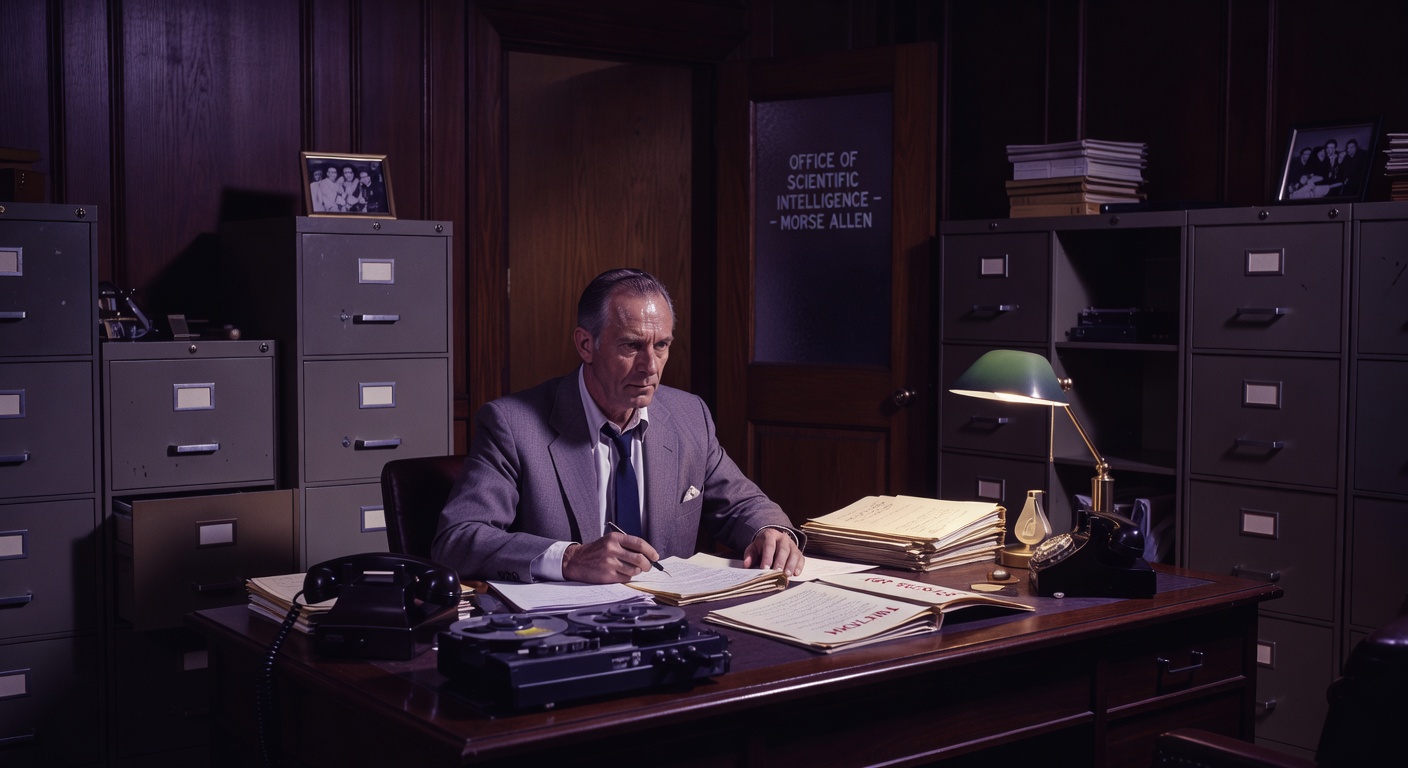
In the dim corridors of Langley and the shadowed back rooms of Cold War America, a name rarely surfaces in popular histories of government excess: Morse Allen. Yet this quiet, methodical CIA security officer was, by many accounts, the man who first lit the fuse on the Agency’s obsession with mind control — an obsession that would eventually explode into the infamous MKUltra program and haunt American civil liberties for decades to come.
This is his story. And it is not a comfortable one.
The Man Behind the Curtain
Morse Allen spent his career not in the glamorous espionage divisions of the Central Intelligence Agency, but in the Office of Security — the branch tasked with protecting CIA personnel and infrastructure from enemy infiltration. He was, by all accounts, an unremarkable bureaucrat in appearance. But beneath that bland exterior churned a deeply curious and, critics would later argue, dangerously obsessed mind.
By the late 1940s and early 1950s, Allen had become convinced of something that seemed, at the time, like science fiction: that the human mind could be controlled, overwritten, and weaponized. His fixation wasn’t born in a vacuum. The Cold War had produced a new kind of fear in Washington — a terror not just of Soviet bombs, but of Soviet techniques. American POWs returning from Korea spoke of strange confessions, bizarre docility, and seeming ideological conversions. The term “brainwashing” entered the American lexicon like a virus, and men like Morse Allen were desperate to understand — and replicate — it.
Project BLUEBIRD: The First Blueprint
In 1950, the CIA formally launched Project BLUEBIRD, the Agency’s first structured attempt at developing mind-control techniques. The stated goals were defensive: understand what the Soviets might be doing to American captives, and develop countermeasures. But from the very beginning, the research had an offensive edge that its architects couldn’t quite conceal.
Morse Allen was one of BLUEBIRD’s key architects. Under his direction, the project explored hypnosis, drug-induced states, electroconvulsive therapy, and psychological conditioning. The research drew on German and Japanese wartime medical experiments — much of it procured through morally compromised channels — and attempted to synthesize these techniques into a coherent American program.
Allen’s particular fixation was hypnosis. He threw himself into the literature with a scholar’s intensity and a bureaucrat’s efficiency, reading every paper he could find, attending demonstrations, and eventually practicing the technique himself. CIA documents later declassified and examined by the Senate Select Committee on Intelligence in 1977 describe Allen conducting hypnotic experiments on Agency secretaries — without their knowledge or meaningful consent — to test whether subjects could be induced to reveal classified information while in a trance state.
The results, apparently, were promising enough to continue.
Project ARTICHOKE: The Experiment Escalates
In 1951, BLUEBIRD was reorganized and renamed Project ARTICHOKE. The name change was cosmetic; the ambitions were not. ARTICHOKE was broader, darker, and more aggressive. Where BLUEBIRD had been exploratory, ARTICHOKE was operational. The question was no longer merely “can we control a mind?” but “how do we do it reliably, under field conditions, against unwitting subjects?”
Morse Allen sat at the center of this expansion. He coordinated with the Agency’s Technical Services Staff, with military intelligence, and with a constellation of outside contractors — academics, psychiatrists, and pharmacologists — who were willing to ask questions that their universities would never have sanctioned. ARTICHOKE teams were deployed overseas, reportedly testing techniques on foreign nationals, double agents, and defectors who had no idea they were subjects in a government experiment.
The most chilling aspect of ARTICHOKE, as it emerges from the documentary record, is Allen’s pursuit of what he called the “Manchurian candidate” problem — a term he and his colleagues used before the 1962 film made it famous. Could a human being be conditioned to carry out an act, even an assassination, with no conscious memory of having done so? Could an agent be “programmed” to deny, under any interrogation, that he had committed a crime?
Allen believed the answer was yes. CIA documents describe him arranging experiments in which hypnotized subjects were handed unloaded firearms and instructed to “shoot” a colleague — commands they reportedly followed without hesitation and, in some cases, claimed to have no memory of afterward. These experiments were not conducted in the humane environment of informed clinical research. They were conducted in secret, on unwitting participants, by a government security officer with no medical training and limitless institutional backing.
George White and the Safehouse Operations
Morse Allen’s work did not occur in a hermetic bubble. Among his most consequential collaborations was his connection to George White, a former OSS officer and Federal Bureau of Narcotics agent who became one of the CIA’s most colorful and controversial assets in the mind-control programs.
White was the architect of what became known as the “safehouse” operations — clandestine apartments in New York and San Francisco where unwitting subjects, including prostitutes and their clients, were given drugs (most famously LSD) without their knowledge and observed through one-way mirrors. White notoriously described his work in a letter to CIA chemist Sidney Gottlieb with gleeful abandon: he was, he wrote, a “cop who could take drugs, have parties, and watch the action.”
Allen’s role in these operations was more supervisory than hands-on, but his fingerprints were on the program’s architecture. The safehouses were a logical extension of the questions ARTICHOKE was asking — what happens when you strip a person of their defenses entirely? What do they reveal? What can they be made to do? Allen provided institutional cover and bureaucratic coordination while men like White provided the operational grunt work.
The safehouse operations would later become one of the most damning revelations of the Church Committee hearings in 1975 and the subsequent Senate hearings in 1977. The image of government agents dosing unwitting American citizens with powerful hallucinogens, then watching and recording their behavior, became a symbol of Cold War hubris gone catastrophically wrong.
The Bridge to Sidney Gottlieb and MKUltra
Morse Allen was not the man who would ultimately define the CIA’s mind-control programs. That role fell to Sidney Gottlieb, a brilliant, morally ambiguous chemist who took over the Agency’s Technical Services Staff in the early 1950s and transformed scattered, exploratory projects like BLUEBIRD and ARTICHOKE into the systematic, lavishly funded, and extraordinarily broad program known as MKUltra.
MKUltra, formally approved in April 1953 by CIA Director Allen Dulles, represented a quantum leap in ambition and scale. Where ARTICHOKE had worked at the margins and operated with some degree of compartmentalization, MKUltra spread its tendrils across 44 universities, 15 research foundations, 12 hospitals, and 3 penal institutions. It funded research into hypnosis, drugs, electroshock, radiation, psychosurgery, and a dozen other techniques, all in pursuit of reliable methods of breaking, rebuilding, and controlling the human mind.
Allen’s contribution to this edifice was foundational. The questions he had pursued under BLUEBIRD and ARTICHOKE — the methodologies he had developed, the contractors he had cultivated, the institutional appetite he had whetted — were absorbed into and amplified by MKUltra. Gottlieb inherited a program that Allen had helped make imaginable.
In the bureaucratic choreography of the Cold War intelligence apparatus, Allen was the precursor, the proof-of-concept man. He demonstrated that the CIA could conduct mind-control research, that it could do so in secret, and that it could do so on unwitting subjects without triggering internal alarms loud enough to stop the program. By the time Gottlieb arrived, the institutional culture had already been shaped.
The 1977 Senate Hearings: The Curtain Pulled Back
For decades, the programs Allen helped build remained buried in classified archives. The CIA was not eager to publicize its experiments on American citizens. But in 1973, facing the incoming scrutiny of Watergate-era investigations, CIA Director Richard Helms ordered the destruction of MKUltra files. It was a preemptive act of institutional self-preservation — and it almost worked.
Almost. Because a cache of documents had been misfiled in a records management facility that Helms’s destruction order missed. In 1977, those documents were discovered in response to a Freedom of Information Act request. They became the foundation for what followed: the stunning Senate Select Committee on Intelligence hearings of August 1977, chaired by Senator Ted Kennedy, which finally forced a reckoning with what the CIA had done.
The hearings revealed the full scope of ARTICHOKE, BLUEBIRD, and MKUltra in devastating detail. Witnesses described experiments on prisoners, mental patients, and ordinary citizens — people who had been given LSD, subjected to electroconvulsive shock, kept in sensory deprivation for extended periods, and psychologically manipulated without any knowledge or consent. At least one death, that of Army scientist Frank Olson, was attributed — though the circumstances remain disputed to this day — to the program’s reckless drug experiments.
Morse Allen himself never became a household name. He was not dragged before the cameras in the way that Helms or Gottlieb were. He had retired into the obscurity that careful bureaucrats cultivate. But his role in the early architecture of these programs is documented in the records that survived the purge — records that paint a portrait of a man who, with genuine conviction and institutional support, helped build a machine for breaking human minds.
What It Means
The story of Morse Allen is not simply a Cold War curiosity. It is a case study in how institutions, when shielded from accountability and animated by genuine fear, can normalize the unthinkable one incremental step at a time. Allen did not wake up one morning and decide to run unethical experiments on unwitting subjects. He followed questions where they led, inside a culture that rewarded results and buried doubts.
The experiments he helped design were predicated on a fundamental dehumanization: the idea that some people — enemies, expendables, the institutionalized, the marginalized — could be used as raw material in the pursuit of national security. That logic, once accepted, has no natural stopping point. It metastasizes.
The Church Committee called for reforms. Congress passed laws. The CIA officially shut down MKUltra. But the questions that Morse Allen first posed — can the mind be controlled? Can it be made to act against its own will? — have never fully gone away. They resurface in debates about enhanced interrogation, in controversies over psychological operations, in the classified programs that governments always insist no longer exist.
The archive of the declassified MKUltra documents, available through the CIA’s own Reading Room, runs to thousands of pages. Most Americans have never read a single one. They are a monument to what happens when a government decides that the ends — protecting the nation from its enemies — justify any conceivable means.
Morse Allen was one of the first men to make that decision. He was not the last.
Down the Rabbit Hole
- Frank Olson: The Scientist Who Fell From a Window — Dive into the mysterious 1953 death of the Army biochemist who knew too much about ARTICHOKE and MKUltra’s darkest experiments.
- Sidney Gottlieb: The CIA’s Poisoner-in-Chief — The full story of the man who turned Morse Allen’s questions into an industrial-scale program of human experimentation.
- The Church Committee: When Congress Fought the Deep State — How a Senate investigation in 1975–76 cracked open the CIA and FBI’s most secret and disturbing programs.
- Operation Midnight Climax: LSD, Prostitutes, and the CIA’s Safehouse Experiments — George White’s one-way-mirror operations in New York and San Francisco, and what they reveal about government accountability.
- MKUltra Survivors: The People Who Lived Through Government Mind Control — The documented victims of the program, their testimonies before Congress, and the settlements — or lack thereof — that followed.
Disclaimer: This article is based on declassified government documents, congressional testimony, and reputable investigative journalism. It is intended for educational and informational purposes. The views expressed are those of the author and do not represent legal conclusions about any individual or organization.