Menu

The H-1B Deemed Export Trap

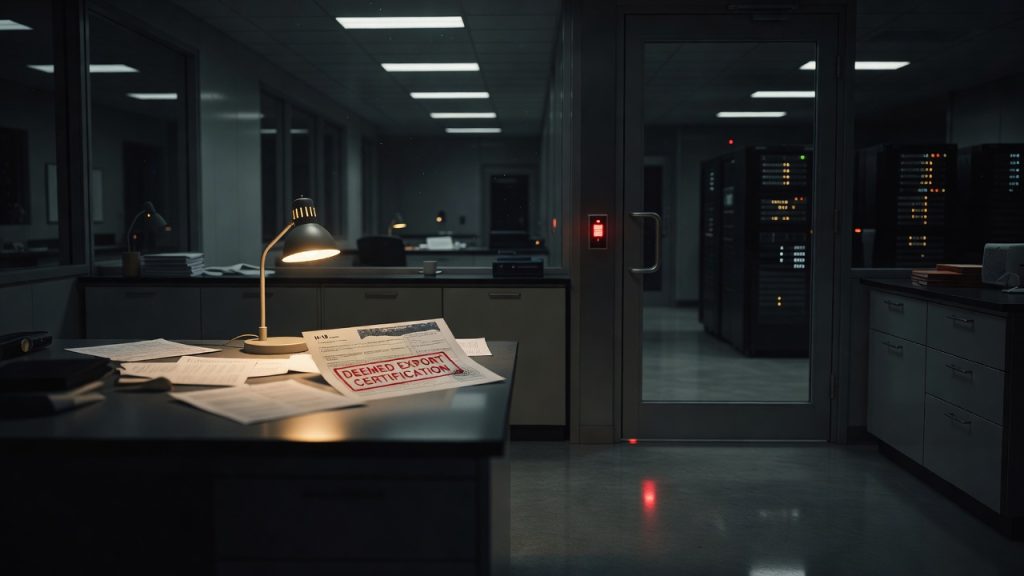
Restricted lab behind an H-1B deemed export certification checkpoint — ConspiracyRealist.com

Some traps do not look like traps. They look like routine paperwork, filed between an HR checklist and a start date. A foreign engineer gets the offer. The lawyer prepares the H-1B petition. A supervisor signs a form. Somewhere inside that packet sits one question: will this worker need a U.S. export license to see what the job actually involves? No alarms. Just a signature that can redraw an office, lab, or campus with invisible lines most people never notice until the badge reader turns red.

The Case For

A visa petition quietly became an export-control checkpoint

This is not folklore. It is written directly into the immigration process. In its FAQ on Part 6 of Form I-129, USCIS says the agency revised the petition in 2010 to add a certification regarding the release of controlled technology or technical data to foreign persons in the United States. That certification applies to H-1B, H-1B1, L-1, and O-1A petitions. If a license is required, the petitioner must certify that the beneficiary will not access the controlled technology or technical data until the license is obtained.

The wording matters because it turns an immigration filing into a national-security decision point. The 2026 Form I-129 instructions say employers must review the Export Administration Regulations and the International Traffic in Arms Regulations, determine whether a license is needed, and, if it is, prevent access until authorization arrives. USCIS also makes clear that a petition can still be approved before the license does. In other words, the worker can enter the system before the system decides what the worker is allowed to know.

The rule was built to answer real government warnings

USCIS says Part 6 was added after two government reports flagged a hole between immigration processing and export control enforcement. One was a 2002 GAO report on vulnerabilities in the deemed-export licensing system. The other was a 2004 multi-agency inspectors general report finding that immigration adjudication did not sufficiently account for the protection of controlled technology. The official story is not that employers were running spy rings. It is that federal agencies worried sensitive know-how could move to countries of concern through ordinary status changes and ordinary hiring.

That concern did not stay in the past. In August 2024, the Bureau of Industry and Security said in a press release for the academic community that universities had spent the previous decade disclosing export-control violations and that institutions should integrate compliance into everyday operations for professors, students, staff, and visitors. Read that slowly. Everyday operations. Not covert compounds. Not exotic black budgets. Daily administration.

The practical effect is an invisible internal border

Once that certification becomes real, the workplace can split in two. A 2006 GAO report on universities and export-controlled information found that when export controls apply, institutions may reject a contract, restrict who can participate, or move work to controlled off-campus facilities. That is the part that gives the topic its charge. The public hears “open research” and “global talent.” The administrative record shows locks, exclusions, and compartmentalized access whenever the research crosses into controlled territory.

That same logic is visible in the recent Conspiracy Realist deep dives on deemed exports in university labs and technology control plans on campus. The H-1B certification is the paper trigger for those wider control systems, deciding who can see code, enter a lab, or join a meeting that defines the work.

The Realist’s Eye

Most H-1B filings do not hide a shadow program

Now for the brake pedal. USCIS also says the licensing requirement affects only a small percentage of petitioners because most technology is not controlled for release to foreign persons. The regulations preserve a large zone of openness, especially where work falls under the fundamental-research exclusion. The point is not that every H-1B petition masks some buried national-security drama. Most do not. Many employers check the box, document their reasoning, and move on.

That matters because it keeps this topic from collapsing into melodrama. An export-control certification is not proof of a conspiracy. In many settings, it is basic legal hygiene. Aerospace, advanced computing, defense-adjacent engineering, and some biotech fields really do sit close to dual-use or munitions rules. It would be strange if the government ignored that reality completely. The existence of a checkpoint does not automatically prove abuse at the checkpoint.

The unresolved tension is how normal this architecture has become

Still, the realist cannot ignore what the paperwork reveals. Once immigration compliance, export law, and workplace design fuse together, a routine hiring process starts to carry a second function. It does not just ask whether a worker can do the job. It asks whether the state is comfortable with what that worker might learn while doing it. And because the process operates through forms, access controls, and internal reviews, it remains largely invisible to outsiders.

That invisibility is where the tension lives. There is no need to claim that universities or companies are secretly running black programs. The documents already show something subtler and more modern: a system where the border can be relocated inside the institution itself. One person’s onboarding packet becomes another person’s restricted folder. One visa filing becomes a quiet architecture of permissions. The mechanism is legal. The question is whether the public fully understands how often open workplaces are being reorganized around security categories few employees ever see named out loud.

That is why this subject lingers. The H-1B export-control question looks bureaucratic because it is bureaucratic. But bureaucracy is often where power hides best.

What We Know For Certain

  • USCIS added Part 6 to Form I-129 in 2010, and it applies to H-1B, H-1B1, L-1, and O-1A petitions.
  • If a license is required, the petitioner must certify that the beneficiary will not access controlled technology or technical data until authorization is obtained.
  • USCIS says Part 6 was added in response to a 2002 GAO report and a 2004 inspectors general report about export-control vulnerabilities.
  • BIS said in 2024 that academic institutions had disclosed export-control violations over the previous decade and should integrate compliance into everyday operations.
  • GAO reported that universities sometimes limit participation, reject contracts, or move work to controlled facilities when export controls apply.

The Unanswered Questions

  • How often do employers answer the H-1B export-control question incorrectly because they treat it as routine paperwork?
  • How many workers arrive in open research environments only to discover parts of the job are fenced off by licensing rules?
  • As AI, quantum, and advanced biotech controls tighten, will more ordinary hiring decisions become export-control decisions in disguise?
  • Who measures the long-term effect of these internal restrictions on the promise of open scientific collaboration?

The Closer — You Decide

No smoking gun is needed here. The form is real. The certification is real. The government reports that gave birth to it are real. So is the possibility that a hiring packet can quietly redraw the boundaries of knowledge inside an institution that still calls itself open. Maybe that is prudent security. Maybe it is the normalization of a softer, quieter kind of control. Either way, the paper trail exists, the architecture exists, and the questions are not going away. The evidence is on the table. You decide.

dive down the rabbit hole

The H-1B Deemed Export Trap

S-FX.com
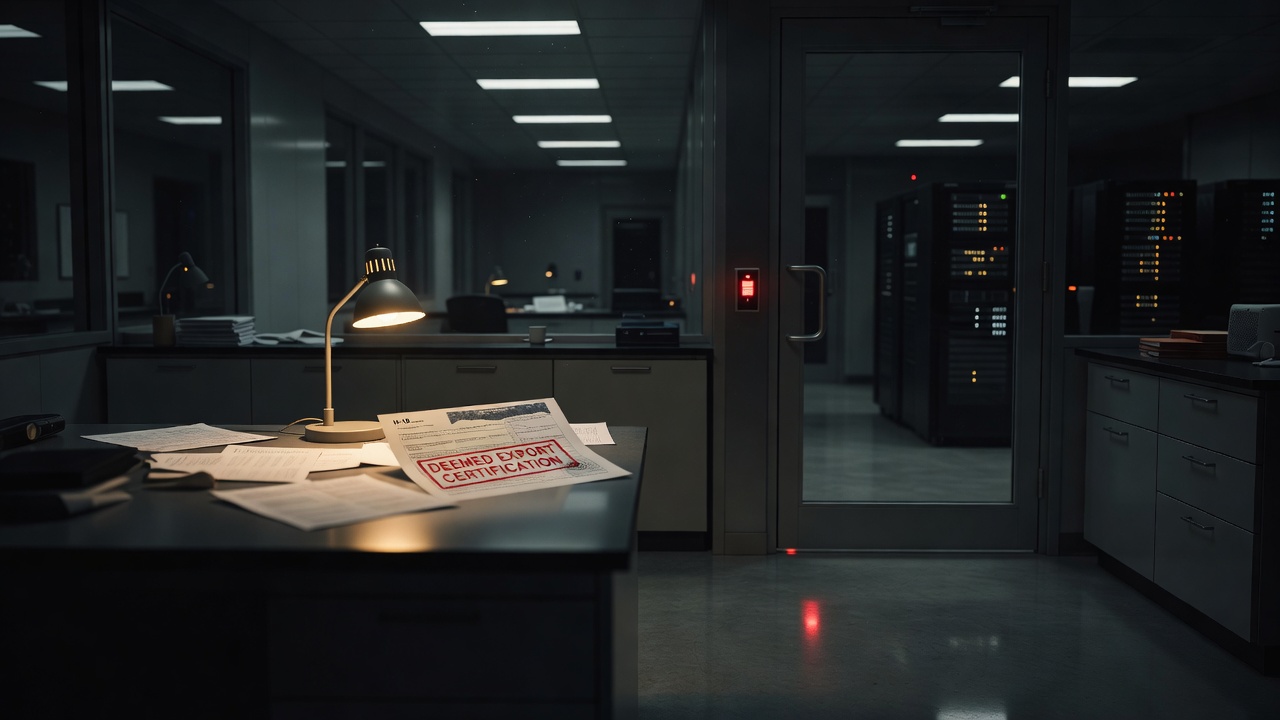
Restricted lab behind an H-1B deemed export certification checkpoint — ConspiracyRealist.com

Some traps do not look like traps. They look like routine paperwork, filed between an HR checklist and a start date. A foreign engineer gets the offer. The lawyer prepares the H-1B petition. A supervisor signs a form. Somewhere inside that packet sits one question: will this worker need a U.S. export license to see what the job actually involves? No alarms. Just a signature that can redraw an office, lab, or campus with invisible lines most people never notice until the badge reader turns red.

The Case For

A visa petition quietly became an export-control checkpoint

This is not folklore. It is written directly into the immigration process. In its FAQ on Part 6 of Form I-129, USCIS says the agency revised the petition in 2010 to add a certification regarding the release of controlled technology or technical data to foreign persons in the United States. That certification applies to H-1B, H-1B1, L-1, and O-1A petitions. If a license is required, the petitioner must certify that the beneficiary will not access the controlled technology or technical data until the license is obtained.

The wording matters because it turns an immigration filing into a national-security decision point. The 2026 Form I-129 instructions say employers must review the Export Administration Regulations and the International Traffic in Arms Regulations, determine whether a license is needed, and, if it is, prevent access until authorization arrives. USCIS also makes clear that a petition can still be approved before the license does. In other words, the worker can enter the system before the system decides what the worker is allowed to know.

The rule was built to answer real government warnings

USCIS says Part 6 was added after two government reports flagged a hole between immigration processing and export control enforcement. One was a 2002 GAO report on vulnerabilities in the deemed-export licensing system. The other was a 2004 multi-agency inspectors general report finding that immigration adjudication did not sufficiently account for the protection of controlled technology. The official story is not that employers were running spy rings. It is that federal agencies worried sensitive know-how could move to countries of concern through ordinary status changes and ordinary hiring.

That concern did not stay in the past. In August 2024, the Bureau of Industry and Security said in a press release for the academic community that universities had spent the previous decade disclosing export-control violations and that institutions should integrate compliance into everyday operations for professors, students, staff, and visitors. Read that slowly. Everyday operations. Not covert compounds. Not exotic black budgets. Daily administration.

The practical effect is an invisible internal border

Once that certification becomes real, the workplace can split in two. A 2006 GAO report on universities and export-controlled information found that when export controls apply, institutions may reject a contract, restrict who can participate, or move work to controlled off-campus facilities. That is the part that gives the topic its charge. The public hears “open research” and “global talent.” The administrative record shows locks, exclusions, and compartmentalized access whenever the research crosses into controlled territory.

That same logic is visible in the recent Conspiracy Realist deep dives on deemed exports in university labs and technology control plans on campus. The H-1B certification is the paper trigger for those wider control systems, deciding who can see code, enter a lab, or join a meeting that defines the work.

The Realist’s Eye

Most H-1B filings do not hide a shadow program

Now for the brake pedal. USCIS also says the licensing requirement affects only a small percentage of petitioners because most technology is not controlled for release to foreign persons. The regulations preserve a large zone of openness, especially where work falls under the fundamental-research exclusion. The point is not that every H-1B petition masks some buried national-security drama. Most do not. Many employers check the box, document their reasoning, and move on.

That matters because it keeps this topic from collapsing into melodrama. An export-control certification is not proof of a conspiracy. In many settings, it is basic legal hygiene. Aerospace, advanced computing, defense-adjacent engineering, and some biotech fields really do sit close to dual-use or munitions rules. It would be strange if the government ignored that reality completely. The existence of a checkpoint does not automatically prove abuse at the checkpoint.

The unresolved tension is how normal this architecture has become

Still, the realist cannot ignore what the paperwork reveals. Once immigration compliance, export law, and workplace design fuse together, a routine hiring process starts to carry a second function. It does not just ask whether a worker can do the job. It asks whether the state is comfortable with what that worker might learn while doing it. And because the process operates through forms, access controls, and internal reviews, it remains largely invisible to outsiders.

That invisibility is where the tension lives. There is no need to claim that universities or companies are secretly running black programs. The documents already show something subtler and more modern: a system where the border can be relocated inside the institution itself. One person’s onboarding packet becomes another person’s restricted folder. One visa filing becomes a quiet architecture of permissions. The mechanism is legal. The question is whether the public fully understands how often open workplaces are being reorganized around security categories few employees ever see named out loud.

That is why this subject lingers. The H-1B export-control question looks bureaucratic because it is bureaucratic. But bureaucracy is often where power hides best.

What We Know For Certain

  • USCIS added Part 6 to Form I-129 in 2010, and it applies to H-1B, H-1B1, L-1, and O-1A petitions.
  • If a license is required, the petitioner must certify that the beneficiary will not access controlled technology or technical data until authorization is obtained.
  • USCIS says Part 6 was added in response to a 2002 GAO report and a 2004 inspectors general report about export-control vulnerabilities.
  • BIS said in 2024 that academic institutions had disclosed export-control violations over the previous decade and should integrate compliance into everyday operations.
  • GAO reported that universities sometimes limit participation, reject contracts, or move work to controlled facilities when export controls apply.

The Unanswered Questions

  • How often do employers answer the H-1B export-control question incorrectly because they treat it as routine paperwork?
  • How many workers arrive in open research environments only to discover parts of the job are fenced off by licensing rules?
  • As AI, quantum, and advanced biotech controls tighten, will more ordinary hiring decisions become export-control decisions in disguise?
  • Who measures the long-term effect of these internal restrictions on the promise of open scientific collaboration?

The Closer — You Decide

No smoking gun is needed here. The form is real. The certification is real. The government reports that gave birth to it are real. So is the possibility that a hiring packet can quietly redraw the boundaries of knowledge inside an institution that still calls itself open. Maybe that is prudent security. Maybe it is the normalization of a softer, quieter kind of control. Either way, the paper trail exists, the architecture exists, and the questions are not going away. The evidence is on the table. You decide.

The H-1B Deemed Export Trap

Restricted lab behind an H-1B deemed export certification checkpoint — ConspiracyRealist.com

Some traps do not look like traps. They look like routine paperwork, filed between an HR checklist and a start date. A foreign engineer gets the offer. The lawyer prepares the H-1B petition. A supervisor signs a form. Somewhere inside that packet sits one question: will this worker need a U.S. export license to see what the job actually involves? No alarms. Just a signature that can redraw an office, lab, or campus with invisible lines most people never notice until the badge reader turns red.

The Case For

A visa petition quietly became an export-control checkpoint

This is not folklore. It is written directly into the immigration process. In its FAQ on Part 6 of Form I-129, USCIS says the agency revised the petition in 2010 to add a certification regarding the release of controlled technology or technical data to foreign persons in the United States. That certification applies to H-1B, H-1B1, L-1, and O-1A petitions. If a license is required, the petitioner must certify that the beneficiary will not access the controlled technology or technical data until the license is obtained.

The wording matters because it turns an immigration filing into a national-security decision point. The 2026 Form I-129 instructions say employers must review the Export Administration Regulations and the International Traffic in Arms Regulations, determine whether a license is needed, and, if it is, prevent access until authorization arrives. USCIS also makes clear that a petition can still be approved before the license does. In other words, the worker can enter the system before the system decides what the worker is allowed to know.

The rule was built to answer real government warnings

USCIS says Part 6 was added after two government reports flagged a hole between immigration processing and export control enforcement. One was a 2002 GAO report on vulnerabilities in the deemed-export licensing system. The other was a 2004 multi-agency inspectors general report finding that immigration adjudication did not sufficiently account for the protection of controlled technology. The official story is not that employers were running spy rings. It is that federal agencies worried sensitive know-how could move to countries of concern through ordinary status changes and ordinary hiring.

That concern did not stay in the past. In August 2024, the Bureau of Industry and Security said in a press release for the academic community that universities had spent the previous decade disclosing export-control violations and that institutions should integrate compliance into everyday operations for professors, students, staff, and visitors. Read that slowly. Everyday operations. Not covert compounds. Not exotic black budgets. Daily administration.

The practical effect is an invisible internal border

Once that certification becomes real, the workplace can split in two. A 2006 GAO report on universities and export-controlled information found that when export controls apply, institutions may reject a contract, restrict who can participate, or move work to controlled off-campus facilities. That is the part that gives the topic its charge. The public hears “open research” and “global talent.” The administrative record shows locks, exclusions, and compartmentalized access whenever the research crosses into controlled territory.

That same logic is visible in the recent Conspiracy Realist deep dives on deemed exports in university labs and technology control plans on campus. The H-1B certification is the paper trigger for those wider control systems, deciding who can see code, enter a lab, or join a meeting that defines the work.

The Realist’s Eye

Most H-1B filings do not hide a shadow program

Now for the brake pedal. USCIS also says the licensing requirement affects only a small percentage of petitioners because most technology is not controlled for release to foreign persons. The regulations preserve a large zone of openness, especially where work falls under the fundamental-research exclusion. The point is not that every H-1B petition masks some buried national-security drama. Most do not. Many employers check the box, document their reasoning, and move on.

That matters because it keeps this topic from collapsing into melodrama. An export-control certification is not proof of a conspiracy. In many settings, it is basic legal hygiene. Aerospace, advanced computing, defense-adjacent engineering, and some biotech fields really do sit close to dual-use or munitions rules. It would be strange if the government ignored that reality completely. The existence of a checkpoint does not automatically prove abuse at the checkpoint.

The unresolved tension is how normal this architecture has become

Still, the realist cannot ignore what the paperwork reveals. Once immigration compliance, export law, and workplace design fuse together, a routine hiring process starts to carry a second function. It does not just ask whether a worker can do the job. It asks whether the state is comfortable with what that worker might learn while doing it. And because the process operates through forms, access controls, and internal reviews, it remains largely invisible to outsiders.

That invisibility is where the tension lives. There is no need to claim that universities or companies are secretly running black programs. The documents already show something subtler and more modern: a system where the border can be relocated inside the institution itself. One person’s onboarding packet becomes another person’s restricted folder. One visa filing becomes a quiet architecture of permissions. The mechanism is legal. The question is whether the public fully understands how often open workplaces are being reorganized around security categories few employees ever see named out loud.

That is why this subject lingers. The H-1B export-control question looks bureaucratic because it is bureaucratic. But bureaucracy is often where power hides best.

What We Know For Certain

  • USCIS added Part 6 to Form I-129 in 2010, and it applies to H-1B, H-1B1, L-1, and O-1A petitions.
  • If a license is required, the petitioner must certify that the beneficiary will not access controlled technology or technical data until authorization is obtained.
  • USCIS says Part 6 was added in response to a 2002 GAO report and a 2004 inspectors general report about export-control vulnerabilities.
  • BIS said in 2024 that academic institutions had disclosed export-control violations over the previous decade and should integrate compliance into everyday operations.
  • GAO reported that universities sometimes limit participation, reject contracts, or move work to controlled facilities when export controls apply.

The Unanswered Questions

  • How often do employers answer the H-1B export-control question incorrectly because they treat it as routine paperwork?
  • How many workers arrive in open research environments only to discover parts of the job are fenced off by licensing rules?
  • As AI, quantum, and advanced biotech controls tighten, will more ordinary hiring decisions become export-control decisions in disguise?
  • Who measures the long-term effect of these internal restrictions on the promise of open scientific collaboration?

The Closer — You Decide

No smoking gun is needed here. The form is real. The certification is real. The government reports that gave birth to it are real. So is the possibility that a hiring packet can quietly redraw the boundaries of knowledge inside an institution that still calls itself open. Maybe that is prudent security. Maybe it is the normalization of a softer, quieter kind of control. Either way, the paper trail exists, the architecture exists, and the questions are not going away. The evidence is on the table. You decide.

Table of contents