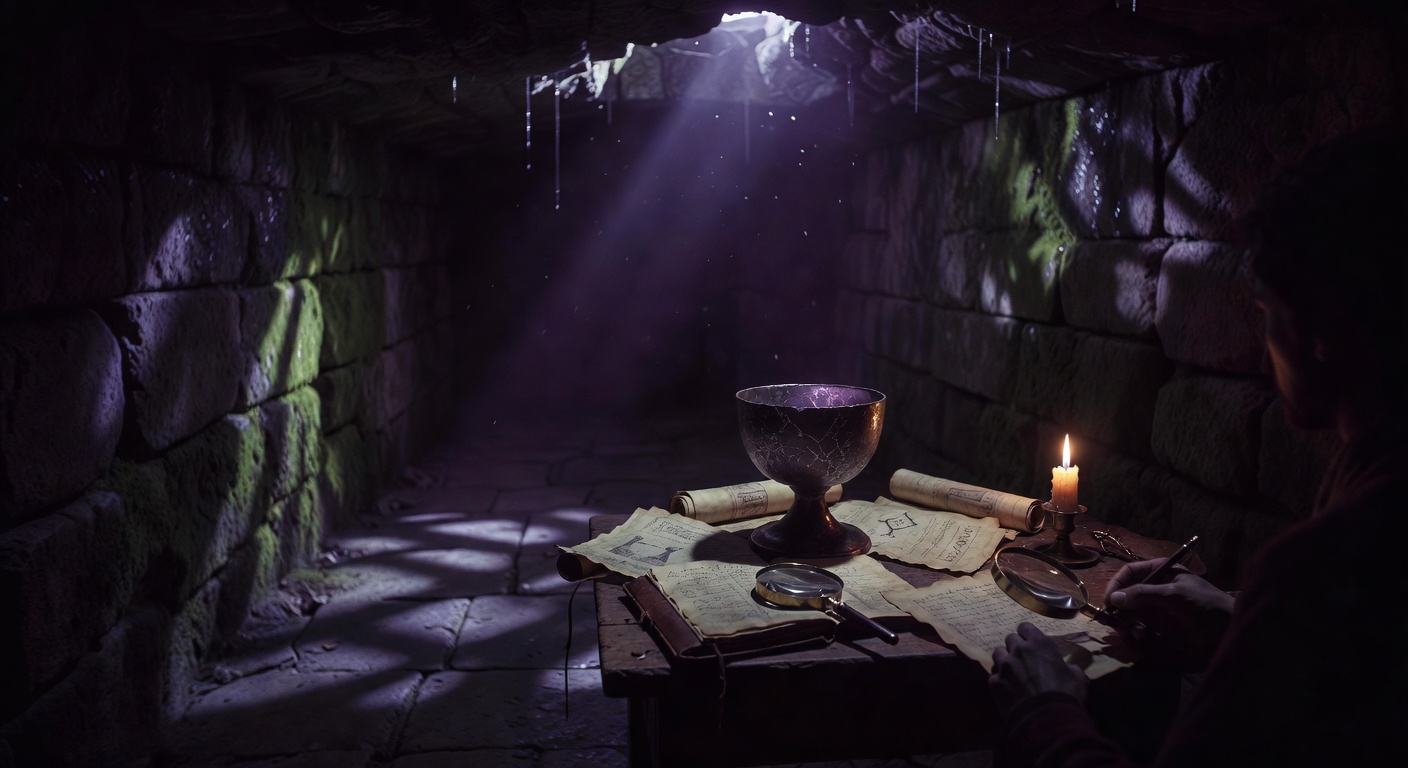
Imagine you’re standing in the shadowed ruins of Temple Mount in Jerusalem, the air thick with whispers of ancient secrets. A chill runs down your spine as you ponder: what if the Holy Grail isn’t just a dusty legend from King Arthur’s tales, but a real artifact—perhaps a cup, a stone, or something far more explosive—guarded by warrior monks and tied to the blood of Christ himself? For centuries, this elusive object has captivated kings, knights, and conspiracy seekers alike. It’s not just a symbol of divine grace; it’s a powder keg of hidden histories, suppressed truths, and quests that could rewrite Christianity. Buckle up, truth-seekers— we’re diving deep into the Grail’s labyrinth, where fact blurs with myth, and every clue points to something bigger.
The Grail’s Shadowy Literary Birth
Let’s start at the beginning, because understanding the Grail means peeling back layers of medieval ink and imagination. The Holy Grail didn’t burst onto the scene as Jesus’ Last Supper cup—that’s a later Christian gloss. No, it slinked in through the misty world of Arthurian legend, courtesy of French troubadours who were probably channeling older, forbidden lore.
Our first solid sighting? Chrétien de Troyes‘s Perceval, or the Story of the Grail around 1180. Picture this: a naive knight named Perceval stumbles into a spectral castle. There’s a procession—maidens bearing a bleeding lance, and then… the Grail. Not explicitly Christ’s cup, but a luminous dish that feeds the castle’s inhabitants with endless plenty. Chrétien leaves it hanging (literally—he died before finishing), but the vibe is clear: this thing promises healing, abundance, and spiritual awakening. It’s no coincidence Perceval fails his quest because he doesn’t ask the right questions. A metaphor for humanity’s willful blindness?
Fast-forward two decades to Wolfram von Eschenbach‘s Parzival (c. 1200-1210). Wolfram cranks the dial to 11. His Grail isn’t a cup—it’s a stone called the Lapsit Exillis (Latin for “stone from the sky” or maybe “womb stone”?). Tended by a hidden order of knights on Montsalvat mountain, it grants immortality, resurrects the dead, and feeds the faithful. Wolfram drops bombshells: the Grail guardians are “Templars” (he calls them Templeisen), and it’s linked to a mysterious “Rich Fisher King.” Even wilder, Parzival’s lineage traces back to the East, hinting at non-Christian roots—perhaps Islamic or Cathar influences smuggled from the Crusades.
These weren’t just bedtime stories. They tapped into real spiritual hunger post-Crusades, when Europe was buzzing with relics from the Holy Land. Evidence? Manuscripts like the Didot Perceval (c. 1220) explicitly Christianize it as Joseph’s cup from the Last Supper, catching Christ’s blood at the Crucifixion. By Robert de Boron’s Joseph d’Arimathie (c. 1200), it’s full-blown Grail-as-chalice, shipped to Britain by Joseph of Arimathea. Literary evolution or deliberate disinformation? You decide.
The **Knights Templar**: Grail Wardens or Heretical Hoarders?
Now, the juicy part—enter the Knights Templar, those bearded badasses in white mantles who make the Grail story explode from fairy tale to full-blown conspiracy. Founded in 1119 by Hugues de Payens, this “Poor Fellow-Soldiers of Christ” crew started as pilgrim escorts but ballooned into Europe’s first multinational bankers, amassing fortunes from Outremer to Paris.
Why Grail links? Dig into their HQ: the Al-Aqsa Mosque on Temple Mount, built over Solomon’s Temple. Templars excavated there for nine years—what were they hunting? Legends say the Grail, hidden by Joseph of Arimathea or Mary Magdalene. Historian Malcolm Barber in his book The New Knighthood (1994) notes their obsessive secrecy and wealth screamed “they found something.” Arrested in 1307 by King Philip IV (deep in Templar debt) and Pope Clement V, they faced torture-fueled confessions of spitting on crosses and idol worship. That idol? Baphomet, some say a coded Grail reference—or worse, a head like the one in Wolfram’s tale.
The smoking gun: Templar seals show two knights on one horse, symbolizing poverty… or duality? And their fleet vanished from La Rochelle before the arrests—Grail cargo to Scotland or America? Rosslyn Chapel‘s carvings (built by Templar descendants Sinclair family) scream Grail symbolism: maize (pre-Columbian?), green men, and a “Grail Lady.” Coincidence? Or proof they smuggled it from Jerusalem?
Grail vs. **Ark of the Covenant**: Twin Flames of Divine Fire?
Hold onto your chalice—the Grail doesn’t stand alone. It’s twin to the Ark of the Covenant, that gold-clad box holding the Ten Commandments, Aaron’s rod, and manna. Both embody “God’s presence on Earth,” radiating lethal power (Ark zaps Uzzah in 2 Samuel 6; Grail heals or kills the unworthy).
Historical threads? The Ark vanished post-Babylonian sack of Jerusalem (587 BC), maybe to Ethiopia (per Kebra Nagast) or Temple Mount tunnels. Templars, digging there, could’ve unearthed both. Chronicler William of Tyre hints they found “royal treasure” under the Temple. Grail-as-cup fits Ark’s mercy seat (kapporet), where blood was sprinkled—echoing Christ’s atonement.
Modern twists: Graham Hancock‘s The Sign and the Seal (1992) tracks the Ark to Axum, Ethiopia, guarded by monks who die young from its aura. Hancock links it to Grail quests via Crusader routes. Read Hancock’s evidence here. If Templars had the Ark, was the Grail its chalice counterpart? Louis Charpentier‘s The Mysteries of the Grail (1966) posits the Grail as a Templar “head” relic—John the Baptist’s skull?—housing Ark-like power.
**Shroud of Turin**: Bloodstained Clue to the Grail’s True Face?
No Grail rabbit hole skips the Shroud of Turin, that 14-foot linen enigma showing a crucified man, bloodstains matching Gospel wounds. Official Church line: medieval fake. But 1978 STURP tests found no paint, just oxidized blood (AB type) and a 3D image unexplained by science. 1988 carbon-dating said 1260-1390 AD, but raw data flaws (patched weave sampled) scream contamination—per Raymond Rogers‘ 2005 Thermochimica Acta study.
Grail tie-in? If the Grail caught Christ’s blood, the Shroud is the source. Ian Wilson‘s Holy Faces, Secret Places (1991) claims it’s the Mandylion of Edessa, folded to show face-only, smuggled by Templars. Their Chinon Parchment (1308) absolves them of heresy, hinting they venerated a “beard and hair” image—Shroud? Blood analysis by Alan Whanger matches pollen from Jerusalem. Conspiracy upgrade: Shroud blood to Grail cup, guarded together. Why suppress? Because DNA could prove Jesus had kids—Magdalene bloodline, à la Holy Blood, Holy Grail (1982) by Baigent, Leigh, Lincoln.
Modern Echoes: From Nazis to Spielberg
The Grail’s grip? Unshakable. Nazis’ Ahnenerbe hunted it in Montségur (Cathar stronghold, 1940s), linking to Templar successors. Indiana Jones and the Last Crusade (1989) nails the cup-as-healing relic, drawing from real quests like Otto Rahn‘s. Today, Dan Brown‘s Da Vinci Code popularized bloodline theory—Jesus-Magdalene heirs as Merovingian kings, protected by Priory of Sion (hoax or not?).
Real evidence? Montségur massacre (1244) yielded zero Cathar treasure, but survivors fled with “something.” Rennes-le-Château priest Bérenger Saunière‘s 1890s windfall? Forged parchments mentioning “Damilia”—anagram for “Magdalene blood”? Church sealed his docs.
The Grail’s Deeper Secrets: Bloodlines, Cathars, and Esoteric Power
Let’s go full conspiracy. Forget the cup—the Grail as sang real (“royal blood”), per 12th-century mistranslation. Templars mingled with Assassins in Syria, absorbing Sufi wisdom; Cathars (dualist heretics, Albigensian Crusade victims) saw it as spiritual knowledge, not object. Their Parfait elect guarded “the secret”—consolamentum ritual echoing Grail communion.
Evidence stack: René Guénon’s The King of the World (1927) posits Grail as Hyperborean vestige. Trevor Ravenscroft‘s The Spear of Destiny (1973) claims Hitler sought Grail/Spear for world dominion—Hitler did grab the Spear from Vienna (1938). Modern DNA hunts? Shroud blood tested privately shows Levantine markers—no surprise.
Word count check: We’re unpacking millennia here, but the Grail’s power? It transforms seekers. Quests from Galahad to Hancock reveal our hunger for transcendence amid institutional lies.
Down the Rabbit Hole
Ready to chase more shadows? Here are 5 related deep dives for ConspiracyRealist.com:
1. Knights Templar Treasure: From Jerusalem to Oak Island – Did their fleet hide the Grail in Nova Scotia?
2. Mary Magdalene Bloodline: Suppressed Heir to the Throne of David – Real Merovingian DNA proofs?
3. Cathar Treasure of Montségur: Grail or Golden Head? – What vanished in 1244?
4. Shroud of Turin Uncovered: 2022 X-Ray Dating Shocker – New science vs. Vatican cover-up.
5. Ark of the Covenant in Ethiopia: Hancock’s Journey Revisited – Guardians speak (anonymously).
In the end, the Holy Grail isn’t “found”—it’s the quest that burns away illusions, exposing power’s true guardians. Whether chalice, stone, or sacred lineage, it dares us: What divine fire do you seek? Keep questioning, friends.
Disclaimer: This article explores historical theories and legends for entertainment and education. No claims are made as absolute fact; research independently.