Menu

Operation CHAOS: How the CIA Ran an Illegal Spy Program on American Citizens

Operation CHAOS: How the CIA Ran an Illegal Spy Program on American Citizens

The year was 1967. America was tearing itself apart over Vietnam. Hundreds of thousands of students, veterans, and ordinary citizens were marching in the streets, burning draft cards, and demanding an end to a war that had already claimed tens of thousands of American lives. The anti-war movement was the largest domestic protest movement the country had seen since the labor struggles of the 1930s.

And the Central Intelligence Agency — an agency legally prohibited from conducting operations inside the United States — was watching every bit of it.

Operation CHAOS was the CIA’s massive, illegal domestic surveillance program, launched in 1967 and running until 1974. It compiled files on over 7,200 American citizens and 1,000 domestic organizations. It infiltrated protest groups, worked in coordination with the FBI and local police, and built a secret database of the American left. And when it was finally exposed, it revealed just how thoroughly the intelligence community had turned its tools of foreign espionage against the American people themselves.

Origins: The White House Wants Answers

Operation CHAOS was born of a specific political anxiety. President Lyndon Johnson was convinced that the anti-war movement, which was making his presidency untenable, must be receiving direction and funding from foreign powers — specifically from the Soviet Union, Cuba, or North Vietnam. If domestic opposition to his war could be shown to be foreign-controlled, it could be discredited. If it was genuinely homegrown, that was a different and more disturbing conclusion.

Johnson tasked CIA Director Richard Helms with finding out. Helms assigned the task to counterintelligence chief James Angleton, who in turn created a special unit within the counterintelligence staff. The program that emerged was called CHAOS.

The CIA’s own charter — the National Security Act of 1947 — explicitly prohibited the agency from conducting domestic intelligence operations. The agency had no law enforcement powers within the United States. CHAOS violated these prohibitions from day one.

The Scale of Surveillance

The CHAOS program grew dramatically under both Johnson and his successor, Richard Nixon. Nixon was, if anything, even more obsessed than Johnson with the idea that his political enemies were foreign-backed traitors. He demanded more intelligence. The CIA delivered.

By the time CHAOS was wound down in 1974, it had:

Compiled files on 7,200 American citizens and 1,000 domestic organizations. Created a computerized database called HYDRA containing information on tens of thousands of Americans. Sent undercover CIA officers into student groups, anti-war organizations, and left-wing political movements. Recruited informants from within domestic organizations to report on their members. Shared intelligence with local police departments and the FBI’s own domestic surveillance program, COINTELPRO.

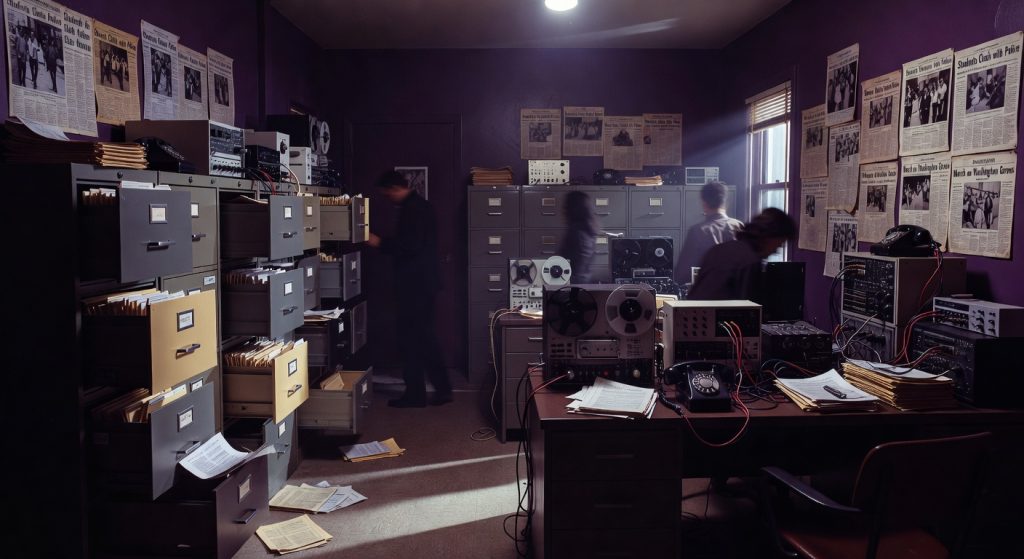
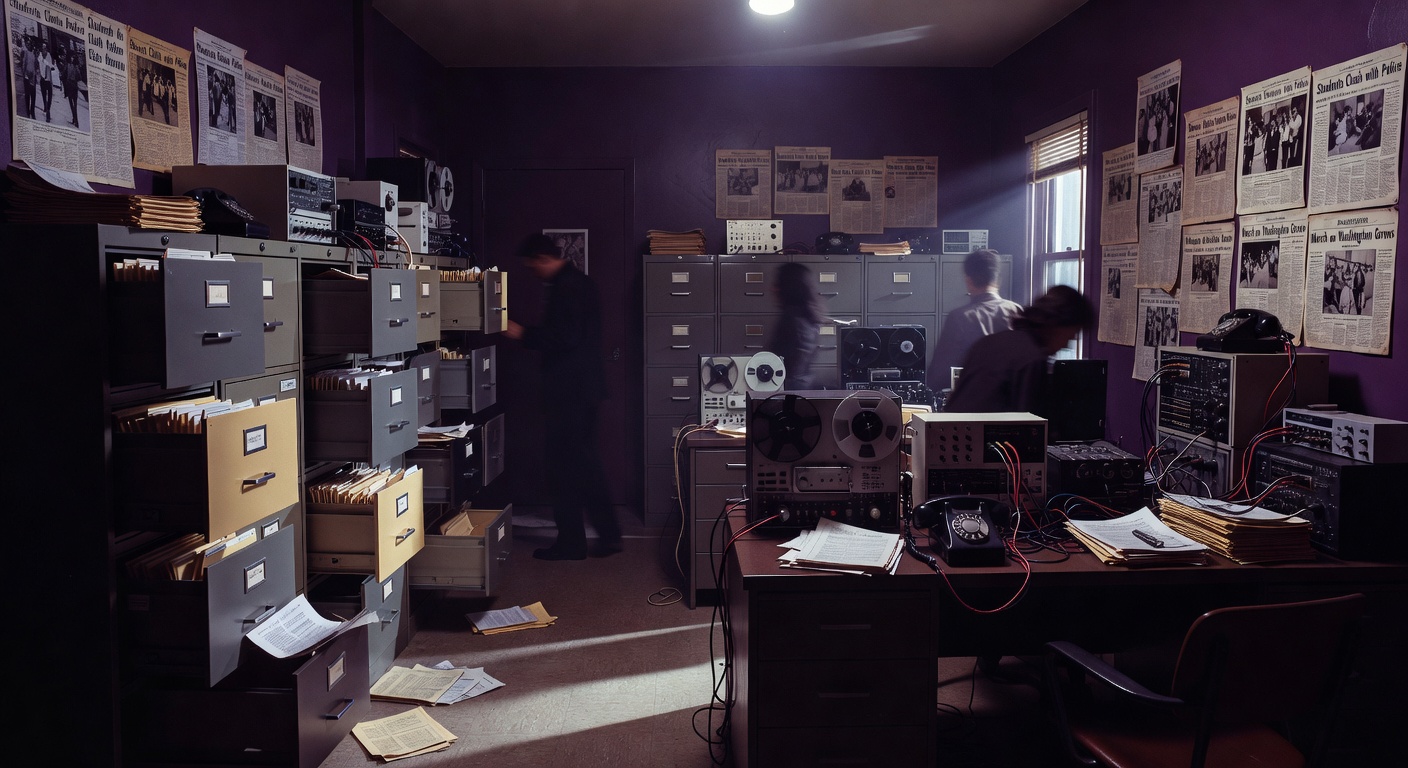
The program was run from a secret room at CIA headquarters in Langley, accessible only to cleared personnel. Its files were kept separate from normal CIA records to minimize the possibility of exposure.

The Infiltrators

Perhaps the most remarkable aspect of CHAOS was its use of undercover officers. The CIA trained agents to pose as radical activists — to live within protest communities, build trust over months or years, and report back on the activities, plans, and personalities of movement leaders.

These officers infiltrated Students for a Democratic Society (SDS), the Black Panther Party, Vietnam Veterans Against the War, and dozens of other organizations. They attended rallies, went to meetings, developed friendships — all while filing detailed reports with the CIA.

Some officers reportedly traveled to Europe to infiltrate American expatriate activist communities there. The program cast a wide net — far wider than any reasonable definition of “foreign influence operations” could justify.

The files that were eventually reviewed by investigators were filled not with evidence of foreign control but with the detailed personal information of Americans exercising their constitutional rights to free speech and assembly. Political beliefs. Personal relationships. Sexual behavior. Medical histories. This information was collected on American citizens by their own spy agency.

The Angleton Factor

James Jesus Angleton, the legendary and increasingly paranoid CIA counterintelligence chief, saw CHAOS as part of his broader hunt for Soviet penetration of American society. Angleton was convinced that Soviet intelligence had deeply penetrated not only the CIA but the entirety of the American left — that the entire anti-war movement might be, in some sense, a Soviet operation.

This worldview was not entirely without basis — the Soviets did fund and support some leftist organizations — but Angleton’s application of it became increasingly untethered from evidence. He saw penetration everywhere. He destroyed careers based on suspicion. And CHAOS reflected his conviction that every domestic dissident was potentially a foreign asset.

Angleton’s influence on the program helps explain why it grew far beyond any rational intelligence purpose. By its end, CHAOS was less a counterintelligence operation than a comprehensive political surveillance program targeting the American left in its entirety.

The Nixon Escalation

When Richard Nixon took office in 1969, he inherited CHAOS and immediately sought to expand it. Nixon’s political paranoia was profound and well-documented. He saw enemies everywhere — in the press, in academia, in the Democratic Party, in the anti-war movement.

In 1970, Nixon’s aide Tom Huston drafted the “Huston Plan” — a comprehensive proposal to dramatically expand domestic intelligence operations, including opening mail, breaking into homes, and intensifying infiltration of domestic groups. Nixon initially approved it before FBI Director J. Edgar Hoover — who objected to CIA encroachment on what he saw as the FBI’s turf — effectively killed it.

But the spirit of the Huston Plan lived on in practice. The Watergate break-in itself was carried out by former CIA officers using intelligence community methods against a domestic political target. The line between foreign intelligence and domestic political operations had blurred to the point of disappearing.

The Church Committee Exposes Everything

The exposure of CHAOS came through one of the most significant exercises of congressional oversight in American history. In 1975, following the Watergate scandal and growing press reports about intelligence abuses, the Senate created the Select Committee to Study Governmental Operations with Respect to Intelligence Activities — universally known as the Church Committee after its chairman, Senator Frank Church of Idaho.

What the Church Committee found was staggering. Not just CHAOS, but the full panorama of intelligence agency abuse: COINTELPRO, assassination plots against foreign leaders, mail opening programs, NSA intercepts of American communications, IRS targeting of political enemies, and much more.

The committee’s final reports — still available on the Senate Intelligence Committee’s website — remain essential reading for anyone who wants to understand the history of American intelligence abuses. They are exhaustive, meticulously documented, and deeply disturbing.

Church himself was shaken by what he found. “The NSA’s capability at any time could be turned around on the American people,” he told NBC News, “and no American would have any privacy left, such is the capability to monitor everything: telephone conversations, telegrams, it doesn’t matter. There would be no place to hide.”

That was 1975. Before the internet. Before smartphones. Before total digital surveillance became a technical possibility.

The Reforms — and Their Limits

The Church Committee’s revelations led to significant reforms. The Foreign Intelligence Surveillance Act (FISA) of 1978 was passed to require court oversight of domestic intelligence operations. Executive orders were issued prohibiting assassination of foreign leaders. The CIA was nominally prohibited from domestic operations.

But reforms have limits. The history of CHAOS — like the history of COINTELPRO, like the history of every intelligence abuse the Church Committee exposed — followed a consistent pattern: the programs existed, they were hidden, they were eventually exposed, promises were made, some reforms were enacted, and then, gradually, the surveillance crept back.

The USA PATRIOT Act of 2001 significantly weakened the FISA framework. The NSA surveillance programs revealed by Snowden in 2013 showed that domestic surveillance had reached scales that would have astonished the Church Committee. The tools have evolved. The appetite for surveillance has not diminished.

The Legacy

Operation CHAOS stands as a documented case study in what happens when intelligence agencies turn their tools inward — when the government treats its own citizens as potential enemies to be monitored, infiltrated, and neutralized.

The victims of CHAOS were not foreign spies. They were students, veterans, writers, civil rights activists, and ordinary Americans who opposed a war and exercised their constitutional rights. Their files are still held by the CIA. Their infiltrators were never publicly identified. The people who ran CHAOS faced no criminal charges.

The lesson of CHAOS is not that the government occasionally makes mistakes. It’s that domestic surveillance, once started, tends to grow — and that the targets tend to be people who challenge power, not people who serve it.

Down the Rabbit Hole

Operation CHAOS connects to a constellation of related programs worth exploring:

  • COINTELPRO — The FBI’s parallel domestic surveillance and disruption program, which went even further than CHAOS in actively sabotaging left-wing organizations through forged letters, informants, and in some cases, suspected involvement in violence.
  • The NSA’s SHAMROCK and MINARET Programs — Revealed by the Church Committee, these programs involved the NSA secretly intercepting international telegrams and monitoring Americans’ overseas communications for decades.
  • The LOVEINT Scandal — In 2013, the NSA admitted that some of its analysts had used surveillance tools to spy on love interests, a small but revealing example of how surveillance powers get misused.
  • PRISM and Upstream Collection — The Snowden revelations about the NSA’s contemporary domestic surveillance capabilities, and how they compare to what the Church Committee found.
  • Fusion Centers — The post-9/11 intelligence-sharing hubs that combine federal, state, and local law enforcement surveillance in ways that have raised significant civil liberties concerns.

Disclaimer: This article is intended for educational and entertainment purposes. The Conspiracy Realist presents documented historical facts, congressional records, and credible investigative journalism alongside analysis. Operation CHAOS is a fully documented historical program. Readers are encouraged to consult the Church Committee reports and form their own conclusions.

dive down the rabbit hole

Operation CHAOS: How the CIA Ran an Illegal Spy Program on American Citizens

Conspiracy Realist
Operation CHAOS: How the CIA Ran an Illegal Spy Program on American Citizens

The year was 1967. America was tearing itself apart over Vietnam. Hundreds of thousands of students, veterans, and ordinary citizens were marching in the streets, burning draft cards, and demanding an end to a war that had already claimed tens of thousands of American lives. The anti-war movement was the largest domestic protest movement the country had seen since the labor struggles of the 1930s.

And the Central Intelligence Agency — an agency legally prohibited from conducting operations inside the United States — was watching every bit of it.

Operation CHAOS was the CIA’s massive, illegal domestic surveillance program, launched in 1967 and running until 1974. It compiled files on over 7,200 American citizens and 1,000 domestic organizations. It infiltrated protest groups, worked in coordination with the FBI and local police, and built a secret database of the American left. And when it was finally exposed, it revealed just how thoroughly the intelligence community had turned its tools of foreign espionage against the American people themselves.

Origins: The White House Wants Answers

Operation CHAOS was born of a specific political anxiety. President Lyndon Johnson was convinced that the anti-war movement, which was making his presidency untenable, must be receiving direction and funding from foreign powers — specifically from the Soviet Union, Cuba, or North Vietnam. If domestic opposition to his war could be shown to be foreign-controlled, it could be discredited. If it was genuinely homegrown, that was a different and more disturbing conclusion.

Johnson tasked CIA Director Richard Helms with finding out. Helms assigned the task to counterintelligence chief James Angleton, who in turn created a special unit within the counterintelligence staff. The program that emerged was called CHAOS.

The CIA’s own charter — the National Security Act of 1947 — explicitly prohibited the agency from conducting domestic intelligence operations. The agency had no law enforcement powers within the United States. CHAOS violated these prohibitions from day one.

The Scale of Surveillance

The CHAOS program grew dramatically under both Johnson and his successor, Richard Nixon. Nixon was, if anything, even more obsessed than Johnson with the idea that his political enemies were foreign-backed traitors. He demanded more intelligence. The CIA delivered.

By the time CHAOS was wound down in 1974, it had:

Compiled files on 7,200 American citizens and 1,000 domestic organizations. Created a computerized database called HYDRA containing information on tens of thousands of Americans. Sent undercover CIA officers into student groups, anti-war organizations, and left-wing political movements. Recruited informants from within domestic organizations to report on their members. Shared intelligence with local police departments and the FBI’s own domestic surveillance program, COINTELPRO.

The program was run from a secret room at CIA headquarters in Langley, accessible only to cleared personnel. Its files were kept separate from normal CIA records to minimize the possibility of exposure.

The Infiltrators

Perhaps the most remarkable aspect of CHAOS was its use of undercover officers. The CIA trained agents to pose as radical activists — to live within protest communities, build trust over months or years, and report back on the activities, plans, and personalities of movement leaders.

These officers infiltrated Students for a Democratic Society (SDS), the Black Panther Party, Vietnam Veterans Against the War, and dozens of other organizations. They attended rallies, went to meetings, developed friendships — all while filing detailed reports with the CIA.

Some officers reportedly traveled to Europe to infiltrate American expatriate activist communities there. The program cast a wide net — far wider than any reasonable definition of “foreign influence operations” could justify.

The files that were eventually reviewed by investigators were filled not with evidence of foreign control but with the detailed personal information of Americans exercising their constitutional rights to free speech and assembly. Political beliefs. Personal relationships. Sexual behavior. Medical histories. This information was collected on American citizens by their own spy agency.

The Angleton Factor

James Jesus Angleton, the legendary and increasingly paranoid CIA counterintelligence chief, saw CHAOS as part of his broader hunt for Soviet penetration of American society. Angleton was convinced that Soviet intelligence had deeply penetrated not only the CIA but the entirety of the American left — that the entire anti-war movement might be, in some sense, a Soviet operation.

This worldview was not entirely without basis — the Soviets did fund and support some leftist organizations — but Angleton’s application of it became increasingly untethered from evidence. He saw penetration everywhere. He destroyed careers based on suspicion. And CHAOS reflected his conviction that every domestic dissident was potentially a foreign asset.

Angleton’s influence on the program helps explain why it grew far beyond any rational intelligence purpose. By its end, CHAOS was less a counterintelligence operation than a comprehensive political surveillance program targeting the American left in its entirety.

The Nixon Escalation

When Richard Nixon took office in 1969, he inherited CHAOS and immediately sought to expand it. Nixon’s political paranoia was profound and well-documented. He saw enemies everywhere — in the press, in academia, in the Democratic Party, in the anti-war movement.

In 1970, Nixon’s aide Tom Huston drafted the “Huston Plan” — a comprehensive proposal to dramatically expand domestic intelligence operations, including opening mail, breaking into homes, and intensifying infiltration of domestic groups. Nixon initially approved it before FBI Director J. Edgar Hoover — who objected to CIA encroachment on what he saw as the FBI’s turf — effectively killed it.

But the spirit of the Huston Plan lived on in practice. The Watergate break-in itself was carried out by former CIA officers using intelligence community methods against a domestic political target. The line between foreign intelligence and domestic political operations had blurred to the point of disappearing.

The Church Committee Exposes Everything

The exposure of CHAOS came through one of the most significant exercises of congressional oversight in American history. In 1975, following the Watergate scandal and growing press reports about intelligence abuses, the Senate created the Select Committee to Study Governmental Operations with Respect to Intelligence Activities — universally known as the Church Committee after its chairman, Senator Frank Church of Idaho.

What the Church Committee found was staggering. Not just CHAOS, but the full panorama of intelligence agency abuse: COINTELPRO, assassination plots against foreign leaders, mail opening programs, NSA intercepts of American communications, IRS targeting of political enemies, and much more.

The committee’s final reports — still available on the Senate Intelligence Committee’s website — remain essential reading for anyone who wants to understand the history of American intelligence abuses. They are exhaustive, meticulously documented, and deeply disturbing.

Church himself was shaken by what he found. “The NSA’s capability at any time could be turned around on the American people,” he told NBC News, “and no American would have any privacy left, such is the capability to monitor everything: telephone conversations, telegrams, it doesn’t matter. There would be no place to hide.”

That was 1975. Before the internet. Before smartphones. Before total digital surveillance became a technical possibility.

The Reforms — and Their Limits

The Church Committee’s revelations led to significant reforms. The Foreign Intelligence Surveillance Act (FISA) of 1978 was passed to require court oversight of domestic intelligence operations. Executive orders were issued prohibiting assassination of foreign leaders. The CIA was nominally prohibited from domestic operations.

But reforms have limits. The history of CHAOS — like the history of COINTELPRO, like the history of every intelligence abuse the Church Committee exposed — followed a consistent pattern: the programs existed, they were hidden, they were eventually exposed, promises were made, some reforms were enacted, and then, gradually, the surveillance crept back.

The USA PATRIOT Act of 2001 significantly weakened the FISA framework. The NSA surveillance programs revealed by Snowden in 2013 showed that domestic surveillance had reached scales that would have astonished the Church Committee. The tools have evolved. The appetite for surveillance has not diminished.

The Legacy

Operation CHAOS stands as a documented case study in what happens when intelligence agencies turn their tools inward — when the government treats its own citizens as potential enemies to be monitored, infiltrated, and neutralized.

The victims of CHAOS were not foreign spies. They were students, veterans, writers, civil rights activists, and ordinary Americans who opposed a war and exercised their constitutional rights. Their files are still held by the CIA. Their infiltrators were never publicly identified. The people who ran CHAOS faced no criminal charges.

The lesson of CHAOS is not that the government occasionally makes mistakes. It’s that domestic surveillance, once started, tends to grow — and that the targets tend to be people who challenge power, not people who serve it.

Down the Rabbit Hole

Operation CHAOS connects to a constellation of related programs worth exploring:

  • COINTELPRO — The FBI’s parallel domestic surveillance and disruption program, which went even further than CHAOS in actively sabotaging left-wing organizations through forged letters, informants, and in some cases, suspected involvement in violence.
  • The NSA’s SHAMROCK and MINARET Programs — Revealed by the Church Committee, these programs involved the NSA secretly intercepting international telegrams and monitoring Americans’ overseas communications for decades.
  • The LOVEINT Scandal — In 2013, the NSA admitted that some of its analysts had used surveillance tools to spy on love interests, a small but revealing example of how surveillance powers get misused.
  • PRISM and Upstream Collection — The Snowden revelations about the NSA’s contemporary domestic surveillance capabilities, and how they compare to what the Church Committee found.
  • Fusion Centers — The post-9/11 intelligence-sharing hubs that combine federal, state, and local law enforcement surveillance in ways that have raised significant civil liberties concerns.

Disclaimer: This article is intended for educational and entertainment purposes. The Conspiracy Realist presents documented historical facts, congressional records, and credible investigative journalism alongside analysis. Operation CHAOS is a fully documented historical program. Readers are encouraged to consult the Church Committee reports and form their own conclusions.

Operation CHAOS: How the CIA Ran an Illegal Spy Program on American Citizens

Operation CHAOS: How the CIA Ran an Illegal Spy Program on American Citizens

The year was 1967. America was tearing itself apart over Vietnam. Hundreds of thousands of students, veterans, and ordinary citizens were marching in the streets, burning draft cards, and demanding an end to a war that had already claimed tens of thousands of American lives. The anti-war movement was the largest domestic protest movement the country had seen since the labor struggles of the 1930s.

And the Central Intelligence Agency — an agency legally prohibited from conducting operations inside the United States — was watching every bit of it.

Operation CHAOS was the CIA’s massive, illegal domestic surveillance program, launched in 1967 and running until 1974. It compiled files on over 7,200 American citizens and 1,000 domestic organizations. It infiltrated protest groups, worked in coordination with the FBI and local police, and built a secret database of the American left. And when it was finally exposed, it revealed just how thoroughly the intelligence community had turned its tools of foreign espionage against the American people themselves.

Origins: The White House Wants Answers

Operation CHAOS was born of a specific political anxiety. President Lyndon Johnson was convinced that the anti-war movement, which was making his presidency untenable, must be receiving direction and funding from foreign powers — specifically from the Soviet Union, Cuba, or North Vietnam. If domestic opposition to his war could be shown to be foreign-controlled, it could be discredited. If it was genuinely homegrown, that was a different and more disturbing conclusion.

Johnson tasked CIA Director Richard Helms with finding out. Helms assigned the task to counterintelligence chief James Angleton, who in turn created a special unit within the counterintelligence staff. The program that emerged was called CHAOS.

The CIA’s own charter — the National Security Act of 1947 — explicitly prohibited the agency from conducting domestic intelligence operations. The agency had no law enforcement powers within the United States. CHAOS violated these prohibitions from day one.

The Scale of Surveillance

The CHAOS program grew dramatically under both Johnson and his successor, Richard Nixon. Nixon was, if anything, even more obsessed than Johnson with the idea that his political enemies were foreign-backed traitors. He demanded more intelligence. The CIA delivered.

By the time CHAOS was wound down in 1974, it had:

Compiled files on 7,200 American citizens and 1,000 domestic organizations. Created a computerized database called HYDRA containing information on tens of thousands of Americans. Sent undercover CIA officers into student groups, anti-war organizations, and left-wing political movements. Recruited informants from within domestic organizations to report on their members. Shared intelligence with local police departments and the FBI’s own domestic surveillance program, COINTELPRO.

The program was run from a secret room at CIA headquarters in Langley, accessible only to cleared personnel. Its files were kept separate from normal CIA records to minimize the possibility of exposure.

The Infiltrators

Perhaps the most remarkable aspect of CHAOS was its use of undercover officers. The CIA trained agents to pose as radical activists — to live within protest communities, build trust over months or years, and report back on the activities, plans, and personalities of movement leaders.

These officers infiltrated Students for a Democratic Society (SDS), the Black Panther Party, Vietnam Veterans Against the War, and dozens of other organizations. They attended rallies, went to meetings, developed friendships — all while filing detailed reports with the CIA.

Some officers reportedly traveled to Europe to infiltrate American expatriate activist communities there. The program cast a wide net — far wider than any reasonable definition of “foreign influence operations” could justify.

The files that were eventually reviewed by investigators were filled not with evidence of foreign control but with the detailed personal information of Americans exercising their constitutional rights to free speech and assembly. Political beliefs. Personal relationships. Sexual behavior. Medical histories. This information was collected on American citizens by their own spy agency.

The Angleton Factor

James Jesus Angleton, the legendary and increasingly paranoid CIA counterintelligence chief, saw CHAOS as part of his broader hunt for Soviet penetration of American society. Angleton was convinced that Soviet intelligence had deeply penetrated not only the CIA but the entirety of the American left — that the entire anti-war movement might be, in some sense, a Soviet operation.

This worldview was not entirely without basis — the Soviets did fund and support some leftist organizations — but Angleton’s application of it became increasingly untethered from evidence. He saw penetration everywhere. He destroyed careers based on suspicion. And CHAOS reflected his conviction that every domestic dissident was potentially a foreign asset.

Angleton’s influence on the program helps explain why it grew far beyond any rational intelligence purpose. By its end, CHAOS was less a counterintelligence operation than a comprehensive political surveillance program targeting the American left in its entirety.

The Nixon Escalation

When Richard Nixon took office in 1969, he inherited CHAOS and immediately sought to expand it. Nixon’s political paranoia was profound and well-documented. He saw enemies everywhere — in the press, in academia, in the Democratic Party, in the anti-war movement.

In 1970, Nixon’s aide Tom Huston drafted the “Huston Plan” — a comprehensive proposal to dramatically expand domestic intelligence operations, including opening mail, breaking into homes, and intensifying infiltration of domestic groups. Nixon initially approved it before FBI Director J. Edgar Hoover — who objected to CIA encroachment on what he saw as the FBI’s turf — effectively killed it.

But the spirit of the Huston Plan lived on in practice. The Watergate break-in itself was carried out by former CIA officers using intelligence community methods against a domestic political target. The line between foreign intelligence and domestic political operations had blurred to the point of disappearing.

The Church Committee Exposes Everything

The exposure of CHAOS came through one of the most significant exercises of congressional oversight in American history. In 1975, following the Watergate scandal and growing press reports about intelligence abuses, the Senate created the Select Committee to Study Governmental Operations with Respect to Intelligence Activities — universally known as the Church Committee after its chairman, Senator Frank Church of Idaho.

What the Church Committee found was staggering. Not just CHAOS, but the full panorama of intelligence agency abuse: COINTELPRO, assassination plots against foreign leaders, mail opening programs, NSA intercepts of American communications, IRS targeting of political enemies, and much more.

The committee’s final reports — still available on the Senate Intelligence Committee’s website — remain essential reading for anyone who wants to understand the history of American intelligence abuses. They are exhaustive, meticulously documented, and deeply disturbing.

Church himself was shaken by what he found. “The NSA’s capability at any time could be turned around on the American people,” he told NBC News, “and no American would have any privacy left, such is the capability to monitor everything: telephone conversations, telegrams, it doesn’t matter. There would be no place to hide.”

That was 1975. Before the internet. Before smartphones. Before total digital surveillance became a technical possibility.

The Reforms — and Their Limits

The Church Committee’s revelations led to significant reforms. The Foreign Intelligence Surveillance Act (FISA) of 1978 was passed to require court oversight of domestic intelligence operations. Executive orders were issued prohibiting assassination of foreign leaders. The CIA was nominally prohibited from domestic operations.

But reforms have limits. The history of CHAOS — like the history of COINTELPRO, like the history of every intelligence abuse the Church Committee exposed — followed a consistent pattern: the programs existed, they were hidden, they were eventually exposed, promises were made, some reforms were enacted, and then, gradually, the surveillance crept back.

The USA PATRIOT Act of 2001 significantly weakened the FISA framework. The NSA surveillance programs revealed by Snowden in 2013 showed that domestic surveillance had reached scales that would have astonished the Church Committee. The tools have evolved. The appetite for surveillance has not diminished.

The Legacy

Operation CHAOS stands as a documented case study in what happens when intelligence agencies turn their tools inward — when the government treats its own citizens as potential enemies to be monitored, infiltrated, and neutralized.

The victims of CHAOS were not foreign spies. They were students, veterans, writers, civil rights activists, and ordinary Americans who opposed a war and exercised their constitutional rights. Their files are still held by the CIA. Their infiltrators were never publicly identified. The people who ran CHAOS faced no criminal charges.

The lesson of CHAOS is not that the government occasionally makes mistakes. It’s that domestic surveillance, once started, tends to grow — and that the targets tend to be people who challenge power, not people who serve it.

Down the Rabbit Hole

Operation CHAOS connects to a constellation of related programs worth exploring:

  • COINTELPRO — The FBI’s parallel domestic surveillance and disruption program, which went even further than CHAOS in actively sabotaging left-wing organizations through forged letters, informants, and in some cases, suspected involvement in violence.
  • The NSA’s SHAMROCK and MINARET Programs — Revealed by the Church Committee, these programs involved the NSA secretly intercepting international telegrams and monitoring Americans’ overseas communications for decades.
  • The LOVEINT Scandal — In 2013, the NSA admitted that some of its analysts had used surveillance tools to spy on love interests, a small but revealing example of how surveillance powers get misused.
  • PRISM and Upstream Collection — The Snowden revelations about the NSA’s contemporary domestic surveillance capabilities, and how they compare to what the Church Committee found.
  • Fusion Centers — The post-9/11 intelligence-sharing hubs that combine federal, state, and local law enforcement surveillance in ways that have raised significant civil liberties concerns.

Disclaimer: This article is intended for educational and entertainment purposes. The Conspiracy Realist presents documented historical facts, congressional records, and credible investigative journalism alongside analysis. Operation CHAOS is a fully documented historical program. Readers are encouraged to consult the Church Committee reports and form their own conclusions.

Table of contents