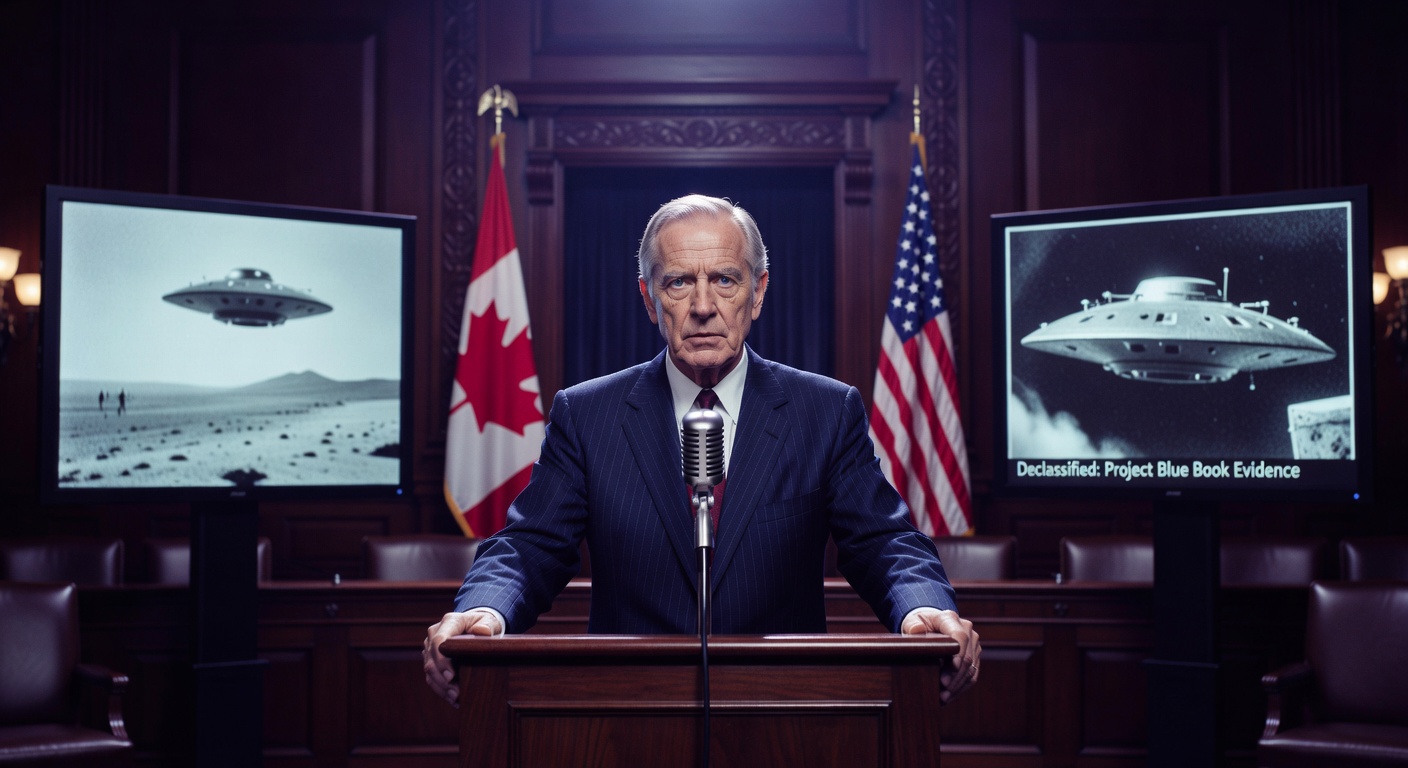
When former Canadian defense minister [Paul Hellyer] said UFOs were real and governments knew more than they admitted, audiences didn’t hear a late-night radio caller. They heard a man who had sat at the center of NATO-era military governance.
Who Hellyer Was
Hellyer served as Canada’s Minister of National Defence (1963–1967) and later Deputy Prime Minister. That background matters because disclosure debates often hinge on witness hierarchy.
A claim from a retired defense minister carries symbolic weight even when based partly on secondary sources.
The 2005 Breakpoint
In 2005, Hellyer publicly aligned with UFO reality claims and argued secrecy around advanced aerospace and possible non-human contact was harming democratic accountability.
He became one of the highest-ranking former officials to speak this openly.
2013 Senate Testimony and Beyond
Hellyer reinforced his position in 2013 public testimony contexts, referencing crash retrieval stories, compartmented programs, and multiple species claims.
Skeptics criticized evidentiary leaps; supporters argued his role was catalytic.
Conclusion
Paul Hellyer did not deliver a neat evidentiary package. He delivered a challenge from inside the political class: stop treating UFO questions as unserious by default. His intervention sits in the same arc as Roswell and modern UAP offices.
Research Threads and Disclosure Context
Investigators returning to Paul Hellyer often find that the hardest part is not collecting stories, but ranking evidence layers: witness memory, instrument logs, official records, and media interpretation. In case file review cycles, details that look trivial in week one become central in month six. That pattern is why long-form analysis still matters. It is also why readers should compare this case with related archives like this connected investigation before locking into a final conclusion.
Another overlooked angle in Paul Hellyer is institutional behavior under uncertainty. Agencies rarely admit complete ignorance in real time; they narrow language, preserve optionality, and protect sources. That can look like a cover-up from one side and risk management from the other. The truth may include both dynamics at once, which is exactly what makes modern disclosure debates so durable.
When researchers map timelines for Paul Hellyer, they usually see three phases: immediate witness shock, bureaucratic classification, and later narrative battle. By the time public audiences engage, the raw event has already passed through multiple filters. That does not mean nothing happened. It means the original signal is mixed with institutional noise, social mythmaking, and selective release cycles.
Investigators returning to Paul Hellyer often find that the hardest part is not collecting stories, but ranking evidence layers: witness memory, instrument logs, official records, and media interpretation. In case file review cycles, details that look trivial in week one become central in month six. That pattern is why long-form analysis still matters. It is also why readers should compare this case with related archives like this connected investigation before locking into a final conclusion.
Another overlooked angle in Paul Hellyer is institutional behavior under uncertainty. Agencies rarely admit complete ignorance in real time; they narrow language, preserve optionality, and protect sources. That can look like a cover-up from one side and risk management from the other. The truth may include both dynamics at once, which is exactly what makes modern disclosure debates so durable.
Down the Rabbit Hole
- [Hellyer’s source map]: Which researchers and insiders most influenced his later-life UFO positions?
- [Canadian vs U.S. disclosure cultures]: How parliamentary culture changes whistleblower dynamics.
- [Black budget archaeology]: How investigators reconstruct hidden procurement lines from public records.
- [Narrative risk management]: When high-status advocates hurt their case by mixing strong and weak claims.
Reference trail starter: CBC profile context on Hellyer’s UFO advocacy.
Disclaimer: This article is for entertainment and educational exploration. Readers are encouraged to research these topics independently and form their own conclusions.