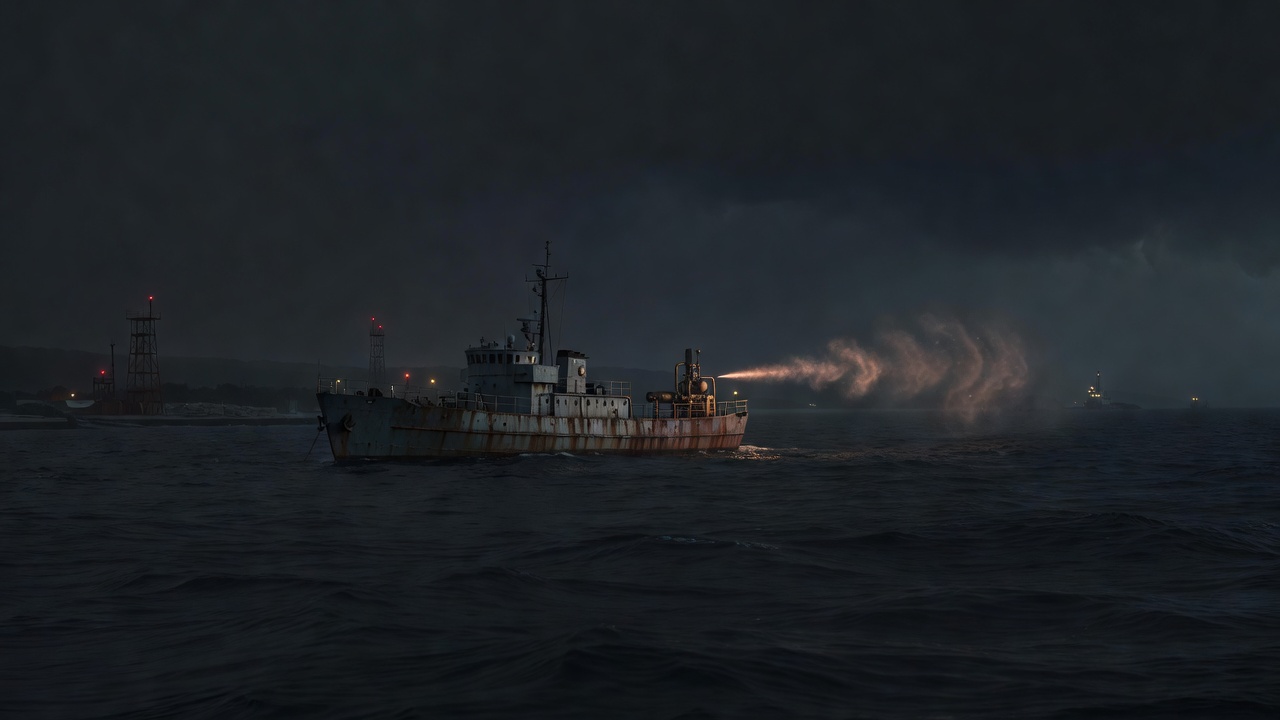
Night settles over the Atlantic in a way that makes distances lie. A ship becomes a shadow. A cloud becomes weather. Somewhere off the coasts of Georgia and the Carolinas in the early 1950s, military planners wanted to know whether something released beyond the horizon could ride the wind inland and pass over American communities before anyone understood what they were breathing. The operation had a soft, harmless name: Dew. But the question beneath it was hard, strategic, and unmistakably Cold War: if a biological cloud came ashore, how much of the country could it touch before daylight?
The Case For
A dry run for biological warfare realism
The strongest case for taking Operation Dew seriously is that the official record already places it inside the logic of America’s offensive and defensive biological-warfare planning. In its 1997 report Toxicologic Assessment of the Army’s Zinc Cadmium Sulfide Dispersion Tests, the National Research Council explained that the Army ran open-air trials to understand how biological agents or their simulants would disperse across real terrain and real communities. The same report states that zinc cadmium sulfide, or ZnCdS, was chosen because it fluoresced under ultraviolet light, had a particle size useful for respiratory penetration studies, and was then considered inert and practical for large-scale testing. That framework is preserved in the public record at the NCBI Bookshelf edition of the NRC report.
Appendix B of the same NRC report identifies Operation DEW I as the test series off Georgia, North Carolina, and South Carolina, tied to Dugway Special Report 162. According to the report’s summaries, Dew I involved offshore releases designed to determine whether a large aerosol cloud could be maintained long enough to drift over land and achieve broad area coverage. The numbers matter here. The published summary says releases stretched roughly 100 to 150 nautical miles and, in some runs, measurable tracer moved across more than 60,000 square miles of populated coastal region. If you wanted proof that planners were thinking beyond a laboratory bench and into continental vulnerability, this is it.
The wider historical backdrop makes Dew feel even less accidental. Appendix A of the NRC report explains that Army planners used cover stories with local officials during some ZnCdS programs, describing the work as smoke-screen research to avoid disclosing the true nature of the operations. That does not prove a sinister health outcome on its own. It does show institutional secrecy around tests that relied on the public not knowing what was being modeled overhead.
Then there is Dew II. A FOIA-released Army Biological Labs technical memorandum from August 1957, Relationship Between Times of Arrival of Cloud, Peak Recovery and Cessation for Operation Dew II, analyzed the movement of the aerosol cloud using operational data from the test series. The memo treated the cloud mathematically, comparing arrival time, peak recovery, and cessation in language similar to fallout modeling. That matters because it suggests the Army was not merely sprinkling harmless tracer to satisfy curiosity. It was refining predictive tools for how an aerosol attack profile would behave after release. The document is now publicly accessible through a FOIA-released copy of the Dew II memorandum. Put plainly: Dew looks less like an isolated oddity and more like a coastal rehearsal in the larger Cold War campaign that later produced Operation LAC’s continental aerosol trials and the broader pattern collected under America’s secret zinc cadmium sulfide test dust program.
The Realist’s Eye
What the documents prove — and what they do not
The realist problem begins where conspiratorial certainty usually rushes in. The documentary record supports that Operation Dew happened, that it used ZnCdS tracer, and that the military wanted to model aerosol transport from sea to land. It does not, by itself, prove malicious intent toward the civilian population or a documented health disaster that officials later buried.
For one thing, the same NRC review that reconstructed these tests also concluded that the measured concentrations from the Army’s ZnCdS programs were unlikely to have produced adverse health effects at the levels estimated in available records. That conclusion remains contested by critics who distrust the Army’s assumptions, but it cannot be ignored. If the evidence is going to be handled honestly, the independent review belongs on the table alongside the operational history.
There is also a scale problem. Operation Dew often gets folded into a broader story of secret domestic experimentation, but Dew itself sits in a narrow evidentiary lane. Much of what circulates online about poisoned coastlines, cancer clusters, or deliberate human testing exceeds what the surviving public documents can carry. Some claims rely on later retellings rather than contemporaneous records. Others blur Dew with later ZnCdS programs or with biological-simulant releases that used different materials and methods.
Dew II raises another caution. The FOIA-released technical memo is valuable, but it is not a master confession. It is a specialized working document, focused on cloud timing relationships and data interpretation. It helps confirm operational seriousness, not every motive or consequence attached to the test in later conspiracy culture.
And then there is the old Cold War phrase that shadows all of this: “considered safe at the time.” The Army’s choices often rested on assumptions later revisited or softened by subsequent science. That does not automatically transform every open-air test into a proven public-health atrocity. It does remind us that official confidence is not the same thing as final truth.
So the tension holds. Operation Dew was real. The secrecy around these programs was real. The military objective was real. But the leap from documented aerosol modeling to fully proven civilian harm still outruns the cleanest evidence now available.
What We Know For Certain
- Operation Dew took place off the southeastern U.S. coast in the early 1950s and included Dew I and Dew II.
- The tests used zinc cadmium sulfide as a tracer to study aerosol dispersion relevant to biological-warfare planning.
- The National Research Council’s 1997 report identifies Dew I and ties it to Dugway Special Report 162.
- A FOIA-released Army Biological Labs memorandum from 1957 confirms operational analysis of Dew II cloud travel data.
- Cold War Army programs sometimes used cover stories with local officials during ZnCdS testing campaigns.
The Unanswered Questions
- How much of the original Dew I and Dew II operational documentation remains classified, lost, or simply undiscovered in public archives?
- What exactly were coastal and local officials told, and which agencies knew the real purpose of the releases at the time?
- How reliable were the Army’s later exposure reconstructions given incomplete records and evolving toxicology standards?
- Did Operation Dew directly shape the planning assumptions that later scaled into government-secrets testing programs like Operation LAC?
The Closer — You Decide
The easy version of this story says it was nothing. The louder version says it was proof of everything. The documents argue for neither shortcut. They show a government willing to model invisible war over its own coastline, willing to hide the purpose behind softer language, and confident enough to call the tracer safe while asking questions big enough to cover half a map. The paperwork is real. The strategy was real. The remaining gap between what was tested and what was risked is still yours to weigh.