Operation LAC: America’s Secret Aerosol Test
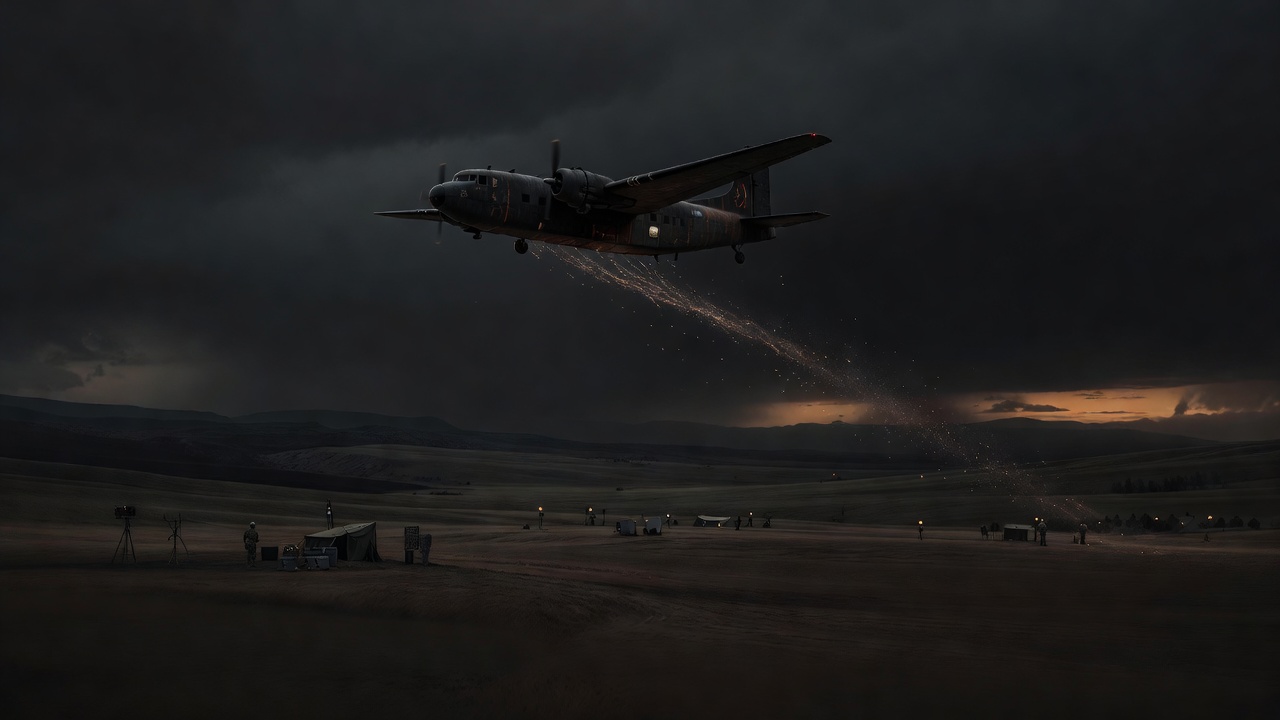
Some experiments announce themselves with sirens, sealed bunkers, and men in masks. Others pass overhead so quietly that the people below never know they were part of the drill. In the late 1950s, while Cold War dread pressed against every map in Washington, the U.S. Army sent aircraft across the American sky to answer a question: if a biological weapon were released over this country, how far would it travel before anyone understood what had happened? The program had a bureaucratic name — Operation LAC, for Large Area Coverage — but its logic was chilling.
The Case For
A real Cold War test built around biological-war logic
The documentary record is not vague about the mission. In Appendix A of the National Research Council’s 1997 assessment of the Army’s zinc cadmium sulfide dispersion tests, the historical background makes clear that the Army believed laboratory and wind-tunnel work could not answer the full vulnerability problem. Military planners wanted to know how an aerosol behaved over real terrain, real cities, and real weather. That logic pushed the Chemical Corps toward open-air testing on a continental scale.
Operation LAC was the most ambitious expression of that thinking. The same NRC record says it was the largest Chemical Corps test of its kind and that it demonstrated the feasibility of covering thousands of square miles with an aerosol meant to simulate biological-agent behavior. Instead of releasing a live pathogen, the Army used zinc cadmium sulfide, or ZnCdS, a fluorescent tracer selected in part because its particle size roughly matched the size military planners considered effective for deep-lung penetration. It could be tracked after release, making the public below part of a data problem they had never consented to join.
The operation’s first major run, on 2 December 1957, followed a path from South Dakota toward International Falls, Minnesota. According to the NRC material and the dose summary prepared for the committee, some of the particles were later detected as far as 1,200 miles away. A typical 400-mile flight line could release about 5,000 pounds of ZnCdS. One of the program’s flight paths ran 1,400 miles. Those are not the dimensions of a laboratory curiosity. They are the dimensions of a national-scale rehearsal.
The wider pattern is what keeps the suspicion alive
The unsettling part is not only the test itself. It is the strategic frame around it. The NRC appendix notes that some American test cities were selected because they approximated Soviet target cities in terrain, climate, structure, and population. It also records that local officials in some cases were given a cover story tied to smoke-screen research rather than the real biological-warfare context.
If you have followed our earlier look at America’s secret test dust or the San Francisco precedent in Operation Sea-Spray, Operation LAC feels less like an isolated oddity and more like part of a doctrine: simulate the attack first, ask the public later, if ever. The strongest case for conspiracy is not that someone invented Operation LAC after the fact. It is that the Army openly built a testing culture in which secrecy and civilian exposure were treated as acceptable tradeoffs in the name of national security.
The Realist’s Eye
The documents prove the test, not the darkest interpretation
That is where the theory needs restraint. Operation LAC is documented. The secrecy is documented. The continental scale is documented. But those facts do not automatically prove that the government was trying to poison its own population, nor do they prove that the Army expected ZnCdS to function as a covert mass-casualty weapon. The official rationale was tracer science: model the dispersion of a biological aerosol without using a live agent. That distinction matters.
It also matters that Congress eventually asked the National Research Council to review the health question directly. In its public-facing summary and a 1997 National Academies news release, the committee concluded that exposure levels from the Army’s ZnCdS releases were far below what would be expected to cause illnesses such as lung cancer, infertility, kidney toxicity, or bone toxicity. The committee’s language was careful but plain: it found no evidence that exposure at those levels could make people sick.
The hardest problem may be ethics, not toxicology
Still, the same NRC FAQ contains an important boundary line. The committee said it did not address the ethical issues raised by the tests. That omission matters because the deepest public wound around Operation LAC is not only whether people were physically harmed. It is whether civilians became unwitting participants in a military experiment designed around worst-case war planning.
There is another reason not to overreach. Later community claims about cancers, environmental injustice, and long-term illness often blend Operation LAC with other Cold War dispersion programs, other cities, and later rooftop or vehicle-based releases. Some of those concerns may deserve investigation on their own terms. But a realist has to separate what the record proves about LAC from what broader Cold War secrecy makes emotionally plausible. Operation LAC shows a government willing to run hidden aerosol tests across huge spaces. It does not, by itself, close the causal gap between exposure and every later illness attributed to that era.
That leaves a more unsettling middle ground. The Army did not invent this story; it documented it. The health review did not endorse mass-poisoning claims; it rejected them at the measured exposure levels it studied. Yet one fact remains: the state decided that informed consent was expendable when strategic vulnerability data was on the line.
What We Know For Certain
- Operation LAC was a real U.S. Army Chemical Corps program in 1957–1958 designed to study large-area aerosol dispersion.
- The Army used zinc cadmium sulfide as a tracer because it could be detected and had particle characteristics relevant to biological-war simulations.
- The first major December 1957 test ran from South Dakota toward northern Minnesota, and particles were later detected up to 1,200 miles away.
- The National Research Council concluded in 1997 that the ZnCdS exposure levels it reviewed were far below levels expected to cause illness.
- The NRC explicitly said ethical questions about the tests were important but outside the committee’s charge.
The Unanswered Questions
- How often did Cold War planners choose American environments because they resembled intended foreign target areas?
- How many local officials were given incomplete cover stories instead of the real biological-war context?
- What did internal Army debates sound like when secrecy and civilian consent collided?
- Would Congress or the public have accepted Operation LAC if the test had been announced in real time?
The Closer — You Decide
Sometimes the file does not reveal a monster. Sometimes it reveals a mindset. Operation LAC tells us that Cold War planners were willing to turn a nation into a map, a sky into a delivery system, and ordinary civilians into background conditions for a classified rehearsal. Maybe the toxicology really was less dramatic than the fear it leaves behind. Maybe the deeper scandal is that consent never got a vote. The program was real, the secrecy was real, and the questions did not disappear when the planes landed. You decide.
Dive deeper: explore more from our Government Secrets archive.