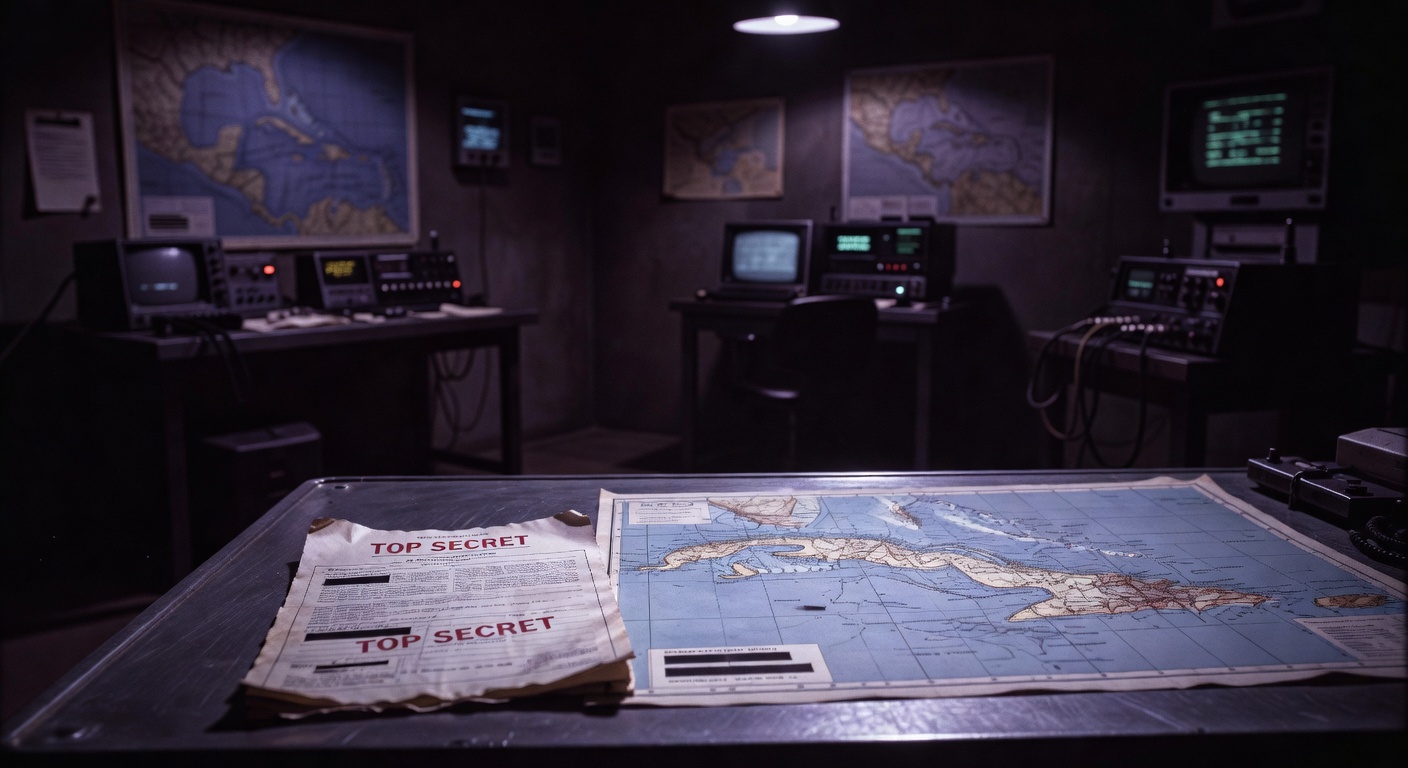
What if the United States government once seriously considered staging terrorist attacks on its own citizens — shooting down civilian airliners, bombing Miami, sinking boats carrying Cuban refugees — all to justify an invasion of Cuba? It sounds like something ripped from a Cold War thriller. But it’s not fiction. It’s a documented proposal that made it all the way to the desk of the Secretary of Defense. The plan was called Operation Northwoods, and for decades, it was buried under layers of classification. When it finally surfaced, it rewrote what many Americans thought they knew about their own government.
The Cold War Pressure Cooker
To understand how a plan like Operation Northwoods could even be conceived, you have to feel the temperature of early 1962. The Cuban Revolution had handed the Soviet Union a foothold ninety miles from Florida. The Bay of Pigs invasion in April 1961 had ended in catastrophic failure, humiliating the Kennedy administration and emboldening Fidel Castro. The Cold War wasn’t an abstraction — it was a daily existential anxiety. American military planners weren’t just war-gaming scenarios; they were desperately searching for a legal or political pretext to finish what the Bay of Pigs had started.
In this pressure cooker, the Joint Chiefs of Staff tasked the Department of Defense and the Cuba Project — a secret government program to overthrow Castro — with developing options. What emerged from that process, on March 13, 1962, was a memorandum so audacious, so morally inverted, that its existence strains belief even today.
The Memo That Should Never Have Been Written
The document was signed by General Lyman Lemnitzer, Chairman of the Joint Chiefs of Staff, and addressed to Secretary of Defense Robert McNamara. Its title: “Justification for US Military Intervention in Cuba.” It proposed what military planners clinically called “pretexts” — manufactured incidents that would provide a legal and public-relations justification for invasion.
The proposals were breathtaking in their cynicism. Among the specific suggestions outlined in the memorandum:
- Staging a fake attack on the U.S. naval base at Guantanamo Bay, complete with mock funerals for “victims” of Cuban aggression.
- Blowing up a U.S. ship in Havana Harbor and blaming Cuban forces — an explicit echo of the USS Maine incident that had sparked the Spanish-American War sixty years earlier.
- Developing a “Communist Cuban terror campaign” in Miami and Washington D.C., including bombings, sinkings of vessels, and harassment of aircraft.
- Shooting down or “hijacking” a CIA drone aircraft, disguised as a commercial airliner, and broadcasting a distress signal over a civilian frequency while announcing it had been attacked by Cuban MiGs.
- Sinking a boatload of Cuban refugees attempting to flee to Florida, then blaming Castro’s forces.
These weren’t idle brainstorming notes. This was a formal memorandum from the nation’s top military command to the civilian leadership. It was presented to Secretary McNamara in a meeting on March 13, 1962.
Kennedy’s Response — and Lemnitzer’s Fate
President John F. Kennedy rejected the proposal outright. According to accounts from the meeting, Kennedy was not merely uninterested — he was reportedly appalled. He dismissed General Lemnitzer from the room and, shortly after, declined to reappoint him as Chairman of the Joint Chiefs when his term expired. Lemnitzer was quietly transferred to become Supreme Allied Commander Europe, a prestigious but effectively lateral move that removed him from the center of power.
The plan was shelved. But here’s the part that lingers: it was never supposed to be made public. The Joint Chiefs’ recommendation was classified at the highest levels and remained buried for decades. Its existence only became known because of the Assassination Records Review Board, established in the wake of Oliver Stone’s film JFK, which compelled the declassification of thousands of documents related to the Kennedy assassination. Operation Northwoods was among the files released in the late 1990s.
The Document Goes Public
When journalist James Bamford published details of Operation Northwoods in his 2001 book Body of Secrets, it caused a significant stir — though perhaps not as much as one might expect given the gravity of what it revealed. Bamford had obtained the declassified documents through the National Security Archive, and he laid out the proposals in stark detail.
You can read the original document yourself. The National Security Archive hosts the declassified Northwoods memorandum in its entirety. There’s no interpretation required. The words are there, in bureaucratic black and white, proposing that the United States government murder its own citizens to manufacture a war.
The revelation should have been earth-shattering. In many ways, it was — for those who encountered it. But mainstream news coverage at the time was muted. The document slipped in and out of public consciousness without triggering the institutional reckoning that might have been expected. Instead, it became a cornerstone of alternative history research, a documented proof-of-concept for those who argue that government false-flag operations are not merely paranoid fantasies.
What Operation Northwoods Actually Proves
Here’s what’s important to understand: Operation Northwoods was not carried out. Kennedy rejected it. No fake terror attacks were staged. No civilian planes were shot down. The plan died in the meeting room where it was presented.
But its significance isn’t about what happened — it’s about what could happen, and what was seriously proposed by the highest levels of the American military establishment. It proves, conclusively, that senior U.S. government officials were willing to consider staging terrorist attacks on American civilians as a tool of foreign policy. Not as a fringe idea, not as a rogue plot, but as a formal memorandum from the Joint Chiefs of Staff.
This matters enormously as a matter of historical record. When people ask whether governments ever actually plan false-flag operations, Operation Northwoods is the answer. Not a theory. Not a rumor. A declassified document with letterhead and signatures.
The Assassination Connection
Operation Northwoods has become inevitably intertwined with speculation about the assassination of President Kennedy. The chain of reasoning goes like this: Kennedy rejected the Northwoods plan and removed General Lemnitzer. Kennedy was also in the process of a broader conflict with the CIA and military-industrial complex over Vietnam, Cuba, and the general direction of American foreign policy. Kennedy was killed in November 1963.
The existence of Northwoods doesn’t prove any such connection. But it does establish something crucial: it demonstrates that powerful figures within the U.S. military were willing to contemplate extreme, illegal, and murderous actions to achieve their policy goals — and that they had specific, documented grievances with the Kennedy White House. Whether that translates into anything more sinister is a rabbit hole unto itself. But the foundation of that rabbit hole is now a matter of declassified record.
False Flags: A Pattern or an Aberration?
Critics of the conspiracy research community sometimes dismiss false-flag theories as inherently paranoid. But Operation Northwoods complicates that dismissal. If the Joint Chiefs of Staff drew up detailed plans in 1962 to fake Cuban terrorism, what does that tell us about the general culture of covert operations in the Cold War era?
We know the CIA orchestrated coups in Iran in 1953 and Guatemala in 1954. We know about Operation Gladio, the NATO stay-behind networks in Europe that are alleged to have been involved in political violence. We know about the Gulf of Tonkin incident, the alleged attacks on U.S. ships that provided the pretext for massive escalation in Vietnam — attacks that subsequent declassified documents suggest were at minimum exaggerated, and possibly partially fabricated.
Operation Northwoods doesn’t stand alone. It exists within a documented pattern of covert operations, manufactured pretexts, and state deception that spans decades of American foreign policy.
The Legacy of Northwoods
Today, Operation Northwoods occupies a strange place in American political consciousness. It is simultaneously a well-documented historical fact and a touchstone of fringe politics. Mainstream historians acknowledge it. Intelligence scholars cite it. And yet it rarely appears in high school textbooks or standard curricula about the Cold War.
That gap between documented reality and public awareness is itself interesting. A plan to murder American citizens and blame it on Cuba was seriously proposed by the Joint Chiefs of Staff. The president rejected it. The authors faced no legal consequences. The plan was classified for decades. When it emerged, it caused brief controversy and then largely faded from mainstream discussion.
What does that tell us about how we process uncomfortable historical truths? What does it say about the relationship between the national security state and democratic accountability? These aren’t questions with easy answers. But they’re questions that Operation Northwoods demands we ask.
Down the Rabbit Hole
If Operation Northwoods has you pulling at threads, here are five connected rabbit holes worth exploring:
- The Gulf of Tonkin Incident (1964): Were the alleged North Vietnamese attacks on U.S. destroyers real, fabricated, or somewhere in between? Declassified NSA documents suggest the second attack may never have occurred at all.
- Operation Gladio: The NATO-backed secret armies in postwar Europe, alleged to have carried out “false flag” terrorist attacks to discredit left-wing political movements — and confirmed by Italian parliamentary investigations.
- The USS Maine: The 1898 explosion that launched the Spanish-American War — was it an accident, a Spanish attack, or something else? The investigation remains contested to this day.
- The Church Committee (1975): Senate investigations into CIA and FBI abuses that revealed assassination plots, domestic surveillance, and illegal covert operations — the fullest accounting of Cold War-era government misconduct ever assembled.
- COINTELPRO: The FBI’s secret program to infiltrate, discredit, and destroy domestic political organizations — from the Black Panthers to the Socialist Workers Party — using informants, forged documents, and psychological warfare.
Disclaimer: This article is intended for educational and entertainment purposes. The events described are based on declassified historical documents and published historical research. Conspiracy Realist presents these topics as fascinating historical rabbit holes, not as definitive claims about current events or living individuals.