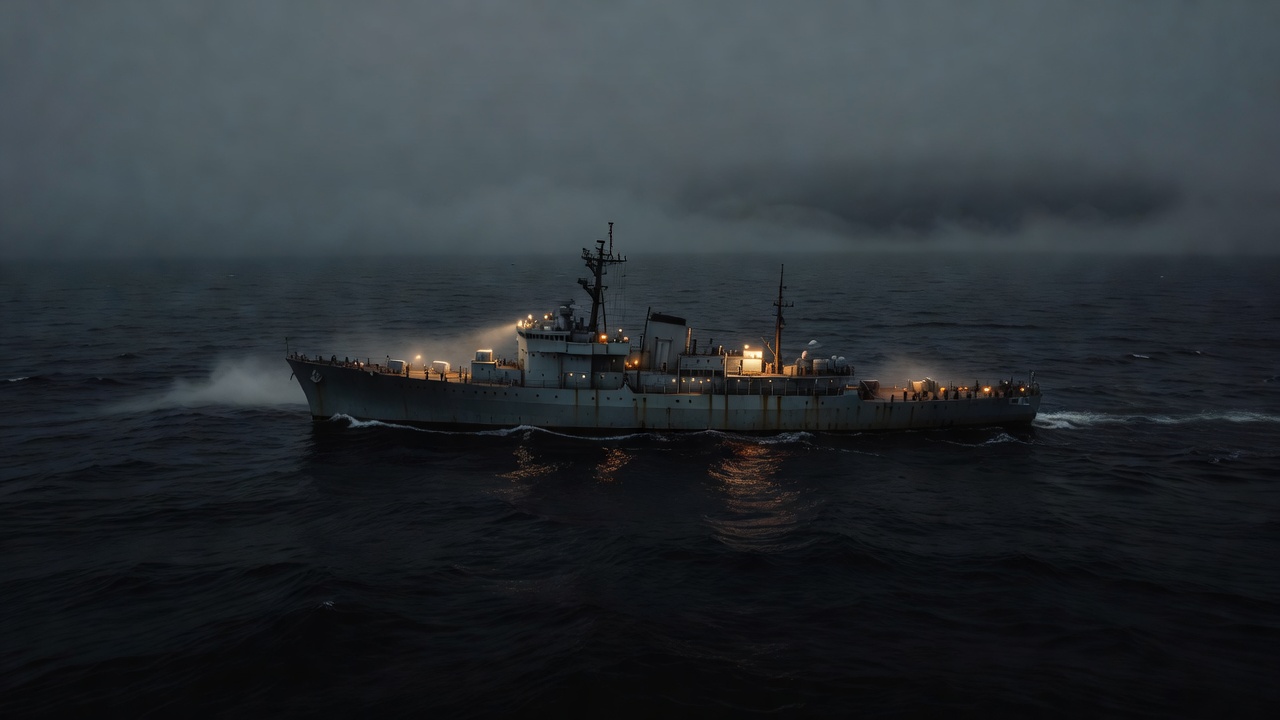
Out on the Pacific, the sea looked empty. That was the point. No crowds. No cameras. Just gray Navy hulls cutting through open water while men in uniform followed orders they did not fully understand. Somewhere in that salt air, particles were being released to see how a ship would breathe them in, how quickly a deck would be contaminated, and how exposed a crew might be before anyone knew an attack had begun. Decades later, the Pentagon called them defensive tests. Veterans and lawmakers asked a darker question: defensive for whom?
The Case For
A real Pentagon program, hidden for decades
Project SHAD—short for Shipboard Hazard and Defense—was not folklore. It was a real Department of Defense testing program conducted under the larger umbrella of Project 112. According to the Defense Health Agency’s official Project 112/SHAD summary, the program ran from 1962 to 1973 and was designed to measure how vulnerable U.S. warships were to chemical and biological attack. The same page says the Deseret Test Center planned 134 tests, confirmed that 50 were conducted, and identified about 6,400 service members as participants.
That alone explains why SHAD unsettles people. This was not an abstract paper exercise. It involved real ships, real crews, and real releases of agents or simulants in operational environments. The Pentagon now says the point was to improve detection, decontamination, and readiness. But for many veterans, the secrecy is the story. The Department of Veterans Affairs says DOD only began declassifying and sharing information at VA’s request in 2000, long after the tests ended and long after many participants had grown old with unanswered health concerns.
The record that fueled suspicion
The distrust did not come from nowhere. In a 2002 House hearing on Military Operations Aspects of SHAD and Project 112, lawmakers pressed DOD and VA officials over delayed disclosures and incomplete records. During that hearing, Rep. Mike Thompson accused the Pentagon of changing its explanations over time—first acting as if Project SHAD did not exist, then suggesting only harmless simulants were involved, and later acknowledging that some tests involved agents such as VX and sarin. Whether one accepts that framing or not, the hearing captures a truth: Congress did not treat SHAD like a settled administrative matter. It treated it like a buried history still coming into view.
The official fact sheets deepen that unease. The Health.mil archive shows tests near Hawaii, the Marshall Islands, Puerto Rico, and California. Some involved simulants such as Bacillus globigii. Others involved more dangerous substances or decontamination chemicals. That matters because the public argument around SHAD has never been only about intent. It has been about informed consent, operational secrecy, and whether servicemembers were used as unknowing instruments in a Cold War readiness machine. If you’ve followed our look at Operation Sea-Spray’s secret biological testing in San Francisco, SHAD feels less like an isolated episode and more like part of a wider pattern.
And then there is the timeline. The Pentagon says the mission to gather and release SHAD data only began in 2000 because records were classified, dispersed, and tied to a test center that closed in the 1970s. Critics hear something else: forty years of silence around chemical and biological testing involving American personnel.
The Realist’s Eye
Secrecy is not the same thing as proof of malice
The strongest case against the darker interpretation is straightforward. DOD has consistently said Project SHAD was created to prepare U.S. forces for chemical or biological attack, not to study how much damage could be done to unwitting sailors. In the 2002 hearing, Pentagon witnesses described SHAD as an operational test program meant to measure ship vulnerability and defensive response, not a human-subject medical experiment. That distinction does not erase the ethical questions, but it matters. Cold War secrecy alone is not proof that the hidden objective was sinister.
There is also an important evidentiary limit. The VA’s Project 112/SHAD pages state that veterans may qualify for benefits if they have a health condition believed to be caused by participation, but the agency’s research summaries do not say SHAD produced a clear, program-wide pattern of long-term illness. The 2007 Institute of Medicine report, Long-Term Health Effects of Participation in Project SHAD, found no clear evidence of specific long-term health effects associated with participation overall. A 2016 follow-up review cited by VA reached a similar conclusion. That does not mean every veteran concern was disproven. It does mean the broadest version of the theory—a documented hidden casualty pattern the government can clearly see and is simply denying—has not been demonstrated in the public record.
The record is real. The certainty is not.
There is another complication: many SHAD tests used simulants rather than live warfare agents, and even when hazardous materials were involved, exposure pathways and dosage are difficult to reconstruct decades later. Records were incomplete. Rosters had to be rebuilt. Some participants were identified only after the declassification effort began. That creates a perfect environment for suspicion, but also a difficult environment for certainty.
So the realist position sits in the tension. The hidden program was real. The delayed disclosure was real. The congressional frustration was real. But the leap from those facts to a fully formed theory of deliberate large-scale human harm still runs ahead of what the verified evidence can support. If anything, SHAD belongs in the broader world of government secrets and black-program history, where the documents often prove something disturbing happened, but not always the exact version later attached to it.
What We Know For Certain
- Project SHAD was a real U.S. military testing program conducted under Project 112 from 1962 to 1973.
- The stated purpose was to test how vulnerable U.S. warships were to chemical and biological attack and improve defensive procedures.
- DOD says 134 tests were planned, 50 were conducted, and 84 were canceled or not executed.
- DOD and VA acknowledge that thousands of service members participated and that declassification and veteran outreach accelerated only after 2000.
- Major public reviews, including Institute of Medicine and later National Academies work cited by VA, did not find clear evidence of specific long-term health effects across SHAD participants as a whole.
The Unanswered Questions
- How many participants fully understood the nature of the tests while they were happening?
- Are the surviving records complete enough to reconstruct every ship, unit, substance, and exposure pathway with confidence?
- Did the culture of Cold War secrecy prevent earlier medical follow-up for veterans who believed they were exposed?
- How much of the historical outrage comes from hazardous exposure itself, and how much comes from the decades-long delay in disclosure?
- Could small-group harms have been missed even if large population studies showed no clear overall pattern?
The Closer — You Decide
Project SHAD is not one of those stories that vanishes under scrutiny. The veterans were real, and so was the secrecy wrapped around them. What remains harder to pin down is the final shape of the offense: a grim but defensive Cold War program, or a line the Pentagon crossed and explained only when it had no choice. Maybe both truths sit closer together than either side likes. The evidence is on the table. You decide.