Purple Sage and the STOPS Warship Test
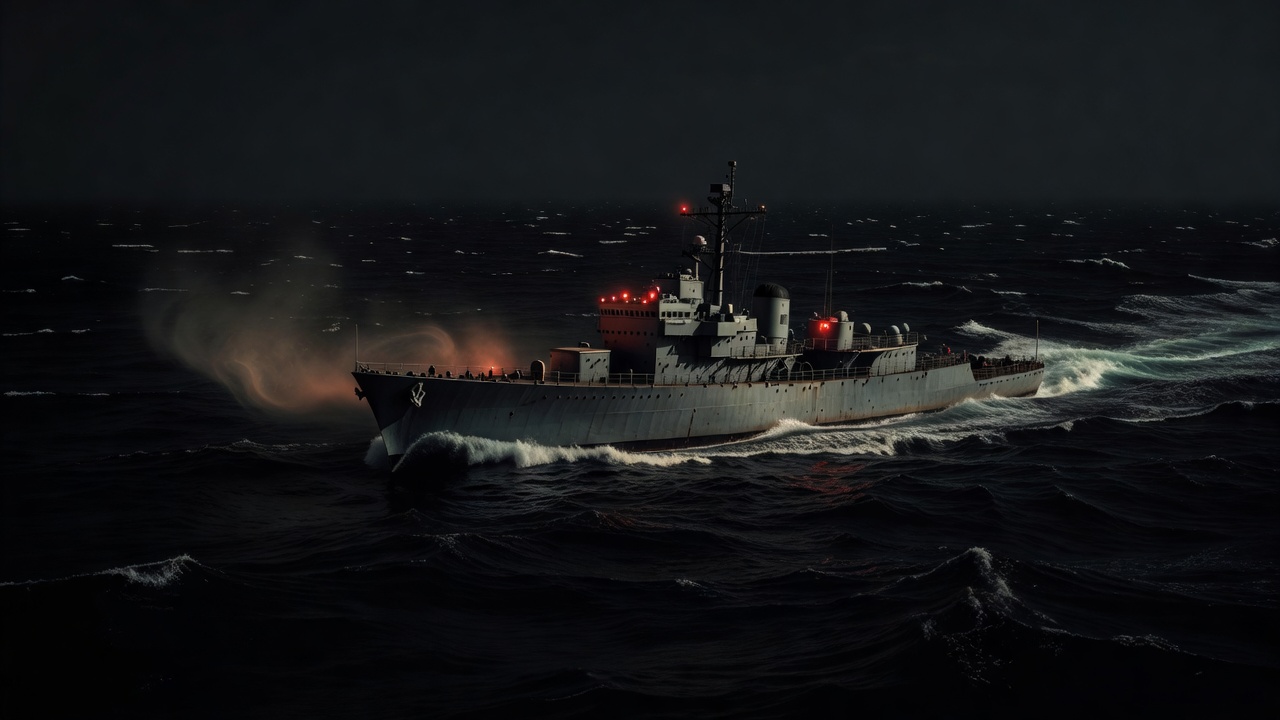
Before dawn off San Diego, the destroyer cut through cold Pacific water as if it were heading toward a war that had not started yet. The crew of the USS Herbert J. Thomas stood inside a floating experiment, some in protective masks, while unseen planners measured what would happen if a chemical cloud wrapped a U.S. warship at sea. No public warning. No headlines. Just a classified Cold War drill with a pastoral codename and a harder truth beneath it: the Navy was rehearsing survival inside an attack scenario, and the men aboard were part of the equation.
The Case For
Purple Sage was not rumor. It was a documented SHAD test.
The strongest reason to take Purple Sage seriously is that the Pentagon eventually admitted it happened. In the Defense Department’s official fact sheet for Project SHAD test 66-5, Purple Sage, the government says the operation ran from January 5 to February 3, 1966, in the Pacific off San Diego. The same sheet identifies the U.S. Army’s Deseret Test Center as the testing organization and the destroyer USS Herbert J. Thomas (DD-833) as the ship involved.
That matters because it strips away the usual first line of doubt. Purple Sage was not a campfire theory built from whispers and photocopies. It sits inside the same official archive that later documented Project SHAD’s broader sea-test program, the Cold War effort designed to measure how vulnerable U.S. warships were to chemical and biological attack.
The stated objective sounds defensive. The scenario still lands hard.
According to the fact sheet, Purple Sage was designed to evaluate the experimental Shipboard Toxicological Operational Protection System, or STOPS, against an “environmental attack with a gaseous chemical warfare agent under operational situations.” That phrase does a lot of work. In plain English, the military wanted to know whether a destroyer could keep functioning if a chemical cloud hit it for real.
The same document says the test agent was methylacetoacetate, described as a sarin nerve-agent simulant. Instead of a live nerve agent, Purple Sage used a stand-in meant to mimic the operational problem without the same lethal stakes. The release method was not abstract. The fact sheet says the simulant was dispersed through a turbine disseminator mounted on the bow of the ship, enveloping the vessel in its own test cloud.
There was a second objective too, and it makes the human dimension harder to ignore. Purple Sage also evaluated what happened when crew members wore MK5 or M17 protective masks for four hours. That turns the operation from a pure equipment check into something more intimate: not just whether a system worked, but whether sailors could still function inside it for hours while the ship remained in play.
The 2007 National Academies review of Project SHAD reinforces that this was part of a wider pattern, noting that one common release method in SHAD was a turbine disseminator located at a ship’s bow. Purple Sage fits that pattern exactly. It was one more instance of Cold War planners using real vessels, real crews, and operational conditions to rehearse the mechanics of chemical survival.
The Realist’s Eye
A secret chemical simulant test is not the same thing as proof of hidden mass poisoning.
This is where the story needs discipline. The available record confirms a classified shipboard test. It does not confirm that Purple Sage used live sarin or that the Navy concealed a disaster off California. The Pentagon’s own description frames methylacetoacetate as a simulant, not a weaponized nerve agent. The same fact sheet characterizes its likely effects as low to moderate irritation to the eyes, skin, and respiratory tract, plus possible gastrointestinal irritation.
That does not make the test harmless in an ethical sense. It does narrow what can be claimed medically from the documents we actually have. Purple Sage is strong evidence of secrecy and exposure-style readiness testing. It is weaker evidence for broader claims that the government knowingly subjected that crew to a lethal chemical attack rehearsal with no concern for consequences.
The record is real, but the archive is incomplete.
The Department of Veterans Affairs says the Defense Department only began declassifying and sharing Project 112 and SHAD information in 2000, decades after the tests. That gap helps explain why SHAD still feels radioactive. When disclosure arrives late, trust arrives later. But incomplete records cut both ways. They fuel suspicion, and they also limit certainty.
Congress recognized that problem. In House Report 108-213, lawmakers backed expanded VA health-care eligibility for Project 112 and SHAD veterans without requiring proof that a specific illness was caused by the tests. That move did not declare Purple Sage a scandal of proven long-term harm. It did acknowledge that the government’s secrecy and recordkeeping failures left veterans in a fog they did not create.
So the hardest realist question is not whether Purple Sage happened. It did. The harder question is whether the surviving documents prove a darker intention than military readiness. Maybe the operation was exactly what the Pentagon later called it: a defensive systems test in a dangerous era. Maybe the deeper scandal is not a hidden body count, but the quiet assumption that service members could be folded into classified exposure scenarios without meaningful informed consent.
What We Know For Certain
- Purple Sage was an official Project SHAD test, designated test 66-5, conducted from January 5 to February 3, 1966, off San Diego.
- The test involved the USS Herbert J. Thomas and was run by the U.S. Army’s Deseret Test Center.
- The stated purpose was to evaluate the STOPS protective system against a simulated chemical attack scenario.
- The agent used was methylacetoacetate, identified in official records as a sarin simulant, dispersed through a turbine disseminator on the ship.
- Purple Sage also assessed crew performance while wearing protective masks for a four-hour period.
The Unanswered Questions
- What exactly did crew members know about the nature of Purple Sage before the trials began?
- How were operational-performance results from the four-hour mask tests evaluated, and where are those records now?
- Why did so much SHAD documentation remain buried until VA-driven declassification efforts decades later?
- Were sailors given any meaningful opportunity to refuse participation in a classified exposure scenario like this one?
The Closer — You Decide
Purple Sage does not need embellishment to be unsettling. The official record already gives us enough: a classified sea test, a chemical simulant cloud, a destroyer under trial conditions, and a crew asked to operate inside the envelope. Maybe that was prudent Cold War defense planning. Maybe it crossed a line the government only admitted after time made the questions quieter. The documents are real. The gaps are real. The evidence is on the table. You decide.
Read our Scarlet Sage investigation for the biological counterpart to Purple Sage, or explore more in Government Secrets.