Menu

Reverse Engineering Alien Technology: Are We Flying Ships Not Built on Earth?

Reverse Engineering Alien Technology: Are We Flying Ships Not Built on Earth?

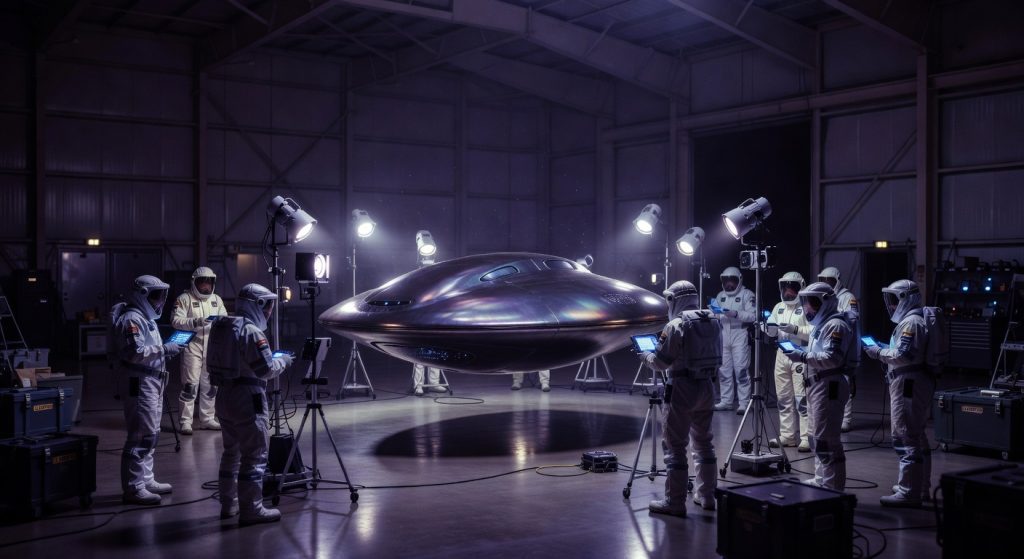
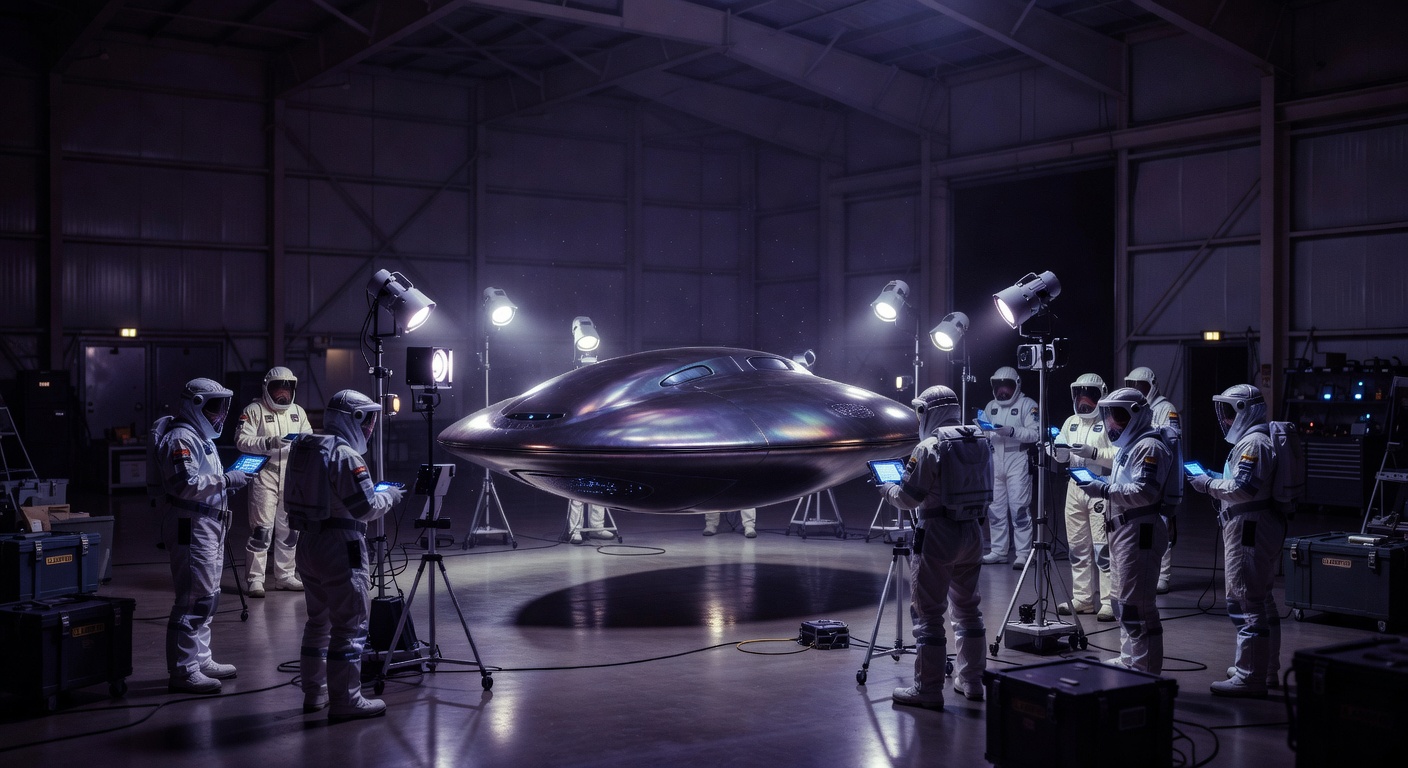
Picture this: a sprawling military hangar in the Nevada desert, fluorescent lights humming overhead, and a team of engineers — some with PhD’s from MIT, others pulled from classified defense contractors with names you’ll never find in a phone book — hunched over something that doesn’t quite look like anything Boeing or Lockheed Martin ever rolled off an assembly line. The metal is wrong. The geometry is wrong. And according to the people who claim to have been there, the physics is wrong.

This isn’t the plot of a summer blockbuster. This is, according to an growing body of whistleblower testimony, declassified documents, and congressional hearings, an approximation of what’s allegedly been happening inside the United States’ most secretive defense programs for the better part of eight decades. The question that should be keeping you up at night isn’t whether UFOs exist — at this point, even the Pentagon has conceded that. The question is: what exactly are we doing with them?

Welcome to the murky, fascinating, and deeply unsettling world of reverse engineering alien technology.


The Claim That Won’t Go Away

Every few years, the reverse engineering story gets a new chapter — a new witness, a new document, a new crack in the official silence. But the core allegation has remained remarkably consistent since at least the late 1940s: that the United States government recovered craft of non-human origin and has been attempting (with varying degrees of success) to understand and replicate the technology within them.

The story arguably starts with Roswell, New Mexico, July 1947. Something crashed in the desert near a remote ranch. The Army Air Force initially announced they had recovered a “flying disc.” Within 24 hours, they walked it back — weather balloon, they said. But the original press release didn’t disappear, and neither did the witnesses. Rancher Mac Brazel, military intelligence officer Jesse Marcel Sr., and dozens of others described materials unlike anything produced on Earth: foil that returned to its original shape when crumpled, I-beams with strange hieroglyphic-like markings, and a lightness to the debris that defied expectations.

Marcel, speaking publicly decades later, was unambiguous: “It was not anything from this Earth. I am sure of that.”

Whether you believe Roswell or dismiss it as Cold War hysteria, what’s harder to dismiss is what came after it.


Bob Lazar and the S-4 Facility

In 1989, a man named Bob Lazar went on Las Vegas local television and blew the lid off what he claimed was a reverse engineering program operating out of a facility he called S-4, located just south of the more famous Area 51. Lazar said he was hired as a physicist to work on the propulsion system of recovered alien craft — specifically, he claimed, nine discs of varying design were being studied at the site.

His account was detailed, technical, and scientifically coherent in ways that caught the attention of researchers for years after. He described a propulsion system based on an element he called “Element 115” — an element that didn’t officially exist on the periodic table at the time. In 2003, scientists synthesized moscovium (element 115). Lazar had been right about the atomic weight and some predicted properties.

His critics (and there are many) point to unverifiable credentials, inconsistencies in his story over the years, and the obvious possibility that he fabricated the whole thing. His defenders note that his employment at Los Alamos National Laboratory — which he claimed and which was initially disputed — was eventually confirmed through a phone directory. He’s passed multiple polygraph tests. And crucially: why would someone make up element 115 in 1989?

The Bob Lazar story remains one of the most polarizing in UFO research. But his core claim — that recovered craft exist and are being back-engineered at classified facilities — has since been echoed by people with far more verifiable credentials.


The Whistleblowers Get Louder

For decades, reverse engineering claims lived in the shadow of fringe research. Then came David Grusch.

In June 2023, Grusch — a decorated Air Force veteran, former intelligence official, and member of the UAP Task Force — went public with allegations that shook official Washington. He told journalists at The Debrief and NewsNation that the U.S. government possesses “intact and partially intact” craft of non-human origin, and has maintained a multi-decade reverse engineering program, funded through illegally redirected black budget appropriations, hidden from congressional oversight.

This wasn’t some anonymous internet tipster. Grusch filed formal whistleblower complaints with the Intelligence Community Inspector General, which found his claims “credible and urgent.” He testified before Congress under oath. He named specific government contractors — entities like Lockheed Martin, MITRE, and others — as allegedly being involved in the program. And he wasn’t alone: he claimed to represent a broader group of intelligence community officials willing to talk, if granted proper legal protections.

The testimony sent shockwaves through Capitol Hill. Senator Chuck Schumer co-sponsored the UAP Disclosure Act of 2023, explicitly citing the need to declassify records related to non-human intelligence and recovered materials. The bill’s language was striking — it included the phrase “non-human intelligence” and “technologies of unknown origin.” This was not the language of weather balloons.

You can read Grusch’s full congressional testimony via the House Oversight Committee’s official record.


What Would Reverse Engineering Actually Look Like?

Let’s set aside the question of whether it’s happening for a moment and ask a more grounded one: if a government did recover a craft from a genuinely advanced non-human civilization, what would the reverse engineering process even look like?

This is where the story gets genuinely fascinating — and sobering.

Modern reverse engineering in classified defense programs follows a rough playbook: study the object, try to understand its principles of operation, attempt to replicate it using known materials and manufacturing processes, and iterate from there. The problem with truly alien technology is that each step of this process might be insurmountable with current human science.

Consider propulsion. If these craft use some form of gravity manipulation or exotic field propulsion — as Lazar and others have alleged — we don’t even have a theoretical framework mature enough to explain it, let alone replicate it. Our best models of physics, General Relativity and Quantum Mechanics, still refuse to play nice with each other. A civilization that cracked that problem would be operating from a scientific foundation we literally cannot yet imagine.

Materials science presents equally staggering challenges. If the craft use metamaterials — substances engineered at the atomic level with properties not found in nature — reproducing them might require manufacturing tolerances and processes we don’t have. Some researchers, including journalist George Knapp (who broke the Bob Lazar story and has investigated UAPs for decades), have suggested that fragments of recovered materials have been shared with defense contractors precisely because government labs couldn’t make progress on their own.

The alleged result? Incremental, tortured progress. Some technologies that feel suspiciously ahead of their time — fiber optics, integrated circuits, Kevlar — have occasionally been whispered about in certain research circles as potentially “seeded” discoveries, though such claims remain deeply speculative and unverified.


The Black Budget and the Unaccountable Programs

One of the more concrete threads in the reverse engineering story is the money. The U.S. defense black budget — classified spending not subject to normal congressional oversight — runs to tens of billions of dollars annually. Documents leaked by Edward Snowden in 2013 confirmed the existence of a $52.6 billion “black budget” request for fiscal 2013 alone, covering 16 spy agencies and dozens of programs.

Grusch specifically alleged that funding for alleged alien technology programs was being illegally redirected from other authorized programs, routed through private contractors to avoid congressional scrutiny. If true, this would be one of the most significant constitutional violations in American history — unelected officials and defense contractors controlling technology and information that rightfully belongs to the people, with zero democratic accountability.

This isn’t just a UFO story. It’s a story about the limits of oversight, the concentration of power, and what happens when “national security” becomes a magic phrase that ends all questions.

Former Senate Majority Leader Harry Reid, who championed the creation of the Pentagon’s secret UAP study program AATIP (Advanced Aerospace Threat Identification Program), said before his death that he believed the U.S. had recovered non-human craft. “I was told for decades that Lockheed had some of these retrieved materials,” he told journalist George Knapp in one of his final interviews. “And I tried to get, as I recall, a classified approval to do that work. It took years, it took years.”


The Skeptic’s Case (And Why It Matters)

Intellectual honesty requires engaging with the counterarguments seriously. And there are real ones.

The most damning is the argument from physical evidence: where is it? If the U.S. has been reverse engineering alien craft for 75+ years, why don’t we have anti-gravity cars, warp drives, or energy sources that make nuclear power look quaint? The absence of transformative technological leaps — or rather, the presence of technologies that still feel very human in their limitations — is a genuine puzzle if you accept the reverse engineering premise.

Defenders of the theory have answers: that the technology is so different from our paradigm that progress has been glacially slow; that some technology has been back-engineered but is being held back for strategic reasons; that the programs are so compartmentalized that even their participants see only tiny pieces of the puzzle. These are coherent explanations, but they’re also unfalsifiable ones — the mark of a theory that can absorb any countervailing evidence.

There’s also the simpler explanation: that witnesses like Lazar and Grusch are either mistaken, deceived (fed disinformation by intelligence agencies, a known historical practice), or in rarer cases, deliberately fabricating. Intelligence agencies have a long history of using UFO mythology as cover for classified conventional programs. The CIA acknowledged using Area 51 test flights of the U-2 spy plane as cover for UFO reports in declassified documents from the 1990s.

None of this definitively disproves the reverse engineering hypothesis. But it does demand careful thinking over credulous acceptance.


The Congressional Pressure Campaign

What’s undeniably real — whatever the underlying truth — is the political momentum that’s built around these allegations in recent years.

The UAP Disclosure Act, the establishment of the All-domain Anomaly Resolution Office (AARO), multiple classified congressional briefings, and a string of hearings featuring military pilots, intelligence officials, and now whistleblowers: the institutional machinery of the U.S. government is clearly grappling with something. Former AARO director Sean Kirkpatrick pushed back on crash retrieval claims, but even his office’s final report acknowledged unexplained cases that couldn’t be attributed to conventional phenomena.

Representative Tim Burchett, a Republican from Tennessee who has been among the most vocal congressional advocates for UAP transparency, has repeatedly claimed that he believes the government is actively hiding recovered craft and biological materials. Whatever you think of his conclusions, the fact that sitting members of Congress are saying these things publicly — and demanding access to classified programs through official channels — marks a profound shift from even five years ago.

The story of reverse engineering alien technology has moved from Art Bell’s late-night radio to Senate subcommittee hearings. That alone should make you pay attention.


So Are We Flying Them?

Here’s the question the headline promised: are there craft, derived from non-human technology, that human pilots have actually flown?

Grusch has been notably careful on this specific point. He has alleged possession and reverse engineering programs, but has not publicly claimed that operational back-engineered craft exist. Some other alleged insiders have gone further — retired Army Sergeant Daniel Sheehan and others in the disclosure movement have claimed that partially functional reverse-engineered systems exist, but none have provided verifiable specifics.

What we do know with certainty is that the U.S. has a track record of developing classified aircraft so far ahead of their time that they genuinely looked like UFOs to civilian witnesses — the U-2, the SR-71, the B-2, and allegedly several programs still entirely classified. Could some of what the public interprets as alien craft be human-built vehicles benefiting from non-human design insights? The answer, honestly, is: we don’t know.

And that uncertainty is precisely the point. When the most powerful government on Earth can’t — or won’t — give its own elected representatives a straight answer about what’s in its hangars, something is deeply, structurally wrong. Whether the secret is alien spacecraft, exotic classified human technology, or some combination of both, the secrecy itself is the scandal.

The universe is approximately 13.8 billion years old. Life on Earth has been present for roughly 4 billion of those years. Modern humans have existed for perhaps 300,000 years. Technological civilization, in our current form, for barely 200. If even a fraction of the cosmos has produced civilizations that had a million-year head start on us, the idea that some of their technology might be sitting in a warehouse in Nevada isn’t science fiction. It’s statistics.

The question isn’t really whether we could be flying ships not built on Earth. It’s whether we’ve been lied to long enough that we forgot to ask.


Down the Rabbit Hole

If this story has you asking more questions than it answered, good — that’s the point. Here are five threads worth pulling:

  • The AATIP Files: What the Pentagon’s Secret UFO Program Actually Found — A deep dive into the Advanced Aerospace Threat Identification Program, what was studied, and what remains classified.
  • Element 115: Bob Lazar’s Wildest Claim and the Science That (Partially) Backed It Up — How a substance that didn’t exist when Lazar described it ended up on the periodic table fifteen years later.
  • The Black Budget: How the U.S. Funds Programs Nobody Votes On — Tracing the money behind America’s most classified defense programs, and why oversight failures matter even if you don’t believe in UFOs.
  • David Grusch vs. The Pentagon: A Whistleblower Story for the Ages — A detailed timeline of Grusch’s allegations, the government’s responses, and what Congress has actually done about it.
  • Crash Retrieval Programs: A Global History of Governments and Downed UFOs — From Roswell to the Soviet Union’s own alleged recoveries, the international dimension of the UFO cover-up story.

Disclaimer: The content on Conspiracy Realist is intended for entertainment and educational exploration. Claims made by witnesses, whistleblowers, and researchers are presented as alleged and should be evaluated critically. We encourage readers to consult primary sources and form their own informed conclusions. Nothing here should be taken as verified fact unless explicitly sourced and confirmed.

dive down the rabbit hole

Reverse Engineering Alien Technology: Are We Flying Ships Not Built on Earth?

Conspiracy Realist
Reverse Engineering Alien Technology: Are We Flying Ships Not Built on Earth?

Picture this: a sprawling military hangar in the Nevada desert, fluorescent lights humming overhead, and a team of engineers — some with PhD’s from MIT, others pulled from classified defense contractors with names you’ll never find in a phone book — hunched over something that doesn’t quite look like anything Boeing or Lockheed Martin ever rolled off an assembly line. The metal is wrong. The geometry is wrong. And according to the people who claim to have been there, the physics is wrong.

This isn’t the plot of a summer blockbuster. This is, according to an growing body of whistleblower testimony, declassified documents, and congressional hearings, an approximation of what’s allegedly been happening inside the United States’ most secretive defense programs for the better part of eight decades. The question that should be keeping you up at night isn’t whether UFOs exist — at this point, even the Pentagon has conceded that. The question is: what exactly are we doing with them?

Welcome to the murky, fascinating, and deeply unsettling world of reverse engineering alien technology.


The Claim That Won’t Go Away

Every few years, the reverse engineering story gets a new chapter — a new witness, a new document, a new crack in the official silence. But the core allegation has remained remarkably consistent since at least the late 1940s: that the United States government recovered craft of non-human origin and has been attempting (with varying degrees of success) to understand and replicate the technology within them.

The story arguably starts with Roswell, New Mexico, July 1947. Something crashed in the desert near a remote ranch. The Army Air Force initially announced they had recovered a “flying disc.” Within 24 hours, they walked it back — weather balloon, they said. But the original press release didn’t disappear, and neither did the witnesses. Rancher Mac Brazel, military intelligence officer Jesse Marcel Sr., and dozens of others described materials unlike anything produced on Earth: foil that returned to its original shape when crumpled, I-beams with strange hieroglyphic-like markings, and a lightness to the debris that defied expectations.

Marcel, speaking publicly decades later, was unambiguous: “It was not anything from this Earth. I am sure of that.”

Whether you believe Roswell or dismiss it as Cold War hysteria, what’s harder to dismiss is what came after it.


Bob Lazar and the S-4 Facility

In 1989, a man named Bob Lazar went on Las Vegas local television and blew the lid off what he claimed was a reverse engineering program operating out of a facility he called S-4, located just south of the more famous Area 51. Lazar said he was hired as a physicist to work on the propulsion system of recovered alien craft — specifically, he claimed, nine discs of varying design were being studied at the site.

His account was detailed, technical, and scientifically coherent in ways that caught the attention of researchers for years after. He described a propulsion system based on an element he called “Element 115” — an element that didn’t officially exist on the periodic table at the time. In 2003, scientists synthesized moscovium (element 115). Lazar had been right about the atomic weight and some predicted properties.

His critics (and there are many) point to unverifiable credentials, inconsistencies in his story over the years, and the obvious possibility that he fabricated the whole thing. His defenders note that his employment at Los Alamos National Laboratory — which he claimed and which was initially disputed — was eventually confirmed through a phone directory. He’s passed multiple polygraph tests. And crucially: why would someone make up element 115 in 1989?

The Bob Lazar story remains one of the most polarizing in UFO research. But his core claim — that recovered craft exist and are being back-engineered at classified facilities — has since been echoed by people with far more verifiable credentials.


The Whistleblowers Get Louder

For decades, reverse engineering claims lived in the shadow of fringe research. Then came David Grusch.

In June 2023, Grusch — a decorated Air Force veteran, former intelligence official, and member of the UAP Task Force — went public with allegations that shook official Washington. He told journalists at The Debrief and NewsNation that the U.S. government possesses “intact and partially intact” craft of non-human origin, and has maintained a multi-decade reverse engineering program, funded through illegally redirected black budget appropriations, hidden from congressional oversight.

This wasn’t some anonymous internet tipster. Grusch filed formal whistleblower complaints with the Intelligence Community Inspector General, which found his claims “credible and urgent.” He testified before Congress under oath. He named specific government contractors — entities like Lockheed Martin, MITRE, and others — as allegedly being involved in the program. And he wasn’t alone: he claimed to represent a broader group of intelligence community officials willing to talk, if granted proper legal protections.

The testimony sent shockwaves through Capitol Hill. Senator Chuck Schumer co-sponsored the UAP Disclosure Act of 2023, explicitly citing the need to declassify records related to non-human intelligence and recovered materials. The bill’s language was striking — it included the phrase “non-human intelligence” and “technologies of unknown origin.” This was not the language of weather balloons.

You can read Grusch’s full congressional testimony via the House Oversight Committee’s official record.


What Would Reverse Engineering Actually Look Like?

Let’s set aside the question of whether it’s happening for a moment and ask a more grounded one: if a government did recover a craft from a genuinely advanced non-human civilization, what would the reverse engineering process even look like?

This is where the story gets genuinely fascinating — and sobering.

Modern reverse engineering in classified defense programs follows a rough playbook: study the object, try to understand its principles of operation, attempt to replicate it using known materials and manufacturing processes, and iterate from there. The problem with truly alien technology is that each step of this process might be insurmountable with current human science.

Consider propulsion. If these craft use some form of gravity manipulation or exotic field propulsion — as Lazar and others have alleged — we don’t even have a theoretical framework mature enough to explain it, let alone replicate it. Our best models of physics, General Relativity and Quantum Mechanics, still refuse to play nice with each other. A civilization that cracked that problem would be operating from a scientific foundation we literally cannot yet imagine.

Materials science presents equally staggering challenges. If the craft use metamaterials — substances engineered at the atomic level with properties not found in nature — reproducing them might require manufacturing tolerances and processes we don’t have. Some researchers, including journalist George Knapp (who broke the Bob Lazar story and has investigated UAPs for decades), have suggested that fragments of recovered materials have been shared with defense contractors precisely because government labs couldn’t make progress on their own.

The alleged result? Incremental, tortured progress. Some technologies that feel suspiciously ahead of their time — fiber optics, integrated circuits, Kevlar — have occasionally been whispered about in certain research circles as potentially “seeded” discoveries, though such claims remain deeply speculative and unverified.


The Black Budget and the Unaccountable Programs

One of the more concrete threads in the reverse engineering story is the money. The U.S. defense black budget — classified spending not subject to normal congressional oversight — runs to tens of billions of dollars annually. Documents leaked by Edward Snowden in 2013 confirmed the existence of a $52.6 billion “black budget” request for fiscal 2013 alone, covering 16 spy agencies and dozens of programs.

Grusch specifically alleged that funding for alleged alien technology programs was being illegally redirected from other authorized programs, routed through private contractors to avoid congressional scrutiny. If true, this would be one of the most significant constitutional violations in American history — unelected officials and defense contractors controlling technology and information that rightfully belongs to the people, with zero democratic accountability.

This isn’t just a UFO story. It’s a story about the limits of oversight, the concentration of power, and what happens when “national security” becomes a magic phrase that ends all questions.

Former Senate Majority Leader Harry Reid, who championed the creation of the Pentagon’s secret UAP study program AATIP (Advanced Aerospace Threat Identification Program), said before his death that he believed the U.S. had recovered non-human craft. “I was told for decades that Lockheed had some of these retrieved materials,” he told journalist George Knapp in one of his final interviews. “And I tried to get, as I recall, a classified approval to do that work. It took years, it took years.”


The Skeptic’s Case (And Why It Matters)

Intellectual honesty requires engaging with the counterarguments seriously. And there are real ones.

The most damning is the argument from physical evidence: where is it? If the U.S. has been reverse engineering alien craft for 75+ years, why don’t we have anti-gravity cars, warp drives, or energy sources that make nuclear power look quaint? The absence of transformative technological leaps — or rather, the presence of technologies that still feel very human in their limitations — is a genuine puzzle if you accept the reverse engineering premise.

Defenders of the theory have answers: that the technology is so different from our paradigm that progress has been glacially slow; that some technology has been back-engineered but is being held back for strategic reasons; that the programs are so compartmentalized that even their participants see only tiny pieces of the puzzle. These are coherent explanations, but they’re also unfalsifiable ones — the mark of a theory that can absorb any countervailing evidence.

There’s also the simpler explanation: that witnesses like Lazar and Grusch are either mistaken, deceived (fed disinformation by intelligence agencies, a known historical practice), or in rarer cases, deliberately fabricating. Intelligence agencies have a long history of using UFO mythology as cover for classified conventional programs. The CIA acknowledged using Area 51 test flights of the U-2 spy plane as cover for UFO reports in declassified documents from the 1990s.

None of this definitively disproves the reverse engineering hypothesis. But it does demand careful thinking over credulous acceptance.


The Congressional Pressure Campaign

What’s undeniably real — whatever the underlying truth — is the political momentum that’s built around these allegations in recent years.

The UAP Disclosure Act, the establishment of the All-domain Anomaly Resolution Office (AARO), multiple classified congressional briefings, and a string of hearings featuring military pilots, intelligence officials, and now whistleblowers: the institutional machinery of the U.S. government is clearly grappling with something. Former AARO director Sean Kirkpatrick pushed back on crash retrieval claims, but even his office’s final report acknowledged unexplained cases that couldn’t be attributed to conventional phenomena.

Representative Tim Burchett, a Republican from Tennessee who has been among the most vocal congressional advocates for UAP transparency, has repeatedly claimed that he believes the government is actively hiding recovered craft and biological materials. Whatever you think of his conclusions, the fact that sitting members of Congress are saying these things publicly — and demanding access to classified programs through official channels — marks a profound shift from even five years ago.

The story of reverse engineering alien technology has moved from Art Bell’s late-night radio to Senate subcommittee hearings. That alone should make you pay attention.


So Are We Flying Them?

Here’s the question the headline promised: are there craft, derived from non-human technology, that human pilots have actually flown?

Grusch has been notably careful on this specific point. He has alleged possession and reverse engineering programs, but has not publicly claimed that operational back-engineered craft exist. Some other alleged insiders have gone further — retired Army Sergeant Daniel Sheehan and others in the disclosure movement have claimed that partially functional reverse-engineered systems exist, but none have provided verifiable specifics.

What we do know with certainty is that the U.S. has a track record of developing classified aircraft so far ahead of their time that they genuinely looked like UFOs to civilian witnesses — the U-2, the SR-71, the B-2, and allegedly several programs still entirely classified. Could some of what the public interprets as alien craft be human-built vehicles benefiting from non-human design insights? The answer, honestly, is: we don’t know.

And that uncertainty is precisely the point. When the most powerful government on Earth can’t — or won’t — give its own elected representatives a straight answer about what’s in its hangars, something is deeply, structurally wrong. Whether the secret is alien spacecraft, exotic classified human technology, or some combination of both, the secrecy itself is the scandal.

The universe is approximately 13.8 billion years old. Life on Earth has been present for roughly 4 billion of those years. Modern humans have existed for perhaps 300,000 years. Technological civilization, in our current form, for barely 200. If even a fraction of the cosmos has produced civilizations that had a million-year head start on us, the idea that some of their technology might be sitting in a warehouse in Nevada isn’t science fiction. It’s statistics.

The question isn’t really whether we could be flying ships not built on Earth. It’s whether we’ve been lied to long enough that we forgot to ask.


Down the Rabbit Hole

If this story has you asking more questions than it answered, good — that’s the point. Here are five threads worth pulling:

  • The AATIP Files: What the Pentagon’s Secret UFO Program Actually Found — A deep dive into the Advanced Aerospace Threat Identification Program, what was studied, and what remains classified.
  • Element 115: Bob Lazar’s Wildest Claim and the Science That (Partially) Backed It Up — How a substance that didn’t exist when Lazar described it ended up on the periodic table fifteen years later.
  • The Black Budget: How the U.S. Funds Programs Nobody Votes On — Tracing the money behind America’s most classified defense programs, and why oversight failures matter even if you don’t believe in UFOs.
  • David Grusch vs. The Pentagon: A Whistleblower Story for the Ages — A detailed timeline of Grusch’s allegations, the government’s responses, and what Congress has actually done about it.
  • Crash Retrieval Programs: A Global History of Governments and Downed UFOs — From Roswell to the Soviet Union’s own alleged recoveries, the international dimension of the UFO cover-up story.

Disclaimer: The content on Conspiracy Realist is intended for entertainment and educational exploration. Claims made by witnesses, whistleblowers, and researchers are presented as alleged and should be evaluated critically. We encourage readers to consult primary sources and form their own informed conclusions. Nothing here should be taken as verified fact unless explicitly sourced and confirmed.

Reverse Engineering Alien Technology: Are We Flying Ships Not Built on Earth?

Reverse Engineering Alien Technology: Are We Flying Ships Not Built on Earth?

Picture this: a sprawling military hangar in the Nevada desert, fluorescent lights humming overhead, and a team of engineers — some with PhD’s from MIT, others pulled from classified defense contractors with names you’ll never find in a phone book — hunched over something that doesn’t quite look like anything Boeing or Lockheed Martin ever rolled off an assembly line. The metal is wrong. The geometry is wrong. And according to the people who claim to have been there, the physics is wrong.

This isn’t the plot of a summer blockbuster. This is, according to an growing body of whistleblower testimony, declassified documents, and congressional hearings, an approximation of what’s allegedly been happening inside the United States’ most secretive defense programs for the better part of eight decades. The question that should be keeping you up at night isn’t whether UFOs exist — at this point, even the Pentagon has conceded that. The question is: what exactly are we doing with them?

Welcome to the murky, fascinating, and deeply unsettling world of reverse engineering alien technology.


The Claim That Won’t Go Away

Every few years, the reverse engineering story gets a new chapter — a new witness, a new document, a new crack in the official silence. But the core allegation has remained remarkably consistent since at least the late 1940s: that the United States government recovered craft of non-human origin and has been attempting (with varying degrees of success) to understand and replicate the technology within them.

The story arguably starts with Roswell, New Mexico, July 1947. Something crashed in the desert near a remote ranch. The Army Air Force initially announced they had recovered a “flying disc.” Within 24 hours, they walked it back — weather balloon, they said. But the original press release didn’t disappear, and neither did the witnesses. Rancher Mac Brazel, military intelligence officer Jesse Marcel Sr., and dozens of others described materials unlike anything produced on Earth: foil that returned to its original shape when crumpled, I-beams with strange hieroglyphic-like markings, and a lightness to the debris that defied expectations.

Marcel, speaking publicly decades later, was unambiguous: “It was not anything from this Earth. I am sure of that.”

Whether you believe Roswell or dismiss it as Cold War hysteria, what’s harder to dismiss is what came after it.


Bob Lazar and the S-4 Facility

In 1989, a man named Bob Lazar went on Las Vegas local television and blew the lid off what he claimed was a reverse engineering program operating out of a facility he called S-4, located just south of the more famous Area 51. Lazar said he was hired as a physicist to work on the propulsion system of recovered alien craft — specifically, he claimed, nine discs of varying design were being studied at the site.

His account was detailed, technical, and scientifically coherent in ways that caught the attention of researchers for years after. He described a propulsion system based on an element he called “Element 115” — an element that didn’t officially exist on the periodic table at the time. In 2003, scientists synthesized moscovium (element 115). Lazar had been right about the atomic weight and some predicted properties.

His critics (and there are many) point to unverifiable credentials, inconsistencies in his story over the years, and the obvious possibility that he fabricated the whole thing. His defenders note that his employment at Los Alamos National Laboratory — which he claimed and which was initially disputed — was eventually confirmed through a phone directory. He’s passed multiple polygraph tests. And crucially: why would someone make up element 115 in 1989?

The Bob Lazar story remains one of the most polarizing in UFO research. But his core claim — that recovered craft exist and are being back-engineered at classified facilities — has since been echoed by people with far more verifiable credentials.


The Whistleblowers Get Louder

For decades, reverse engineering claims lived in the shadow of fringe research. Then came David Grusch.

In June 2023, Grusch — a decorated Air Force veteran, former intelligence official, and member of the UAP Task Force — went public with allegations that shook official Washington. He told journalists at The Debrief and NewsNation that the U.S. government possesses “intact and partially intact” craft of non-human origin, and has maintained a multi-decade reverse engineering program, funded through illegally redirected black budget appropriations, hidden from congressional oversight.

This wasn’t some anonymous internet tipster. Grusch filed formal whistleblower complaints with the Intelligence Community Inspector General, which found his claims “credible and urgent.” He testified before Congress under oath. He named specific government contractors — entities like Lockheed Martin, MITRE, and others — as allegedly being involved in the program. And he wasn’t alone: he claimed to represent a broader group of intelligence community officials willing to talk, if granted proper legal protections.

The testimony sent shockwaves through Capitol Hill. Senator Chuck Schumer co-sponsored the UAP Disclosure Act of 2023, explicitly citing the need to declassify records related to non-human intelligence and recovered materials. The bill’s language was striking — it included the phrase “non-human intelligence” and “technologies of unknown origin.” This was not the language of weather balloons.

You can read Grusch’s full congressional testimony via the House Oversight Committee’s official record.


What Would Reverse Engineering Actually Look Like?

Let’s set aside the question of whether it’s happening for a moment and ask a more grounded one: if a government did recover a craft from a genuinely advanced non-human civilization, what would the reverse engineering process even look like?

This is where the story gets genuinely fascinating — and sobering.

Modern reverse engineering in classified defense programs follows a rough playbook: study the object, try to understand its principles of operation, attempt to replicate it using known materials and manufacturing processes, and iterate from there. The problem with truly alien technology is that each step of this process might be insurmountable with current human science.

Consider propulsion. If these craft use some form of gravity manipulation or exotic field propulsion — as Lazar and others have alleged — we don’t even have a theoretical framework mature enough to explain it, let alone replicate it. Our best models of physics, General Relativity and Quantum Mechanics, still refuse to play nice with each other. A civilization that cracked that problem would be operating from a scientific foundation we literally cannot yet imagine.

Materials science presents equally staggering challenges. If the craft use metamaterials — substances engineered at the atomic level with properties not found in nature — reproducing them might require manufacturing tolerances and processes we don’t have. Some researchers, including journalist George Knapp (who broke the Bob Lazar story and has investigated UAPs for decades), have suggested that fragments of recovered materials have been shared with defense contractors precisely because government labs couldn’t make progress on their own.

The alleged result? Incremental, tortured progress. Some technologies that feel suspiciously ahead of their time — fiber optics, integrated circuits, Kevlar — have occasionally been whispered about in certain research circles as potentially “seeded” discoveries, though such claims remain deeply speculative and unverified.


The Black Budget and the Unaccountable Programs

One of the more concrete threads in the reverse engineering story is the money. The U.S. defense black budget — classified spending not subject to normal congressional oversight — runs to tens of billions of dollars annually. Documents leaked by Edward Snowden in 2013 confirmed the existence of a $52.6 billion “black budget” request for fiscal 2013 alone, covering 16 spy agencies and dozens of programs.

Grusch specifically alleged that funding for alleged alien technology programs was being illegally redirected from other authorized programs, routed through private contractors to avoid congressional scrutiny. If true, this would be one of the most significant constitutional violations in American history — unelected officials and defense contractors controlling technology and information that rightfully belongs to the people, with zero democratic accountability.

This isn’t just a UFO story. It’s a story about the limits of oversight, the concentration of power, and what happens when “national security” becomes a magic phrase that ends all questions.

Former Senate Majority Leader Harry Reid, who championed the creation of the Pentagon’s secret UAP study program AATIP (Advanced Aerospace Threat Identification Program), said before his death that he believed the U.S. had recovered non-human craft. “I was told for decades that Lockheed had some of these retrieved materials,” he told journalist George Knapp in one of his final interviews. “And I tried to get, as I recall, a classified approval to do that work. It took years, it took years.”


The Skeptic’s Case (And Why It Matters)

Intellectual honesty requires engaging with the counterarguments seriously. And there are real ones.

The most damning is the argument from physical evidence: where is it? If the U.S. has been reverse engineering alien craft for 75+ years, why don’t we have anti-gravity cars, warp drives, or energy sources that make nuclear power look quaint? The absence of transformative technological leaps — or rather, the presence of technologies that still feel very human in their limitations — is a genuine puzzle if you accept the reverse engineering premise.

Defenders of the theory have answers: that the technology is so different from our paradigm that progress has been glacially slow; that some technology has been back-engineered but is being held back for strategic reasons; that the programs are so compartmentalized that even their participants see only tiny pieces of the puzzle. These are coherent explanations, but they’re also unfalsifiable ones — the mark of a theory that can absorb any countervailing evidence.

There’s also the simpler explanation: that witnesses like Lazar and Grusch are either mistaken, deceived (fed disinformation by intelligence agencies, a known historical practice), or in rarer cases, deliberately fabricating. Intelligence agencies have a long history of using UFO mythology as cover for classified conventional programs. The CIA acknowledged using Area 51 test flights of the U-2 spy plane as cover for UFO reports in declassified documents from the 1990s.

None of this definitively disproves the reverse engineering hypothesis. But it does demand careful thinking over credulous acceptance.


The Congressional Pressure Campaign

What’s undeniably real — whatever the underlying truth — is the political momentum that’s built around these allegations in recent years.

The UAP Disclosure Act, the establishment of the All-domain Anomaly Resolution Office (AARO), multiple classified congressional briefings, and a string of hearings featuring military pilots, intelligence officials, and now whistleblowers: the institutional machinery of the U.S. government is clearly grappling with something. Former AARO director Sean Kirkpatrick pushed back on crash retrieval claims, but even his office’s final report acknowledged unexplained cases that couldn’t be attributed to conventional phenomena.

Representative Tim Burchett, a Republican from Tennessee who has been among the most vocal congressional advocates for UAP transparency, has repeatedly claimed that he believes the government is actively hiding recovered craft and biological materials. Whatever you think of his conclusions, the fact that sitting members of Congress are saying these things publicly — and demanding access to classified programs through official channels — marks a profound shift from even five years ago.

The story of reverse engineering alien technology has moved from Art Bell’s late-night radio to Senate subcommittee hearings. That alone should make you pay attention.


So Are We Flying Them?

Here’s the question the headline promised: are there craft, derived from non-human technology, that human pilots have actually flown?

Grusch has been notably careful on this specific point. He has alleged possession and reverse engineering programs, but has not publicly claimed that operational back-engineered craft exist. Some other alleged insiders have gone further — retired Army Sergeant Daniel Sheehan and others in the disclosure movement have claimed that partially functional reverse-engineered systems exist, but none have provided verifiable specifics.

What we do know with certainty is that the U.S. has a track record of developing classified aircraft so far ahead of their time that they genuinely looked like UFOs to civilian witnesses — the U-2, the SR-71, the B-2, and allegedly several programs still entirely classified. Could some of what the public interprets as alien craft be human-built vehicles benefiting from non-human design insights? The answer, honestly, is: we don’t know.

And that uncertainty is precisely the point. When the most powerful government on Earth can’t — or won’t — give its own elected representatives a straight answer about what’s in its hangars, something is deeply, structurally wrong. Whether the secret is alien spacecraft, exotic classified human technology, or some combination of both, the secrecy itself is the scandal.

The universe is approximately 13.8 billion years old. Life on Earth has been present for roughly 4 billion of those years. Modern humans have existed for perhaps 300,000 years. Technological civilization, in our current form, for barely 200. If even a fraction of the cosmos has produced civilizations that had a million-year head start on us, the idea that some of their technology might be sitting in a warehouse in Nevada isn’t science fiction. It’s statistics.

The question isn’t really whether we could be flying ships not built on Earth. It’s whether we’ve been lied to long enough that we forgot to ask.


Down the Rabbit Hole

If this story has you asking more questions than it answered, good — that’s the point. Here are five threads worth pulling:

  • The AATIP Files: What the Pentagon’s Secret UFO Program Actually Found — A deep dive into the Advanced Aerospace Threat Identification Program, what was studied, and what remains classified.
  • Element 115: Bob Lazar’s Wildest Claim and the Science That (Partially) Backed It Up — How a substance that didn’t exist when Lazar described it ended up on the periodic table fifteen years later.
  • The Black Budget: How the U.S. Funds Programs Nobody Votes On — Tracing the money behind America’s most classified defense programs, and why oversight failures matter even if you don’t believe in UFOs.
  • David Grusch vs. The Pentagon: A Whistleblower Story for the Ages — A detailed timeline of Grusch’s allegations, the government’s responses, and what Congress has actually done about it.
  • Crash Retrieval Programs: A Global History of Governments and Downed UFOs — From Roswell to the Soviet Union’s own alleged recoveries, the international dimension of the UFO cover-up story.

Disclaimer: The content on Conspiracy Realist is intended for entertainment and educational exploration. Claims made by witnesses, whistleblowers, and researchers are presented as alleged and should be evaluated critically. We encourage readers to consult primary sources and form their own informed conclusions. Nothing here should be taken as verified fact unless explicitly sourced and confirmed.

Table of contents