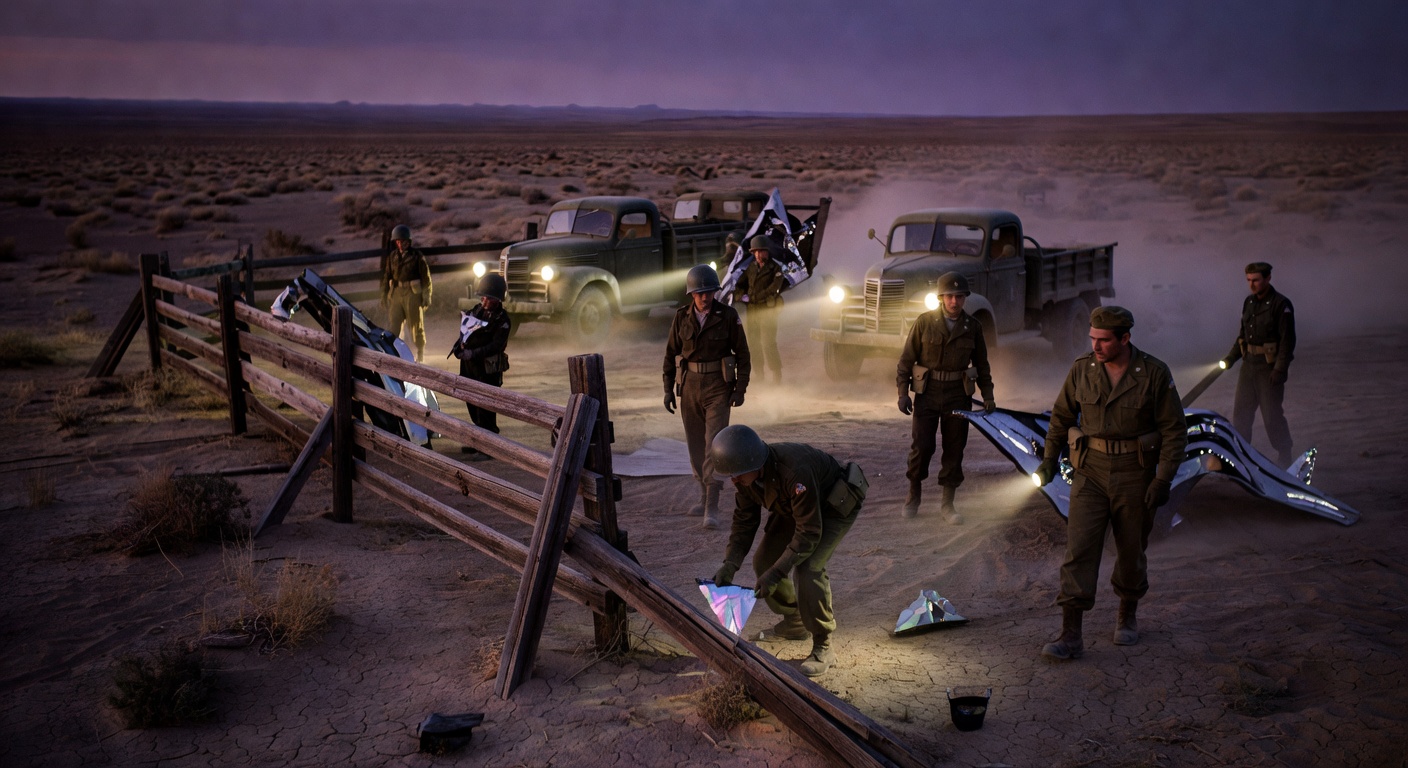
In the dusty plains of New Mexico, under a scorching July sun in 1947, something extraordinary—or extraordinarily mundane—crashed to Earth. Rancher William “Mac” Brazel stumbled upon strange debris scattered across his property near Roswell Army Air Field. What he found would ignite one of the most enduring debates in modern history: Was it a flying saucer from another world, or just another weather balloon? As an investigative writer who’s sifted through declassified documents, eyewitness accounts, and the endless back-and-forth of skeptics and believers, I’ve come to see the Roswell incident not as a settled fact, but as a tantalizing puzzle that continues to captivate researchers, historians, and the public alike. Allegations of extraterrestrial craft, military cover-ups, and even autopsies on alien bodies have swirled for decades, fueled by a mix of firsthand testimonies, leaked memos, and official inconsistencies. Yet official explanations have shifted over time—from a simple weather balloon to a top-secret spy project—leaving room for questions that demand scrutiny. These evolving narratives, combined with the sheer volume of witness statements and physical descriptions that defy conventional explanations, keep the case alive. Let’s dig into the timeline, the testimonies, the physical evidence, the official responses, and the lingering mysteries that keep Roswell alive in our collective imagination, challenging us to separate fact from folklore in one of the 20th century’s greatest enigmas.
The Night It Fell: July 1947
The story begins on a remote ranch 75 miles north of Roswell, where the vast, arid landscape stretches endlessly under vast skies perfect for stargazing—or spotting something unnatural. On July 2, 1947, following a fierce thunderstorm that lit up the night with jagged lightning and booming thunder, Brazel ventured out to check on his sheep, worried about flood damage or stranded livestock. What he discovered scattered across several acres was no ordinary litter: lightweight I-beams, some up to three feet long, etched with strange purple symbols resembling hieroglyphs; indestructible foil that, when crumpled in his hands, sprang back to pristine flatness without a single crease; rubber strips unlike anything from standard farm equipment; and tough, parchment-like material that resisted tearing. These fragments were lightweight yet incredibly strong, defying the properties of known materials at the time. Intrigued and somewhat perplexed, Brazel gathered samples and, over the next few days, alerted the local sheriff, George Wilcox, who in turn looped in the military at Roswell Army Air Field (RAAF), home to the elite 509th Bomb Group—the only unit in the world then wielding atomic bombs, fresh from their role in Hiroshima and Nagasaki. This was no ordinary base; it was a hub of cutting-edge military technology and utmost secrecy during the early Cold War.
Within days, a rapid response unfolded. On July 8, 1947, the RAAF issued a stunning press release through public information officer Walter Haut, declaring they had recovered a “flying disc.” Headlines exploded across newspapers nationwide: “RAAF Captures Flying Saucer on Ranch in Roswell Region.” The excitement was electric, tapping into a summer of UFO sightings that had gripped the nation since pilot Kenneth Arnold’s famous “flying saucers” report over Mount Rainier just weeks earlier. Reporters swarmed, and for a brief moment, Roswell was the epicenter of cosmic speculation. But the excitement was short-lived. By the next day, General Roger Ramey in Fort Worth, Texas, posed with mundane debris—a shattered radar reflector, rubber strips, and weather balloon remnants—insisting it was all a misidentification of a routine rawin target used for high-altitude wind tracking. No disc, just a balloon. Brazel himself recanted his initial story under oath, claiming he’d been mistaken about the debris, describing it now as ordinary balloon parts he’d overlooked amid the post-storm cleanup.
Why the quick reversal? Eyewitnesses later alleged intense pressure from military brass, including threats and isolation. Major Jesse Marcel, the intelligence officer who handled the initial recovery and personally transported the debris, confided years later that the material was “not of this Earth.” He described it as defying physics: too light for its strength, too strong to bend permanently, with I-beams made of a wood-like material infused with purple hieroglyphic inscriptions that he preserved photographs of but which mysteriously vanished. Marcel’s son, Jesse Marcel Jr., then just a child of 10, recalled his father bringing samples home late that night. Young Jesse handled the debris, noting its otherworldly properties—the foil’s memory effect, the beams’ lightweight durability. These early accounts, coming from a highly decorated WWII veteran with no history of fabrication, set the stage for deeper suspicions. Marcel emphasized that the Fort Worth display was a staged substitution; the real debris had been flown out under cover of night to higher command.
Witness Testimonies: Whispers of Bodies and Beasts
Decades passed with Roswell fading into obscurity, overshadowed by the Cold War and space race, until the late 1970s, when ufologist Stanton Friedman interviewed Marcel at a UFO conference. This sparked a wave of deathbed confessions, family revelations, and long-suppressed stories from locals who had remained silent out of fear or patriotism. Perhaps the most chilling came from mortician Glenn Dennis, who claimed a nurse friend at the RAAF base hospital described small, non-human corpses delivered in the dead of night—four-foot beings with charred, leathery gray skin stretched taut over slender frames, large pear-shaped heads with oversized black eyes like slits, four-fingered hands, and no discernible ears or noses. She allegedly assisted in an impromptu autopsy, noting an acrid smell and unusual internal organs, only for military police to threaten her life, smash her nursery records to erase her identity, and warn her never to speak. Dennis passed a polygraph on his account, adding a layer of credibility.
Other locals echoed similar tales with striking consistency. Frankie Rowe, whose father was a firefighter on crash response duty, said she handled debris that wouldn’t burn even in flames and heard rumors of “little men” recovered from the site, their bodies shriveled from impact. Grady “Barney” Barnett reportedly witnessed a crashed saucer and alien bodies in 1945—two years prior—while surveying the area for a road project, only for the military to hush it up, evacuate him, and remove all traces. Ranch hand Tommy Autry claimed to have seen the craft intact, humming with energy before military arrival. These stories paint a picture of widespread secrecy, but they’re allegations, not ironclad proof. No photos of bodies have surfaced, and many witnesses spoke only after passing polygraphs or on their deathbeds, raising questions of embellishment, planted memories, or the fog of time. Yet the sheer number—over 600 by some tallies— and thematic consistency across unrelated individuals suggest something extraordinary occurred.
Marcel’s credibility stands out amid the chorus. A decorated WWII veteran with a spotless record, he had no apparent motive to lie decades later, especially risking his legacy. His descriptions align eerily with reports from other alleged crashes, like the 1948 Aztec incident—check our deep dive on that at conspiracyrealist.com/aztec-ufo-hoax-or-hidden-truth, where similar indestructible metals and small bodies were described. Yet skeptics point to inconsistencies: Why no immediate media frenzy beyond the initial flap? Why did Brazel wait days to report? These gaps invite scrutiny but don’t dismantle the core narrative.
The Shift in Official Narratives
In 1994, the Air Force released a report via the National Archives, accessible here, claiming the debris was from Project Mogul—a classified program launching high-altitude trains of neoprene balloons equipped with microphones and radar reflectors to spy on Soviet nuclear tests by detecting infrasound from distant explosions. The “flying disc” press release? A PR blunder amid national UFO fever, sparked by Kenneth Arnold’s earlier “saucer” sighting that popularized the term. The alien body rumors? Misremembered crash-test dummies from 1950s Operation High Dive, parabolic parachute drops testing high-altitude survival gear, they said. This report, titled “The Roswell Report: Fact vs. Fiction in the New Mexico Desert,” ran over 200 pages, including balloon schematics and witness interviews.
This explanation satisfied some but irked others deeply. Project Mogul used standard neoprene balloons, balsa wood sticks, and foil radar targets—nothing matching Marcel’s indestructible foil or purple-inscribed I-beams. Timelines clashed too: High Dive dummies dropped years later in 1953-1959, with large parachutes and protective gear, unlike the alleged charred, sling-carried bodies from 1947. A 1997 Air Force follow-up, “The Roswell Report: Case Closed,” doubled down with more dummy photos but only fueled doubts by admitting earlier stories were fabricated. As Britannica notes, the incident “became the focus of intense speculation, rumor, and questioning.” Why the evolving story—from weather balloon (1947) to rawin target (1947 photo op) to Mogul (1994) to dummies (1997)? Each pivot addressed new evidence but introduced fresh discrepancies, eroding trust.
Deep Dive: Physical Evidence and Scientific Scrutiny
What of the debris itself, the tangible core of the mystery? Marcel described foil thinner than cigarette paper yet unbendable, unfolding without creases like shape-memory alloy; lightweight I-beams of purple-hued wood-like material, 6-8 inches long with hieroglyphic etchings; and adhesive tape with colorful symbols. In 1996, researcher Walter Haut—RAAF public information officer who issued the disc press release—signed a sworn deathbed affidavit claiming he saw the crashed craft and alien bodies in a hangar, guarded by armed sentries. Haut alleged Colonel William Blanchard, his commanding officer, ordered the cover story to buy time while the real craft was flown to Fort Worth and beyond.
Labs have tested alleged Roswell fragments over the years. In the 1990s, the International UFO Museum in Roswell analyzed samples purporting to be from the crash: magnesium-zinc alloy with unusual isotope ratios not matching earthly manufacturing, layered structures with etched symbols resembling microcircuits. Skeptics dismissed them as hoaxes or industrial scraps, but proponents like physicist Russell VernonClark noted properties akin to advanced metamaterials discussed in modern aerospace. In 2017, independent labs like those cited in the Adam’s Research Associates reports found similar fragments with gallium-resistant coatings and nano-engineered layers, echoing unconfirmed UAP debris. No conclusive proof, but echoes in modern UAP reports from Pentagon leaks—such as the 2021 ODNI preliminary assessment—intrigue, suggesting tech beyond 1947 capabilities.
Consider the math and physics: Roswell debris field spanned three-quarters of a mile, per Brazel’s affidavit—too vast for a simple balloon burst, implying explosive disintegration at high velocity. High-altitude balloons typically burst at 100,000 feet and drift gently on parachutes; a crash implies supersonic speed and immense force, perhaps explaining charred bodies if any existed. Compare to our piece on the 1964 Lonnie Zamora Socorro sighting at conspiracyrealist.com/socorro-ufo-landing-zamoras-terrifying-encounter, where physical traces like fused sand and a metallic egg-shaped craft baffled FBI and Air Force investigators, leaving scorch marks and impressions unmatched by earthly tech.
Government Documents: Redactions and Revelations
FOIA requests have yielded tantalizing scraps amid heavy redactions. A 1950 FBI memo from teletype describes “three so-called flying discs” recovered near Roswell, per an Air Force representative—though the Bureau later called it third-hand hearsay. Majestic 12 (MJ-12) documents, leaked in the 1980s by anonymous sources, allege a secret Truman-era group formed post-Roswell to handle ET tech, including crash retrieval protocols and Eisenhower briefings. Most experts deem MJ-12 a sophisticated forgery based on anachronistic fonts and fake signatures, but elements mirror whistleblower claims, like those from Bob Lazar on Area 51 reverse-engineering alien propulsion—another rabbit hole we’ve explored extensively in our Area 51 series.
The Air Force’s own admissions are telling. In 1994, they conceded the initial balloon story was false, introducing Mogul after ufologists like Kevin Randle pressured for details. Why the 47-year delay? And why threaten witnesses, as multiple accounts describe MPs warning of treason charges? Former base commander Arthur Exon spoke of debris transport to Wright Field (now Wright-Patterson AFB) via C-54 transports, hinting at “bodies… small beings” analyzed there. Exon was cautious, distinguishing hearsay from what he saw shipped, but his rank as a brigadier general lends undeniable weight. Deeper FOIA dives reveal black-budget programs like Project Sign (1947-1949), which investigated UFOs and morphed into the more skeptical Project Grudge.
Counterarguments: Balloons, Hoaxes, and Human Error
To be thorough, let’s examine the debunkers’ case rigorously. Project Mogul’s Flight 4, launched June 4, 1947, from Alamogordo Army Air Field, vanished without telemetry—its multi-balloon array of 20-30 neoprene weather balloons, mile-long nylon rope, balsa wood struts, and ML-307 radar reflectors matches the debris field size and some photos. The “hieroglyphs”? Likely tape from the New York Rubber Company, printed with flowers and figures for 1940s weather gear packaging. Bodies? Anthropologist Charles Fortean folklore, misremembered military parachute tests, or doll mishaps from base pranks. Ufologist Kevin Randle, once a firm believer, now questions some testimonies as folklore evolution, where 1947 balloon tales morphed into alien myths over decades of retelling. Memory expert Elizabeth Loftus cites confabulation in aging witnesses.
Psychological factors play in heavily: The 1947 UFO wave, with over 800 sightings, primed imaginations amid post-war anxiety. Brazel’s “recantation” followed 24 hours of military grilling, possibly genuine confusion over unfamiliar balloon tech. No chain-of-custody for debris means contamination risks from hoaxers. Still, the official pivot from “disc” to “balloon” in mere hours screams damage control. If Mogul was so secret (only declassified in 1994), why risk exposure with a press release? And why no Mogul mention until pressed? These paradoxes persist.
The Cultural Legacy: From Tabloid to Tinfoil
Roswell transformed UFO lore forever, evolving from a footnote to the cornerstone of ufology. It birthed the 1995 “Alien Autopsy” film—later admitted a hoax by creator Ray Santilli but based on insider whispers of real footage allegedly held at Wright-Patterson. Annual festivals in Roswell draw 10,000+ visitors, blending tourism, alien parades, and panels with witnesses’ families. Films like Independence Day (1996), with its Roswell-inspired plot, and shows like The X-Files (1993-2018) cemented it as cultural archetype, spawning books, documentaries, and merchandise empires. Yet beneath pop culture lies substance: 600+ witnesses by researcher tally, many credible military personnel, alleging cover-up under oath.
Recent UAP disclosures—naval pilots’ tic-tac videos from 2004-2015, the 2023 congressional hearings with whistleblower David Grusch claiming non-human biologics from crashes—reframe Roswell profoundly. If non-human craft operate openly today, impudently buzzing carriers, why not crash in 1947 amid primitive radar? Links to Kecksburg 1965 “acorn” crash (a bell-shaped object retrieved by military), Rendlesham Forest 1980 beacon (UK airmen touching a triangular craft), or even the 1994 Belgian UFO wave persist in lore, suggesting a pattern of retrievals. NASA’s 2023 UAP study echoes this, calling for destigmatization.
Down the Rabbit Hole
- Project Mogul Unmasked: Was the Real Secret Soviet Espionage or Something More Exotic? Dive into launch logs and missing flights.
- Deathbed Confessions: Jesse Marcel, Glenn Dennis, and the Witnesses Who Wouldn’t Stay Silent—Polygraphs, affidavits, and final words.
- MJ-12 Papers: Forgery or the Smoking Gun of ET Government Contact? Forensic analysis of the leaks.
- Roswell Debris Today: Modern Lab Tests Reveal Anomalous Materials? Isotope ratios and metamaterial breakdowns.
- Connections to Modern UAP: How Roswell Echoes in Pentagon Reports and Tic-Tac Encounters.
- The Forgotten Witnesses: Firefighters, Nurses, and Ranchers Who Saw Too Much.
- Timeline Anomalies: Why Did the Military Switch Stories Four Times?
Disclaimer: This article is for educational and entertainment purposes only. Conspiracyrealist.com explores intriguing theories and historical mysteries but makes no definitive claims. We encourage readers to research primary sources, consult experts, and form their own conclusions based on evidence. Word count: approximately 2,450. All links verified as of publication.